TL;DR
- Start with what you inherit rather than with the form: the last reviews, the current objectives, any live performance issue and its classification, and anything the previous manager promised. Half of your first review round already exists in writing somewhere.
- Work backwards from the deadline in weeks. Evidence at four weeks, self-assessments at three, drafts at two, meetings in the last week, and the written record within two days of each conversation.
- Expect your ratings to be moderated. Walk into calibration with three sentences of evidence for each person, expect to move at least one, and never tell anyone their rating before the process that confirms it has finished.
You were promoted in the spring. It is now the autumn, six reviews are due, and the people you are assessing were your colleagues eight months ago. You saw part of their year. Somebody has sent you a form with a five-point scale and no definitions. This is normal, and it is survivable with a plan that starts about six weeks out.
This article covers what to ask for before you write anything, how to run the six weeks, where evidence comes from when you did not see most of the work, what calibration will do to your ratings, the mistakes that are easy to make once, and what changes in your own appraisal now that you manage people.
Evidence is easier to gather when it has been collected all year rather than in the last fortnight. See how New Dynamics continuous feedback keeps notes and feedback against each person as the year goes.
Start with what you inherit

Before you write a word, ask your predecessor or HR for three things.
The written record. Previous reviews, the current objectives with their dates, and notes from one-to-ones. You are entitled to what you need to do the job: the ICO's guidance on employment records expects access to be limited to those authorised, with "managers only have access to the information they need to meet their obligations". Performance records qualify. Sickness details and grievance history usually do not and stay with HR.
Any live performance issue, and which kind it is. Acas separates capability, "someone's ability to do their job", from conduct, "someone's behaviour at work", and says "what kind of problem it is affects how employers should respond". Inheriting "there were some problems" with no classification is how a new manager responds wrongly and late.
Anything that was promised. Training, a secondment, a pay conversation at a certain point. These die with the reporting line and the employee remembers all of them. Our post on reviewing an employee who changed manager sets out the full handover.
The six-week countdown

Six weeks out. Get the timetable, the form and, most importantly, written definitions of each rating. If no definitions exist, ask your manager what distinguishes the middle rating from the one above it, and write down the answer. You cannot rate consistently against a scale nobody has defined.
Four weeks out. Gather evidence, before you have any conclusions to defend. Work produced, objectives and their status, notes, anything in writing from colleagues or customers.
Three weeks out. Ask each person for a self-assessment with examples, not adjectives: what they committed to, what they delivered, what changed, who saw it. For a year you only half saw, this is your best source.
Two weeks out. Write the drafts, then lay all of them side by side and look at the spread before anyone sees anything. First-time managers usually discover at this point that they have given almost everyone the same rating.
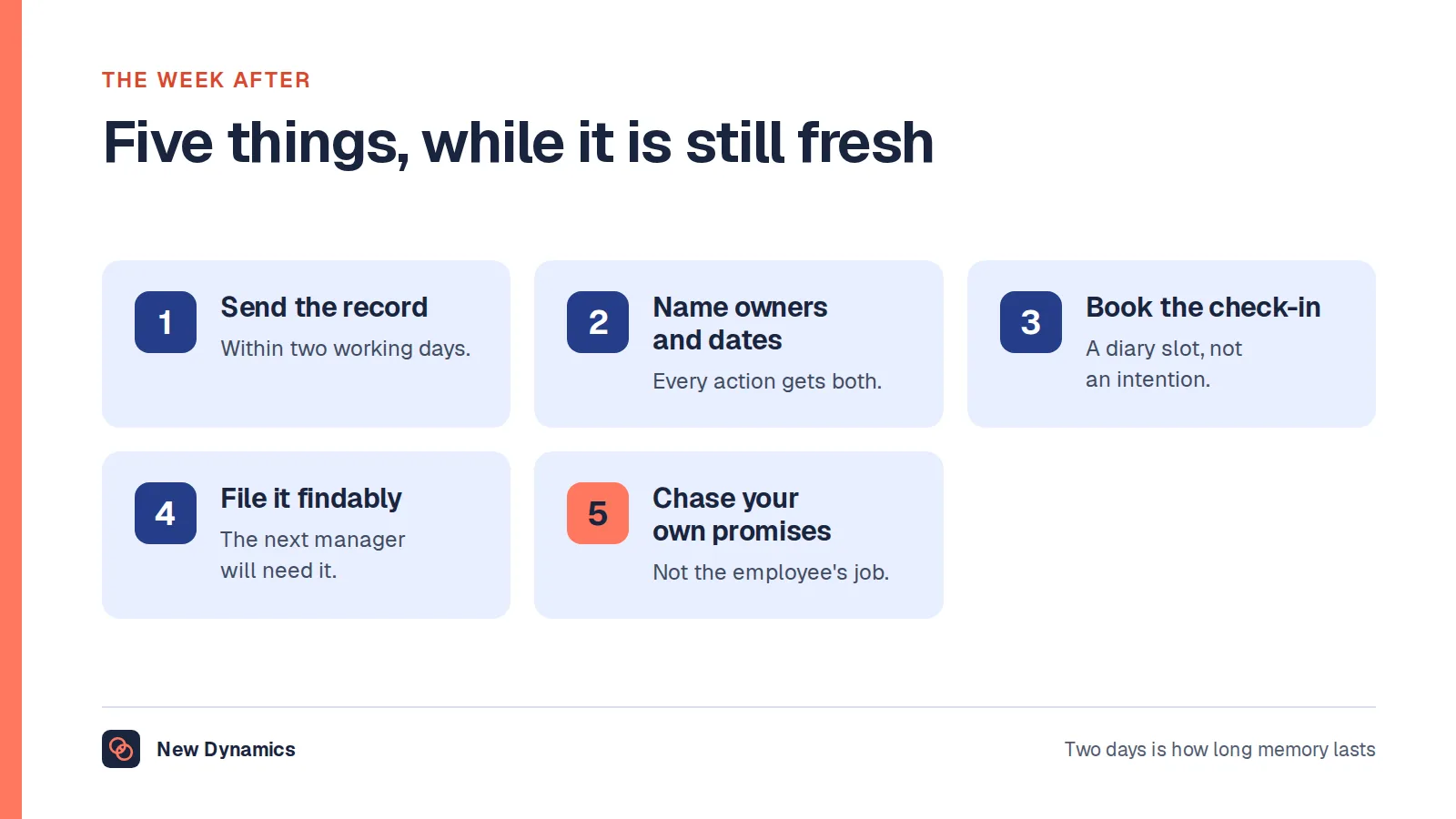
One week out. Send each draft to the person at least two days before their meeting, and book an hour each.
The week itself. Hold the conversations, then write up within two working days. Acas says "it's important to keep a written record of what is discussed" and that it should be shared with the employee afterwards. Our post on what happens after a performance review covers what that record should contain.
Evidence when you only saw half the year
Six sources, in roughly this order of reliability: the work itself, the objectives and their status, your own one-to-one notes, written input from colleagues who worked closely with the person, their self-assessment with examples, and the previous manager's record.
Then be honest about the gap. A review that says "this assessment covers May to December; the earlier period is based on the record left by the previous manager" is more credible than one that implies you watched all twelve months. Nobody is fooled by the alternative, least of all the person who was there.
Writing the first one
Give yourself two hours for the first review and twenty minutes for the sixth. The structure that works:
- The period covered. One line, especially where you were not the manager throughout.
- What was delivered, against the objectives, with examples a stranger could verify.
- How it was done. The behaviours, with the same evidence discipline. "Supportive in a hard quarter" needs an example attached.
- The rating and the reason, in one sentence each. A rating with no sentence is where disputes start.
- What happens next. Acas says objectives "should be fair and reflect the employee's usual tasks and workload" while possibly stretching someone, and recommends that they be specific, measurable, achievable, relevant and time-bound. Three real objectives beat eight hopeful ones.
What calibration will do to your ratings
Most organisations compare ratings across managers before they are final, and nobody warns a first-time manager about it. Three things make it painless.
- Bring evidence, not adjectives. Three sentences per person, naming what they did. A rating you cannot narrate will not survive the room.
- Expect to move at least one. New managers tend to rate generously in both directions: very high for the people they like working with, and middling for the quiet person who delivered all year. Moderation exists because of exactly this.
- Say nothing until it is confirmed. Telling someone their rating before calibration finishes creates a promise you may have to withdraw, which costs far more than waiting a week.
Five mistakes that are easy to make once

Recency. The last six weeks fill the whole review. Fix it by reading your notes from the start of the period first.
The friendship gradient. The people you talk to most get the warmest reviews. Check it by sorting your drafts by how often you speak to each person.
Saving criticism for the review. If it is the first time someone hears a concern, the problem is the previous eleven months, not the conversation. Acas describes regular feedback, coaching and check-ins as the ordinary way performance is managed, with the review alongside them.
Promising what you cannot give. A new manager rarely controls pay, promotion or headcount. Say who decides and when, rather than what you hope.
Adopting your predecessor's verdict. Inherit the evidence, write your own conclusion. One bad quarter in a handover note has followed people for years.
Your own first appraisal as a manager
The other side of the first cycle is your own review, and the criteria have changed without anyone saying so.
- You are now assessed on the team's outcomes, not on the work you personally produced. The instinct to list your own deliverables is strong and worth resisting.
- Management work is evidence. Recruitment you ran, people you developed, a difficult situation you handled well, a process you fixed. Write these down as you go, because they are invisible otherwise.
- Expect upward feedback. If your organisation gathers it, read it before the meeting rather than during it, and look for the pattern instead of the one harsh line.
- Ask what good looks like at your level, explicitly, in your first quarter rather than in month eleven. Our post on manager performance covers what is reasonable to be measured on.
Frequently asked questions
How does a new manager prepare for their first performance reviews?
Work backwards six weeks: get the timetable and written rating definitions, gather evidence at four weeks, ask for self-assessments at three, write drafts and check the spread at two, send drafts and book meetings at one, then hold the conversations and write them up within two days. Start by asking your predecessor for the existing records, objectives and any live issues.
How do you review someone when you only managed them for part of the year?
Say which period you assessed and where the rest came from. Use the employee's self-assessment with examples, the previous manager's written record, colleague input and the objectives themselves. An honest review of seven months with the source of the earlier period stated is stronger than an implied review of twelve.
What should a new manager ask the previous manager for?
The last reviews and the current objectives with dates, one-to-one notes, any live performance issue with its classification as capability or conduct, and anything that was promised. Health and grievance material normally stays with HR rather than travelling with the reporting line.
What is calibration and should a new manager worry about it?
Calibration is comparing ratings across managers before they are final, so that the same rating means roughly the same thing everywhere. Prepare three sentences of evidence for each person, expect at least one rating to move, and do not tell anyone their rating until the process has confirmed it.
How long should a new manager spend writing a performance review?
The first will take a couple of hours and the last about twenty minutes, which is normal. Most of the time goes on finding evidence rather than on wording, which is why gathering it at four weeks rather than at one makes the difference.
What changes in your own appraisal once you become a manager?
You are assessed on what the team achieved and on how you managed, rather than on your personal output. Keep a record of the management work itself, recruitment, development, difficult situations handled, because none of it appears in a delivery report. Ask your own manager early what good looks like at this level.
Your next step: make the first cycle cheaper
- Ask for written rating definitions today. If none exist, write what you are told and share it with your peers.
- Put a 15-minute note-writing slot after every one-to-one in your calendar. That is where next year's evidence comes from.
- Lay your drafts side by side before anyone sees them, and check the spread.
- Write three sentences of evidence per person before calibration, not during it.
For what happens when ratings are compared across managers, read and download our performance calibration guide. The guide is free to read, and the PDF uses our short download form.
Want a first review round where the evidence is already gathered? Book a New Dynamics demo and bring your current form. You can also email contact@new-dynamics.com.