TL;DR
- Within two working days, send a written record of what was discussed and agreed. Acas says it is important to keep a written record of a performance discussion and that it should be shared with the employee afterwards, and the memory of a conversation diverges fast.
- Actions come in three kinds: the employee's, the manager's and the organisation's. The second and third are the ones that quietly die, and they are the ones the employee remembers a year later.
- If the employee disagrees, add their comments to the record rather than rewriting it. They can raise a concern informally first, escalate it formally if that does not work, and ask for a copy of what you hold about them at any time.
A review meeting goes well. Both people leave with a warm feeling and a rough sense of what was agreed. Nothing is written down. Six weeks later the employee believes a training budget was approved and the manager believes it was "something to look at", and both are right about what they heard.
This article covers what should happen in the two days, two weeks and three months after a review: the written record, the follow-up email with wording you can adapt, who owns which action, how pay decisions should be communicated, and what to do if the employee disagrees with what was said.
Actions agreed in a meeting need somewhere to live afterwards. See how New Dynamics workflows keep the steps after a review moving instead of sitting in an inbox.
The week after

Acas puts the written record at the centre of this: "it's important to keep a written record of what is discussed", and "this should be shared with the employee afterwards". Two working days is a reasonable target, because that is roughly how long an accurate memory of a long conversation survives.
Everything else in the week follows from it: each action gets an owner and a date, the next conversation gets a slot in the diary, the record goes somewhere a future manager will find it, and anything you promised to check gets chased by you rather than by the employee.
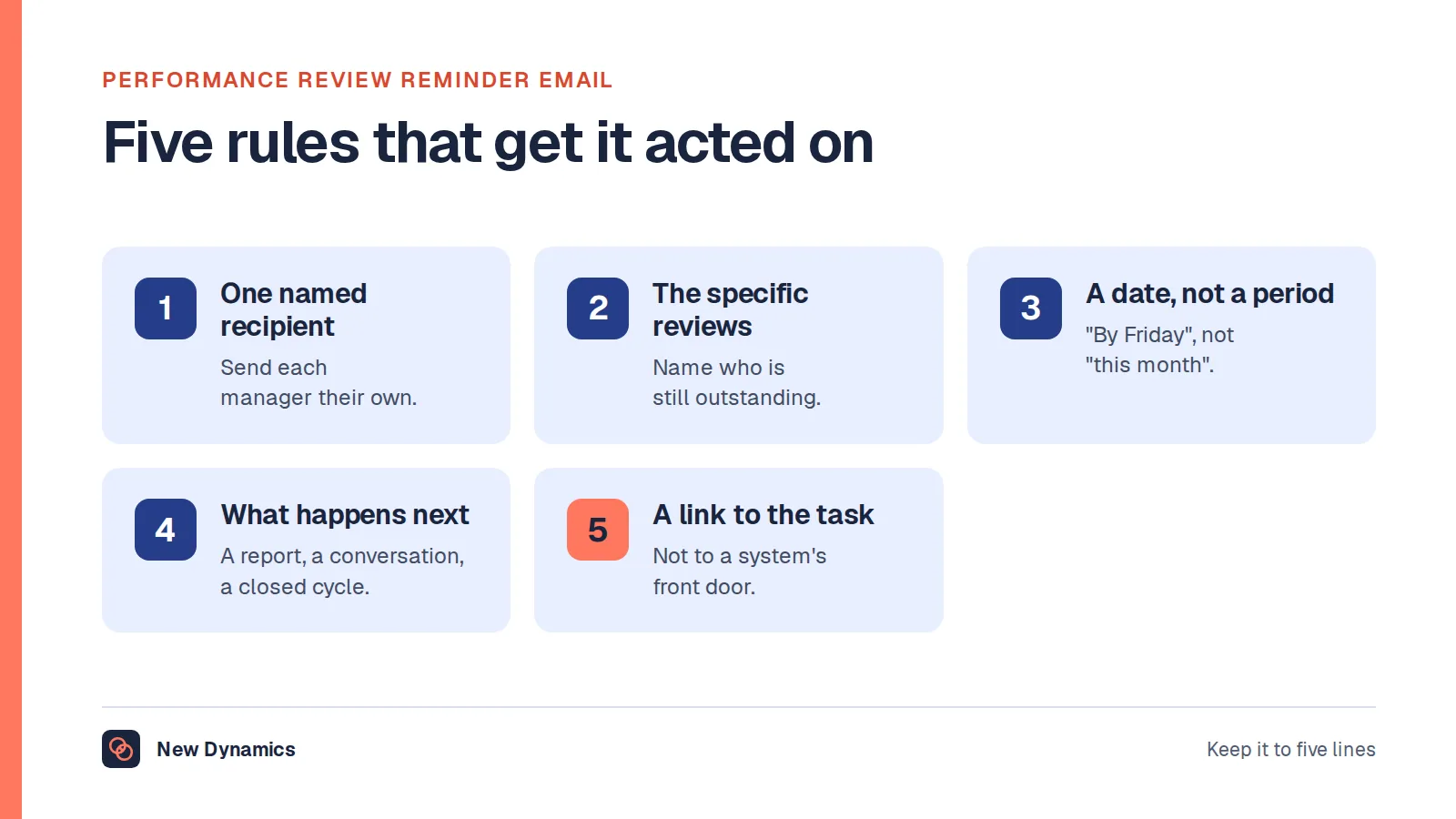
The follow-up email: six parts

- The period covered, stated in one line. This matters more than it sounds, especially where someone worked part of the period.
- A short summary of what was discussed, in the employee's language rather than the form's.
- The rating, if there is one, and what it means. A letter or a number with no sentence attached is where most disputes start.
- The agreed actions, each with an owner and a date. Three specific ones beat ten aspirational ones.
- Anything still to be confirmed, with who is confirming it and when.
- How to respond, including how to add comments or raise a disagreement.
Keep it under a page. A follow-up nobody finishes reading is the same as no follow-up.
Five example emails to adapt
These are written as wording to adapt, not as scripts to send unchanged.
1. A straightforward review
"Thanks for the conversation yesterday. To confirm what we discussed, covering January to December: your rating is (rating), which means (one sentence). The three things we agreed are (action one, owner, date), (action two, owner, date) and (action three, owner, date). I have put 30 minutes in the diary for (date) to check in on the first one. If anything here does not match your memory of the conversation, reply and I will add your comments to the record."
2. Where an objective was missed
"To confirm yesterday's review, covering (period). We agreed that (objective) was not met, and that the main reasons were (reason) and (reason). Neither of those is something you could have resolved alone, so the actions are mine as well as yours: I will (manager action) by (date), and you will (employee action) by (date). We will look at it again on (date) rather than waiting for the next cycle."
3. Where the employee disagreed
"Thank you for being direct yesterday. To record both views accurately: my assessment is (summary). Your view is that (summary of their view, in their words where possible). I have attached both to the record rather than changing my assessment, and I have asked (name of HR contact or second manager) to look at the rating alongside the rest of the team before it is final. If you would like to add anything in writing, send it by (date) and it will go on the record."
4. Where something is still to be confirmed
"To confirm yesterday's review, covering (period). Two things are still open: (the pay or budget decision), which (name) decides and will communicate by (date), and (the role or training question), which I will come back to you on by (date). I will tell you the answer either way, including if it is no."
5. A short check-in rather than a full review
"Quick note after this morning's check-in. Since the review in (month), (action) is done, (action) has slipped because (reason), and we have changed (objective) to (new wording) to reflect (change). Nothing else changes. Next check-in (date)."
Three kinds of action, and who owns them

The employee's actions are the ones that get written down. Objectives, development, a specific piece of work to pick up.
The manager's actions are the ones that get agreed verbally and then evaporate: the introduction to make, the workload to rebalance, the training request to submit, the feedback to collect from a colleague. These should appear in the follow-up with your name next to them, which is uncomfortable and is the point.
The organisation's actions are the slowest and the most visible to the employee: a pay decision, a promotion, a role change, a budget. They are rarely in the manager's gift, which makes it tempting to leave them vague. Say who decides, by when, and that the answer will be communicated either way.
A review where only one of the three lists exists is not an agreement, it is an instruction.
Pay and promotion: say when, not just what
If the rating feeds a pay decision that happens later, tell the person the date, the decision maker and the route by which they will hear. Silence after a review is read as a no, and it is usually read that way by the people who were most pleased with the conversation.
Where the answer is no, say so plainly and give the reason, and prefer doing it yourself rather than letting someone work it out from a payslip.
The check-ins that make it real
Acas describes informal conversation alongside the formal cycle: "sharing regular feedback", "coaching" and "regular check-ins, sometimes known as one-to-ones". Two of them do most of the work after a review.
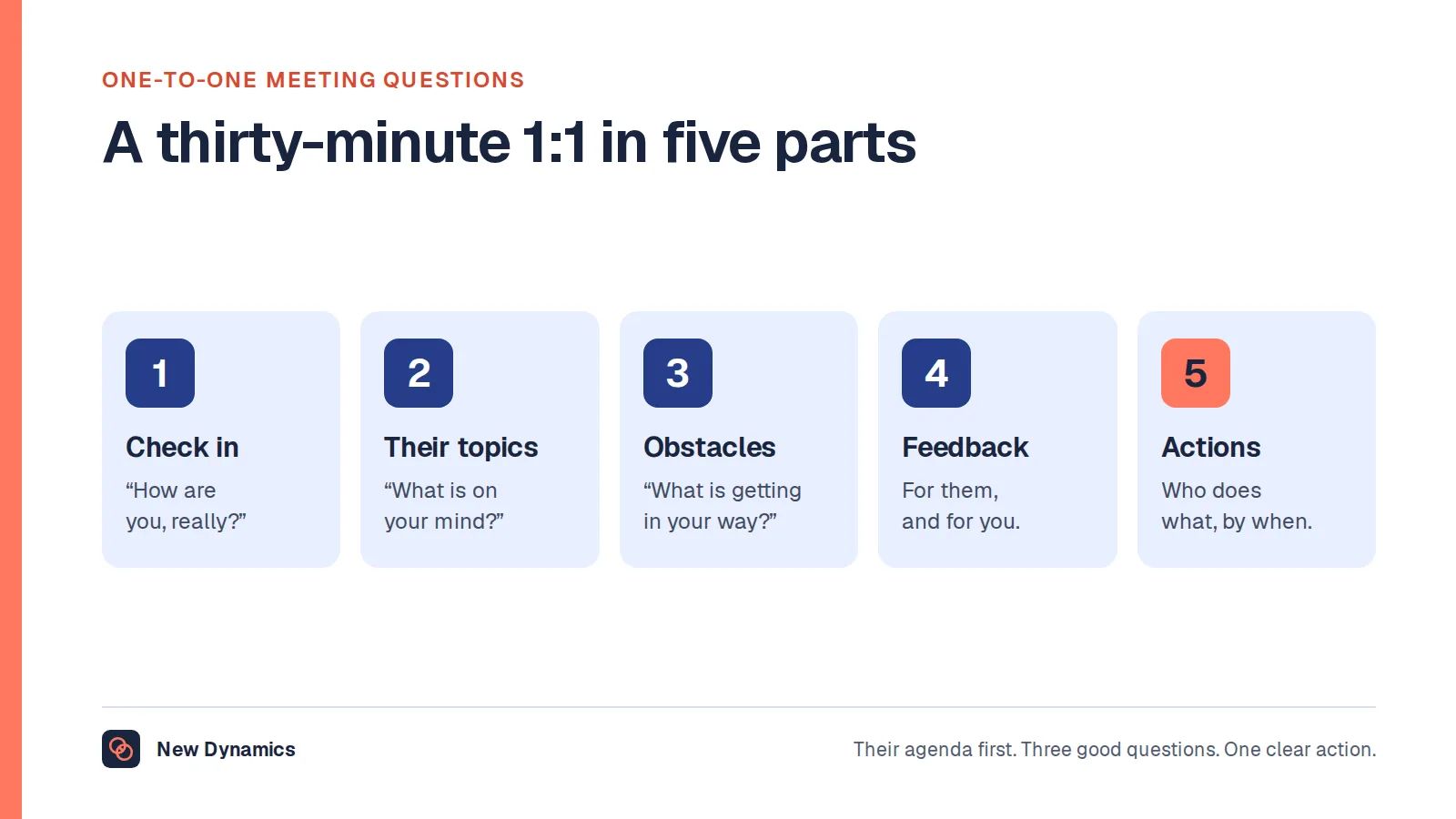
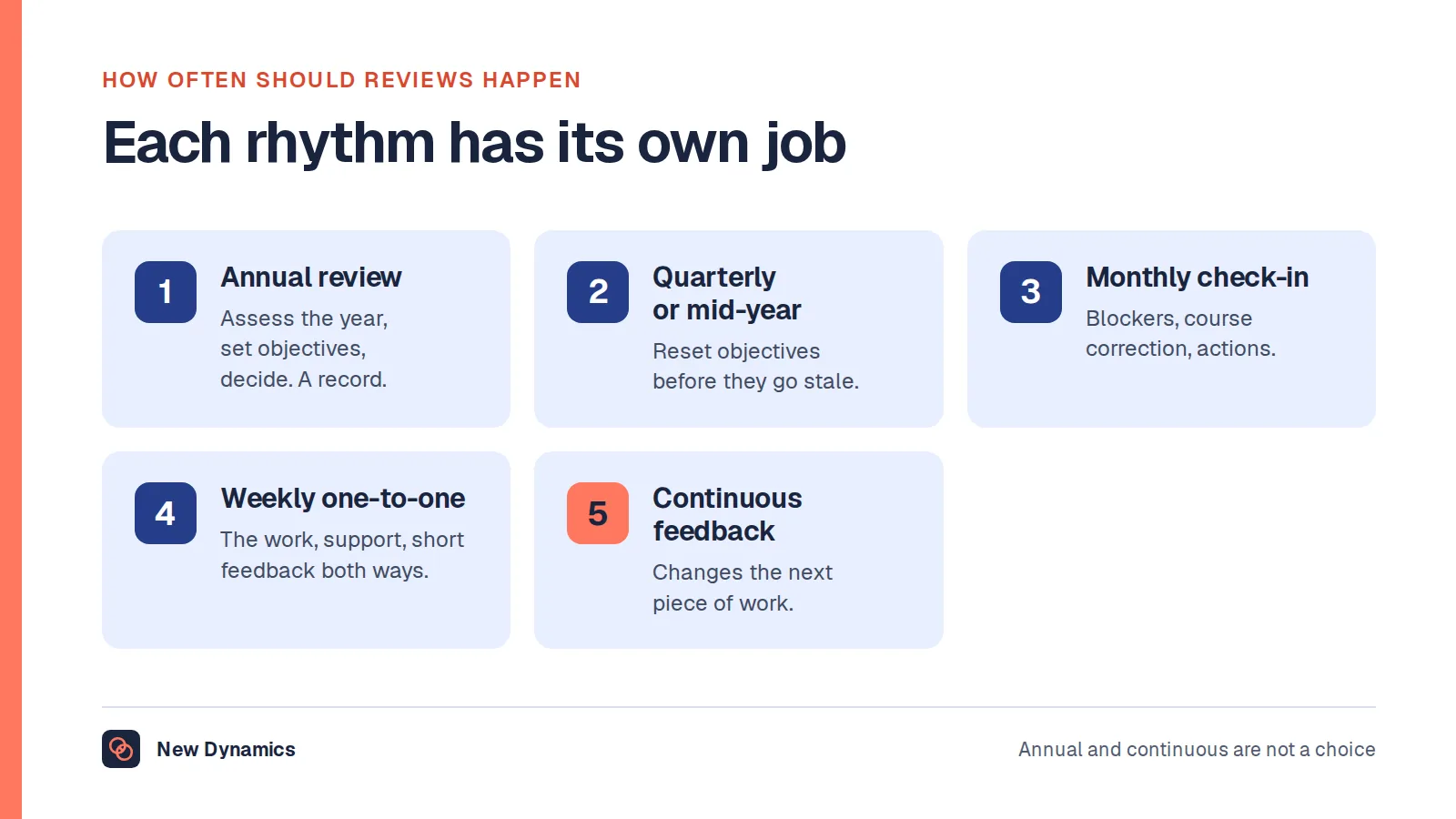
A check-in at about a month tests whether the actions survived contact with the job. A check-in at about three months tests whether the objectives are still the right ones. Both are short, and both are better than discovering in month eleven that an objective stopped making sense in month two. Our post on performance review frequency covers choosing the rhythm, and one-to-one meeting questions covers what to actually ask.
If the employee disagrees
Disagreement handled well is a sign the process is working. Handled badly, it is the first step towards a formal complaint.
- Add, do not overwrite. Put their comments on the record alongside your assessment. A record that shows two views is more credible than one that shows none.
- Separate the facts from the judgement. Factual errors get corrected. A different reading of the same work is a disagreement, and it can be recorded as one.
- Offer a second pair of eyes where the rating affects pay or progression, usually a calibration conversation or an HR review rather than a rerun of the meeting.
- Know the route. Acas says that where someone has a problem at work "it's usually a good idea for them to raise it informally first", and that an employer "should respond even if the problem's raised informally". If that does not resolve it, a grievance procedure is "a formal way for an employee to raise a problem or complaint to their employer".
- Expect them to be able to see the file. The ICO describes the right of access, "commonly called a subject access request (SAR)", as the right "to obtain a copy of their personal information from your organisation", with no formal requirements about how the request is made and a response due "without delay and within one month". Write every review as something the employee will read, because they can.
Six weeks later, this is what good looks like
- The employee can state their rating and the reason for it without looking it up.
- Three actions exist, with owners, and at least one is finished.
- The manager's own actions are among them.
- The next check-in is in the diary, not in an intention.
- Any open pay or role decision has a date attached to it.
- The written record is somewhere a future manager can find it.
Frequently asked questions
What should you do straight after a performance review?
Write up and send the record within about two working days: the period covered, a summary of the discussion, the rating and what it means, the agreed actions with owners and dates, anything still to be confirmed, and how to respond. Acas says a written record of a performance discussion should be kept and shared with the employee afterwards.
What should a performance review follow-up email include?
Six things: the period the review covered, a short summary in plain language, the rating and one sentence explaining it, the agreed actions with an owner and a date each, anything still open with who is deciding and by when, and how the employee can add comments or disagree. Keep it to a page.
How long after a performance review should pay be discussed?
Tell the person the date rather than leaving it open. If the decision sits elsewhere, name the decision maker and the week they will hear, and confirm that they will be told either way. Silence after a review is usually read as a refusal, which costs goodwill that the meeting just earned.
What can an employee do if they disagree with their review?
Ask for their comments to be added to the record, correct any factual errors, and ask for the rating to be looked at alongside the rest of the team if it affects pay or promotion. Acas suggests raising a problem informally first and says employers should respond even then, with the formal grievance procedure available if that does not work.
Can an employee get a copy of their performance review?
Yes. The ICO says the right of access, usually called a subject access request, lets someone obtain a copy of their personal information, that there are no formal requirements about how the request is made, and that the employer must respond without delay and within one month. Write reviews on the assumption that the person will read them.
How often should you check in after a review?
Twice in the first quarter is usually enough: once at about a month to see whether the actions survived the job, and once at about three months to see whether the objectives are still right. Both can be short. Acas describes these regular check-ins as part of managing performance alongside the formal review.
Your next step: close the loop on the last cycle
- Open the last three reviews you held and check whether a written record was sent. If not, send it now, late and honest.
- List every action from those reviews and mark the owner. If they are all the employee, the review was an instruction.
- Put a 30-minute check-in in the diary for each person, dated.
- Find the oldest open promise you made in a review and either deliver it or tell the person it is not happening.
For the conversations that carry the actions between reviews, read and download our manager one-to-one guide. The guide is free to read, and the PDF uses our short download form.
Want review actions that survive the week after the meeting? Book a New Dynamics demo and bring the last review you ran. You can also email contact@new-dynamics.com.