TL;DR
- A waiter, waitress or server takes orders and brings food and drink to customers at their tables. The three titles describe the same job, and server is the usual gender-neutral term.
- The six main duties are preparing the section, welcoming guests, taking orders and advising on the menu and allergens, serving, checking back and solving problems, and taking payment and resetting.
- A banquet server does the same work at events, to a set menu and a timed plan. In the UK, staff must be trained on allergens, and all tips must be passed to workers without deductions.
A chef can cook a perfect plate and still lose the customer, because the person who carried it to the table was slow, vague about the ingredients or nowhere to be seen when the bill was wanted. Waiting staff are the restaurant, as far as most guests are concerned.
This article gives a waiter job description that also serves for a waitress or a server: what the job is, the six main duties, how banquet service differs, the skills that matter, two UK rules that every employer should know, a template to adapt and wording for a CV or resume.
Hospitality teams take on new people often, and a good start keeps them. See how New Dynamics onboarding brings tasks, early goals and manager conversations into a clear path for a new starter.
What does a waiter, waitress or server do?
The Cambridge Dictionary defines a waiter as “a man whose job is to bring the food to customers at their tables in a restaurant”, and a waitress as the female equivalent. In American English the usual word is server: “a person who serves food in a restaurant”.
The job is the same whatever the title. In a job advert, use a neutral title such as server, or waiter or waitress together, so that nobody is put off applying. Our guide to writing a job ad explains why wording matters.
In England, the occupation sits within the food and beverage team member apprenticeship, a Level 2 standard whose listed job roles include “Waiter or waitress”. The earlier hospitality team member standard, which it replaces, describes the heart of the work. It is about “recognising customer needs, knowing how to match them to the products and services of the business and working as part of a team”, so that every customer “feels welcomed and looked after”.
That standard also notes where the work happens: “bars, restaurants, cafés, conference centres, banqueting venues, hotels or contract caterers”.
Waiter and server duties: six responsibilities
- Prepare the section. Lay tables, polish cutlery and glasses, stock the service station, learn the day's specials and find out what has run out.
- Welcome guests. Greet people promptly, seat them or take over from the host, present menus and offer drinks.
- Take orders and advise. Describe dishes, answer questions about ingredients and allergens, suggest drinks and extras, and enter the order accurately.
- Serve food and drink. Carry plates safely, serve each course to the right person at the right time and keep the table clear.
- Check back and solve problems. Return after the first mouthfuls, notice an empty glass and put mistakes right quickly, involving a manager when needed.
- Take payment and reset. Present the bill, take payment accurately, thank the guests and relay the table for the next party.
Around these come closing duties: cleaning, restocking, cashing up and handing over to the next shift.
The Skills England standard states the skills plainly. Two of them read: “Deliver excellent customer service in line with the business / brand standards with the aim of exceeding customer expectations” and “Carefully handle payments, transactions, stock and packaging to minimise unnecessary financial loss”. It also expects staff to check that customers are satisfied and to act on feedback.

Banquet server duties: what is different
The Cambridge Dictionary defines a banquet as “a large formal meal for many people, often followed by speeches in honour of someone”. A banquet server, also called a banquet waiter or banqueting waiter, serves at weddings, conferences, award dinners and similar events, usually in a hotel or an events venue. Skills England lists conference and banqueting among the specialist areas of hospitality.
The six duties still apply. Three things change.
- A set menu, served to everyone at once. There is little order-taking. The skill lies in serving a whole room the same course within minutes, often by carrying several plates or serving from platters.
- A timed plan and a team. Service follows a running order agreed with the organiser: reception drinks, call to dinner, courses, speeches, coffee. Servers work in a drilled team, with a briefing before every event.
- Setting up and breaking down. Banquet staff lay the room to a floor plan, often moving tables, chairs and equipment, and clear it afterwards.
Banquet work is often casual or part-time, with evening and weekend shifts. A job description should say so plainly, along with the physical demands.
Dietary needs matter more at a banquet, not less. Guests state them in advance, and the server must get the right plate to the right seat.

Five skills of a good server
- Customer service. Warmth, attention and the judgement to know when a table wants conversation and when it wants to be left alone.
- Memory and accuracy. Orders, table numbers, modifications and allergies, held correctly under pressure.
- Teamwork and communication. The standard's wording is: “Communicate accurately and effectively with others in line with the business culture”. A server works all evening with the kitchen, the bar and colleagues on the floor.
- Pace and stamina. Hours on your feet, carrying weight, at the speed of the busiest hour.
- Product knowledge. The standard expects staff to know the products and services that the business offers, their prices and special offers, and “how to match them to customers' needs”.
Experience is often not essential. Many employers hire for attitude and train the rest, which makes the job a common first step. Our guide to the meaning of entry level explains the term.
Two UK rules that every employer should know
Allergens
The Food Standards Agency's allergen guidance for food businesses, which applies to England, Northern Ireland and Wales, says that food businesses need to tell customers if any food that they provide contains any of 14 listed allergens as an ingredient. It is direct about staff: “Food businesses must make sure that staff receive training on allergens.”
For a server, that means never guessing. If a guest asks whether a dish contains nuts, the right answer is the written allergen information or a check with the kitchen. Put allergen training in the job description and in the first week's induction.
Tips
GOV.UK's guidance on tips at work states: “By law, all tips must be given to workers without deductions.” It adds that tips “do not count towards the National Minimum Wage”, and that there is a statutory code of practice, which covers fair and transparent distribution and the need for a written tipping policy and accurate records.
Say in the job description how tips are shared. Candidates will ask.
Both summaries are general information, not legal advice. The allergen guidance applies to England, Northern Ireland and Wales, so check the rules that apply elsewhere.
Waiter or server job description template
Adapt the wording to your business. Replace the text in square brackets.
Job title: Server (waiter or waitress)
Reports to: [Restaurant manager or supervisor]
Location and hours: [Site]. [Hours per week]. Shifts include evenings, weekends and public holidays.
Purpose of the job: To give every guest a warm, accurate and well-timed service, so that they enjoy their visit and want to return.
Main duties
- Prepare your section before service: tables, cutlery, glassware and service station.
- Welcome guests, present menus and take drink and food orders accurately on [the ordering system].
- Know the menu, the specials and the allergen information, and check with the kitchen whenever you are unsure.
- Serve food and drink promptly and safely, and clear tables between courses.
- Check that guests are satisfied, resolve problems quickly and involve the manager when needed.
- Present bills and take payment accurately, following cash and card procedures.
- Carry out opening and closing duties, and follow food safety, health and safety and licensing rules.
For banquet roles, add: Set up and clear function rooms to the event plan. Serve set menus to large groups to a timed running order. Attend the briefing before each event.
Essential requirements
- A friendly, attentive manner with customers.
- Clear spoken English, and accuracy with orders and money.
- Able to stand, walk and carry plates and trays for a full shift.
- Reliable, punctual and well presented.
Desirable
- Experience in a restaurant, bar, café or events venue.
- A food safety or allergen awareness certificate.
Pay and conditions: [Hourly rate]. Tips are shared by [method], in line with our written tipping policy. [Meals on duty, uniform, holiday].
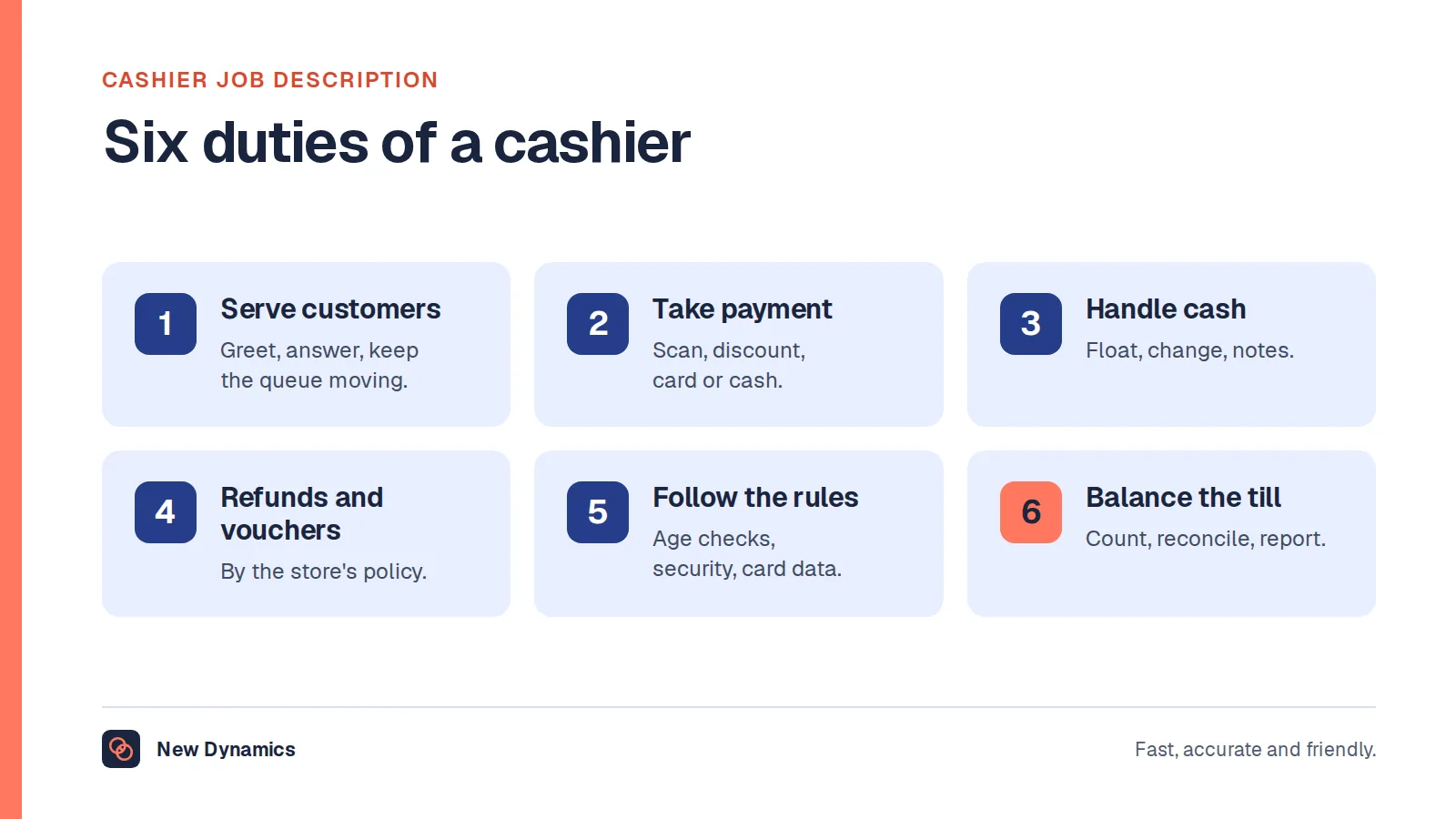
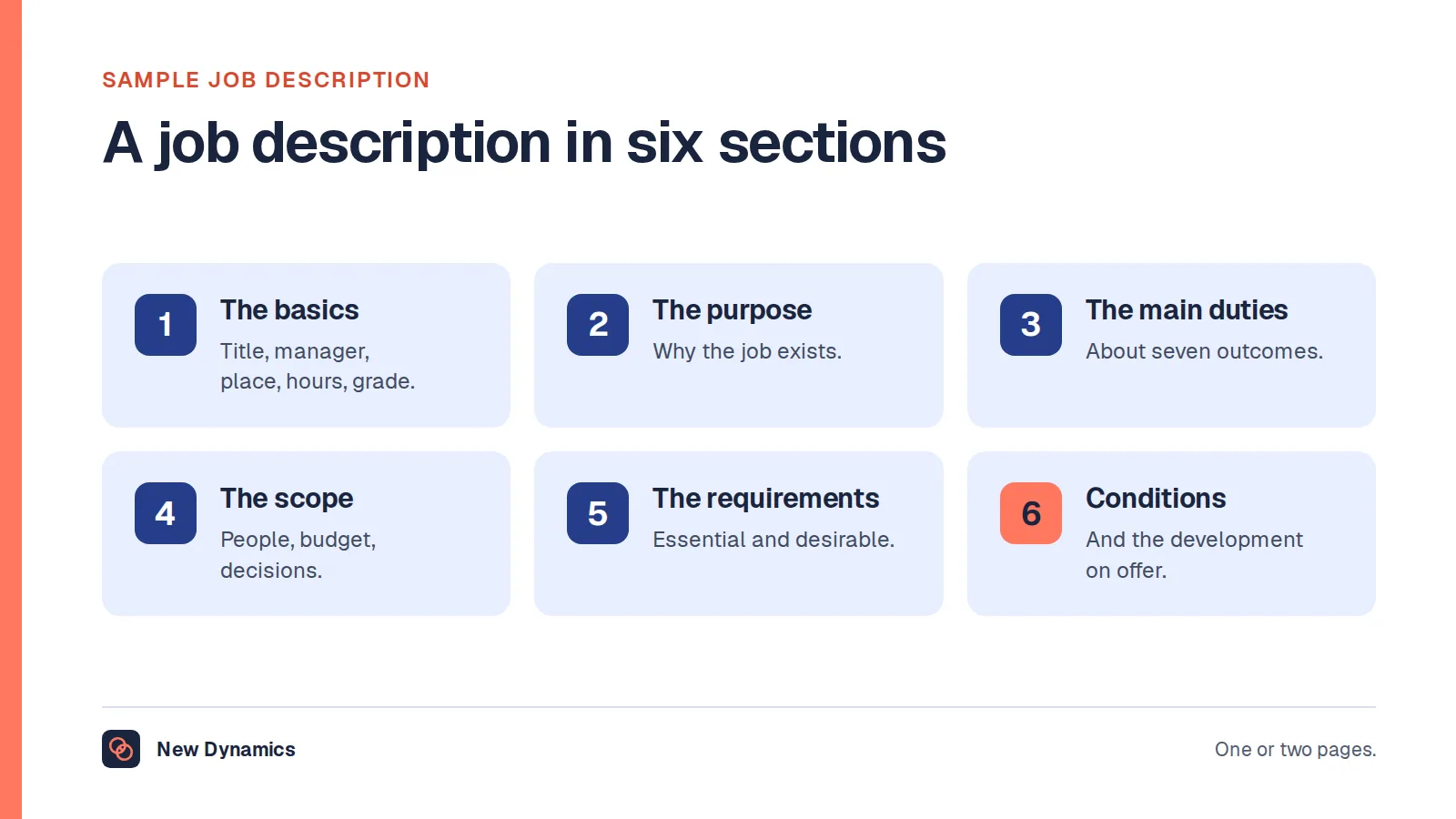
For the general format, see our sample job description. For another customer-facing role, see our cashier job description.
How to describe waiter or waitress work on a CV or resume
“Served customers in a busy restaurant” undersells the job. Five details turn it into evidence.
- Scale. The size of the restaurant or your section, and the number of covers in a typical shift.
- Pace. The kind of service: fine dining, high-volume casual, breakfast, banquets of several hundred.
- Sales. Anything that shows you helped the business: wine recommendations, specials sold, a good record on feedback cards.
- Knowledge. Menu and wine knowledge, allergen training, the ordering and payment systems that you used.
- Trust. Cashing up, holding keys, training new starters or supervising a section.
For example: “Served a section of eight tables in a 90-cover restaurant, completed allergen training and trained four new starters.” Use your own real figures. The same skills transfer well to retail, reception and customer service roles.

Common mistakes
A gendered job title. “Waitress wanted” narrows your field and risks a discrimination complaint.
Silence about hours. Evening, weekend and split shifts should be in the advert, not a surprise at interview.
Vague words about tips. State the method.
No mention of allergens. It is a safety-critical part of the job.
Forgetting the physical demands. Say honestly what the work involves, and consider reasonable adjustments for disabled applicants.
Hiring for experience only. Attitude and reliability often matter more than years served.
Frequently asked questions
What is the job description of a waiter or waitress?
A waiter or waitress prepares the dining area, welcomes guests, takes food and drink orders, advises on the menu and allergens, serves each course, checks that guests are satisfied, takes payment and resets tables, working closely with the kitchen and bar.
What is a server at a restaurant?
A server is a person who serves food and drink to customers in a restaurant. It is the usual American term, and a gender-neutral alternative to waiter and waitress. The duties are the same.
What does a banquet server do?
A banquet server serves food and drink at events such as weddings, conferences and award dinners. The work involves setting up the room, serving a set menu to many guests at once to a timed plan, clearing between courses and breaking the room down afterwards.
What skills does a waiter need?
The main skills are customer service, memory and accuracy, teamwork and communication, pace and stamina, and knowledge of the menu, drinks and allergens. Reliability and a friendly manner matter more to many employers than experience.
How do I describe waitress duties on a resume?
Give the scale of the restaurant or section, the type and pace of service, anything that shows sales or good feedback, your menu, allergen and system knowledge, and examples of trust such as cashing up or training new staff. Use real numbers.
Do waiters keep their tips in the UK?
GOV.UK states that, by law, all tips must be given to workers without deductions, and that tips do not count towards the National Minimum Wage. A statutory code of practice covers fair distribution and written tipping policies. Tips remain subject to Income Tax.
Your next step
If you are hiring, copy the template, fill in the square brackets and add your tipping method and shift pattern. If you are applying, rewrite your experience with the five details above.
For a first week that covers allergens, systems and standards properly, read and download our employee onboarding guide. The guide is free to read, and the PDF uses our short download form.
Want every new starter to have clear tasks and goals from the first shift? Book a New Dynamics demo and bring your current approach. You can also email contact@new-dynamics.com.