TL;DR
- Group dynamics means the forces at work between people in a group: who takes which role, what the unwritten rules are, whose voice carries, how close the group is and how it handles disagreement. They explain the common experience of a group of capable people producing poor work, and of an unremarkable group producing very good work.
- Groups also change over time. The open textbook _Principles of Management_ describes Tuckman's model, developed in 1965 “to explain the complexities that he had witnessed in team development”, with a fifth stage added in 1977: forming, the “polite stage”; storming, the “win-lose” stage where members clash for control and “people begin to choose sides”; norming, where ground rules and shared responsibility take hold; and performing, where the team is “completely self-directed and requires little management direction”. Storming is not a sign the team is broken.
- What predicts effectiveness is not who is in the group. Google's research into team effectiveness found psychological safety first, where “teammates feel safe to take risks around their team members”, then dependability, structure and clarity, meaning and impact. A manager changes dynamics mostly by changing conditions: clarity of goals and roles, how decisions are made, how disagreement is handled, and what happens to the person who admits a mistake.
Put six capable people in a room with a clear task and you cannot predict what you will get. One group argues productively and finishes early. Another agrees with everything the loudest person says and delivers something nobody believed in. The work was the same and the people were comparable. What differed was the group dynamics.
This article explains the group dynamics meaning in plain terms, sets out the five forces that make up a group's behaviour, describes how groups change over time, summarises what the evidence says actually predicts effectiveness, names four common failure modes, and gives six things a manager can do. It is about working groups at work, not therapy groups.
Dynamics change when conversations change, and most of them happen between two people rather than in a meeting. See how New Dynamics continuous feedback helps colleagues share feedback and recognition as part of everyday work.
What group dynamics means
Group dynamics are the forces at work between the members of a group that shape how it behaves and what it produces. They are not the group's task, its skills or its resources. They are the patterns that emerge when people work together: who speaks and who defers, what is said openly and what is said afterwards, which rules nobody wrote down but everybody follows, and what happens when two members disagree.
The term covers both the study of those forces and the forces themselves. When someone says "the dynamics in that team are difficult", they mean the second.
Group or team? A group is any set of people who interact. A team is a group whose members depend on each other for a shared result. Every team has dynamics; not every group needs to manage them. Our post on why teamwork matters sets out the difference and why the distinction changes what a manager should expect.
The five forces
- Roles. The jobs people take beyond their job titles: the one who organises, the one who asks the awkward question, the one who smooths things over, the one who quietly does the work. Roles are mostly assigned by the group rather than chosen, and a group missing a role will press someone into it.
- Norms. The unwritten rules: whether meetings start on time, whether it is acceptable to disagree with the manager, whether people answer messages at night, whether a mistake gets discussed or buried. Norms are learned in the first weeks and are the hardest thing to change later. Principles of Management puts shaping them at the centre of managing a team: "shaping the team's norms and culture (how are decisions made, what are our rules, how do we manage conflict, etc.)".
- Status and influence. Who is listened to, which is not the same as who is senior. Influence follows expertise, confidence, tenure, likeability and volume, in proportions that vary by group and are rarely examined.
- Cohesion. How strongly members want to stay in the group and how much they identify with it. Cohesion helps a group persist through difficulty, and at high levels it starts to suppress dissent, which is where it turns from an asset into a risk.
- Conflict. How disagreement is handled. Principles of Management notes that conflict handled poorly "can create distrust within a group, it can be disruptive to group progress and morale, and it could be detrimental to building lasting relationships", while also setting out its benefits. A group with no visible conflict is usually not a group without disagreement; it is a group where disagreement has gone somewhere else.

How groups change over time
Dynamics are not fixed. The open textbook Principles of Management describes team development over time through Tuckman's model: "In 1965, educational psychologist Bruce Tuckman at Ohio State University developed a four-stage model to explain the complexities that he had witnessed in team development", originally called Tuckman's Stages of Group Development, to which he added a fifth stage, adjourning, in 1977.
- Forming. The "polite stage". The team focuses on similarities, looks to the leader for structure and direction, discusses issues at a general level, and begins to develop an informal pecking order while remaining friendly.
- Storming. The "win-lose" stage. Members vie for leadership and test group processes, "people begin to choose sides", and attitudes to the team and the project turn negative, with frustration about goals, tasks and progress.
- Norming. The team starts to work well together, buys into group goals, establishes and maintains ground rules and boundaries, and shows willingness to share responsibility and control. Members begin to value each other's contributions.
- Performing. The team "is completely self-directed and requires little management direction", with confidence, pride and enthusiasm, and alignment between vision, team and self.
The practical lesson is about the second stage. Most managers read storming as evidence that the team is broken or that they have hired the wrong people, and respond by suppressing the disagreement, which delays norming indefinitely. Storming handled openly is how a group works out its rules.

What actually predicts effectiveness
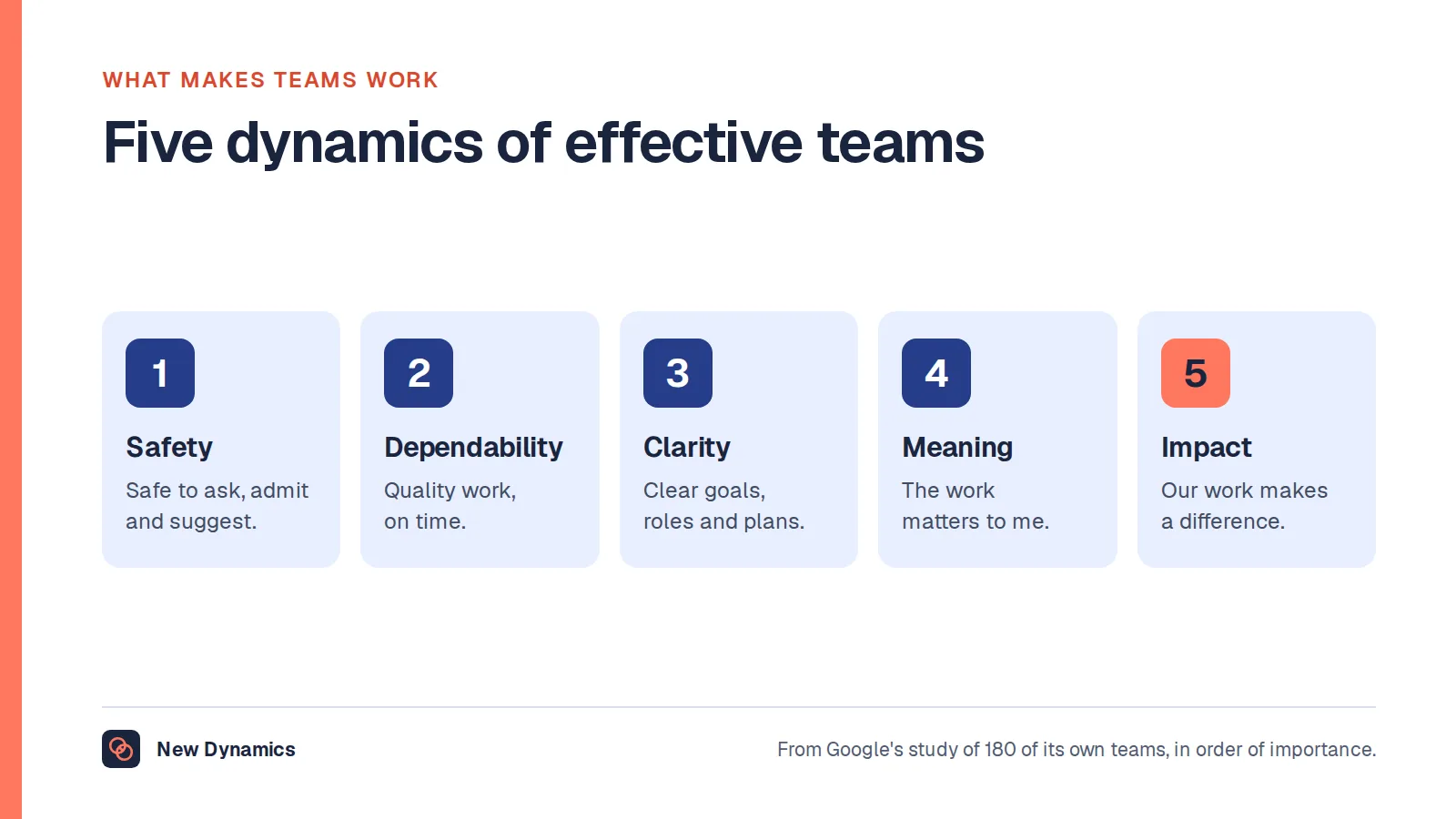
Google's research into team effectiveness looked for what distinguished its effective teams and found five things, in order of importance:
- Psychological safety. On teams with strong cultures, "teammates feel safe to take risks around their team members. They feel confident that no one on the team will embarrass or punish anyone else for admitting a mistake, asking a question, or offering a new idea."
- Dependability. "On dependable teams, members reliably complete quality work on time", rather than shirking responsibilities.
- Structure and clarity. An individual's understanding of job expectations, the process for meeting them and the consequences of performance, with goals that are "specific, challenging, and attainable".
- Meaning. A sense of purpose in the work or its output, which "is personal and can vary".
- Impact. The subjective judgement that the work is making a difference, which seeing the contribution to organisational goals can reveal.
Four of the five are conditions a manager sets rather than personalities a manager selects. That is the encouraging part: dynamics are more changeable than they feel from inside a difficult team.
Four failure modes
- Conformity. The group converges on the first or loudest opinion, and the people who disagree say nothing. High cohesion plus low psychological safety produces this reliably.
- Free riding. Effort disappears into the group, particularly in larger groups and where individual contributions are invisible. The cure is visible ownership of specific pieces, not exhortation.
- Dominance. One or two people take most of the airtime, and the group's output becomes their output. Measurable and fixable: count who speaks for how long in one meeting.
- Buried conflict. Disagreement leaves the room and reappears as delay, quiet non-compliance and corridor conversations. This is the most expensive of the four because nobody can point to it.

Six things a manager can do
- Make the goal and the roles explicit. Most "dynamics problems" are ambiguity problems. Who is deciding what, by when, and who is consulted.
- Name the norms out loud, including the awkward ones: how decisions are made, how disagreement is raised, what response times are expected. Principles of Management recommends helping the team "identify and formalize the ground rules for team engagement" before adversity arrives.
- Change how the room works. Ask the quietest person first, go round the table before the senior person speaks, separate idea generation from evaluation. Small mechanics change who has influence.
- Respond well to the first mistake. What happens to the first person who admits an error sets the psychological safety of the group for months.
- Give conflict a channel. A regular point in the agenda for what is not working, a pre-mortem before a decision, a rotating role whose job is to argue the other side.
- Have the individual conversation. Most of what shapes a group is settled one-to-one, not in the group meeting.
How to tell what your team's dynamics are
Three cheap diagnostics, none of which requires a survey:
- Count the airtime in one meeting. Who spoke, for how long, and who did not speak at all.
- Ask three people separately what the team's unwritten rules are. If they give different answers, the norms are not shared.
- Look at the last disagreement. Where did it happen, how did it end, and who has not mentioned it since.
Frequently asked questions
What does group dynamics mean?
The forces at work between the members of a group that shape how it behaves and what it produces: the roles people take, the unwritten rules the group follows, whose voice carries influence, how close the group is, and how it handles disagreement. The term covers both those forces and the study of them.
What are the stages of group development?
The open textbook Principles of Management describes Tuckman's model, developed in 1965 with a fifth stage added in 1977: forming, the polite stage; storming, the win-lose stage where members clash for control and choose sides; norming, where ground rules and shared responsibility take hold; performing, where the team is self-directed and needs little management direction; and adjourning, when the team disbands.
What makes team dynamics good?
Google's research found five factors, with psychological safety the most important: teammates feeling safe to take risks without being embarrassed or punished for admitting a mistake, asking a question or offering a new idea. Then dependability, structure and clarity, meaning and impact. Four of the five are conditions a manager can set.
How do you fix bad group dynamics?
Start with clarity of goal and roles, because much of what looks like a relationship problem is ambiguity. Then make the norms explicit, change the mechanics of how meetings work so influence is not decided by volume, respond well when someone admits a mistake, give disagreement a proper channel, and do the work in one-to-ones rather than in the group.
Is conflict in a group always bad?
No. Principles of Management sets out both sides: handled poorly, conflict can create distrust, disrupt progress and morale and damage lasting relationships; handled well it has real benefits. A group with no visible disagreement usually has disagreement happening somewhere less useful.
Your next step: look at one meeting
- Count the airtime in your next team meeting and write down who did not speak.
- Ask three people separately what the team's unwritten rules are.
- Name two norms out loud at the next meeting: how decisions get made, and how to disagree.
- Give the next disagreement a place on the agenda rather than letting it leave the room.
For the conversations where most of this is actually settled, read and download our manager one-to-one guide. The guide is free to read, and the PDF uses our short download form.
Want feedback, check-ins and goals in one place, so a team's conditions are visible rather than guessed at? Book a New Dynamics demo and bring your current team agenda. You can also email contact@new-dynamics.com.