TL;DR
- An insurance agent arranges cover for clients. O*NET's occupation, Insurance Sales Agents, covers those who “sell life, property, casualty, health, automotive, or other types of insurance” and who “may refer clients to independent brokers, work as an independent broker, or be employed by an insurance company”. The National Careers Service gives “insurance agent” as an alternative title for insurance broker, describing the job as using knowledge of the market “to help find the right cover, at the best price, for their customers”.
- The job sits between the client and the underwriter and runs on facts. O*NET's tasks include interviewing prospective clients to obtain data about their resources and needs and “the physical condition of the person or property to be insured”, contacting the underwriter and submitting forms “to obtain binder coverage”, calculating premiums, and then handling renewals, policy changes and claims, the half of the year that adverts leave out.
- In the UK the work is regulated, and many agents operate as appointed representatives. The FCA states that “an appointed representative (AR) carries on regulated activity under the responsibility of an authorised firm, known as ‘the principal’”, and that the principal “is responsible for making sure the AR is fit and proper and complies with our rules”. That decides who is accountable for what the agent says, and belongs in the job description.
An insurance agent is judged on new business and spends half the year on renewals, mid-term adjustments and claims. Adverts describe the first half. That mismatch explains a good deal of the turnover in the trade.
This article sets out an insurance agent job description an agency, broker or insurer can use: what the job is, nine duties, how agents differ from brokers, account handlers and underwriters, the UK regulated layer, how the job is paid, routes in and a template. It is general information about the occupation, not insurance, legal or regulatory advice.
Agents are measured on new business, retention and compliance at the same time, and all three need to be visible rather than argued about at review time. See how New Dynamics Goals & OKRs keep targets and progress in one place.
On the insurer's side of the same transaction sits our underwriter job description, covering the decision, the authority limits and the referrals.
What is an insurance agent?
An insurance agent arranges insurance cover for clients, placing the risk with an insurer and staying with the policy afterwards.
O*NET's occupation is Insurance Sales Agents, covering those who "sell life, property, casualty, health, automotive, or other types of insurance" and who "may refer clients to independent brokers, work as an independent broker, or be employed by an insurance company". Its reported job titles include Insurance Agent, Insurance Broker and Insurance Sales Agent.
In the UK the National Careers Service's insurance broker profile gives "insurance agent" as an alternative title, and describes the work as using "their knowledge of the insurance market to help find the right cover, at the best price, for their customers".
Agent, broker, account handler, underwriter

- Agent. Arranges cover for clients. Where an agent is tied to one insurer, the choice is that insurer's products; where independent, the whole market.
- Broker. In UK usage, an intermediary acting for the client and searching the market. The titles overlap heavily, which is why an advert should describe the panel rather than rely on the word.
- Account handler. Services an existing book: renewals, adjustments, queries and documentation, usually without carrying a new business target.
- Underwriter. Works for the insurer and decides whether to accept the risk, on what terms and at what price. The agent submits to them; they are not the same job.
Two useful questions for any advert: whose products can this person offer, and do they carry a new business target or a book?
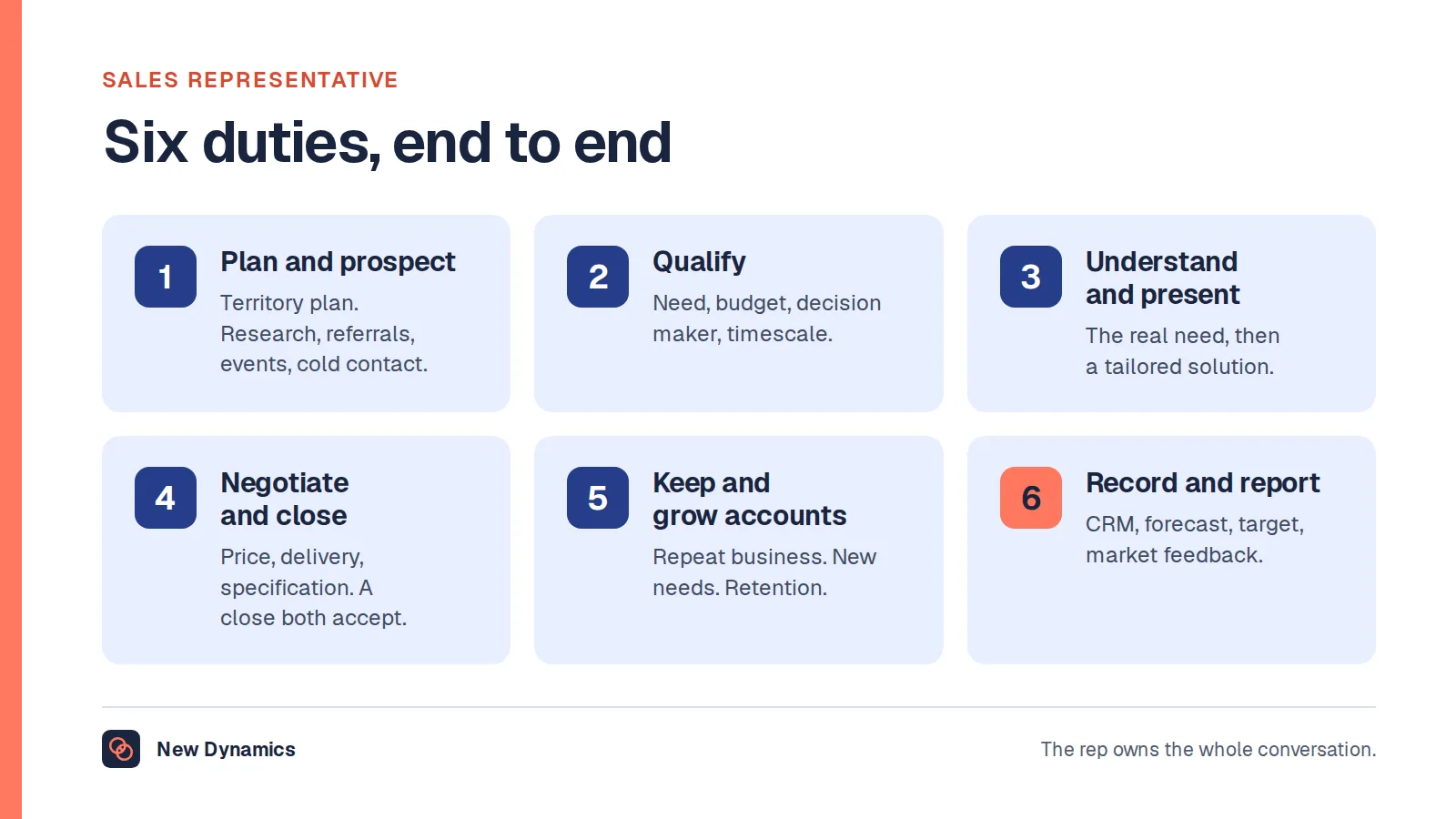
Nine duties
- Prospect. "Seek out new clients and develop clientele by networking to find new customers and generate lists of prospective clients", and "develop marketing strategies to compete with other individuals or companies who sell insurance".
- Fact-find. "Interview prospective clients to obtain data about their financial resources and needs, the physical condition of the person or property to be insured, and to discuss any existing coverage." Everything downstream depends on this being complete and accurate.
- Assess and research. Gather information to assess needs and risk, research policies, and in some lines "inspect property, examining its general condition, type of construction, age, and other characteristics, to decide if it is a good insurance risk".
- Place the risk. "Select company that offers type of coverage requested by client to underwrite policy", "contact underwriter and submit forms to obtain binder coverage", and negotiate terms with insurers.
- Quote and explain. "Customize insurance programs to suit individual customers, often covering a variety of risks", "explain features, advantages, and disadvantages of various policies", and "calculate premiums and establish payment method".
- Issue and onboard. "Ensure that policy requirements are fulfilled, including any necessary medical examinations and the completion of appropriate forms", and "call on policyholders to deliver and explain policy".
- Renew and adjust. "Perform administrative tasks, such as maintaining records and handling policy renewals", renew or adjust existing policies, and "analyze insurance program and suggest additions or changes, or to change beneficiaries".
- Support claims. "Confer with clients to obtain and provide information when claims are made on a policy", and "monitor insurance claims to ensure they are settled equitably for both the client and the insurer".
- Record and comply. Make sure paperwork meets legal requirements, keep client records up to date, create case reports for underwriters and risk surveyors, and "attend meetings, seminars, and programs to learn about new products and services".

The half of the job nobody advertises
Duties seven and eight are where the relationship is kept or lost, and where an agent earns the renewal that pays for the year after.
- Renewals are not administration. A renewal is a fresh conversation about what changed: a new vehicle, a bigger turnover, a building extension, a claim.
- Mid-term adjustments arrive at inconvenient moments and have to be right.
- Claims are when the client finds out whether the cover was correctly arranged. An agent who disappears at claim stage has no book in three years.
If your advert does not mention renewals and claims, expect candidates who are surprised by them.
The regulated layer, and the appointed representative model
Arranging insurance in the UK is a regulated activity, and a large part of the market operates through the appointed representative model.
The FCA's page on the responsibilities of principal firms explains the structure plainly: "an appointed representative (AR) carries on regulated activity under the responsibility of an authorised firm, known as 'the principal'", and "the principal is responsible for making sure the AR is fit and proper and complies with our rules".
The principal's obligations, per the same page, include:
- Having "a written AR agreement", which "should set out what business the AR can do".
- Assessing the AR before appointing them "to ensure they're fit and proper, financially stable and suitable to carry out business for your firm".
- Notifying the FCA "at least 30 days before the appointment takes effect".
- Regularly reviewing "the AR's activities, business and senior management".
- Taking "reasonable steps to ensure your AR acts within the scope of their appointment".
- Ensuring the firm "has adequate skills and resources to oversee your AR", including where the AR's business changes or expands.
- Providing complaints and revenue data annually, and ensuring the AR continues to meet standards "such as the Consumer Duty".
For a job description, three things follow. The advert should say whether the role sits in an authorised firm or with an appointed representative. It should name the scope: which products, which customers, and what the person may not do. And it should say what training and competence assessment applies, because someone is accountable for it either way. Which permissions apply to a given firm and role is a question for that firm's compliance team and the FCA Handbook.
Pay, targets and behaviour
Insurance sales roles typically pay a basic salary plus commission or bonus, and the measures chosen quietly decide how the person works.
- New business only produces churn: policies written cheaply, renewed badly, lost in year two.
- Retention alongside new business rewards the conversations that actually build a book.
- Compliance and file quality need a place in the scheme, or they become the thing that gets skipped under pressure.
- Claims service rarely appears in a scheme and always shows up in retention.
Write the scheme down before the person starts, and do not change it mid-year. Our compensation policy guide covers how to set out pay and variable pay so that it can be explained to the person it applies to.
Routes in and progression
The National Careers Service gives three routes:
- University. A degree in a subject such as business studies, finance, surveying, engineering or law, then an insurance company's graduate training scheme.
- Apprenticeship. Insurance Practitioner level 3 advanced, Insurance Professional level 4 higher, or Senior Insurance Professional level 6 degree apprenticeship.
- Work. Starting as an insurance trainee or junior account handler and becoming a broker through workplace training and promotion, with employers usually looking for GCSEs including English and maths, A levels, and IT skills. Experience in customer care, finance or sales helps but is not essential.
Progression, per the same profile: account handling or business development; specialising in property, commercial or motor insurance; management; moving into loss adjusting, underwriting or compliance; or setting up a brokerage or working as a freelance consultant.
An insurance agent job description template
Job title: Insurance agent / account executive
Reports to: Branch or sales manager
Regulatory status: [authorised firm, or appointed representative of the named principal], [lines of business], [personal or commercial]
Purpose: Arrange suitable insurance cover for clients, retain and grow the book, and service policies properly from quotation through to claim.
Responsibilities
- Generate new business from enquiries, referrals, networking and marketing activity.
- Carry out a full fact-find and record the client's demands and needs.
- Research the market or panel, and prepare quotations that the client can compare.
- Submit risks to underwriters with complete and accurate information, and negotiate terms.
- Explain cover, exclusions, excesses and price clearly, and confirm in writing.
- Issue documentation and make sure policy requirements are completed.
- Manage renewals and mid-term adjustments, and re-check needs at each renewal.
- Support clients at claim stage and follow the claim through to settlement.
- Keep accurate records and work within the firm's compliance procedures and training and competence scheme.
You will need: [qualifications, or willingness to study for them]; attention to detail; the ability to explain cover in plain English; and comfort with a target.
Pay: [basic salary] plus [commission or bonus scheme], measured on [new business, retention, file quality].
What the advert should say
- The market. Tied, panel or whole of market; personal lines, commercial or a specialism.
- The book and the target. Inherited book or cold start; what is measured and over what period.
- The regulatory position. Authorised firm or appointed representative, and what study is funded.
- The service half. Renewals, adjustments and claims, and who does them.

Frequently asked questions
What is an insurance agent?
Someone who arranges insurance cover for clients, placing the risk with an insurer and servicing the policy afterwards. O*NET describes the occupation as selling life, property, casualty, health, automotive or other types of insurance, noting that agents may refer clients to independent brokers, work as an independent broker, or be employed by an insurance company.
What does an insurance agent do day to day?
Prospects for clients, carries out fact-finds, researches the market, submits risks to underwriters, prepares and explains quotations, calculates premiums, issues documentation, handles renewals and mid-term adjustments, supports clients through claims, and keeps records that meet legal requirements. The National Careers Service adds creating case reports for underwriters and risk surveyors.
What is the difference between an insurance agent and a broker?
The titles overlap, and the National Careers Service treats "insurance agent" as an alternative title for insurance broker. Where a distinction is drawn, an agent may be tied to one insurer or a panel, while a broker acts for the client and searches the market. The practical question for a candidate is whose products they can offer.
Do insurance agents need qualifications in the UK?
There is no single legal qualification for the job itself, but the firm must meet the regulator's training and competence requirements, and professional insurance qualifications are the normal route. Entry can be through a degree and graduate scheme, an Insurance Practitioner, Insurance Professional or Senior Insurance Professional apprenticeship, or starting as a trainee or junior account handler and qualifying while working.
What is an appointed representative in insurance?
The FCA explains that an appointed representative carries on regulated activity under the responsibility of an authorised firm called the principal, and that the principal is responsible for making sure the AR is fit and proper and complies with FCA rules. The principal must have a written agreement setting out what business the AR can do, assess the AR before appointment, notify the FCA at least 30 days beforehand, review the AR's activities regularly, and ensure standards such as the Consumer Duty continue to be met. This is general information, not legal advice.
How are insurance agents paid?
Usually a basic salary plus commission or bonus. What the scheme measures matters more than the headline figure: new business alone tends to produce churn, while including retention, file quality and claims service rewards the work that actually builds a book.
Your next step: advertise both halves of the job
- Say whose products the person can offer, and whether there is a book to inherit.
- Put renewals, adjustments and claims in the advert alongside new business.
- State the regulatory position and what study is funded.
- Write the commission scheme down before the start date, and leave it alone for the year.
For setting out pay and variable pay so it can be explained to the person it applies to, read and download our compensation policy guide. The guide is free to read, and the PDF uses our short download form.
Want targets, check-ins and reviews in one place, so new business, retention and compliance are all visible? Book a New Dynamics demo and bring your current scorecard. You can also email contact@new-dynamics.com.