TL;DR
- A job board is a website where employers publish vacancies and candidates search and apply. The board hosts the advert and passes on the application; it does not manage the hiring process, and it is not the same thing as an aggregator, an applicant tracking system, a careers site or an agency.
- Where you advertise is a fairness question as well as a reach one. Acas advises advertising “in at least 2 different ways or places”, considering “whether the places you advertise reach a diverse range of people”, and warns that advertising only on social media “could miss out on applicants who do not use it”.
- Not every board is commercial. Employers in England, Scotland and Wales can “advertise and manage your vacancies on the ‘Find a job’ service” run by GOV.UK, with a separate service for Northern Ireland.
"Job board" is used for four different things in the average hiring conversation, which is why two people can agree to "put it on the job board" and mean completely different work.
This article explains what a job board is, the four things it is not, the types that exist, what a posting needs, what happens to candidate data, and what to measure. It names no commercial boards and ranks nothing: choosing between vendors is your call, and this is about how the category works.
Hiring is a process with stages, forms and approvals, whoever hosts the advert. See how New Dynamics workflows let you define your own rather than track them in a spreadsheet.
The definition
A job board is a website where employers publish vacancies and candidates search and apply to them. The board's job is distribution: it shows the advert to people looking for work, collects the application or sends the candidate to the employer's own form, and passes it on.
That is the whole function. Everything people expect a board to do beyond that (sift, score, schedule, keep records, tell candidates where they stand) belongs to other systems.
The four things a job board is not

- An aggregator. Aggregators do not host adverts primarily; they collect them from boards and careers sites and present them in one search. An employer can appear on one without ever having posted there.
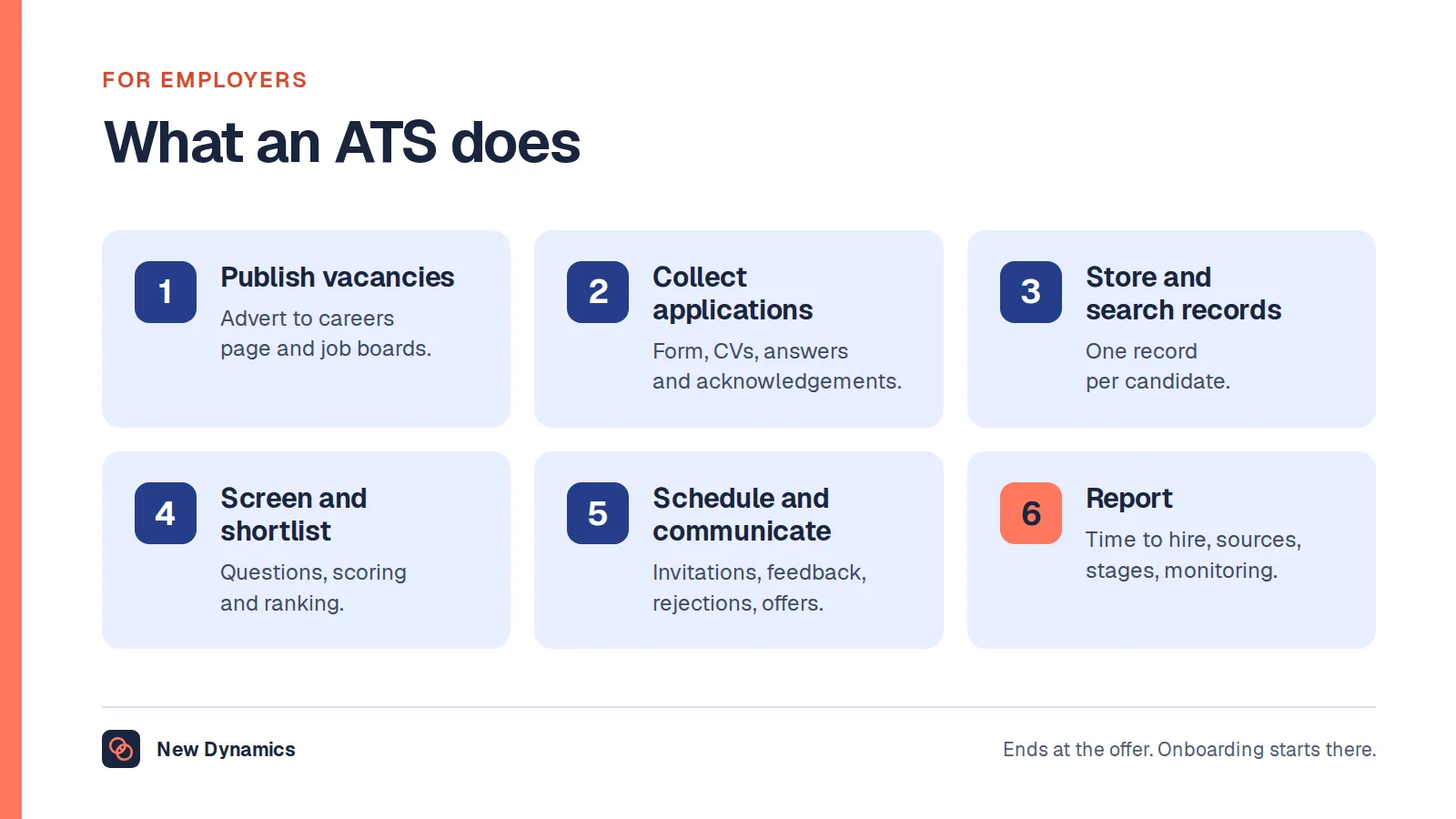
- An applicant tracking system. The ATS is where the application lands and the process is run: stages, notes, scores, communication and records. Our post on ATS meaning covers that side, and our resume parsing post covers what happens to a CV once it arrives.
- A careers site. Yours, on your domain, with your vacancies only. A board carries many employers; a careers site carries one.
- A recruitment agency. A board sells visibility. An agency sells shortlisting, and takes a fee on a placement.
The distinction matters commercially. Paying a board for a posting buys attention, not screening. If the applications arrive unscreened and nobody has capacity to read them, that is the expected outcome rather than a failure of the product.
The types
- Generalist boards carry every kind of vacancy and have the largest audiences.
- Niche and sector boards carry one industry, profession or type of work, and tend to produce fewer but more relevant applications.
- Government services. In the UK, employers can advertise a job on the "Find a job" service, which is "only available for England, Scotland and Wales", with "a different service to advertise vacancies in Northern Ireland". You sign in, or create sign-in details, to use it.
- Professional body and membership boards, often attached to a register or a community.
- Internal boards. The list of vacancies open to your own staff, which is a job board in every meaningful sense and usually the worst-maintained one in the organisation.
- Community and specialist boards serving particular groups, regions or working patterns.
Most employers use a small mix rather than one, which is also what Acas suggests for a different reason.
Where to advertise, and why it is a fairness question
Acas's guidance on advertising a job is direct: "you're not legally required to advertise a job, but it's a good idea to", because "you're less likely to break the law by discriminating, even if you did not intend to", and "you're more likely to get a wider range of applicants who are suitable for the job".
Three points from that guidance shape where and how you post:
- Advertise in more than one place. "It's a good idea to advertise in at least 2 different ways or places. For example, in a newspaper and on a jobs website." Consider "whether the places you advertise reach a diverse range of people", since advertising only on social media "could miss out on applicants who do not use it".
- Apply your own policy consistently. If you have a recruitment policy, "you must apply it in the same way to everyone", including any rule about advertising internally first.
- Watch the wording. You "must not ask for or exclude anyone with a certain protected characteristic". Acas gives examples: "recent graduate" or "highly experienced" can discriminate on age; "barmaid" or "handyman" imply a sex; and specifying a nationality rather than a language can discriminate on race, so "German-speaking sales rep" is better than "German sales rep".
This is general information rather than legal advice.
What a posting needs

Boards vary in what they ask for, but a posting that works contains the same things everywhere:
- A title people search for. Internal titles that mean nothing outside your organisation cost you applications before anyone reads a word.
- The location and the working pattern, stated plainly: site, hybrid days, shifts, hours.
- Pay, or a range. A posting without it gets fewer and worse-matched applications, and candidates ask anyway.
- What the person will actually do, in a few specific lines rather than a full job description pasted in.
Add how to apply, a closing date if there is one, and a named contact for questions about adjustments.
Candidate data, and who else is in the chain
Posting on a board means a third party is handling applicants' personal information alongside you. The ICO's draft guidance on recruitment and selection, the consultation has closed and it says the final version "will be published in due course", is aimed at "employers and organisations which carry out recruitment on behalf of employers, such as recruitment agencies, head-hunters or consultancies", and covers "all potential employment relationships, including employees, contractors, volunteers or gig and platform workers".
Two observations in it are worth acting on. Recruiting employers are likely to process information "about candidates, prospective candidates, temporary workers, contractors, referees, emergency contacts, and dependants", some of it sensitive, including "details about health, diversity, or criminal convictions". And "the labour market supply chain can be complex, with end-to-end recruitment processes often involving several organisations", a board, an aggregator, an ATS, an agency and an assessment provider can all touch one application.
Practically: know which organisations receive applicant data, what each keeps, for how long, and what candidates are told. Read the ICO's recruitment and selection guidance rather than relying on a vendor's summary of it.
Choosing a board without a vendor list
Six questions that work regardless of which boards you are considering:
- Where do your last ten good hires come from? Start there rather than with a list.
- Does the board reach the people who do this job, or only people who search for jobs generally?
- What does the application experience look like on a phone, end to end, including any account creation?
- Where does the application land, and does it reach your ATS without rekeying?
- What does it cost per posting, per slot or per application, and what is the commitment?
- What data does the board keep, and what does it tell candidates about that?
Test the last two before committing to a year.
What to measure

- Applications by source, counted only where the source is recorded accurately. Guessing makes every other number wrong.
- Shortlist rate by source. Fifty applications producing one interview is worse than eight producing three.
- Hires by source, over enough vacancies to mean anything.
- Cost per hire by source, including the time spent reading applications, which is the cost people leave out.
Avoid judging a board on application volume alone. It is the number boards report most enthusiastically and the one least connected to a filled vacancy.
Frequently asked questions
What is a job board?
A website where employers publish vacancies and candidates search and apply to them. The board distributes the advert and passes on the application. It does not sift, score, schedule or keep your hiring records, which is what an applicant tracking system does.
What is the difference between a job board and an ATS?
A job board is external and public: it shows your vacancy to people looking for work. An applicant tracking system is yours: it receives applications, holds the stages, notes, scores and communication, and keeps the records. Boards bring candidates in; the ATS is where the hiring process happens.
What is the difference between a job board and an aggregator?
A board hosts adverts that employers post to it. An aggregator collects adverts from many boards and careers sites and presents them in one search, so a vacancy can appear on an aggregator without the employer ever posting there.
Are there free job boards?
Yes, including government-run services. In the UK, employers in England, Scotland and Wales can advertise vacancies on the "Find a job" service, with a separate service for Northern Ireland. We do not publish a ranked list of commercial boards, because their coverage, pricing and terms change.
Where should I advertise a job?
In at least two different places, chosen for whether they reach the people who do the job, as Acas advises. Consider whether the places you use reach a diverse range of people, and remember that advertising only on social media misses applicants who do not use it. Apply any internal advertising policy consistently.
What should a job board posting include?
A title people actually search for, the location and working pattern, the pay or a pay range, a few specific lines on what the person will do, how to apply, a closing date if there is one, and a contact for questions about reasonable adjustments.
Your next step: check where your good hires come from
- List your last ten good hires and where each one saw the vacancy.
- Advertise in at least two places, chosen for reach rather than habit.
- Check the advert's wording against the Acas examples before it goes live.
- Record the source accurately, and measure shortlist and hire rates rather than applications.
For the process that runs after the advert (criteria, shortlisting, scoring and a decision you can defend) read and download our recruitment and selection guide. The guide is free to read, and the PDF uses our short download form.
Want the stages after "applied" (screening, interviews, approvals) in one place with a completion view? Book a New Dynamics demo and bring your current hiring process. You can also email contact@new-dynamics.com.