TL;DR
- Good interview questions are tied to the job, open, asked one at a time, the same for every candidate and possible to score. Clever questions that fail those tests tell you little.
- This article gives 60 questions in eight groups: motivation, experience, behavioural, situational, working with others, learning, strategic and unusual. All were written by our editorial team.
- Some questions must not be asked. GOV.UK tells employers not to ask about protected characteristics, marriage or children, and the US EEOC says that pre-offer questions about disability are prohibited.
An hour is not long to decide whether to work with someone for years. Many interviewers spend it on questions that they thought of in the lift: tell me about yourself, where do you see yourself in five years, what is your greatest weakness. The candidate has rehearsed all three. Nobody learns anything.
This article gives you 60 interview questions to ask candidates, grouped by what each group reveals, with guidance on choosing them, the questions that the law tells you to avoid and a plan for the hour. All 60 were written by our editorial team, and you are free to use and adapt them.
What you ask at interview should match what you expect afterwards. See how New Dynamics performance reviews bring goals, feedback and development into one fair discussion.
Four kinds of interview question
- Motivation questions. Why this job, why now, and what the person wants from work.
- Behavioural questions. What the person did in a real situation in the past. “Tell me about a time when…”
- Situational questions. What the person would do in a likely situation in the future. “What would you do if…”
- Skills questions and work samples. Whether the person can do the work: a technical question, a short exercise, a piece of their work to talk through.
The second and third kinds come from the structured interview. The US Office of Personnel Management describes the structured interview as a method that measures job-related competencies “by systematically inquiring about their behavior in past experiences and/or their proposed behavior in hypothetical situations”. Among the benefits that it lists are these two: “All candidates are asked the same predetermined questions in the same order” and “All responses are evaluated using the same rating scale and standards for acceptable answers”.

Five tests of a good interview question
- Job-related. It comes from the job description or the person specification. If you cannot say which requirement it tests, drop it.
- Open. It cannot be answered with yes or no.
- Single. One question at a time. Candidates answer the last part of a triple question and forget the rest.
- The same for everyone. Acas, in its guidance on interviewing job applicants, says that “it's a good idea to ask each applicant the same questions where possible”. Follow-up questions can differ.
- Scorable. You have agreed beforehand what a strong answer contains.

Motivation questions
- What made you apply for this role?
- What do you know about what we do, and what would you like to know?
- What are you looking for in your next job that you do not have now?
- Which part of this job description appeals to you most? Which part least?
- What kind of work gives you energy, and what kind drains it?
- What would make you leave a job?
- What do you need from a manager to do your best work?
- If you joined us, what would you hope to have achieved in a year?
What they reveal: whether the person wants this job or any job, and whether what they want is something that you can offer.
Experience and skills questions
- Talk me through the piece of work on your CV that you are proudest of. What was your part in it?
- Which of your past roles is closest to this one? What is different?
- What is the hardest technical problem that you have solved? How did you approach it?
- Which tools or methods in this field do you know best? Where are you still learning?
- Show me, or describe, how you would do [a core task of the job].
- What would you need to learn in your first three months here?
- What is a common mistake in this kind of work, and how do you avoid it?
- How do you check the quality of your own work?
What they reveal: whether the person can do the work, and how honestly they describe the edges of their knowledge. Where you can, replace one of these with a short work sample.
Behavioural questions
- Tell me about a time when you had too much to do. How did you decide what came first?
- Describe a mistake that you made at work. What did you do about it?
- Tell me about a time when you disagreed with a decision. What did you do?
- Give me an example of a goal that you did not reach. What happened?
- Describe a time when you had to learn something quickly.
- Tell me about a time when you improved the way something was done.
- Describe a time when you dealt with an unhappy customer or colleague.
- Tell me about a time when you took responsibility for something that was not strictly your job.
- Give me an example of feedback that changed how you work.
- Describe a time when you had to deliver bad news.
What they reveal: how the person behaves, as opposed to how they say they behave. Follow up with “What did you do, exactly?”, “What happened next?” and “What would you do differently?”
Situational questions
- You are given a task with a deadline that you think cannot be met. What do you do?
- Two colleagues give you conflicting instructions. How do you handle it?
- You notice that a colleague has made an error that affects a customer. What do you do?
- You finish your own work early. What next?
- You are asked to do something that you have never done before, and nobody is free to show you. How do you start?
- A customer asks for something that our policy does not allow. What do you say?
What they reveal: judgement. Build the scenarios from real situations in the job. They suit candidates with little work history, who cannot answer behavioural questions from experience.
Questions about working with others
- Describe the best team that you have worked in. What made it good?
- Tell me about a colleague whom you found difficult. How did you work with them?
- How do you like to receive feedback? Give me an example of when it worked.
- Tell me about a time when you helped a colleague to succeed.
- How do you keep other people informed about your work?
- Describe a time when you had to persuade someone who did not report to you.
- What do colleagues come to you for?
- What would your last manager say that you are working on?
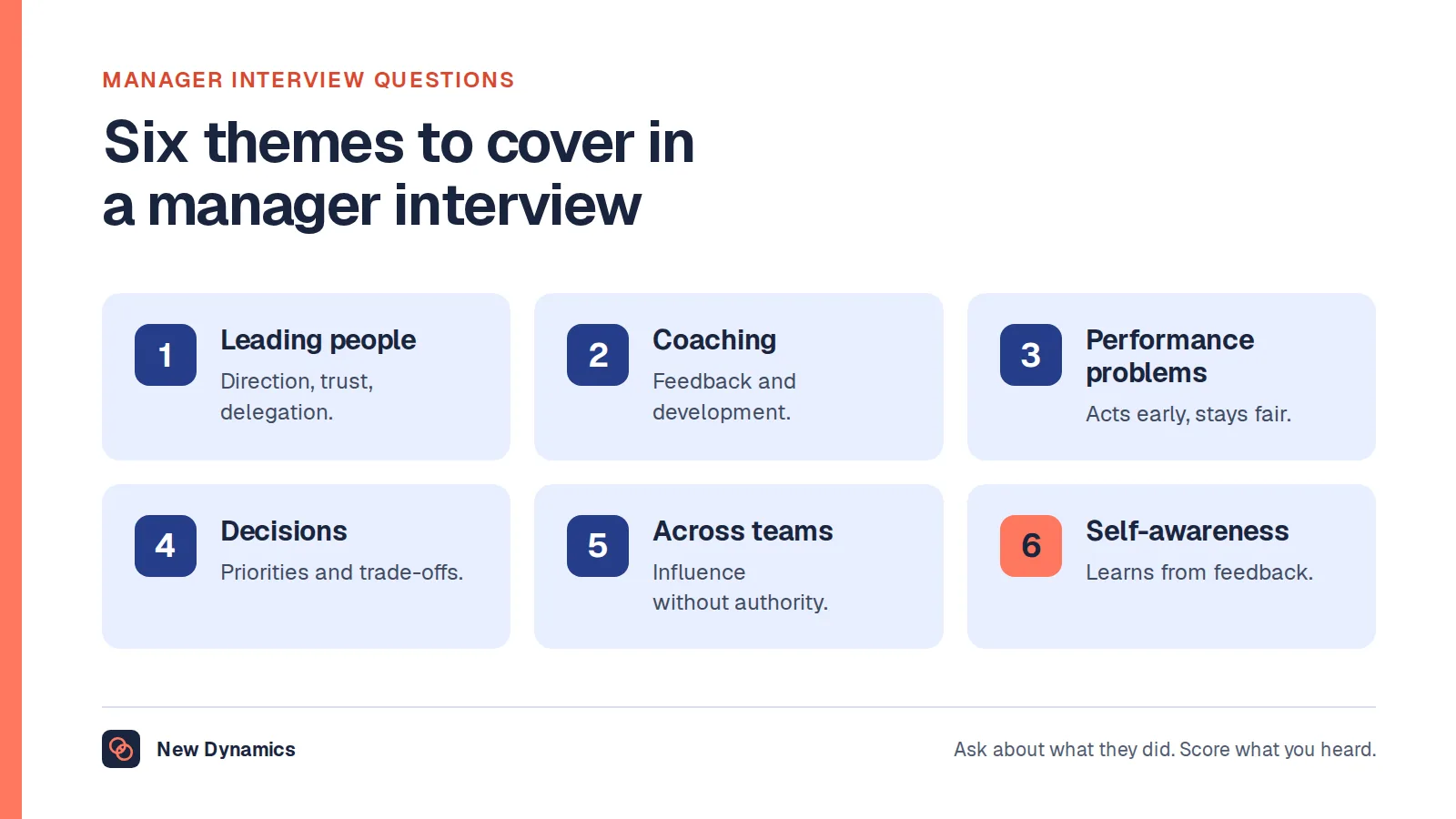
What they reveal: how the person affects the people around them. For more on this theme, see our manager interview questions.
Questions about learning and growth
- What have you learned in the past year that changed how you work?
- What skill are you building now, and how?
- Tell me about a time when you were out of your depth. What did you do?
- What do you want to be better at in two years?
- Who has taught you the most in your career, and what did they teach you?
- When did you last change your mind about something important at work?
What they reveal: whether the person keeps learning. In many jobs, this matters more than what they know today.
Strategic interview questions
These are for senior or specialist roles, where you need to see how the person thinks about the wider picture.
- What do you think is the biggest challenge facing a team like ours in the next two years?
- If you had this job, what would you look at first, and why?
- Tell me about a time when you had to choose between a short-term gain and a long-term benefit.
- How do you decide what not to do?
- Describe a decision that you made with incomplete information. How did it turn out?
- Which measure would you use to judge your own success in this role?
- Tell me about a time when you changed the direction of a piece of work. What told you to change?
- What would you want to know about our customers before you made any changes?
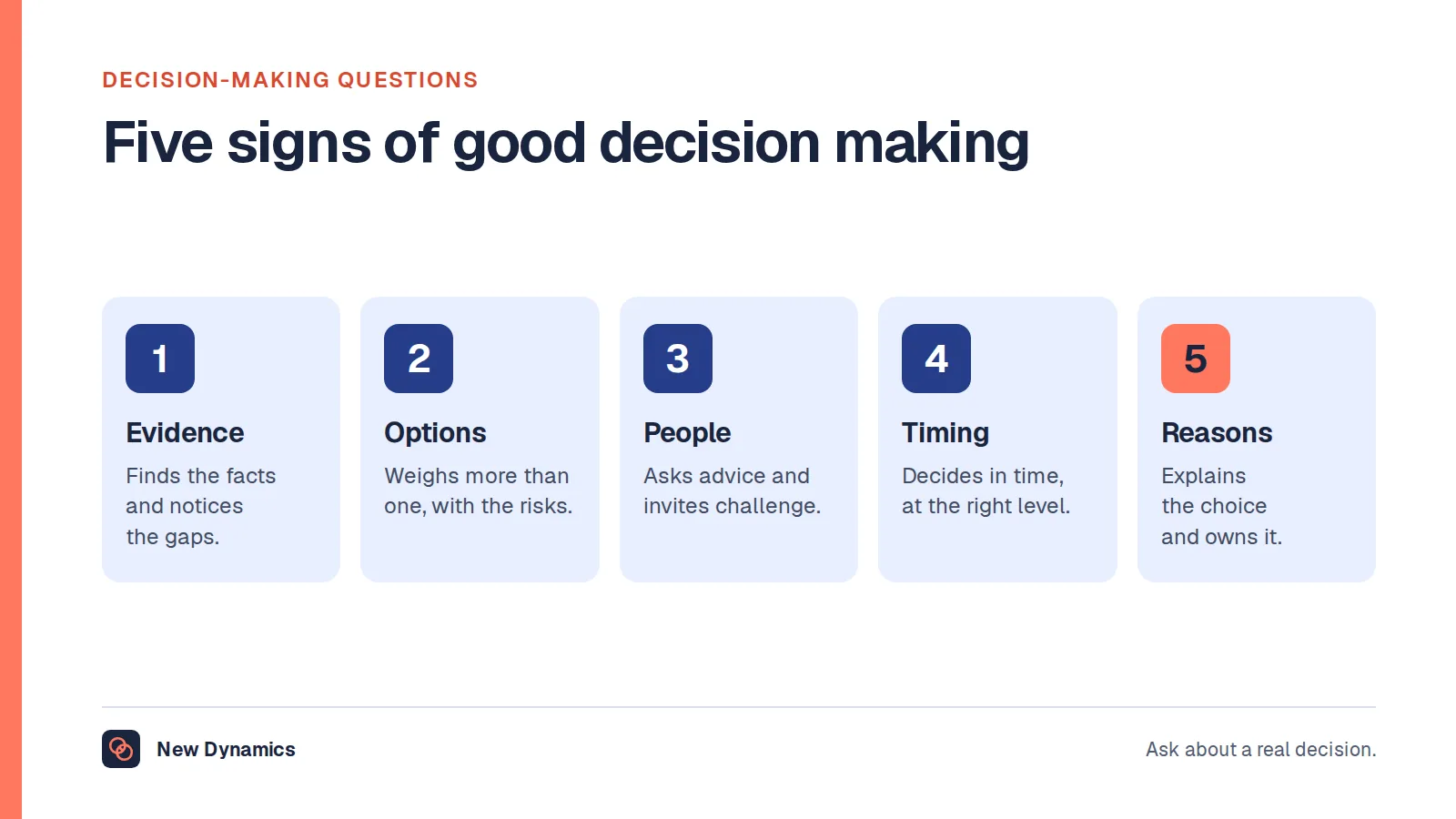
For more of this kind, see our 50 decision-making questions.
Unique interview questions that still earn their place
An unusual question is worth asking only if it passes the five tests. These do.
- What is something about how you work that does not show on your CV?
- Teach me something in two minutes.
- What is a widely held view in your field that you disagree with?
- Which question did you hope that we would ask, and what is your answer?
- What did you think was wrong with our application process?
- If we gave you a free afternoon every week to improve something here, what would you pick?
Leave out brainteasers, trick questions, and “which animal would you be?” They test nerve and quick wit, which few jobs need.
Questions you must not ask
In Great Britain, GOV.UK's guidance on discrimination in recruitment says: “You must not ask candidates about ‘protected characteristics’”. Nor may you ask whether they are married, single or in a civil partnership, or whether they have children or plan to have children. It adds that you can ask about health or disability only in limited circumstances, for example to find out whether someone needs help to take part in a selection test or interview. Acas states the principle in one line: “Questions must not discriminate.”
In the United States, the Equal Employment Opportunity Commission's summary of prohibited practices says that information requested before an offer should be limited to what is “essential for determining if a person is qualified for the job”, and that information about race, sex, national origin, age and religion is irrelevant to that. It states: “Employers are explicitly prohibited from making pre-offer inquiries about disability.”
So avoid questions such as:
- “Are you planning to start a family?”
- “How old are you?” or “When did you leave school?”
- “Where are you really from?”
- “Do you have any health problems?”
- “Which church do you go to?”
- “What does your partner do?”
If a fact matters to the job, ask about the requirement. “This role involves working two Saturdays a month. Can you do that?” is a fair question, put to every candidate. This is general information, not legal advice.
A plan for the hour: six stages
- Welcome and outline. Introduce the panel, explain the format and the timing, and say that you will take notes.
- Opening questions. Two motivation questions to settle the candidate.
- Core questions. Six to eight behavioural, situational and skills questions, each tied to a requirement. This is most of the hour.
- The candidate's questions. Leave ten minutes. What they ask tells you something too.
- Next steps. Acas advises telling applicants when and how they will hear, and what sort of feedback to expect.
- Score alone, straight away. Each interviewer scores every answer against the agreed scale before discussing it. Acas suggests that, if possible, each interview should be carried out by more than one person.

Common mistakes
Too many questions. Eight good questions with follow-ups beat twenty asked at speed.
Different questions for different candidates. You cannot then compare them.
Talking more than the candidate. Aim to speak for a fifth of the time.
Deciding in the first five minutes, and spending the rest of the hour confirming it.
Hiring for “fit” without saying what it means. Undefined, it tends to mean “like us”.
No notes. Memory tends to favour the most recent and the most charming candidate.
Frequently asked questions
What are good interview questions to ask candidates?
Good questions are tied to the job, open, asked one at a time, the same for every candidate and possible to score. Examples: “Tell me about a time when you had too much to do. How did you decide what came first?” and “What would you need to learn in your first three months here?”
What are strategic interview questions?
Strategic interview questions show how a candidate thinks about the wider picture, and suit senior or specialist roles. Examples: “If you had this job, what would you look at first, and why?” and “How do you decide what not to do?”
What are some unique interview questions?
Try “Teach me something in two minutes”, “What is a widely held view in your field that you disagree with?” or “Which question did you hope that we would ask?” Avoid brainteasers and trick questions, which reveal little about how someone will do the job.
How many questions should I ask in an interview?
For a one-hour interview, plan two opening questions and six to eight core questions, with follow-ups, and leave ten minutes for the candidate's questions. Fewer questions asked well tell you more than many asked quickly.
What questions are illegal to ask in an interview?
In Great Britain, GOV.UK says that you must not ask about protected characteristics, or whether candidates are married or have or plan to have children. In the US, the EEOC says that pre-offer questions about disability are prohibited, and that questions which reveal race, religion, age or national origin should generally be avoided.
Should every candidate get the same questions?
Yes, as far as possible. Acas calls it a good idea, because it helps you to treat applicants in the same way. The US Office of Personnel Management lists it as a feature of structured interviews. Follow-up questions can vary with the answers.
Your next step: build your question set
- List the five or six requirements that matter most for the role.
- Choose one or two questions from this article for each, and add a work sample if you can.
- Agree with your fellow interviewers what a strong answer contains.
- Use the same set for every candidate, and score alone before you compare.
For a fair process from the job description to the offer, read and download our recruitment and selection guide. The guide is free to read, and the PDF uses our short download form.
Want the expectations that you set at interview to carry through to goals and reviews? Book a New Dynamics demo and bring your current process. You can also email contact@new-dynamics.com.