TL;DR
- Job classification is the practice of grouping jobs into grades or classes so that jobs of broadly similar demand sit together and can be paid and managed consistently. It has two senses: the general practice any employer can use, and the formal position classification systems of large public services. The US Office of Personnel Management describes the second kind precisely: classification standards “define Federal white collar occupations, establish official position titles, and describe the various levels of work”, and are used to determine the occupational series, title, grade and pay system for a position.
- It is not the same as job evaluation, job analysis or a job description, though it depends on all three. Analysis finds out what the job involves; the description records it; evaluation assesses the relative demand of one job against others; classification places the result in a grade. Four methods are in common use: ranking, classification against grade definitions, point-factor scoring and market pricing, and most organisations end up with a hybrid.
- The reason to do it properly is equal pay. Acas says equal work includes “‘work rated as equivalent' – work that's found to be equivalent, usually using a job evaluation process”, and notes that jobs which look different, such as a clerical job and a warehouse job, can be equal work. A structure you cannot explain is a structure you cannot defend, so write grade definitions in plain words, classify the job rather than the person, and review when jobs change.
Somebody asks why their job is a grade 5 and the job next door is a grade 6, and the honest answer in many organisations is that nobody now living knows. Job classification is the work that prevents that: grouping jobs into grades so that similar demands sit together, pay can be explained and the structure survives the person who built it.
This article defines job classification, separates it from job evaluation, job analysis and job descriptions, sets out the four methods and what each is good for, explains the equal pay reason it matters, and gives six steps to build or refresh a structure with a template for a grade definition. It describes the UK legal position and is general information, not legal advice.
A grade structure only works if people can see where a role sits and what sits above it. See how New Dynamics org charts show roles, reporting lines and the relationships between them.
What is job classification?
Job classification is the process of grouping jobs into a defined set of classes or grades, based on the demands of the work, so that jobs of broadly equivalent demand are treated consistently in pay, progression and management.
The term carries two senses.
The general practice. Any employer with more than a handful of roles ends up needing one: a way of saying that these five jobs belong together, that this one is a level above, and that pay ranges attach to the levels rather than to individuals.
Formal position classification. Large public services operate published systems. The US Office of Personnel Management's guidance on classifying General Schedule positions describes what such a system produces: classification standards and functional guides that “define Federal white collar occupations, establish official position titles, and describe the various levels of work”, used in “determining the occupational series, title, grade, and pay system for positions”. That is the mature version: occupation, title, level and pay system, all documented and appealable.
Classification, evaluation, analysis and description
These four are used interchangeably in conversation and mean different things.
| Term | Question it answers |
|---|---|
| Job analysis | What does this job actually involve, and what does it require? |
| Job description | How do we record that, in a document people can use? |
| Job evaluation | How demanding is this job compared with others here? |
| Job classification | Which grade does that level of demand belong in? |
Analysis produces the facts, the description records them, evaluation ranks the job against others, and classification places it. Skip the first two and the last two become guesswork; our job description template covers the recording, and the job evaluation guide covers separating the value of a role from the contribution of the person in it.

The four methods
- Ranking. Put every job in order of overall demand, from most to least, and draw lines to create grades. Quick and cheap; works in a small organisation; becomes unusable past a few dozen jobs and is hard to defend because the reasoning is implicit.
- Classification, or grading. Write definitions for each grade first, describing the level of responsibility, judgement, knowledge and impact expected, then slot each job into the grade whose definition fits best. This is the method the term "job classification" usually names. Transparent and quick to apply once the definitions exist; its weakness is that borderline jobs get argued over and definitions drift.
- Point-factor. Score each job against weighted factors, such as knowledge, responsibility, decision-making, contacts and working conditions; total the points; group point ranges into grades. The most defensible method and the most work; used where equal pay risk is high or the organisation is large.
- Market pricing. Attach jobs to external salary survey benchmarks and let the market define the hierarchy. Keeps pay competitive, but it imports the market's inequalities and is a poor answer on its own to an equal pay challenge, because the market is not a defence for paying differently for equal work.
Most organisations run a hybrid: a point-factor or classification core for internal consistency, checked against market data for the roles that are hard to recruit.

Why it matters: equal pay
The legal reason to classify carefully is equal pay. Acas's guidance on equal pay and the law says that by law men and women must get equal pay for doing "equal work", which the law classes as work that is “the same, similar, equivalent or of equal value”, and sets out the three ways work can be equal:
- Like work, “work where the job and skills are the same or similar”;
- Work rated as equivalent, “work that's found to be equivalent, usually using a job evaluation process”, for example because the level of skill, responsibility and effort needed is equivalent;
- Work of equal value, “work that is not similar but is of equal value”, because the skill, training, responsibility or demands of the working conditions are of equal value.
Acas adds the point that surprises people: “Some jobs can be classed as equal work, even if the roles seem different. For example, a clerical job and a warehouse job might be classed as equal work.” Equal pay law covers pay and contractual terms including basic pay, pension, hours, leave, overtime, redundancy and sick pay, contractual bonuses and benefits.
Two practical implications. A classification scheme is how an employer demonstrates that jobs were rated as equivalent, so the reasoning must be recorded, not remembered. And a scheme that classifies traditionally female-dominated and male-dominated roles by different logic, or with factors that quietly favour one, is a risk rather than a protection. This is general information; take advice on your own scheme.
Six steps to build or refresh a structure
- Decide the purpose and scope. Pay consistency, career paths, equal pay defensibility, or all three; and which jobs are in. Say what you will do with the outcome before you start, because people will ask.
- Get the job information right. Current, accurate descriptions of the job as it exists, not as it was written three years ago or as the post-holder would like it. This is the step organisations skip and the step everything else rests on.
- Choose the method from the four above, and write it down with the factors and weightings if you are scoring. Involve a group that spans the organisation rather than one function.
- Write the grade definitions. Plain language, describing levels of responsibility, judgement, knowledge, autonomy and impact, so that a manager can read two adjacent grades and see the difference.
- Classify, moderate and record. Apply the method, then moderate across departments so that the same standard is used everywhere, and record the reason for each placement. Keep a few benchmark jobs per grade as anchors.
- Publish, appeal, review. Tell people how the structure works, give a route to question a placement, and review when a job changes materially and on a fixed cycle. A structure with no appeal route gets challenged in less comfortable ways.

What a grade definition should contain
For each grade, one page:
- The kind of work: the typical purpose and scope of roles at this level.
- Responsibility: for people, budget, assets, risk or outcomes.
- Judgement and autonomy: what decisions are made at this level, and what is escalated.
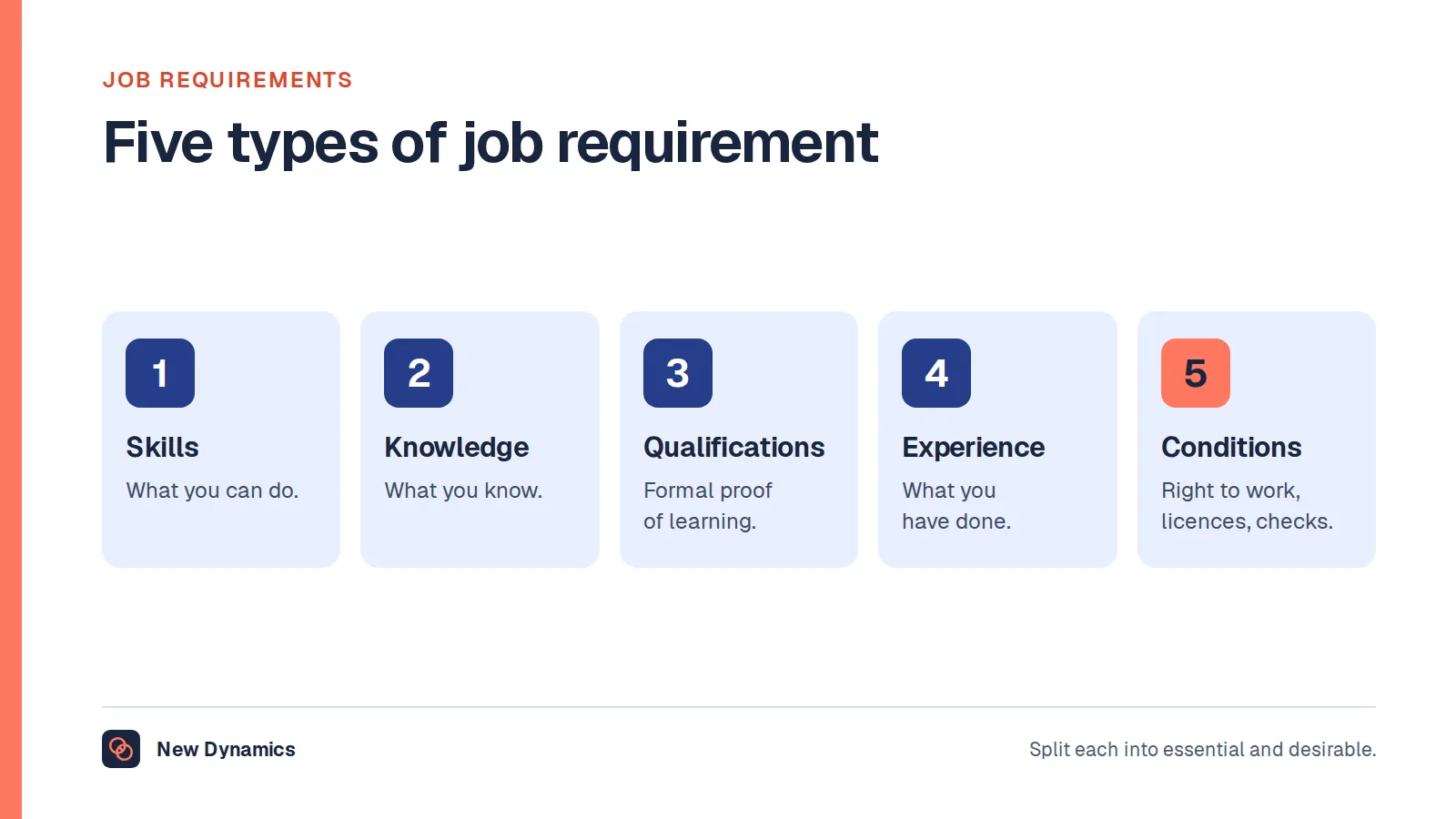
- Knowledge and experience: what is needed to do the work, expressed as capability rather than as a qualification wherever possible.
- Impact: who and what is affected when the work is done well or badly.
- Benchmark jobs: two or three real roles that sit squarely in the grade.
Avoid defining grades by the number of reports, by qualification alone or by salary. Each of those defines the grade by something other than the work.
Pitfalls
- Classifying the person, not the job. The most common failure. A strong post-holder is a reason for a good rating or pay progression, not a higher grade.
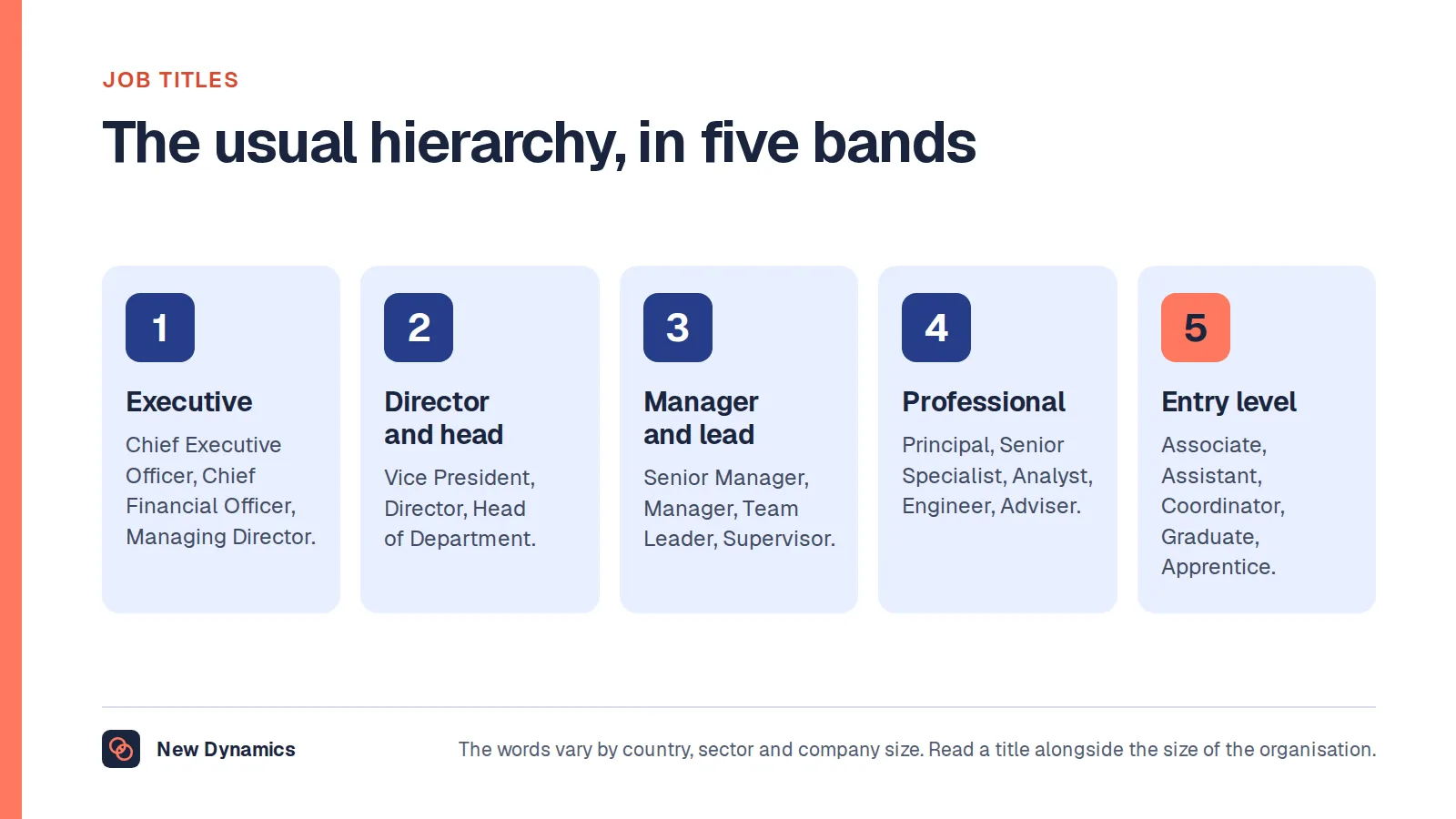
- Title inflation. Titles drift upwards to solve recruitment or retention problems, and the structure stops meaning anything. Our post on job titles covers the discipline.
- Grade drift. Every regrade is upward, nothing ever moves down, and the paybill rises without the work changing. Requires moderation and an owner.
- Unwritten reasoning. If the record says only "grade 6", the decision cannot be explained or defended later.
- A structure nobody can read. If managers cannot use the grade definitions without ringing HR, the scheme has failed however rigorous the scoring was.
- Never reviewing. Jobs change. A structure reviewed once a decade describes an organisation that no longer exists.
Frequently asked questions
What is job classification?
The process of grouping jobs into grades or classes according to the demands of the work, so that jobs of broadly equivalent demand are paid and managed consistently. In formal public-sector systems it goes further: the US Office of Personnel Management describes classification standards that define occupations, establish official titles and describe the levels of work, determining a position's series, title, grade and pay system.
What is the difference between job classification and job evaluation?
Job evaluation assesses how demanding one job is compared with others in the same organisation. Job classification places the result into a defined grade. Evaluation produces a ranking or a score; classification produces a grade with a definition behind it. In practice the two are run together, and "classification" is also the name of one specific evaluation method, in which jobs are matched against written grade definitions.
What are the methods of job classification?
Four are common: ranking, which orders jobs by overall demand; classification or grading, which matches jobs to written grade definitions; point-factor, which scores jobs against weighted factors and groups the totals into grades; and market pricing, which sets the hierarchy from external salary data. Most organisations combine an internal method with a market check.
Why does job classification matter for equal pay?
Because equal pay law recognises "work rated as equivalent", which Acas describes as work found to be equivalent, usually through a job evaluation process. A sound, recorded classification scheme is how an employer shows why two jobs sit at the same or different levels, and Acas notes that jobs that look different, such as a clerical job and a warehouse job, can be equal work.
How often should a grade structure be reviewed?
When a job changes materially, and on a fixed cycle besides, typically annually for spot checks and every few years for the structure itself. Build in an appeal route so that individual placements can be questioned without waiting for the review.
Your next step: make one grade explainable
- Pick two adjacent grades and read their definitions side by side. If you cannot see the difference, rewrite them.
- Check that the reason for each benchmark job's placement is written down.
- Look at where traditionally female-dominated and male-dominated roles sit, and test the logic that put them there.
- Publish the structure and the appeal route, and set the review date.
For the practice of separating the value of a role from the contribution of the person in it, read and download our job evaluation guide. The guide is free to read, and the PDF uses our short download form.
Want roles, levels and reporting lines visible in one place, so a grade structure is something people can see rather than guess at? Book a New Dynamics demo and bring your current grade definitions. You can also email contact@new-dynamics.com.