TL;DR
- Job requirements are the skills, knowledge, qualifications, experience and other conditions that a person needs in order to do a particular job. They usually appear in a job specification, also called a person specification.
- Good adverts separate the essential from the desirable. Candidates should apply when they meet the essentials. Employers should be able to justify every line.
- Requirements that are not truly needed shrink the pool and can discriminate. Acas says that employers must be able to prove a good reason for any job requirement in an advert.
“What are the requirements?” is the first question a candidate asks about a vacancy, and the one that employers answer worst. Adverts often list degrees that the job does not need, years of experience picked out of the air and a dozen “must haves” that the person eventually hired does not have.
This article explains what job requirements are, the five types, the difference between essential and desirable, how to read requirements as a candidate, and how to write them as an employer so that they are clear, fair and lawful.
Requirements describe what someone needs on day one. Goals describe what they will achieve afterwards. See how New Dynamics Goals & OKRs turn a role into clear objectives once the person has started.
What are job requirements?
Job requirements are the things that a person needs in order to do a particular job: skills, knowledge, qualifications, experience and any other conditions, such as the right to work in the country.
The open textbook Introduction to Business, published by OpenStax, explains where they come from in its section on human resources management. The starting point is a job analysis, “a study of the tasks required to do a job well”, which is used “to specify the essential skills, knowledge, and abilities required for the job”. Two documents follow.
- The job description. “The tasks and responsibilities of a job are listed in a job description.”
- The job specification. “The skills, knowledge, and abilities a person must have to fill a job are spelled out in a job specification.”
In the UK the second document is usually called a person specification. Job requirements are its contents. The job description says what the work is. The requirements say what a person needs to bring.
The five types of job requirement
| Type | What it covers | Examples |
|---|---|---|
| Skills | What the person can do | Writing clearly, using a spreadsheet, negotiating, welding |
| Knowledge | What the person knows | Employment law, a programming language, food hygiene rules |
| Qualifications | Formal proof of learning | A degree, a trade certificate, professional registration |
| Experience | What the person has done before | Managed a team, worked in a call centre, run a project |
| Other conditions | Things the role or the law demands | Right to work, a driving licence, background checks, shift availability |
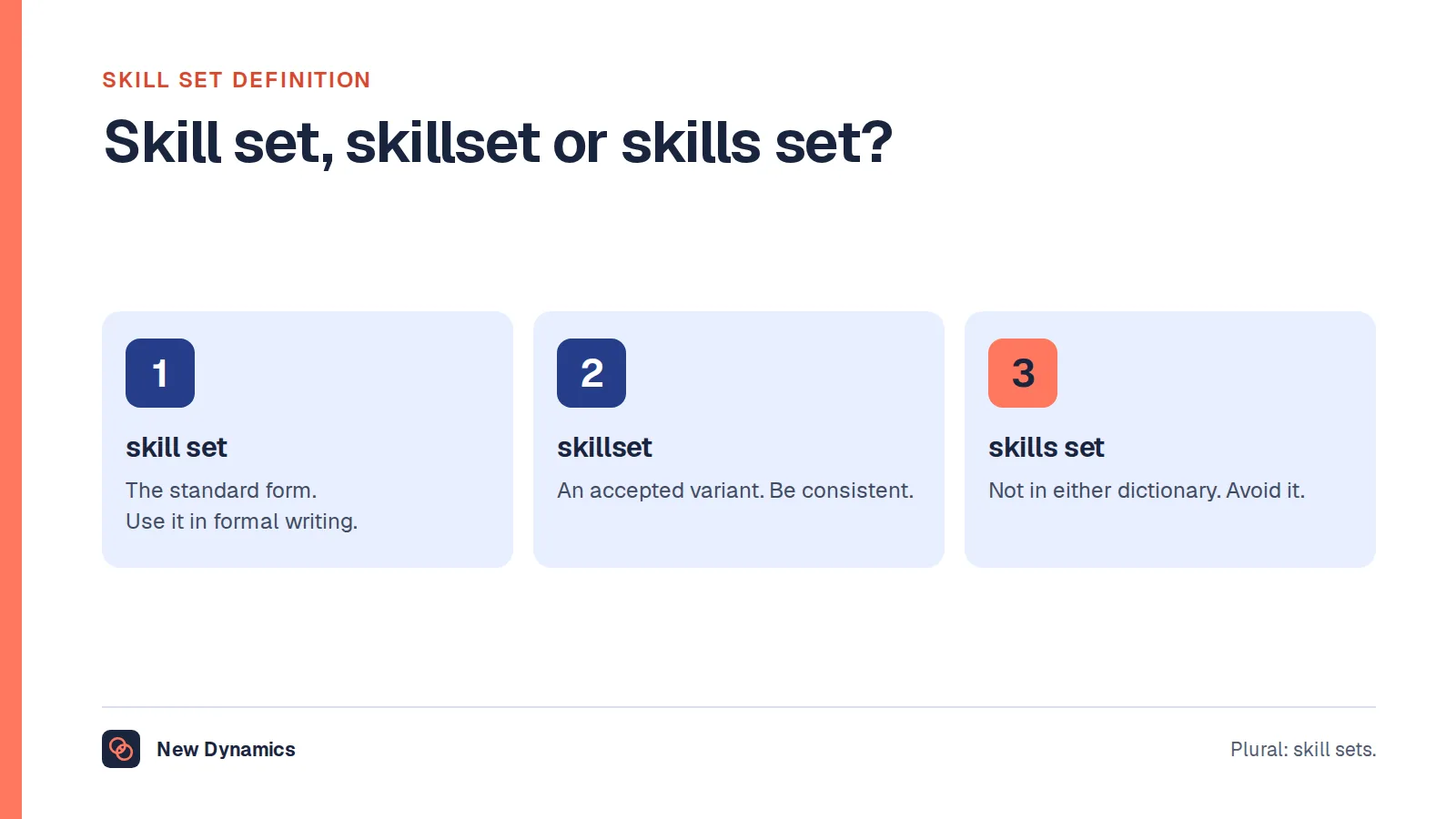
Behaviours, such as reliability and teamwork, are usually treated as skills. Our guide to the definition of skill set explains how hard and soft skills fit together.

Essential and desirable
Most well-written specifications split requirements into two lists.
- Essential: the job cannot be done without it, from the first day or after reasonable training.
- Desirable: helpful, and likely to separate strong candidates, but something that could be learned in the role.
The test for “essential” is strict. Ask: if an otherwise excellent candidate lacked this, would we really turn them down? If the honest answer is no, the requirement is desirable.
Job requirements examples
These are illustrations for an imaginary customer support adviser role.
| Essential | Desirable | |
|---|---|---|
| Skills | Clear written English. Calm on the phone with upset customers | Experience of a ticketing system |
| Knowledge | None needed before starting. Product training is given | Knowledge of consumer rights |
| Qualifications | None | A customer service qualification |
| Experience | Some experience of dealing with the public, paid or unpaid | A year in a contact centre |
| Other | Right to work in the UK. Able to work one Saturday in four | A second language |
Notice what is missing: a degree, “three to five years' experience” and “excellent communication skills” with no definition.
How to read job requirements as a candidate
- Separate the essential from the desirable. If the advert does not, do it yourself. Conditions such as right to work, licences and registrations are fixed. Most other lines are softer than they look.
- Match with evidence. For each essential requirement, note one example that shows you meet it. Paid work, study, volunteering and caring all count.
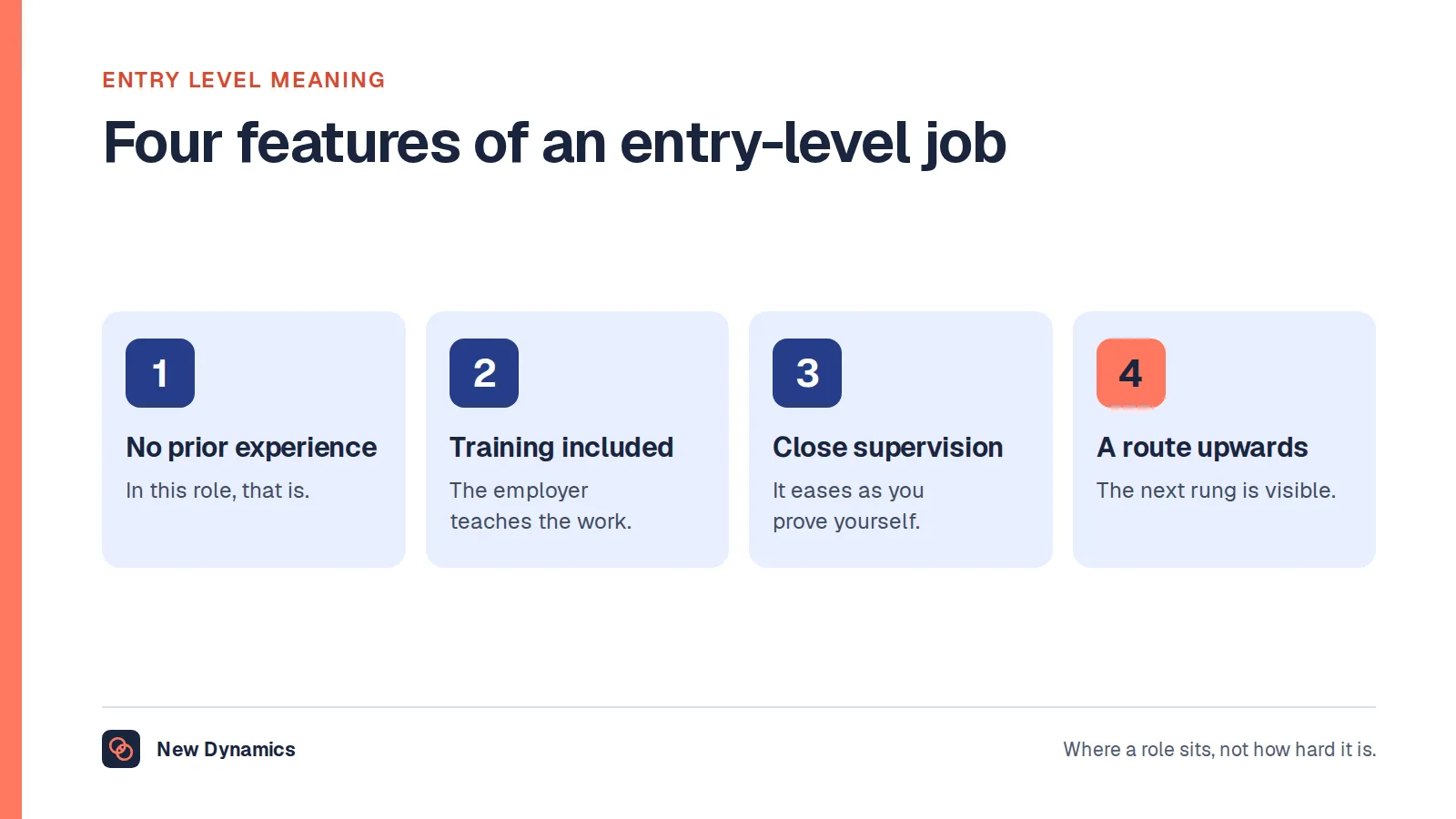
- Apply when you meet the essentials. Treat the desirable list as a bonus. Our guide to the meaning of entry level covers adverts that ask first-job candidates for experience.
- Ask when it is unclear. “Is the degree essential, or would equivalent experience be considered?” is a fair question to put to a recruiter.
- Read the requirements as information. An advert with twenty essentials and no salary tells you something about the employer.
How to write job requirements: six steps
- Start from the work. List the main tasks and the results expected. This is the job analysis, and everything else follows from it.
- Name what each task needs. For every task, write the skill or knowledge that it demands. If a requirement does not trace back to a task, remove it.
- Split essential from desirable. Apply the strict test above. Aim for no more than six to eight essentials.
- Describe, do not label. Replace “excellent communicator” with “can explain a technical fault to a customer in plain language”. A requirement that can be observed can be assessed.
- Check for discrimination. Question every requirement about age, years of experience, qualifications, physical ability, hours and location. See the next section.
- Use the same requirements all the way through. The advert, the shortlisting grid, the interview questions and the scoring should all use the same list. Our manager interview questions show how to turn a requirement into a question.

Requirements and discrimination law
A requirement that is not genuinely needed can exclude people unlawfully, even when nobody intends it. Two official sources make the point. This is general information, not legal advice.
Great Britain. Acas's guidance on advertising a job says that words such as “recent graduate” or “highly experienced” can discriminate against age, and that “you must be able to prove you have a good reason for any job requirement in your advert”. It gives further examples:
- gendered titles such as “handyman”. Acas advises using “inclusive language that defines the job not the applicant”;
- specifying a nationality when the real need is a language. “German-speaking sales rep” is more appropriate than “German sales rep”;
- requiring a handwritten application “when handwriting is not crucial to the job”, which might disadvantage people with dyslexia or arthritis.
Acas also recommends giving applicants the job description and the person specification, because these “help make clear what the job requires and reduce the risk of discrimination”.
United States. The Equal Employment Opportunity Commission's page on prohibited employment policies and practices says that it is illegal to publish a job advertisement “that shows a preference for or discourages someone from applying for a job” because of a protected characteristic. Its example is an advert seeking “recent college graduates”, which “may discourage men and people over 40 from applying and may violate the law”.
The practical rule is the same in both places. For every requirement, be ready to answer the question: why does the job need this?

Common mistakes
Copying the last advert. Jobs change. Requirements written five years ago describe a different role.
Degree by default. Ask whether the job needs the degree, or the skills that you hope a degree signals. If it is the skills, name them.
Years as a proxy. “Five years' experience” measures time, not ability. Describe what the person should be able to do.
The impossible list. Fifteen essentials describe nobody. Strong candidates who take the list literally may not apply.
Requirements you will waive. If you would hire a great candidate without it, it was never essential.
Forgetting adjustments. A physical or scheduling requirement may need to flex for a disabled candidate. Decide what the job truly needs, as opposed to how it has always been done.
Frequently asked questions
What are job requirements?
Job requirements are the skills, knowledge, qualifications, experience and other conditions that a person needs in order to do a particular job. They are usually listed in a job specification, which is also called a person specification.
What is the difference between a job description and job requirements?
A job description lists the tasks and responsibilities of the job. Job requirements, set out in the job or person specification, list what a person must have in order to do those tasks, such as skills, knowledge and qualifications.
What is the difference between essential and desirable requirements?
An essential requirement is one that the job cannot be done without. A desirable requirement is helpful but could be learned in the role. Employers shortlist on the essentials, and use the desirables to separate strong candidates.
Should I apply if I do not meet all the requirements?
Usually yes, if you meet the essential ones. Fixed conditions such as right to work, licences and professional registration are non-negotiable, but many other lines are preferences. Show evidence for each essential requirement.
What are examples of job requirements?
Examples include clear written English, experience of dealing with the public, a forklift licence, knowledge of food hygiene rules, professional registration as a nurse, the right to work in the country and availability for weekend shifts.
Can a job requirement be discriminatory?
Yes. A requirement that is not genuinely needed can disadvantage people because of age, sex, disability or another protected characteristic. Acas says that employers must be able to prove a good reason for any job requirement in an advert.
Your next step: justify every line
- Take one current or recent advert.
- For each requirement, write the task that it serves. Delete any that you cannot link to a task.
- Move everything that you would waive for a great candidate into the desirable list.
- Rewrite two labels, such as “strong communicator”, as something that you could observe.
For a full, fair hiring process, read and download our recruitment and selection guide. The guide is free to read, and the PDF uses our short download form.
Want the requirements of a role to become clear goals once someone starts? Book a New Dynamics demo and bring a job description. You can also email contact@new-dynamics.com.