TL;DR
- A job specification, or person specification, is the second half of a vacancy: the criteria a person must meet to do the job. It exists to make selection consistent. Acas's method is to “select the applicants who best match the job description and person specification”, turning “each point in the job description and person specification into a checklist”, then assessing and scoring each application against it.
- Split each criterion into essential or desirable, and be honest about which. O*NET separates the three things people actually need in order to do work, “how much education people need to do the work, how much related experience people need to do the work, and how much on-the-job training people need to do the work”, and keeping them apart stops a specification asking for a degree when it means a skill.
- Criteria that are not genuinely needed are where the legal risk lives. GOV.UK warns that “you can discriminate against someone even if you do not intend to. For example, you can discriminate indirectly by offering working conditions or rules that disadvantage one group of people more than another.” Every criterion should be defensible as something the job actually requires.
Most shortlisting arguments are not really about the candidates. They are about criteria nobody wrote down, so two people are quietly using different ones.
A job specification fixes that. It is the person half of a vacancy: what someone must know, be able to do and have done in order to do the job, split into essential and desirable, with a note of how each will be assessed. This article sets out how to write one, how to keep criteria defensible, and how to score them. It is general information about hiring, not legal advice.
The criteria you hire against should be the criteria you later review against, or the first appraisal becomes a different conversation from the interview. See how New Dynamics performance reviews let you run the review cycle on your own form, with completion visible instead of chased.
Job specification or job description?
They are two documents and they answer different questions.
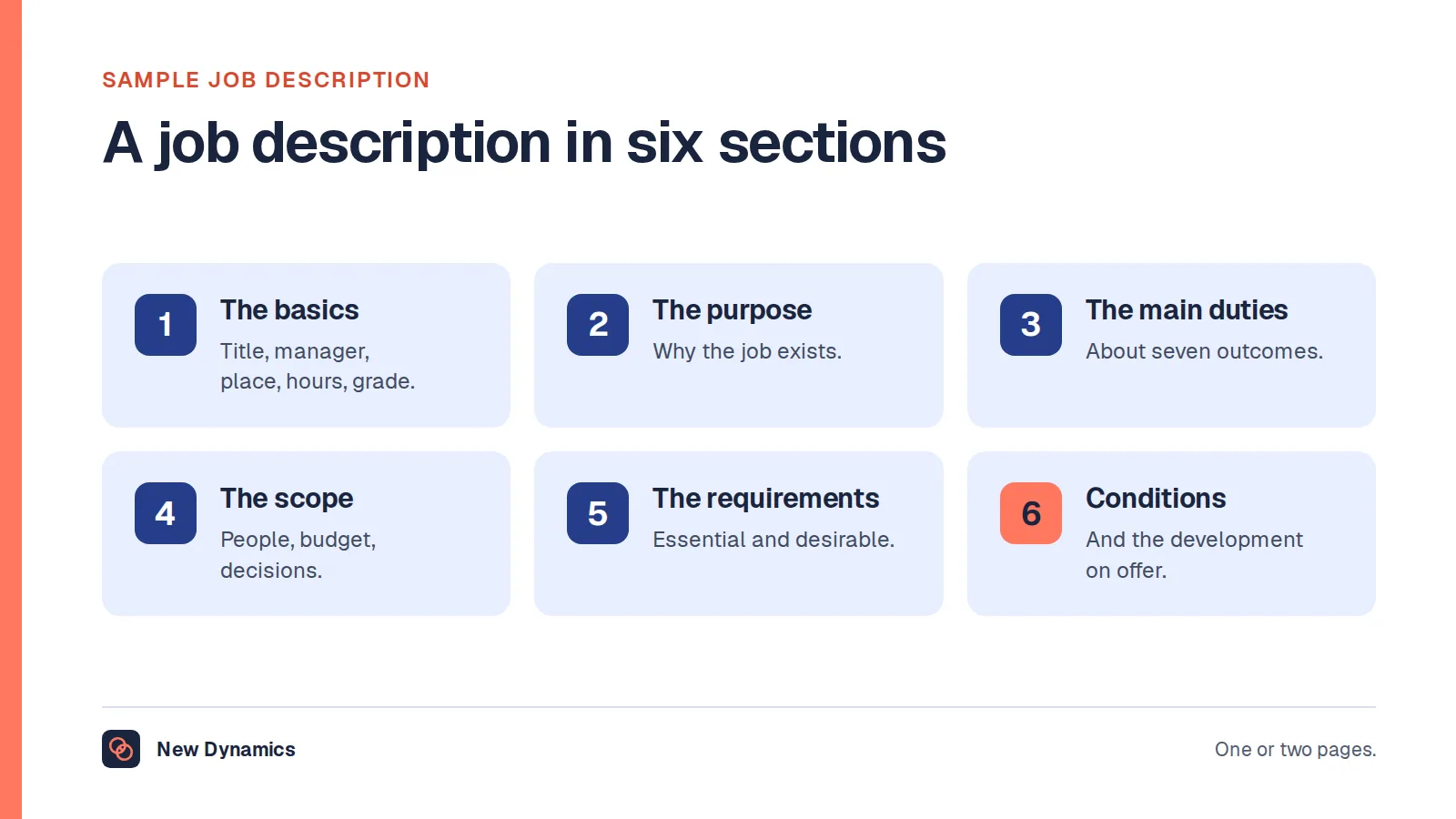
- The job description says what the job is: purpose, duties, scope, reporting line and conditions. Our job description template sets out the six sections and a blank to copy. Acas publishes an outline job description template covering "the main headings to use", "the role's main duties" and "who the employee will report to".
- The job specification, often called the person specification, says what the person needs in order to do it.
"Job specification" is also sometimes used loosely to mean the whole pack. If a colleague asks for a job spec, check which they mean before you write the wrong document.
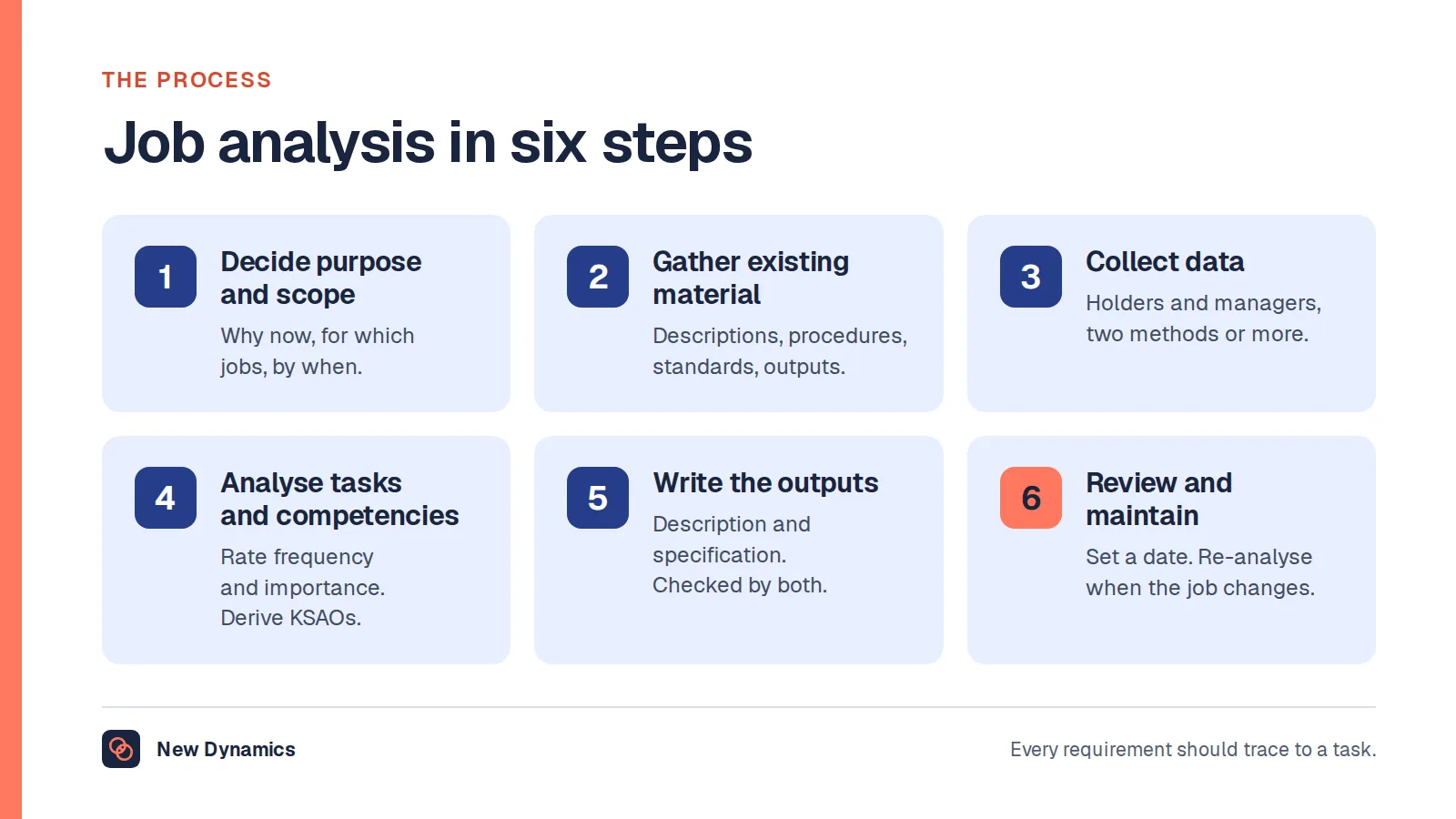
Both come out of the same evidence. Our post on job analysis covers how to gather it rather than guessing.
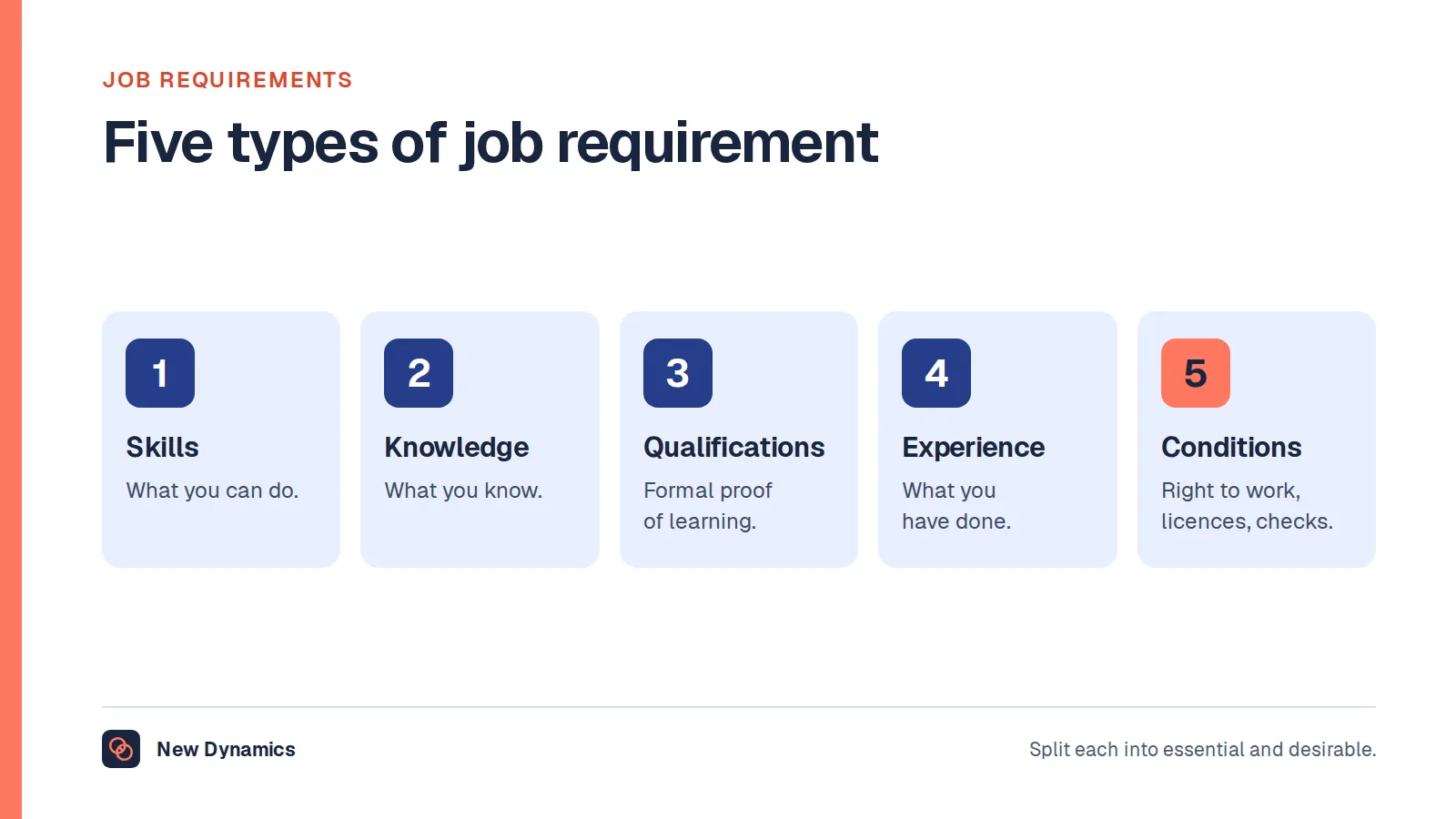
The five headings

- Knowledge. What the person must already understand: a regulatory framework, a product area, a body of technical knowledge, the rules of a trade.
- Skills and abilities. What they must be able to do: operate something, write something, analyse something, handle a difficult conversation.
- Experience. What they must have done before, expressed as the achievement rather than the years.
- Qualifications and training. Certificates, licences, registrations and mandatory training, separated from knowledge, because the two are not the same thing.
- Requirements of the role. The practical conditions: a driving licence where driving is genuinely part of the job, the shift pattern, travel, a DBS check where the role is eligible for one.
Keeping qualifications apart from knowledge matters. O*NET's explanation of Job Zones separates the three things an occupation actually demands, "how much education people need to do the work, how much related experience people need to do the work, and how much on-the-job training people need to do the work", with zones running from "very little to some preparation" up to "extensive preparation". A specification that collapses those three into "degree required" has usually stopped describing the job.
Essential or desirable: the test

Three questions decide it.
- Could someone do the job on day one without it? If yes, it is not essential.
- Can it be learned quickly in the role? If yes, it is desirable, or it is training you should offer.
- Would you actually reject an otherwise excellent applicant for lacking it? If not, it is not essential. Say so, or delete it.
The point is not tidiness. Essential criteria exclude people, so each one has to be worth what it excludes.
Write criteria that can be assessed
A criterion you cannot assess is a preference, and preferences are where bias lives.
- Weak: "Excellent communication skills." Better: "Can explain a technical decision to a non-technical colleague in writing." Assessed by: a written exercise.
- Weak: "Team player." Better: "Has worked as part of a shift team and can give an example of resolving a disagreement at work." Assessed by: interview question.
- Weak: "5 years' experience." Better: "Has run a monthly close end to end, unsupervised." Assessed by: application form and interview.
- Weak: "Attention to detail." Better: "Can check a document against a specification and find the discrepancies." Assessed by: a short exercise.
Write the assessment method next to each criterion while you draft it. If you cannot name one, you have found a criterion to cut.
Map each criterion to a method
Three or four methods cover almost everything: the application form, a work-sample exercise, the interview, and checks such as references, qualifications or a licence.
Each criterion should have at least one. Two things follow. You stop assessing the same thing three times. And you notice the criterion nobody is actually testing, which is usually the one people argue about at shortlisting.
Acas's advice is to use "the information you've told applicants you will use to make any decisions", application forms and CVs, for example. It also warns against using personal social media to decide whether to interview or hire someone, noting you might be breaking the law "particularly if" either "they did not agree to you using the information in this way" or "you looked at some applicants' social media profiles, but not others". Information someone puts on a jobs site or a business networking site can usually be used, as long as it is used in a way that does not discriminate.
The criteria that quietly discriminate
This is the part a specification gets wrong without anyone intending it.
GOV.UK's guidance for employers on preventing discrimination states that it is against the law "to treat someone less favourably than someone else because of a personal characteristic such as religion, sex, gender reassignment or age", that discrimination can include not hiring someone, and (the part that catches specifications) that "you can discriminate against someone even if you do not intend to. For example, you can discriminate indirectly by offering working conditions or rules that disadvantage one group of people more than another."
Criteria worth a second look:
- Years of experience as a proxy for competence. It filters by age and by career break, and it rarely predicts what the numbers suggest.
- A degree where the job needs the skill, not the certificate.
- "Continuous employment history", which excludes carers, people who have been ill, and people who have been out of the labour market.
- A driving licence where the job needs someone to get to sites, not to drive.
- Physical requirements stated as tasks rather than as capabilities, without considering reasonable adjustments.
- "Cultural fit", which is not a criterion at all. If you mean specific behaviours, write those.
For each criterion, be able to finish the sentence: "this is needed because the job involves…". If you cannot, it is a preference.
On using protected characteristics deliberately, Acas is clear about the limits: any action "must not cause 'detriment' to another protected group", where detriment "means someone is treated worse than someone else". Positive action during recruitment "only applies when 2 candidates are otherwise of equal merit and you need a tiebreaker", and "should only be used as a last resort". Acas's practical suggestion is to reduce tiebreakers in the first place: "if scoring candidates out of 10 points causes tiebreakers, you could increase it to 20".
Scoring and shortlisting

Acas sets out the method plainly. Select the applicants "who best match the job description and person specification", doing it "in a fair way for each person", by:
- turning "each point in the job description and person specification into a checklist";
- assessing the information in each application form against the checklist;
- scoring each application form against the checklist.
Two further points from the same guidance. Ideally two or more people should be involved in choosing who to interview, because this "reduces the risk of personal biases or unintended discrimination". And the staff involved should "use a consistent decision-making process, such as a scoring system".
A workable scale: 0 for no evidence, 1 for partial, 2 for meets, 3 for exceeds. Score essentials first; anyone scoring 0 on an essential is out, and that decision is explainable. Use desirables to rank the rest.
Our recruitment and selection guide sets out how to build the scoring sheet so it is quick enough to use and still defensible afterwards.
A blank job specification template
Job title: … Reports to: … Reference: …
Criterion Essential or desirable Assessed by Knowledge … Skills and abilities … Experience … Qualifications and training … Requirements of the role …
A worked example: warehouse team leader
| Criterion | Essential or desirable | Assessed by |
|---|---|---|
| Understands stock control and goods-in processes | Essential | Application, interview |
| Can plan a shift's work across a team and reallocate when someone is absent | Essential | Interview scenario |
| Can give clear instructions and check they have been understood | Essential | Interview |
| Has supervised or coordinated others at work | Essential | Application, references |
| Has used a warehouse management system | Desirable | Application |
| Counterbalance forklift licence | Desirable, training offered | Certificate check |
| Able to work the shift pattern set out in the advert | Requirement | Interview, offer |
Seven criteria, each assessable, each defensible. The forklift licence is desirable and funded rather than essential, which widens the field without lowering the standard.
Common mistakes
- Writing it after the advert. The advert should come from the specification, not the other way round.
- Twelve essential criteria. Anything over about eight means several are not really essential.
- Criteria that repeat the duties. The description already lists the duties; the specification says what the person needs in order to do them.
- No assessment method. The criterion will be judged on impression.
- Never revisiting it. If the shortlist is empty or enormous, the specification is wrong, not the labour market.
Frequently asked questions
What is a job specification?
A statement of what a person needs in order to do a job: the knowledge, skills and abilities, experience, qualifications and training, and practical requirements of the role, each marked essential or desirable and each with a method of assessment. It is often called a person specification, and it is the companion to the job description.
What is the difference between a job description and a job specification?
The job description describes the job: its purpose, duties, scope, reporting line and conditions. The job specification describes the person who can do it. Acas's shortlisting method uses both, turning each point in the job description and person specification into a checklist and scoring applications against it.
How do you write a job specification?
Start from evidence about the job rather than the last advert. Write criteria under five headings, knowledge, skills and abilities, experience, qualifications and training, and requirements of the role. Mark each essential or desirable using the day-one test. Write next to each one how it will be assessed. Then check that every criterion is genuinely needed for the work.
What is the difference between essential and desirable criteria?
Essential criteria are those a person must have to do the job from the start; desirable criteria are those that would help but can be learned or trained. The test is whether you would genuinely reject an otherwise excellent applicant for lacking it. Essential criteria exclude people, so each one should be worth what it excludes.
How many criteria should a job specification have?
Few enough that each can be assessed properly, usually around six to eight essential criteria, plus a short list of desirables. A long list of essentials usually means some are preferences, and it makes scoring slow and inconsistent.
Can a job specification be discriminatory?
Yes, including unintentionally. GOV.UK warns that you can discriminate even without intending to, for example indirectly, by applying rules that disadvantage one group more than another. Criteria such as a fixed number of years of experience, a degree where a skill is what is needed, or an unbroken employment history deserve particular scrutiny. This is general information, not legal advice.
Your next step: rewrite one specification
- Take the last vacancy you filled and list the criteria that actually decided it.
- Compare them with the specification you advertised. Most of the time they differ.
- Rewrite it under the five headings, marking each criterion essential or desirable, with the assessment method beside it.
- Delete every criterion you cannot finish the sentence "this is needed because the job involves…" for.
For turning that into a scoring sheet a busy hiring manager will actually use, read and download our recruitment and selection guide. The guide is free to read, and the PDF uses our short download form.
Want the criteria you hire on to become the criteria you review on, on your own form? Book a New Dynamics demo and bring a recent job specification. You can also email contact@new-dynamics.com.