TL;DR
- Job analysis is a detailed examination of the tasks involved in a job and the knowledge, skills and experience needed to do it. It produces two outputs: a description of the work and a specification of the person.
- The US Office of Personnel Management calls job analysis the foundation for all assessment and selection decisions, because it establishes the competencies a job requires, shows that they are job-related and provides legal defensibility for how people are selected.
- Five methods gather the data: observation, interviews, questionnaires, work diaries and reviewing existing material. A six-step process turns the data into a job description, a person specification and, from there, fair hiring, grading, training and appraisal.
Most job descriptions are written by someone who has never done the job, in an afternoon, from the last advert. Most competency frameworks are borrowed. Most grading disputes come down to nobody having agreed what the job actually involves. Job analysis is the discipline that fixes all three, and it is older, simpler and more useful than its reputation suggests.
This article gives the definition of job analysis, explains what it produces and why regulators care about it, describes five methods of gathering the data, sets out a six-step process and names the mistakes that turn it into a paper exercise.
A job analysed properly gives a manager a clear picture of what good looks like, which is the starting point for every fair review. See how New Dynamics performance reviews bring goals, feedback and development into one fair discussion.
What is job analysis?
The Cambridge Dictionary defines job analysis, in its HR sense, as “a detailed examination of the tasks involved in a particular job and the skills, knowledge, and experience needed to do it”.
The US Office of Personnel Management, which sets hiring policy for the federal government, describes the purpose on its job analysis page: “Job analysis is the foundation for all assessment and selection decisions. To identify the best person for the job, it is crucial to fully understand the nature of that job.” It explains that job analysis develops that understanding “by examining the tasks performed in a job, the competencies required to perform those tasks, and the connection between the tasks and competencies.”
Two ideas sit inside that definition.
- The work. What is done, how often, with what tools, to what standard, under what conditions and with what authority.
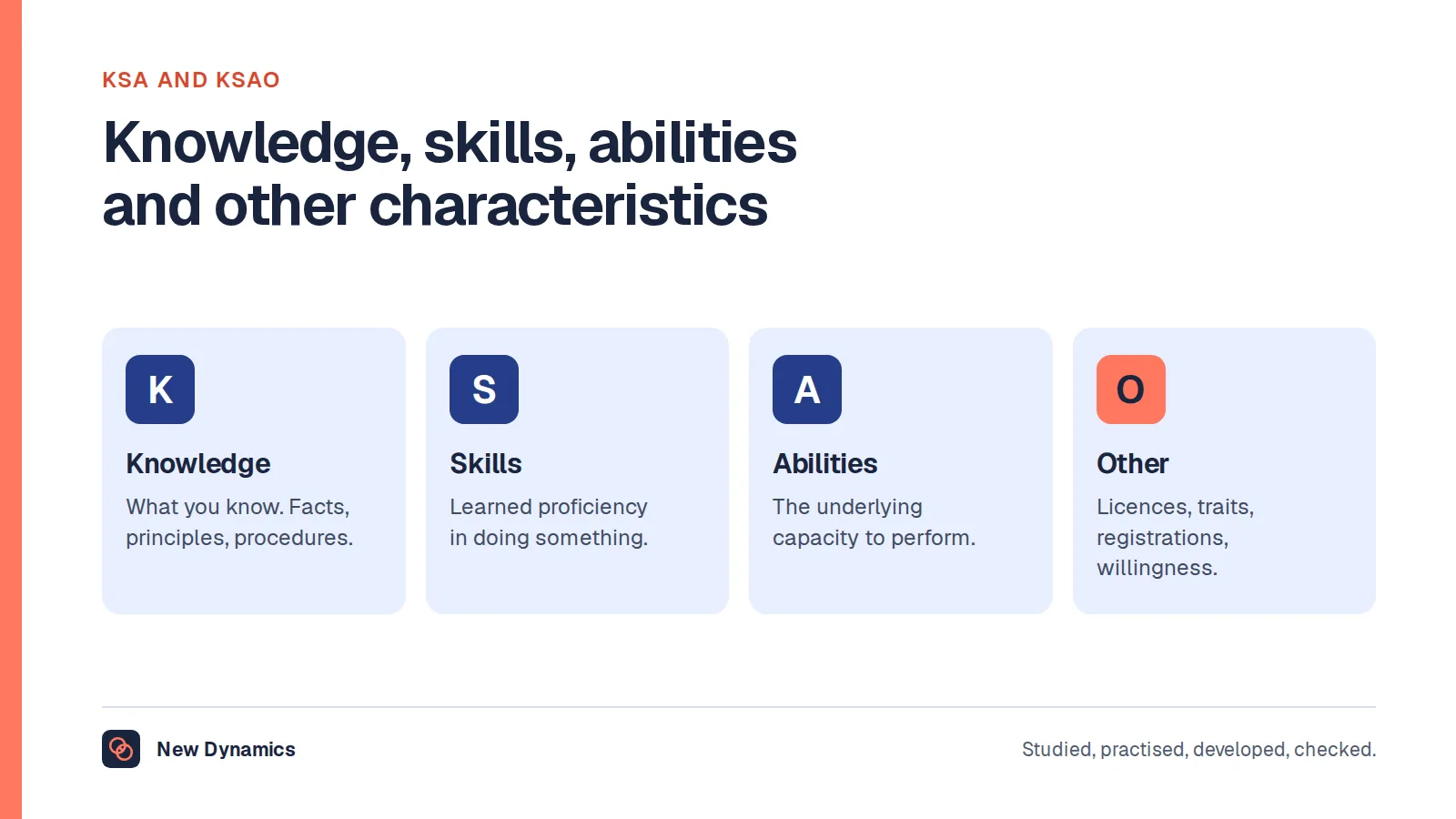
- The person. What knowledge, skills, abilities and other characteristics someone needs to do that work. Our guide to the meaning of KSA explains those categories.
Job analysis is about the job, not the job holder. A good analysis of a role produces the same answer whoever is sitting in it.
What job analysis produces, and why it matters
OPM lists three uses of job analysis data: to “establish and document competencies required for a job”, to “identify the job-relatedness of the tasks and competencies needed to successfully perform the job”, and to “provide a source of legal defensibility of assessment and selection procedures”. It adds that the information can also be used to determine job requirements, training needs, position classification and grade levels, and to inform promotions and performance appraisals.
In practice the analysis produces two documents and feeds six processes.
- The job description. Purpose, duties, responsibilities, reporting lines and conditions. Our job description template shows the form.
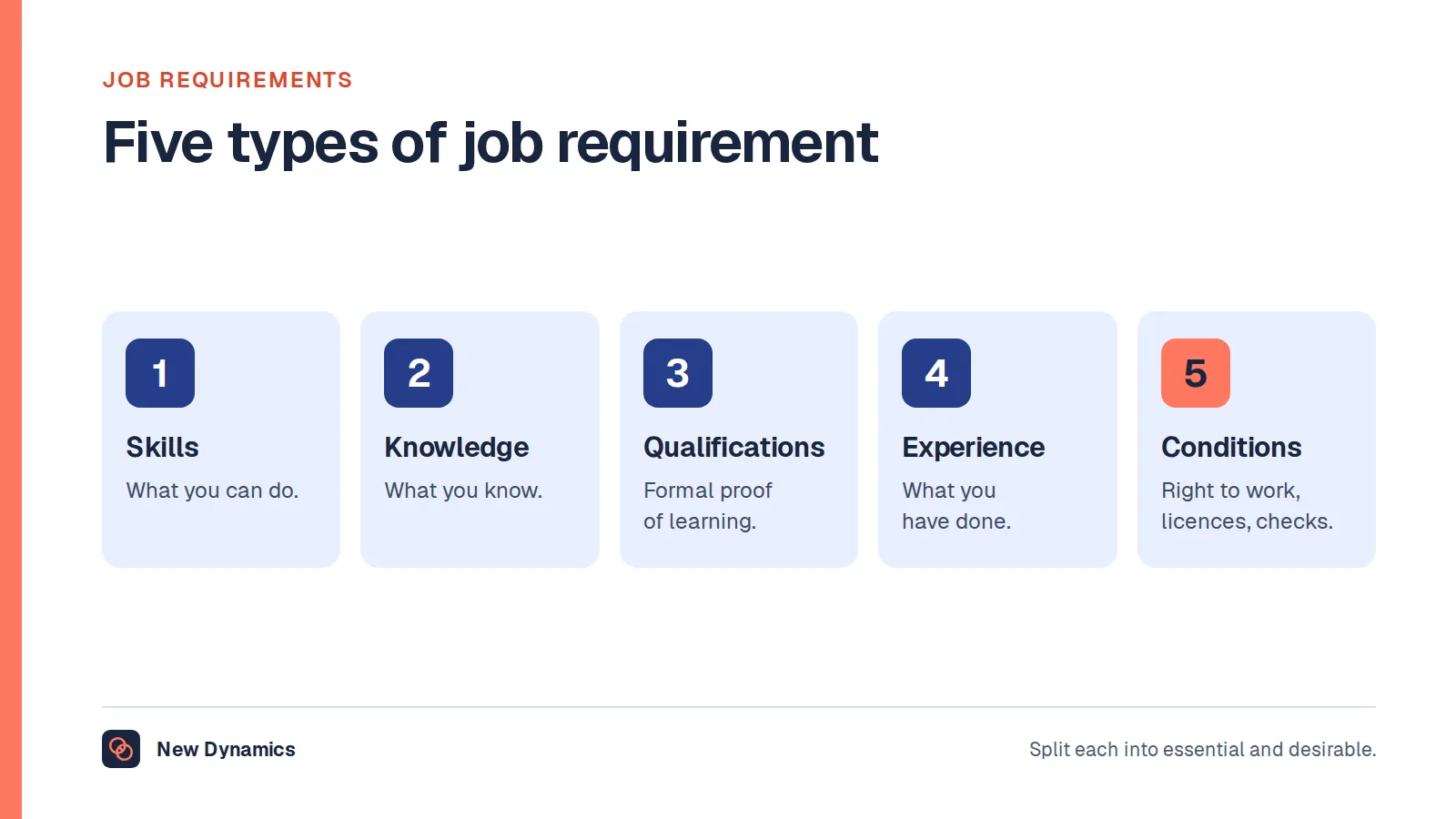
- The person specification. The knowledge, skills, abilities and other characteristics required, divided into essential and desirable. Our guide to job requirements explains how to write them.
And from those two:
- Recruitment and selection. Adverts, shortlisting criteria, interview questions and tests that are demonstrably about the job. Requirements that trace back to the analysis are far easier to defend if challenged as discriminatory.
- Job evaluation and pay. Grading a role fairly against others depends on an agreed account of what it involves. Our job evaluation guide covers the method.
- Training and development. The gap between what the job needs and what the holder has is the training plan.
- Performance appraisal. Objectives and ratings rest on the duties the analysis recorded.
- Job design and workforce planning. Analysis shows where work is duplicated, overloaded or missing.
- Health, safety and adjustments. Physical demands and conditions recorded in the analysis inform risk assessments and reasonable adjustments.

Five job analysis methods
- Observation. Watch the job being done, over enough time to see the whole cycle. Best for physical, routine and visible work; weak for thinking work.
- Interviews. Structured conversations with job holders and their managers, separately, about what they do, how often and what makes it hard. Best for understanding judgement and priorities; needs more than one voice to avoid one person's version.
- Questionnaires. Structured forms, sometimes standardised inventories, completed by many job holders. Best for large populations and comparisons across jobs; weak on nuance.
- Work diaries and logs. Job holders record what they do over days or weeks. Best for jobs whose content varies; depends on diligent recording.
- Reviewing existing material. Previous descriptions, competency frameworks, procedures, outputs, systems data and, where they exist, occupational standards such as those Skills England publishes for apprenticeships. Fast and cheap, and never enough on its own.
Most good analyses combine at least two methods, and always include the job holder and the manager, because they usually disagree about what the job is.

Job analysis in six steps
- Decide the purpose and scope. Why now: a vacancy, a grading review, a restructure, a training plan? What will be produced, for which jobs, by when? The purpose decides the depth.
- Gather existing material. Current descriptions, org charts, procedures, targets, any relevant standard or framework, and the outputs the job produces.
- Collect data from job holders and managers. Choose methods from the five above. Ask about tasks, frequency, importance, difficulty, tools, decisions, contacts, conditions and what distinguishes good from adequate performance.
- Analyse tasks and competencies. List the tasks, rate each for frequency and importance, and derive the knowledge, skills, abilities and other characteristics each requires. OPM's guidance stresses the connection between the tasks and the competencies: every requirement should trace to a task.
- Write the outputs. The job description and the person specification, in plain language, with essential and desirable requirements separated. Have the job holder and the manager check them.
- Review and maintain. Jobs change. Set a review date, and re-analyse when the vacancy, the technology or the structure changes.

Job analysis, job description and job evaluation
| Term | What it is | Question it answers |
|---|---|---|
| Job analysis | The examination of what a job involves and needs | What does this job consist of? |
| Job description | The written account of the job that analysis produces | What will the person do? |
| Person specification | The written account of the person required | Who can do it? |
| Job evaluation | The systematic comparison of jobs to decide relative worth and grade | How big is this job compared with others? |
Analysis comes first. Evaluation without analysis grades a title, not a job.
Common mistakes
Describing the person, not the job. An analysis that records what the current holder happens to do, including the tasks they invented, produces a job nobody else can fill.
One source. The manager's view alone, or the holder's alone, is half the picture.
Copying the last description. If nothing changes between analyses, either the job is unusually stable or nobody looked.
Recording tasks without judging them. A list of forty tasks with no frequency or importance rating cannot produce a person specification.
Requirements with no task behind them. A degree, a number of years or a personality trait that traces to nothing in the analysis is a preference, and possibly a discriminatory one.
Filing it. An analysis that does not change the advert, the interview, the grade or the appraisal was a waste of everyone's afternoon.
Frequently asked questions
What is job analysis?
Job analysis is a detailed examination of the tasks involved in a particular job and the skills, knowledge and experience needed to do it. It produces a job description and a person specification, and it underpins fair recruitment, grading, training and appraisal.
What is the purpose of job analysis?
To understand the job fully before describing, filling, grading or judging it. The US Office of Personnel Management says job analysis establishes the competencies a job requires, shows that they are job-related and provides legal defensibility for selection procedures, and that it also informs training, classification and appraisal.
What are the methods of job analysis?
Observation, interviews with job holders and managers, questionnaires, work diaries or logs, and reviewing existing material such as descriptions, procedures and occupational standards. Good analyses combine at least two methods.
What is the difference between job analysis and job description?
Job analysis is the process of examining a job. The job description is one of its outputs: the written account of the job's purpose, duties and conditions. The other output is the person specification, which describes the person required.
What is the difference between job analysis and job evaluation?
Job analysis establishes what a job involves. Job evaluation compares jobs systematically to decide their relative worth and grade. Evaluation depends on analysis: you cannot compare jobs fairly until you have agreed what each one is.
Who should carry out a job analysis?
Usually HR or a trained analyst, with the job holder and the line manager as the main sources and reviewers. Both must be involved, separately, because they often describe the same job differently.
Your next step
Pick one job that is about to be advertised or regraded. Before anyone writes the advert, spend an hour with the holder and an hour with the manager, list the tasks, rate them and derive the requirements. Then compare the result with the current description.
For the method that turns the analysis into a fair grade, read and download our job evaluation guide. The guide is free to read, and the PDF uses our short download form.
Want the duties you analysed to be the ones reviews measure? Book a New Dynamics demo and bring your current approach. You can also email contact@new-dynamics.com.