TL;DR
- A harmless prank is reversible in five minutes, costs nobody any money, needs no access to anyone's accounts, and leaves the target laughing rather than explaining. All fifteen ideas below meet that bar and were written by our team.
- Four things turn a prank into something else: harassment, bullying, safety and other people's property. The Equality Act 2010 defines harassment as unwanted conduct related to a protected characteristic that has “the purpose or effect” of violating someone's dignity, purpose is not required.
- Acas notes that behaviour can still be bullying “even if they do not realise it or do not intend to bully someone”, and that a one-off incident counts. “It was only a prank” describes the intent, not the effect, and the effect is what gets assessed.
Every office prank works the same way: somebody is surprised, and somebody else planned it. Whether that is funny or grim depends almost entirely on who was chosen and how easily it can be undone.
This article gives fifteen office prank ideas that are genuinely harmless, four tests to run before you start, the four lines a prank must not cross, and what to do when one lands badly. The law described is Great Britain, and this is general information rather than legal advice.
Teams that laugh together usually also thank each other out loud. See how New Dynamics recognition makes praise for real work visible rather than private.
About these ideas: all fifteen were written by the New Dynamics editorial team for this post. Every one is reversible in under five minutes, none needs anyone's password, and none involves food, vehicles, money or safety equipment.
Four tests before you start

- Reversible in five minutes. If undoing it takes an afternoon, it is not a prank, it is unpaid work you have given someone.
- Costs nobody anything. No damaged property, no wasted materials, no missed deadline, no expenses claim.
- Needs nobody's password, phone or account. If it only works because a laptop was unlocked, pick a different prank.
- The target gets to laugh. Not tolerate it, not be a good sport about it, actually laugh. If you cannot picture that, you have picked the wrong person.
A fifth test is worth adding for anyone in charge: would you be comfortable if the newest starter watched the whole thing and concluded that this is how the team treats each other?
Fifteen harmless office pranks
Desk pranks
- The slow creep. Move their monitor two centimetres to the left each day. Nobody notices on day one. On day nine they are typing at an angle and cannot explain why.
- Laminate something mundane. A single biro, a teaspoon, one sticky note reading "sticky note". Leave it on their desk with no explanation and never mention it.
- Over-packaged stationery. Wrap their stapler in an absurd amount of brown paper, add a printed label from the "Stationery Import Division" and put it in the post tray.
- Drawer swap. Move the pens into the cables drawer and the cables into the pens drawer, then reverse it before you go home.
- One googly eye each. Stick a single googly eye on every object at their desk except the one they touch most, so the mug is watching but the keyboard is not.
Screen and inbox pranks
- Change your own display name to theirs for a morning. No access to their account needed, and the confusion lands on you rather than them.
- Answer their meeting invitation formally. Accept a fifteen-minute catch-up with a two-page PDF acceptance letter, signed, with a reference number.
- A printed progress bar taped across the top of their monitor, stuck at 94%, labelled "Installing updates".
- Set your own out-of-office to answer the question they get asked six times a day, then forward every asker to yourself.
- Add one agenda item to a recurring meeting you own: "5 mins, [name] explains the printer". Remove it before the meeting, or do not, depending on how much they like the printer.
Meeting pranks
- The agreed word. Everyone in the team uses the same unremarkable word once in a meeting ("granular" works well) and waits to see who spots it.
- Polite applause every time anyone says "circle back". Nobody is named, everybody is implicated, and the phrase quietly disappears from the team's vocabulary.
- Matching backgrounds. On a video call, everyone but one person uses the same photo of the office plant. Works best when nobody acknowledges it.
Kitchen and shared-space pranks
- The reserved plant. A laminated "Reserved for 14:00" sign on the office plant, replaced each week with a later time, until someone asks who is meeting the plant.
- A duck a week. Add one small rubber duck to a shared shelf every Monday. The prank is not the ducks, it is how long the team goes without mentioning them.
None of these is hilarious on paper. That is deliberate: the funny part of a good office prank is the shared bemusement, not the moment of shock, and the ideas that read as spectacular on a list are usually the ones that end badly.
The four lines a prank must not cross

Harassment
Section 26 of the Equality Act 2010 says a person harasses another where they engage "in unwanted conduct related to a relevant protected characteristic" and the conduct "has the purpose or effect of, (i) violating B's dignity, or (ii) creating an intimidating, hostile, degrading, humiliating or offensive environment for B". It also covers "unwanted conduct of a sexual nature".
Read "or effect" carefully: intent is not required. And in deciding whether conduct had that effect, the Act says that "each of the following must be taken into account, (a) the perception of B; (b) the other circumstances of the case; (c) whether it is reasonable for the conduct to have that effect". The protected characteristics listed are age, disability, gender reassignment, race, religion or belief, sex and sexual orientation. A prank that turns on any of them is not a prank.
Acas puts the same point plainly on its guidance about sexual harassment: behaviour can amount to sexual harassment where it has that effect "even if it was not intended". Acas also notes that employers "must take steps to prevent sexual harassment happening in the first place" and "can be held responsible for the actions of their workers", which is called vicarious liability. So the employer's exposure does not depend on whether the prankster meant well either.
Bullying
Acas explains that although there is no legal definition of bullying, it can be described as unwanted behaviour that is "offensive, intimidating, malicious or insulting", or "an abuse or misuse of power that undermines, humiliates, or causes physical or emotional harm to someone". Three details in that guidance matter for pranks:
- Bullying "might be a regular pattern of behaviour or a one-off incident", so once is enough.
- It "can still be bullying even if they do not realise it or do not intend to bully someone".
- It "might not always be obvious or noticed by others", which is exactly how the same person ends up being the target every time without anyone deciding that they should be.
Two of the examples Acas lists are recognisable as pranks gone wrong: "excluding someone from team social events" and "putting humiliating, offensive or threatening comments or photos on social media". Photographing a colleague mid-prank and posting it is where a five-minute joke becomes a grievance.
Safety
Section 7 of the Health and Safety at Work etc. Act 1974 puts a duty on every employee "to take reasonable care for the health and safety of himself and of other persons who may be affected by his acts or omissions at work". Section 8 of the same Act is even blunter: "No person shall intentionally or recklessly interfere with or misuse anything provided in the interests of health, safety or welfare".
That settles a whole category. Fire extinguishers, alarms, machine guards, protective equipment, signage, exits and first aid kits are not prank material, on any day, in any industry. Neither are stairs, ladders, electricity, water near equipment, vehicles, or anything involving food, drink or allergies. In a workplace with moving plant or machinery, the safe rule is that pranks stop at the office door.
Someone else's computer or property
The unlocked-laptop email is the most common office prank in Britain and the one people think about least. Section 1 of the Computer Misuse Act 1990 makes it an offence where a person causes a computer to perform a function "with intent to secure access to any program or data held in any computer", the access "is unauthorised", and they know at the time that it is.
Nobody is suggesting that a joke email to the team is heading for the Crown Court. The point is narrower and more practical: it is unauthorised access, it almost certainly breaches your own IT policy, and the audit log does not record that it was funny. Lock the laptop, tell them you could have, and leave it there. The same goes for phones, drawers, bags, cars and anything with a lock on it.
Who is the prank actually for?

The honest question, and the one that separates a team joke from a status display. A prank is for the target when they are in on the shape of it, they get the last word, and it works because everyone knows them well. It is for the prankster when the point is an audience, the surprise is the entire joke, or the target's reaction is the content.
Three patterns worth watching for if you manage people:
- The same person every time. If one colleague is always the target, that is not a coincidence and it is no longer about humour.
- Seniority running downhill. Pranks played by the person who writes the reviews land differently, whatever the intent. Acas describes bullying as including an abuse or misuse of power.
- The laugh that arrives late. Someone who laughs a beat after everyone else is managing the room, not enjoying themselves.
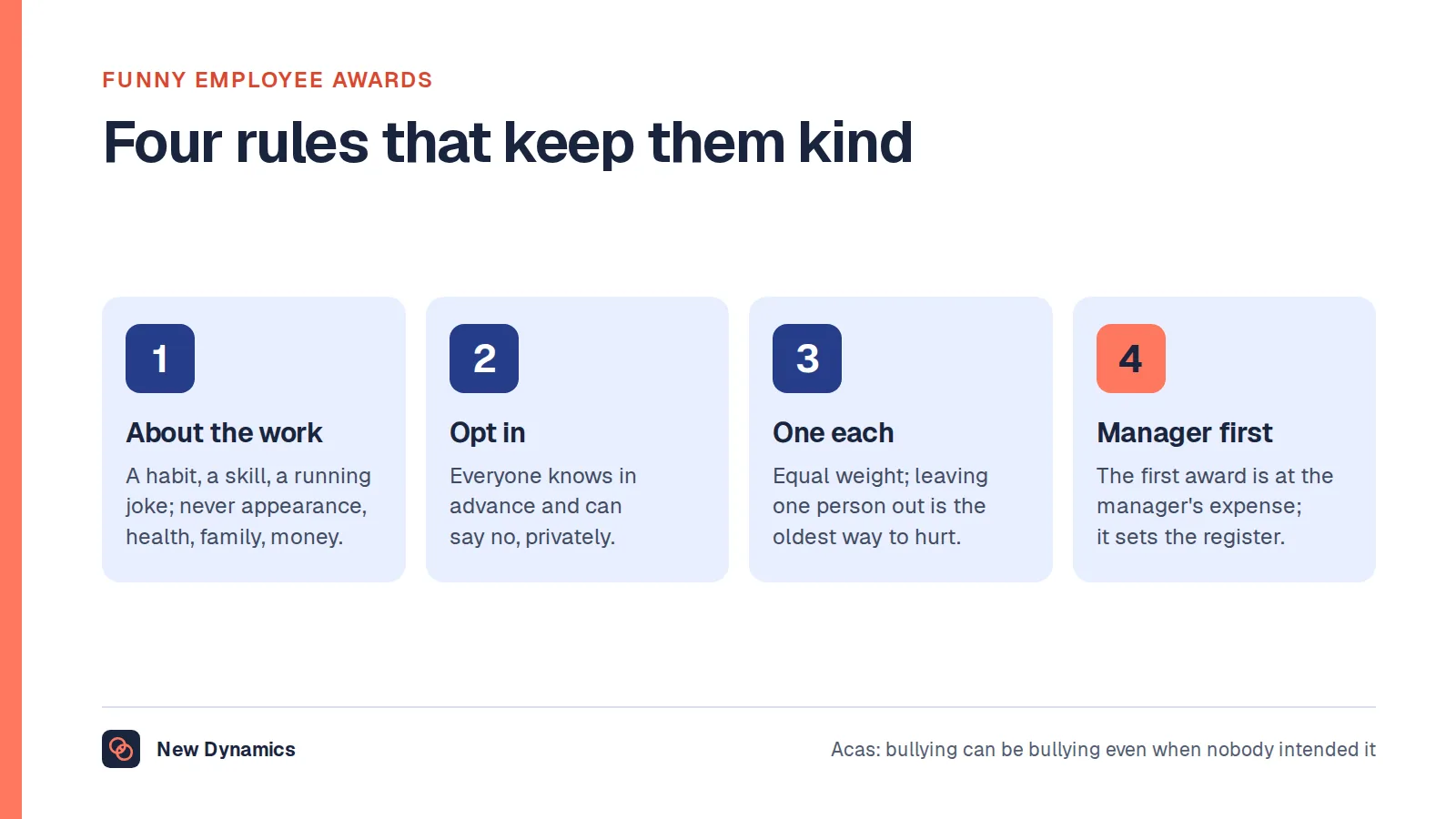
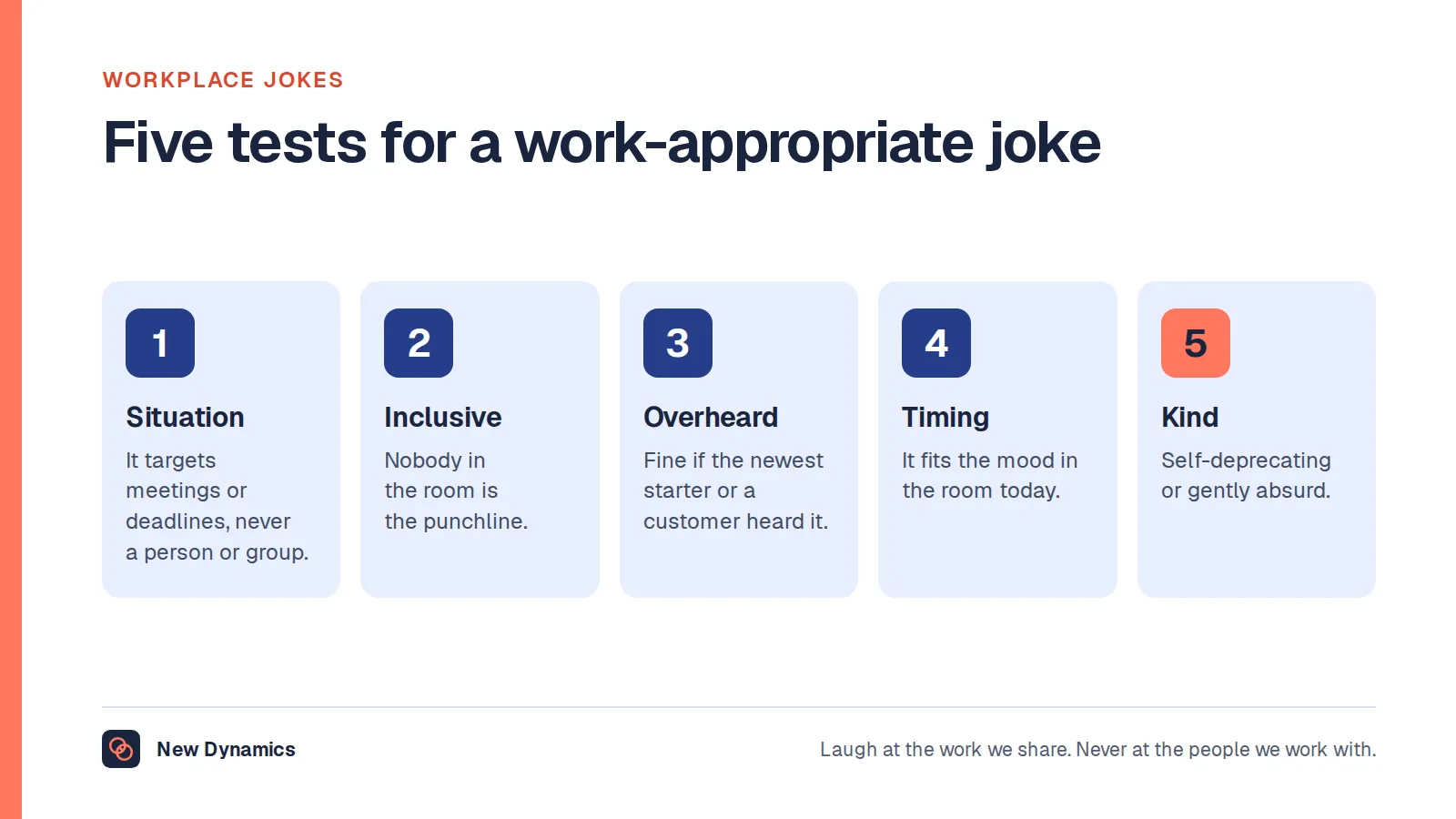
Our post on workplace jokes covers the same line in humour, and our funny employee awards post covers the version of this that people actually keep on their desk.
New starters: not in the first week
A prank depends on the target knowing they are safe. A new starter does not know that yet, cannot tell a joke from a policy, and has nobody to check with. Anything that looks like initiation (a fake task, a fake meeting, a fake telling-off, a made-up rule about the kitchen) costs more than it earns, because the person cannot distinguish it from how the organisation actually works.
Wait until they have pranked someone first. That is the reliable signal that they feel established enough to be a target.
When a prank lands badly
It will happen eventually, and the recovery matters more than the prank did.
- Stop and undo it immediately, without an audience and without explaining how good the plan was.
- Apologise for the effect, not the intent. "I am sorry, that clearly landed badly" works. "It was only a joke" is a defence, and defending yourself is not apologising.
- Tell your manager before they hear it elsewhere, especially if anyone else saw it or a photo exists.
- Do not repeat it with a different target to prove the first reaction was unreasonable.
If you are the manager, treat a complaint as a complaint. Acas is clear that employers have a legal duty of care to protect workers from harm, should "do all they can to try to prevent bullying happening", and should take any bullying complaint seriously and look into it promptly. Our anti-harassment policy guide covers the written version of all of this.
The one-line rule worth writing down
Most organisations do not need a pranks policy. They need one sentence in the handbook that people can remember on the day:
Jokes are welcome. Anything that involves a person's protected characteristics, anyone's account or property, or any safety equipment, is not a joke, and photographs of colleagues are not shared without their agreement.
That sentence does the work of a page, and it survives being repeated from memory in a kitchen.
Frequently asked questions
What are some harmless office prank ideas?
Reversible, low-cost ones: moving a monitor two centimetres a day, laminating a biro, over-wrapping a stapler, swapping two drawers, adding a single googly eye to everything on a desk, taping a printed progress bar stuck at 94% to a monitor, an agreed word that everyone uses once in a meeting, polite applause for a piece of jargon, or adding one rubber duck to a shared shelf each week.
When does an office prank become harassment?
When it relates to a protected characteristic (age, disability, gender reassignment, race, religion or belief, sex or sexual orientation) or is of a sexual nature, and it has the purpose or effect of violating someone's dignity or creating an intimidating, hostile, degrading, humiliating or offensive environment. Under the Equality Act 2010 the effect is enough; the person does not have to have intended it. This is general information, not legal advice.
Can you be disciplined for a prank at work?
Yes. A prank can breach a code of conduct, an IT policy or a health and safety rule, and it can amount to bullying or harassment regardless of intent. Pranks involving safety equipment or another person's accounts are the most serious, because the duties there sit in legislation rather than in a handbook.
Is sending an email from a colleague's unlocked laptop illegal?
It is unauthorised access to a computer, which is what section 1 of the Computer Misuse Act 1990 addresses, and it will almost certainly breach your employer's IT policy. Whatever the likelihood of prosecution, it is a poor risk for a joke. Lock the laptop and tell them you could have.
Are April Fool's pranks a good idea at work?
They are the same prank with a licence attached, and the licence does not change the four lines. One team-wide, opt-in joke works well. Fifteen individual surprises aimed at people who did not ask for them produces exactly the problems the rest of this article describes.
Should managers join in with office pranks?
Carefully, and better as the target than the instigator. Anything that travels down the reporting line carries weight the joke did not intend, and Acas describes bullying as including an abuse or misuse of power. Being a good-natured target costs a manager nothing and tells the team a great deal.
Your next step: agree the line before the next one
- Run the four tests before any prank: reversible in five minutes, costs nothing, needs no password, and the target actually laughs.
- Rule out protected characteristics, safety equipment, other people's accounts and property, and photographs shared without agreement.
- Check who the target has been the last three times.
- Put one sentence in the handbook rather than a policy nobody reads.
For the written version (what the policy says, who it protects and how a complaint is handled) read and download our anti-harassment policy guide. The guide is free to read, and the PDF uses our short download form.
Want recognition, one-to-ones and reviews that show a team is working well rather than just laughing well? Book a New Dynamics demo and bring your current handbook. You can also email contact@new-dynamics.com.