TL;DR
- A performance review, an absence support conversation and a capability process are three different things with three different purposes. Running any two of them in the same meeting is the mistake that causes most of the damage, and it is the easiest one to avoid.
- Agree contact in writing early: how often, by what channel, with whom, and what gets shared. Acas says employers and employees should agree how to stay in touch and how much contact is reasonable, and that people off work should still be told about promotions, reorganisations and redundancies.
- Rate the period actually worked and say which period that is. Where absence is linked to a disability, an attendance measure applied unchanged is a reasonable-adjustments question, because Acas lists a sickness record linked to disability among the triggers for making adjustments.
Someone has been off since February with a long-term condition. The review cycle opens in October. The form has a box for attendance, a rating scale that assumes twelve months of work, and a deadline that does not care. The manager has three bad instincts available: send the form anyway, score the year as a failure, or pretend the person is not on the team.
This article covers whether the review should run at all, how to agree contact without turning it into pressure, how to rate a part-year honestly, what the return should look like, and the question most guidance avoids: what to do when there was a genuine performance concern before the absence began. It describes the position in Great Britain and is general information, not legal advice.
Objectives that were agreed for a year nobody completed need closing rather than rolling forward. See how New Dynamics goals and OKRs keep the objective history visible when a year stops part-way through.
Keep three processes apart

The performance review assesses work that was done, over a stated period. It is not a measure of availability.
Absence support is welfare: how the person is, what support helps, what occupational health says, what a return might look like. Acas notes that these meetings "might be called 'welfare meetings'", and their purpose is support rather than assessment. The paperwork belongs here too: GOV.UK says employees "need to give their employer proof if they're ill for more than 7 days", and a fit note is evidence for the absence process, not an input to a performance rating.
A capability process is a formal route with its own procedure and its own consequences. Acas defines capability as "someone's ability to do their job", separates it from conduct, and says that where "sickness prevents an employee from doing their job, their employer should take steps to support them to return to work", adding that dismissal on those grounds "should be a last resort" and that where the illness is a disability the employer "must do everything they reasonably can to support them".
Mixing any two of these is the mistake that does the damage. A welfare call that turns into a performance conversation teaches the employee that the phone is dangerous, and they stop answering it. A review meeting that drifts into capability is a formal step taken without any of the formal protections. Three purposes, three meetings, three records.
Does the review happen at all?
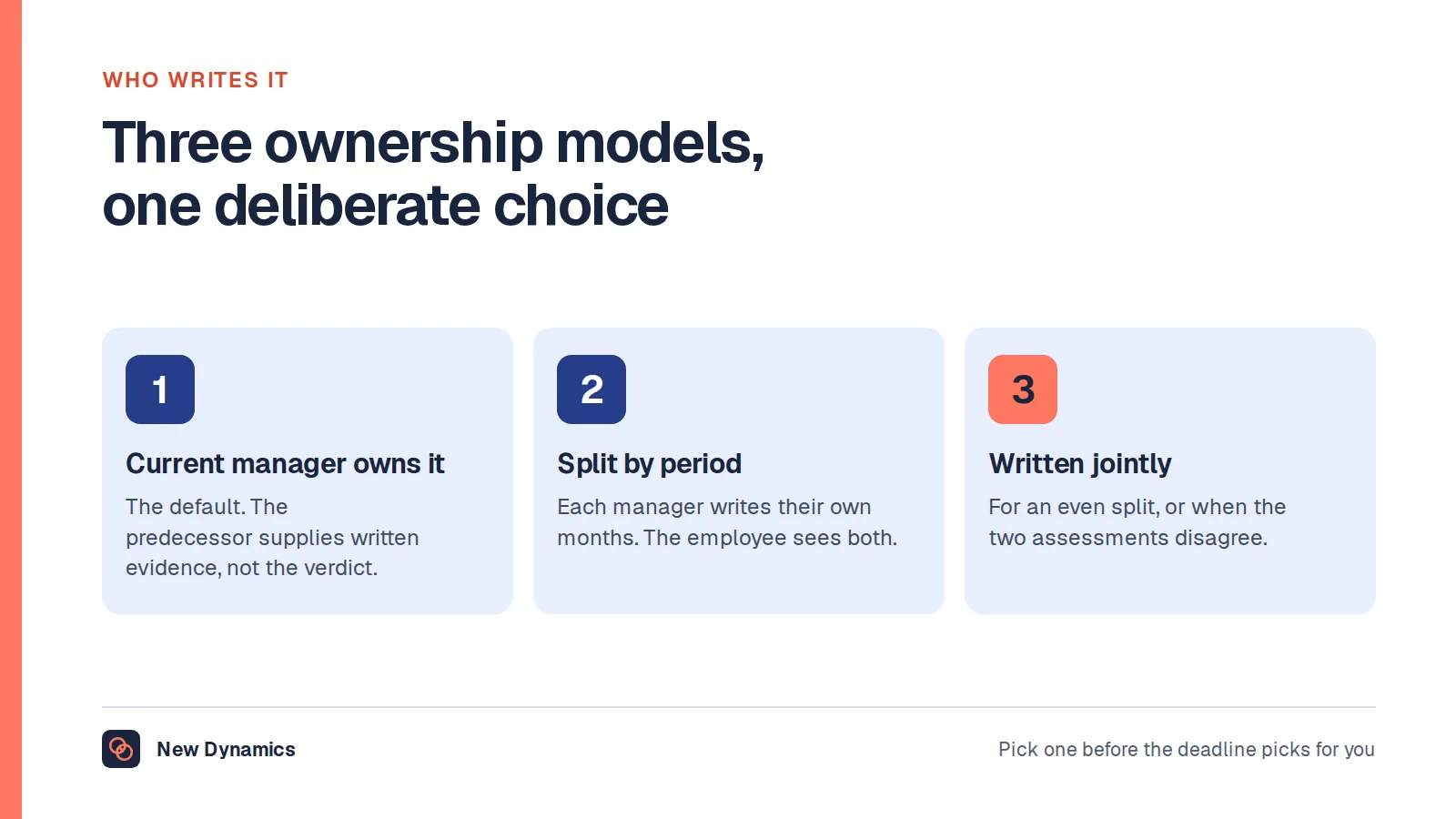
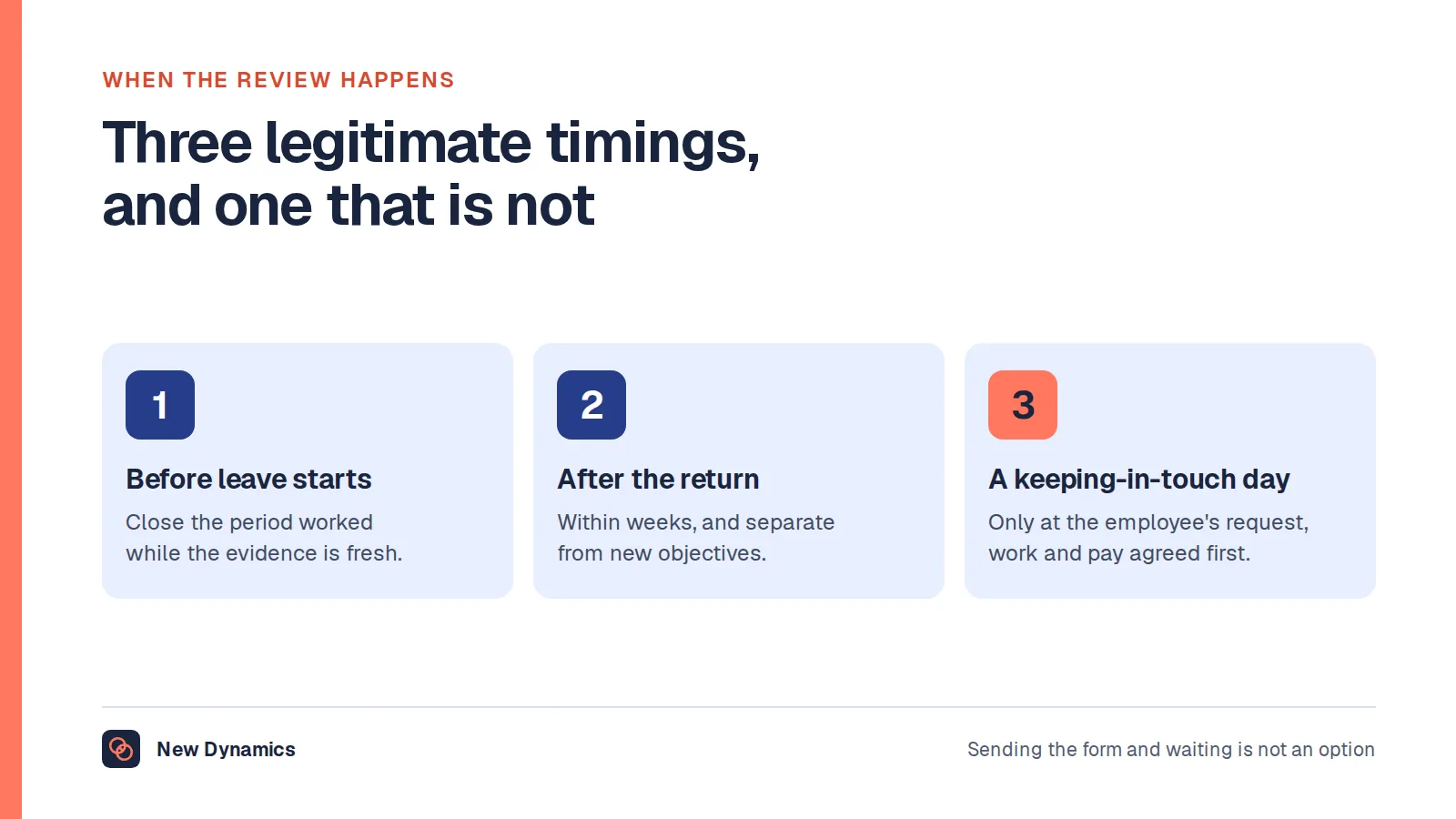
Three workable answers, depending on how long the absence has run and how the person is.
Close out the period worked, from the record. Where the absence began part-way through the cycle, the manager can write up what was achieved before it started, using objectives, evidence and existing notes, and share it when the person is back. No meeting is required of someone who is signed off.
Pause the cycle and complete it on return. The cleanest option for a long absence. The review happens after the return-to-work conversation, covers the period actually worked, and is kept separate from the discussion about objectives going forward.
Hold a short review during absence, only if the employee asks for it. Some people want it: an unfinished year is its own source of worry. It should be at their request, at a time they choose, never a condition of anything, and never attached to a welfare call.
What should not happen is a form emailed to someone who is signed off, with a deadline and a reminder. If non-response then shows up as a missing self-assessment, the process has manufactured a disadvantage out of an illness.
Agree contact, then keep to it
Acas is direct about this: "employers and employees should agree on how to stay in touch during absence and how much contact is reasonable", and the things to agree are "how often the contact should be", "how to contact each other, for example by email, phone or face-to-face meetings" and "who the employee will be in contact with". Where someone is off with a mental health problem, it adds that the employer "should agree the purpose, type and level of contact with the employee" so that it is "useful and not overwhelming".

One part of this is easy to get wrong in the other direction. Acas says employers "should update employees who are off work for any reason about: promotion or other job opportunities; redundancies; reorganisations that could affect their job", and warns that "in some circumstances, an employer could be discriminating against an employee if they're off work and miss something important", giving the example of someone off sick due to a disability who misses an opportunity. Protecting someone from work news is not a kindness when the news is a job they would have applied for.
Rating the period that was worked
- Name the period. "This review covers January to February" is honest and complete. A rating presented as a year's assessment when two months were worked is not.
- Do not mark untried objectives as missed. An objective whose window fell inside the absence was not attempted. The form should be able to say so.
- Keep the absence out of the comments. "Limited contribution this year", "lost ground" and "needs to rebuild" are all the absence, rewritten.
- Treat attendance measures carefully. Acas lists among the triggers for making reasonable adjustments the case where "someone's absence record, sickness record or delay in returning to work is because of, or linked to, their disability", and says adjustments are required by law under the Equality Act 2010. An attendance trigger or an attendance score applied without adjustment is therefore a question to raise with HR before the rating is final, not after.
- Include them in calibration, with the period stated, so that a short assessed period does not quietly become a low rating.
The same part-year discipline covered in reviewing an employee on maternity leave applies here, with the addition that disability may be in play, which changes what the organisation must actively do rather than merely avoid.
Objectives: pause, do not roll
Objectives agreed in January for a full year stop being meaningful in March. Close them in writing with a short note of where each one got to, and record what was handed to someone else. Rolling them forward untouched produces a return in which the person is already behind on work they could not have done.
On return, set new objectives dated from the return, after any adjustments have been agreed, and size them for a phased return if there is one. Someone coming back at three days a week should not carry five days of objectives for the first month.
The return sequence

Acas describes the return to work meeting as "often just an informal chat" that is not a legal requirement, and lists what it is for: making sure the person is ready, talking about "any work updates that happened while they were off", seeing if they need support, agreeing a plan such as a phased return, and agreeing "what they would like other workers to know about their absence and what they would like to keep confidential". It adds that where the worker is disabled, "their employer should review their reasonable adjustments".
Run those in order. The welfare conversation first, the adjustments review second, objectives third, and the performance review of the period worked last, once the person is actually back at work. Compressing them into one meeting in week one is how a return goes wrong.
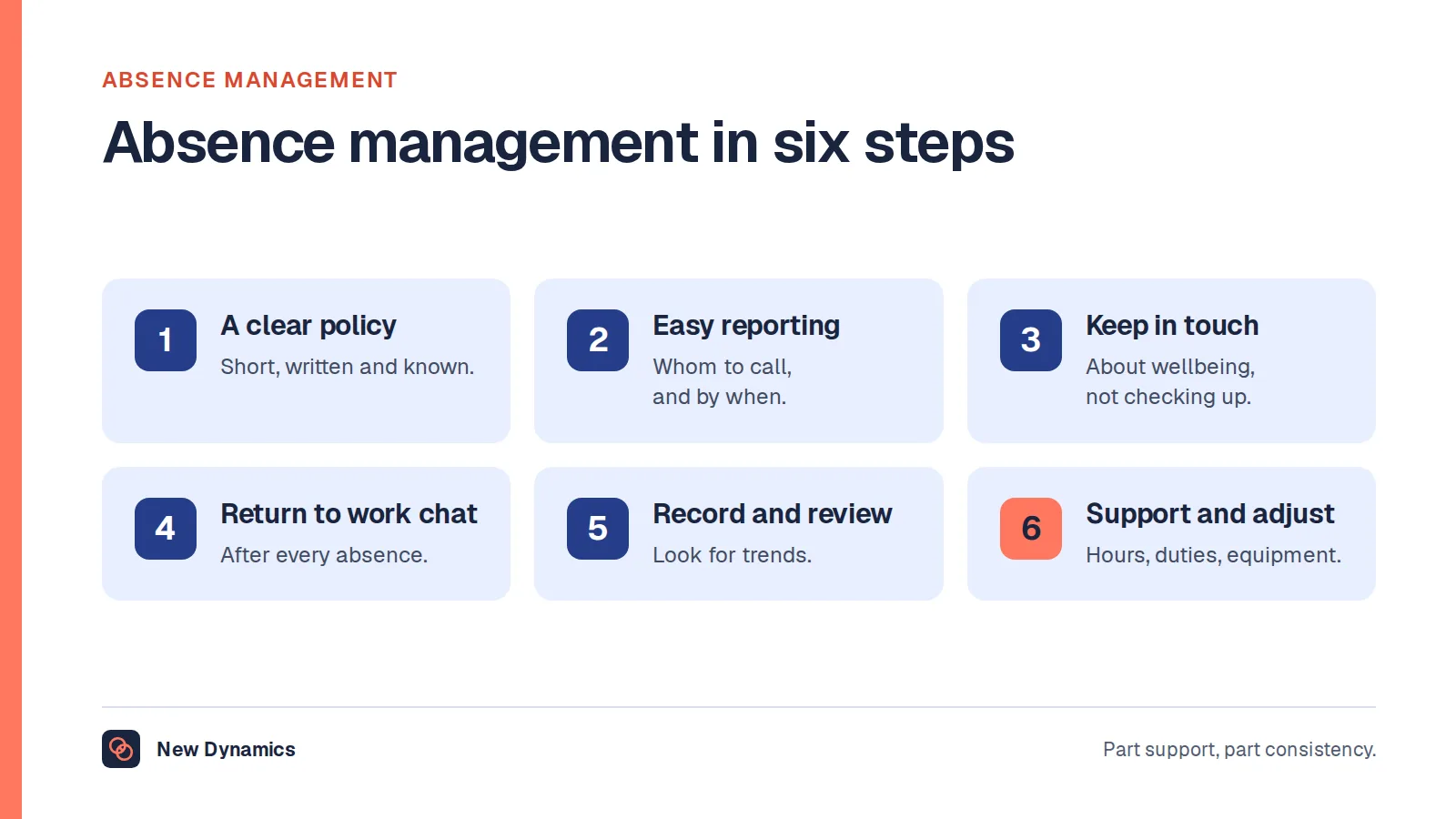
Our post on absence management covers the policy side of this, including what the return conversation should cover for shorter absences.
When there was a performance concern before the absence
This is the part most guidance skips, and the silence is unhelpful, because the situation is common and the instinct to do nothing can be as unfair as the instinct to press on.
The concern does not disappear, and it does not accelerate either. In practice:
- Write down what was already established, factually and with dates, if it is not already recorded. Reconstructing it a year later is worse for everyone, including the employee.
- Do not pursue a performance process during the absence. Contact stays welfare contact, at the agreed frequency.
- Consider the connection. If the condition was affecting the work before the absence, adjustments may be the answer rather than a performance process, and Acas lists difficulty with "any part of their job" among the triggers for making them.
- Resume on return, in order, and slowly. Return to work meeting, adjustments, a settling period, then the performance conversation. Picking up a concern in the first week back, before adjustments have been agreed, is both unkind and procedurally weak.
- Take advice before any formal step. Where disability may be involved, the sequence matters as much as the decision.
Frequently asked questions
Can you do a performance review while an employee is off sick?
You can write up the period they worked from the record at any point, but you should not require a signed-off employee to attend a review meeting or complete a form to a deadline. A review during absence should happen only at the employee's request, at a time that suits them, and never as part of a welfare call or as a condition of anything.
Should someone on long-term sick leave be given a performance rating?
Usually yes, for the period they actually worked, with that period stated. Leaving them out of the ratings removes them from everything the ratings feed, including pay decisions. What must not happen is a rating that covers months of absence, or a lower score justified by the time off.
How often should a manager contact an employee on long-term sick leave?
As often as the two of you agreed at the start, which Acas says should cover how often, by what channel and with whom. There is no fixed number: someone off after surgery and someone off with a mental health condition may want very different arrangements. Agree it in writing, keep to it, and revisit it rather than drifting.
Can absence be taken into account in a performance review?
Attendance is a separate matter from performance and belongs in the absence process, not the rating. Where absence is linked to a disability, Acas lists a sickness record linked to disability among the triggers for reasonable adjustments under the Equality Act 2010, so any attendance trigger or score should be considered with HR before it is applied. This is general information, not legal advice.
Should you tell someone on sick leave about a promotion opportunity?
Yes. Acas says employers should update employees who are off work about promotion or other job opportunities, redundancies and reorganisations that could affect their job, and warns that someone missing something important while off could in some circumstances be discrimination. Send the information and let the person decide what they want to do with it.
What happens to objectives when someone is off sick for months?
Close them in writing with a note of where each one got to and what was handed on, rather than rolling them forward. Set new objectives dated from the return, after any reasonable adjustments have been agreed, and size them for a phased return if one is in place.
Your next step: check the form before the person
- Look at your review form for anything that measures presence rather than work, starting with any attendance field.
- Add a "period covered" field, and make it required. Most of the unfairness in part-year reviews comes from its absence.
- Write down the contact agreement for every absence longer than a month, and store it where the next manager will find it.
- Check last cycle for everyone who had a long absence, and compare their rating with their own previous ones rather than with the team.
For keeping part-year ratings consistent against everyone else's, read and download our performance calibration guide. The guide is free to read, and the PDF uses our short download form.
Want a cycle that records what period a review covers and keeps objectives honest through a long absence? Book a New Dynamics demo and bring your current form. You can also email contact@new-dynamics.com.