TL;DR
- A review process built around a full-time weekday employee quietly penalises everyone else. In Great Britain the comparison is also a legal one: Acas says part-time employees and workers should not be any worse off than a full-time comparator for pay, training and career development, or promotions and job transfers.
- Volume scales with hours. Standards do not. A target of 120 cases a quarter becomes 60 at half the hours, but the quality bar, the behaviours, the rating scale and the length of the review conversation stay exactly the same.
- For shift workers, when you hold the meeting is part of whether the review is fair, and the harder question is who writes it when no single supervisor sees the whole person. For seasonal staff, the review is really a rehire decision, so the record has to outlast the contract.
A distribution site has forty people on one review form. Twelve are full-time on days, eighteen work a rotating shift pattern, ten were taken on for the autumn peak. When the reviews come back, the full-time twelve have detailed, specific write-ups. The shift workers have three lines each. The seasonal ten have nothing at all, because their contracts ended the week the cycle opened. Average ratings follow the same order. Nobody decided any of that.
This article covers the comparison the law requires before you rate anyone, which objectives genuinely scale with hours and which must never be scaled, how to handle shift patterns and multiple supervisors, and what a seasonal employee should leave with. It describes the position in Great Britain and is general information, not legal advice.
A consistent process is what stops the working pattern deciding the rating. See how New Dynamics performance reviews keep one cycle, one form and one standard across every contract type.
The comparison the law already makes for you
Before deciding anything about objectives, it helps to know that the comparison has been defined for you. Acas states that "part-time employees and workers are protected from being treated less favourably than a full-time 'comparator'", and names the law as the Part-time Workers (Prevention of Less Favourable Treatment) Regulations 2000. It lists what they should not be any worse off for, and two items on that list are decided inside a performance review: "training and career development" and "promotions, career breaks and job transfers".
A comparator, Acas says, is "someone who works full time for the same employer and is on the same type of contract", who does "the same or broadly similar work" with "a similar level of qualification, skills and experience". That is a useful discipline even where no legal question arises: it tells you who the part-time employee should be assessed alongside, which is the question most review forms leave to the manager's instinct.
Acas also notes a second body of law in the background: "Treating a part-time worker less favourably than a full-time worker could be indirect sex discrimination. This is because generally, women are more likely to work part time than men." A review round that consistently rates part-timers below their comparators is therefore not only unfair, it is evidence.
Where treatment does differ, GOV.UK says the employer "must be able to show there is a good reason to do so", called "objective justification", and that a worker can ask for a written statement of reasons which the employer must answer within 21 days. "Their objectives were pro rata" is a reason. "They were not around as much" is not.

What scales with hours, and what never does
Pro rata, as GOV.UK puts it, means "in proportion to hours worked", and its example is a benefit: a £1,000 bonus for a full-time worker becomes £500 for someone working half the hours. The same arithmetic applies to the parts of a review that measure quantity, and to nothing else.
Scale with hours:
- Volume targets. Cases closed, calls handled, visits made, invoices processed.
- The number of objectives. Four objectives for a full week is not four for two days.
- Project load. How many pieces of work someone can carry at once.
- Breadth of cover. The range of accounts, lines or wards one person can hold.
Never scale with hours:
- The quality bar. Accuracy, judgement and care are the same at any contract.
- Behaviours and values. These describe how a person works, not how long.
- The rating scale. No separate band, no capped top rating, no "good for a part-timer".
- The development conversation. Someone at half the hours gets a full discussion about their career, not half of one. This is the item Acas lists by name.
- The manager's preparation. A thinner review is itself less favourable treatment.
The failure is usually arithmetic rather than malice. Take a full-time caseworker with a target of 120 completed cases a quarter. A colleague in the same role at half the hours has a target of 60. They complete 64, which is above target, and the review says "lower output than the rest of the team" because the manager compared 64 with 120. The number was right and the comparison was wrong.
One more trap: do not pro rata the work that only exists in whole units. Attending a team meeting, reading a policy, completing mandatory training and preparing for a review all cost the same regardless of contracted hours, and they cost a bigger share of a short week. If those hours are not funded, the part-time employee pays for them out of the time meant for their targets, and then the targets are missed.
Shift workers: the meeting itself is part of the review
Shift patterns create two problems that part-time hours alone do not.
The first is scheduling. GOV.UK defines the night period as "11pm to 6am" unless the worker and employer agree a different seven-hour period in writing that includes midnight to 5am, and night workers "must not work more than an average of 8 hours in a 24-hour period". A review booked for 10am with someone who clocked off at 6am is being held on their rest time, after a night awake. They will agree to it, and they will remember nothing of it. Hold reviews inside the shift, or pay for the attendance and let the person pick the slot. If the only honest option is a day off, it is paid working time.
Rotating patterns also mean the cycle cannot run on a single deadline. A four-on, four-off rota puts some people on nights for most of a two-week review window. Publish the window in rota terms rather than calendar terms, and give managers the rota before they book anything.
The second is evidence. A shift worker is often seen by whichever supervisor happens to be on, which means no one person holds the whole picture. The way this usually breaks is that the review gets written by the supervisor with the most recent shifts in common, and the other eight months disappear.
Two fixes, in order of effort. The cheap one is to make the handover note the evidence base: if shift handovers are already written, they already record who held the line when it went wrong. The better one is to name one owner for each person's review and require written input from every other supervisor who worked with them, which is the model our multi-manager reviews are built for.
Finally, do not let the day shift become the default comparator. Nights are usually quieter in volume and harder in isolation: fewer people to ask, fewer escalation routes, more decisions taken alone. A rating scale that rewards throughput will under-rate the night team every single cycle.
Seasonal staff: the review is a rehire decision
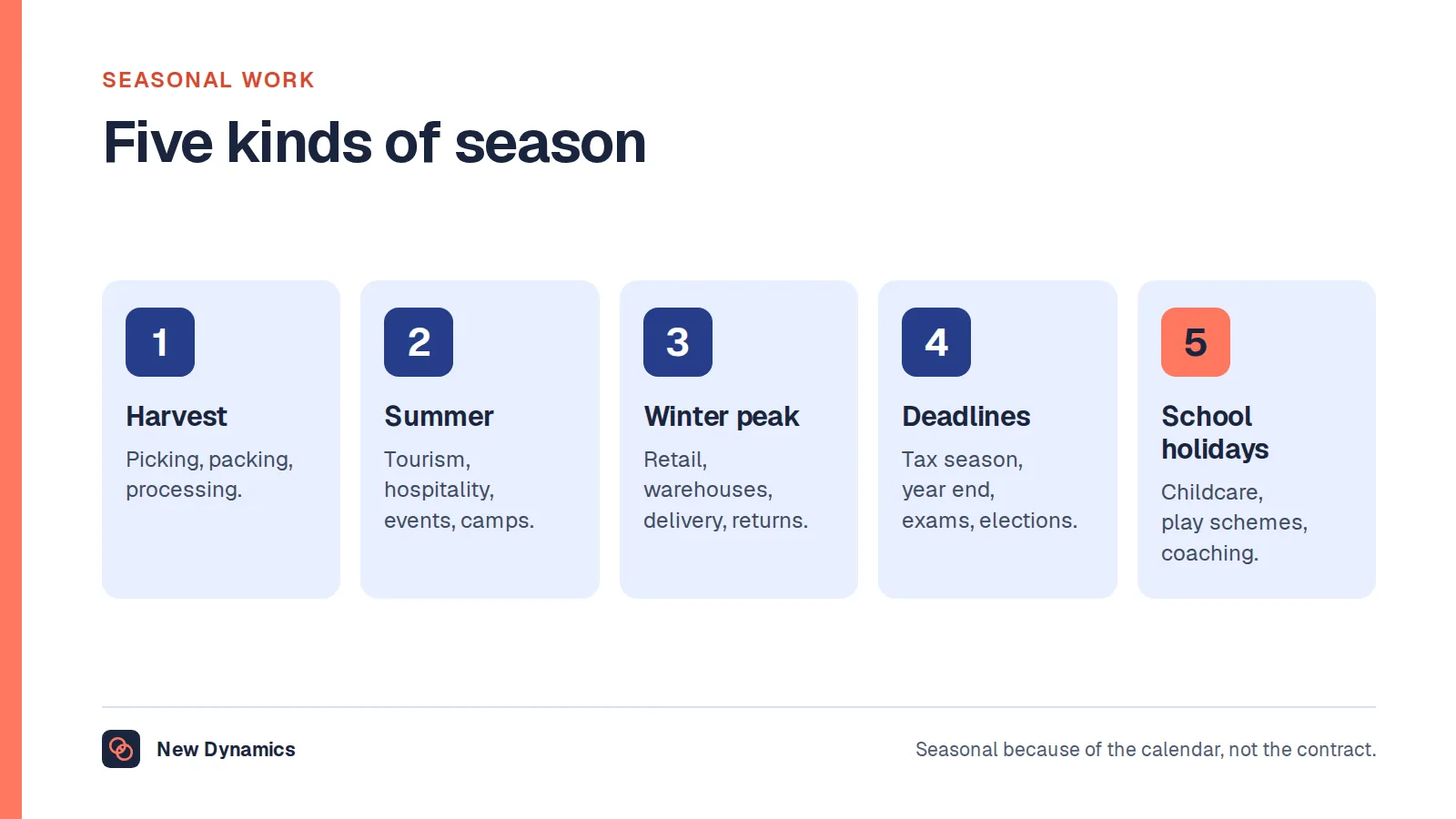
GOV.UK notes that someone may be a fixed-term employee if they are "a seasonal or casual employee taken on for up to 6 months during a peak period". Most organisations skip the review entirely for these contracts, on the reasonable grounds that the person will be gone before the cycle closes.
That is a mistake with a cost attached. The people you hire for the next peak are largely the people you hired for the last one, and the only thing standing between you and a blind rehire decision is whatever a supervisor remembers eight months later. Our write-up of the seasonal job pattern covers the wider recruitment cost of losing that knowledge.
What a seasonal review needs is not the full form. It needs four things, written in the last fortnight of the contract:
- Would we take this person back? Yes, yes with a different role, or no. Recorded plainly, with a reason.
- What they actually did, in enough detail that a different manager could use it next year.
- Anything they learned or were trained on, so you do not pay to train them twice.
- What they would want next time, which is how a returning seasonal hire becomes a supervisor.
Twenty minutes and a short written note beats a full appraisal nobody has time to run. The thing that must not happen is a rehire list with names and no reasons, because that list carries every unexamined preference the season produced.

Five decisions to write down before the cycle opens
These are decisions, not a policy document. Each one takes a sentence, and each one prevents an argument later.
- Which objectives are volume based and therefore pro rata, and which are standards that do not move. Mark them on the form itself, not in a guidance note.
- Which full-time comparator each part-time role is measured against. Write the role, not the person.
- Who owns each review where several supervisors are involved, and who must contribute to it in writing.
- Whether review time, preparation time and self-assessment time are paid working time, and how they are scheduled around a rota.
- The minimum record for a contract that ends mid-cycle, so a leaver is not simply absent from the data.

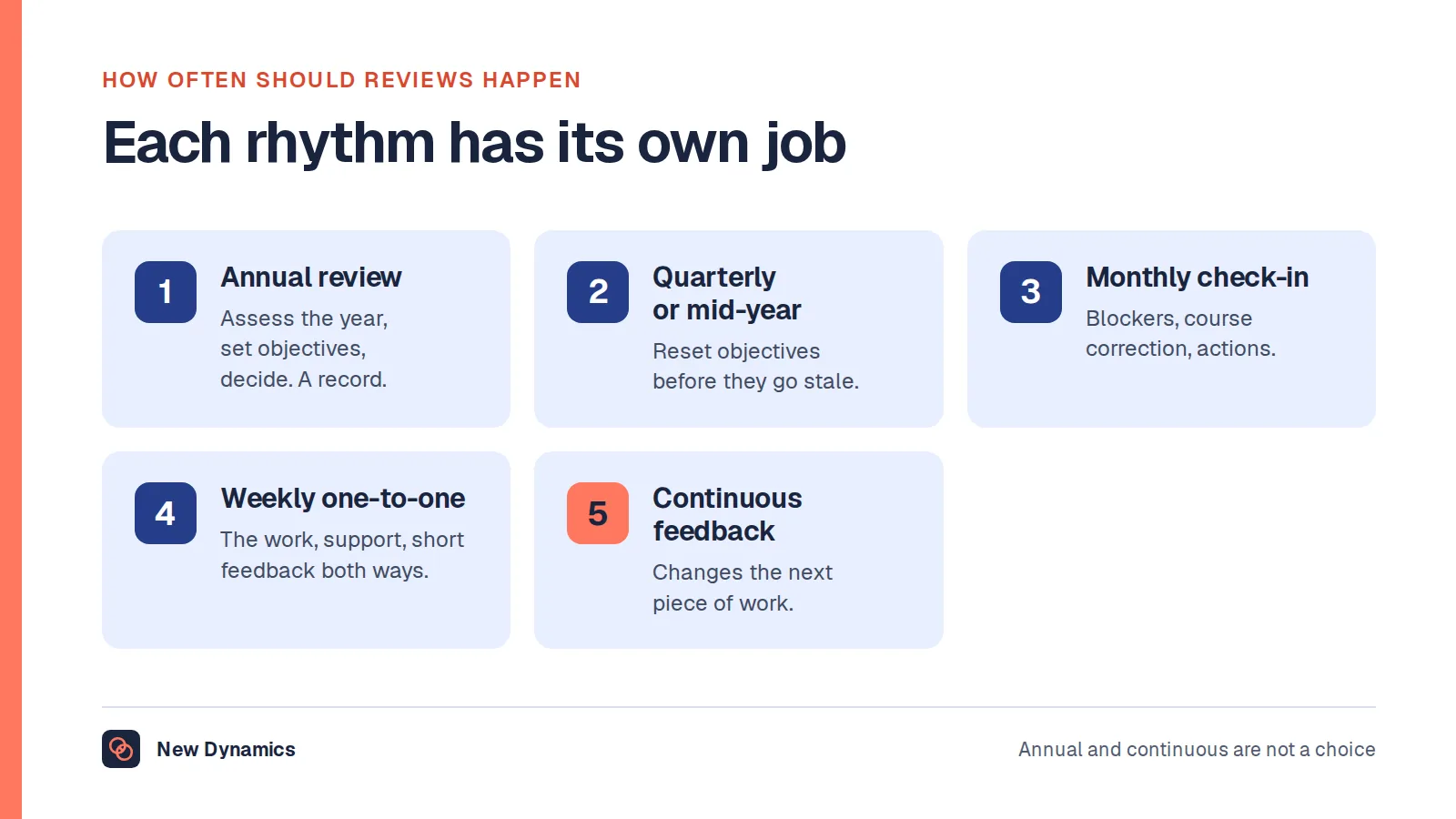
Agreeing a rhythm matters as much as agreeing the content: our guide to performance review frequency covers how often these conversations should happen, and short cycles suit shift and seasonal work far better than one annual event.
Four phrases to strike out
These appear constantly in reviews of people who are not full-time, and every one of them rates the contract rather than the work.
- "Not always available when needed." The contract says when they are available. If the cover is wrong, that is a resourcing decision, not a performance rating.
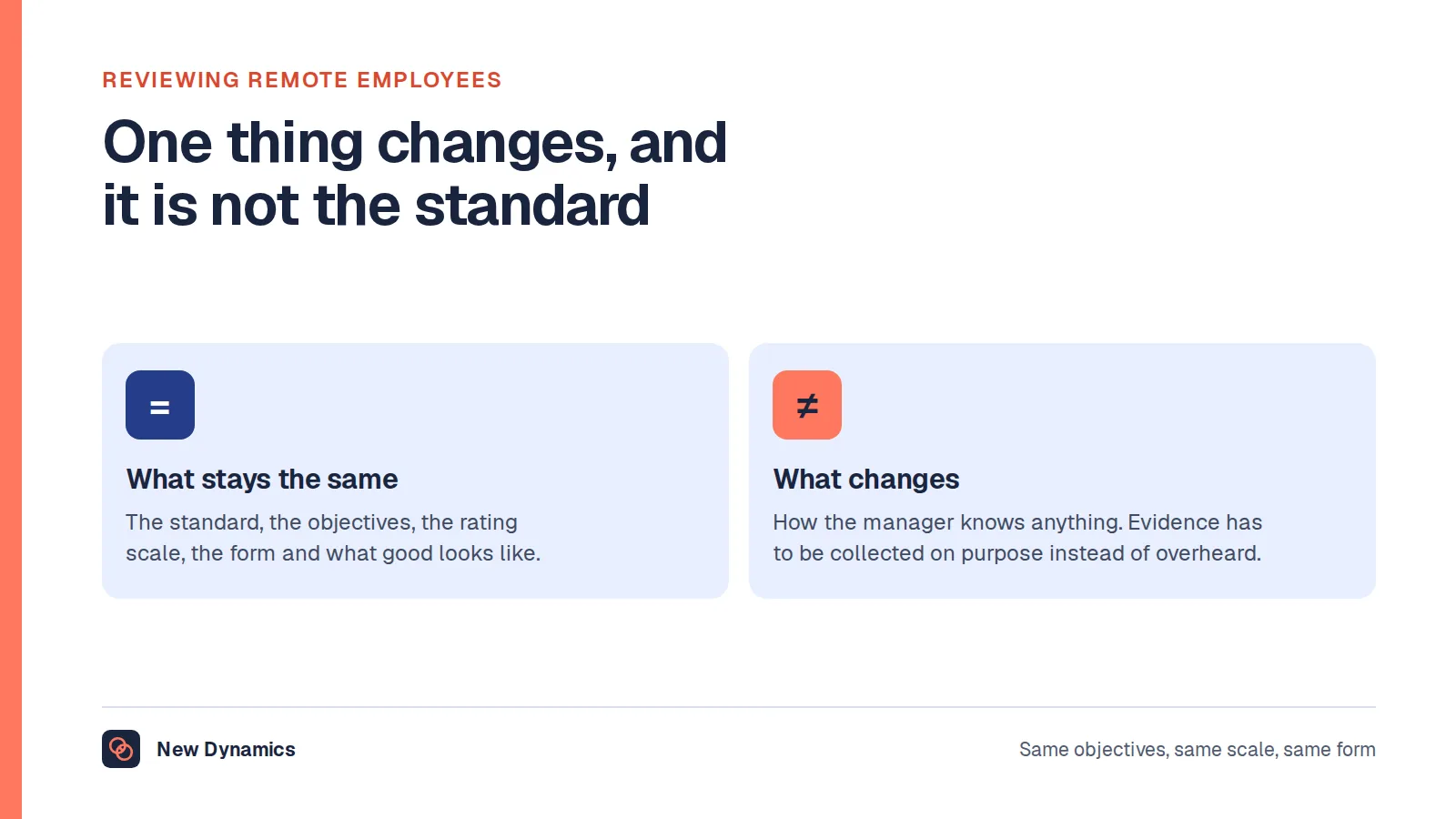
- "Less visible than the rest of the team." Visibility is a function of the rota. This is the same proximity bias that distorts remote performance reviews, and it behaves identically here.
- "Unable to take on additional projects." Unable, or not contracted to? If the extra work was never offered, nothing has been tested.
- "Would benefit from being here more often." Possibly, but that is a conversation about hours, held separately, with the person's consent. It is not a line in a performance rating.
Replace each one with the thing you actually observed in the hours the person worked. If nothing was observed, the honest fix is to gather evidence next cycle, not to score the gap.
Frequently asked questions
How do you do a performance review for a part-time employee?
Use the same form, the same standard and the same rating scale as for a full-time colleague, and change only the quantities. Scale volume targets and the number of objectives in proportion to hours, keep the quality bar and behaviours identical, and give the same amount of time to the conversation and to development. Compare the person against a full-time colleague doing the same or broadly similar work rather than against the team average.
Should objectives be pro rata for part-time staff?
Volume objectives should be, because they measure quantity: a target of 120 units at full time is 60 at half the hours. Standards should not be, because they measure how work is done rather than how much. Mark which is which on the form before the cycle opens, so nobody has to guess, and fund the fixed costs of the job, such as meetings and training, rather than scaling them down.
Is it discrimination to rate part-time staff lower?
It can be. Acas says part-time employees and workers are protected from less favourable treatment than a full-time comparator, under the Part-time Workers (Prevention of Less Favourable Treatment) Regulations 2000, and that worse treatment of a part-time worker could also be indirect sex discrimination because women are more likely to work part time. A pattern of lower ratings without a justified reason is the evidence. This is general information about Great Britain, not legal advice.
When should you hold a performance review with a shift worker?
Inside their shift wherever possible, and never on rest time after nights. GOV.UK defines the night period as 11pm to 6am unless a different seven-hour period is agreed in writing, so a mid-morning meeting after a night shift asks someone to perform while they should be asleep. Publish the review window in rota terms, give managers the rota first, and treat any attendance outside shift as paid working time.
Who writes the review when someone works for several managers?
Name one owner, usually the person accountable for the role rather than whoever shared the most recent shifts, and require short written input from every other supervisor who worked with them. Without a named owner, the review ends up reflecting the last few weeks. Written handover notes are a good evidence base, because they already record who dealt with what.
Do seasonal staff need a performance review?
They need a record, which is not the same as the full cycle. In the last fortnight of the contract, write down whether you would rehire them and why, what they did, what they were trained on, and what they would want next season. GOV.UK treats a seasonal or casual employee taken on for up to six months during a peak period as potentially a fixed-term employee, and your next peak will be staffed largely from this one.
Your next step: test your own last cycle
- Sort last cycle's ratings by contracted hours and by shift pattern, then look at the distribution before you look at the people.
- Open three reviews at random from part-time staff and count the words against three full-time ones. Length is the earliest signal.
- Search your completed forms for the four phrases above, and for the word "availability".
- Mark every objective on your current form as volume based or standard, and fix the ones nobody can classify.
When several supervisors share one employee, the fairness problem is structural rather than personal. Read and download our multi-manager performance guide for the ownership and input model. The guide is free to read, and the PDF uses our short download form.
Want one review cycle that fits every contract and rota you run? Book a New Dynamics demo and bring your current form and a copy of your rota. You can also email contact@new-dynamics.com.