TL;DR
- Acas sets the floor: employers should conduct regular performance reviews for anyone with the legal status of employee, and it is a good idea to do them at least once a year. It also expects managers to talk about performance informally and regularly in between, through feedback, coaching and check-ins.
- So annual against continuous is a false choice. They do different jobs: the formal review produces a record and a decision, the regular conversation changes what happens next week. Dropping either leaves a gap — no record, or no management.
- Choose the cadence from how fast the work changes, how many reports each manager has, whether pay depends on the cycle, and what a regulator or customer expects. Then protect the written record whatever rhythm you land on, because that is the part Acas asks for and the part that survives a disagreement.
"How often should we do performance reviews?" is nearly always asked as a choice between an annual cycle and something continuous. It is not a choice. The two do different work, and an organisation that swaps one for the other usually discovers which job it had stopped doing about a year later.
This article covers what each rhythm is for, where the legal and practical floor sits, the five questions that decide your cadence, when quarterly reviews help and when they become four annual reviews, and how to move from annual reviews to continuous feedback without losing the record.
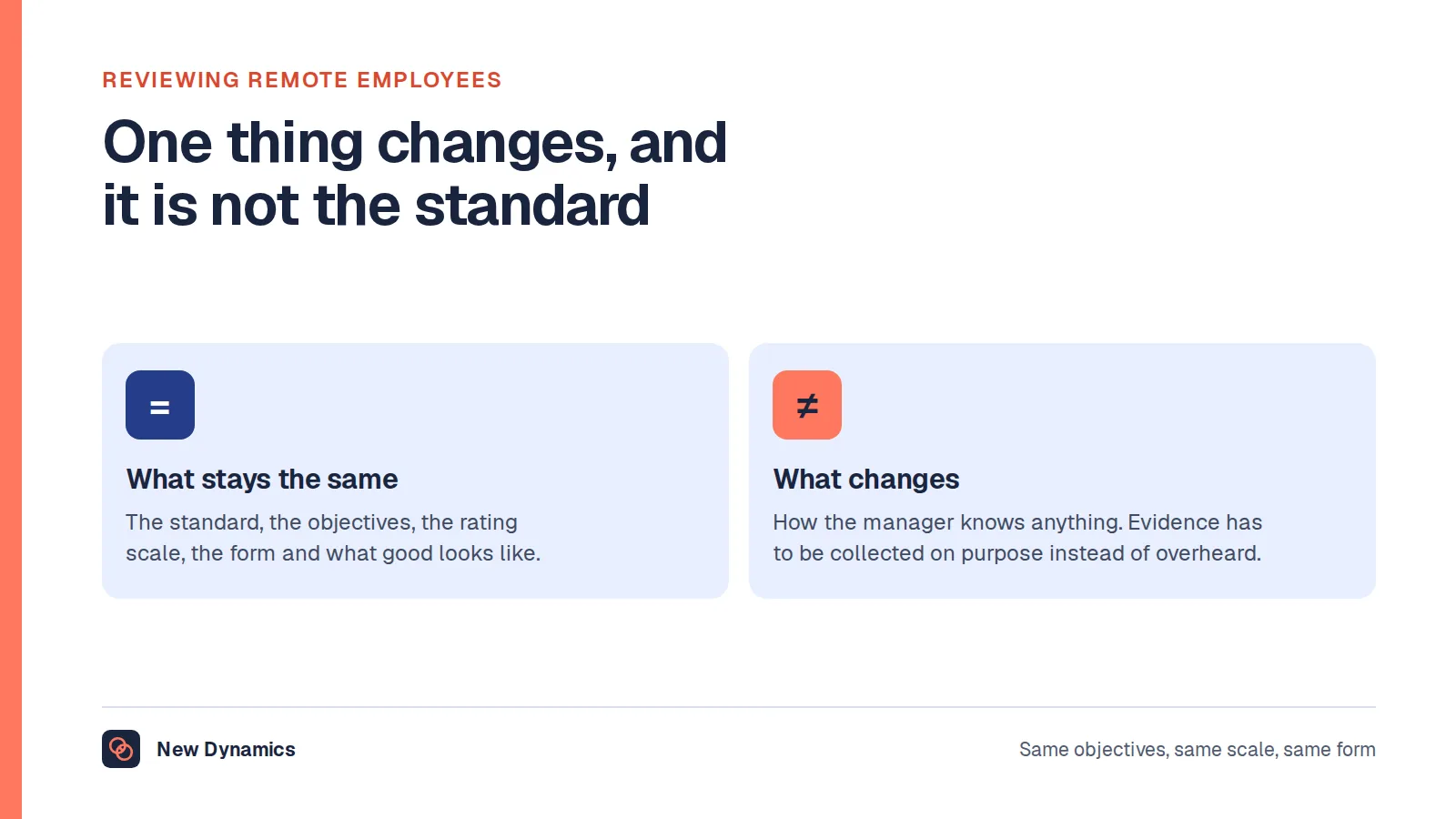
A rhythm only survives if the last conversation is still in front of you. See how New Dynamics continuous feedback gives every employee a regular voice. Rhythm matters most when nobody shares an office; our guide to the performance review for remote employees covers judging work you never see.
The floor, and who sets it
Acas says that "Employers should conduct regular performance reviews for anyone with the legal status of employee" and that "It's a good idea to do them at least once a year". It also says that alongside the formal review, "managers should still talk to employees informally about their performance on a regular basis", through sharing regular feedback, coaching, and "regular check-ins, sometimes known as one-to-ones".
Read those two together and the answer falls out. Once a year is the minimum for the formal part. The informal part is expected to be continuous. Neither replaces the other.
What each rhythm is for
| Rhythm | Job it does | Output |
|---|---|---|
| Annual review | Assess the year, set objectives, decide | A written record, often a rating |
| Mid-year or quarterly | Reset objectives before they go stale | Revised objectives |
| Monthly check-in | Remove blockers, correct course, keep goals honest | Actions for the month |
| Weekly one-to-one | The work itself, support, short feedback both ways | Nothing formal, everything useful |
| Continuous feedback | Change the next piece of work | A better next piece of work |
The common failure is to make each rhythm a smaller version of the one above it. A monthly check-in that produces a rating is an annual review held twelve times, and managers will treat it accordingly.

Why the annual review got a bad name
It is worth being precise about what organisations were actually reacting against. The open textbook Principles of Management, published by OpenStax, describes the shift in its section on performance management: companies "started to think about performance management processes that were less cumbersome, incorporated frequent feedback, and delivered performance impacts". It cites a Deloitte Services survey in which "58% of executives surveyed believed that their current performance management approach drives neither employee engagement nor high performance", and says they wanted something "more nimble, real-time, and individualized—and focused on fueling performance in the future rather than assessing it in the past".
Notice what is being criticised: cumbersome process, infrequent feedback, and looking backwards. None of those is caused by holding a review once a year. They are caused by holding only that, with a long form attached. Our guide to how long a performance review takes covers the form problem; the frequency problem is this one.
Five questions that decide your cadence
- How fast does the work change? If objectives set in January are irrelevant by March, you need a quarterly reset, not a better annual form.
- How many reports does each manager have? Eight reports times a quarterly review is a lot of hours. Cadence has to fit the capacity that exists, not the capacity you wish for.
- Does pay depend on the cycle? If it does, at least one rhythm has to produce a defensible, comparable record at a fixed point.
- What does a regulator, client or accreditation expect? Some sectors need evidence of competence at set intervals, and that interval wins.
- How new are your managers? Inexperienced managers do better with a structure that comes round often. Experienced ones need less scaffolding.
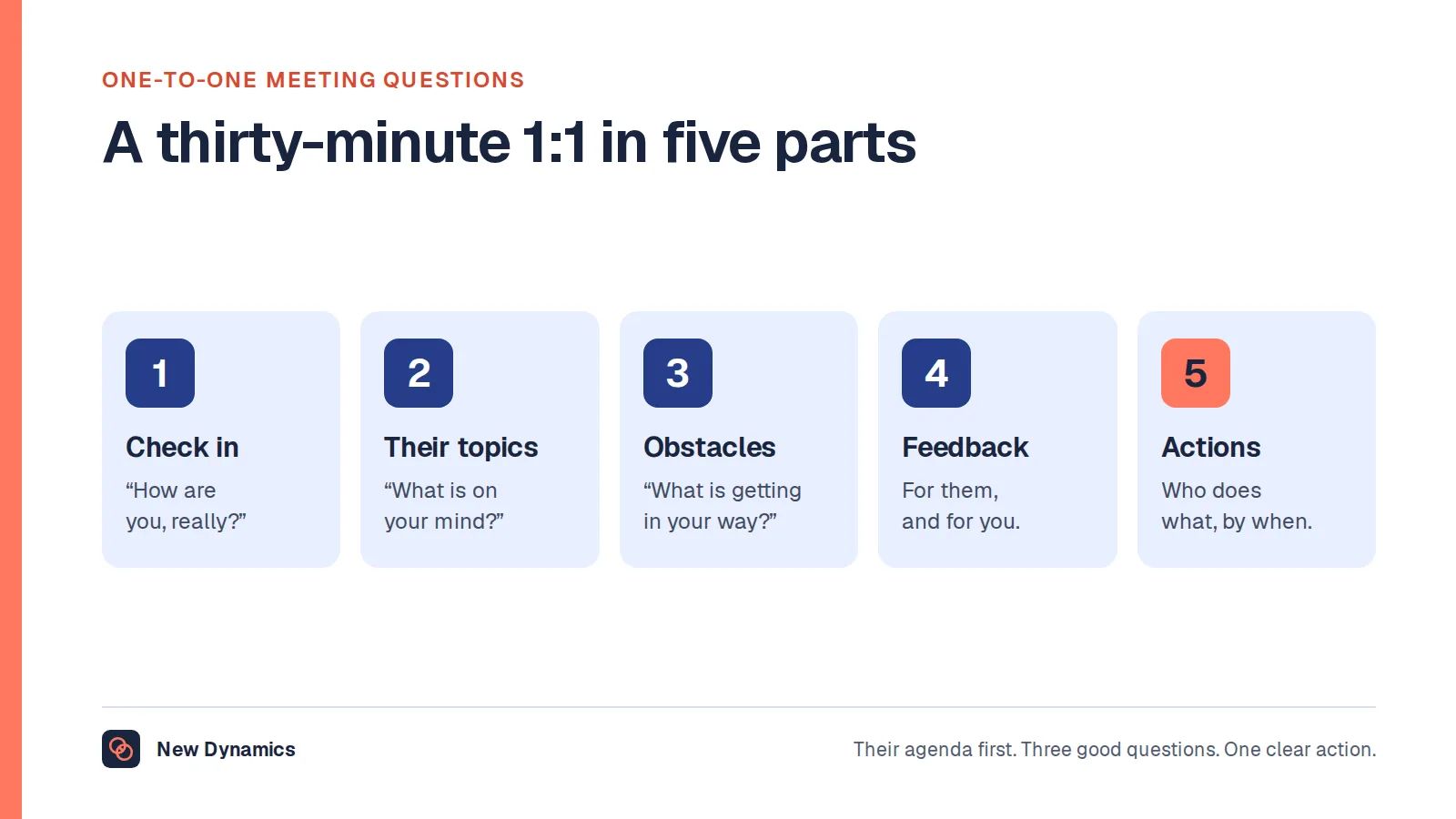
Answer those honestly and the cadence is usually obvious. Our guide to the one-to-one meeting questions gives the in-between conversation a shape.
Quarterly reviews: useful, or four annual reviews?
Quarterly works when each quarter has a real decision in it: objectives that genuinely need resetting, a project ending, a changed priority. It stops working when the quarter is simply the annual form again, four times.
Keep quarterly if you can answer yes to both: would the objectives be out of date if we waited, and does the manager have something to say that has not already been said in a one-to-one? If the answer to the second is no, you do not need a quarterly review — you need to write down what the one-to-ones already established.
Monthly check-ins: what they are not
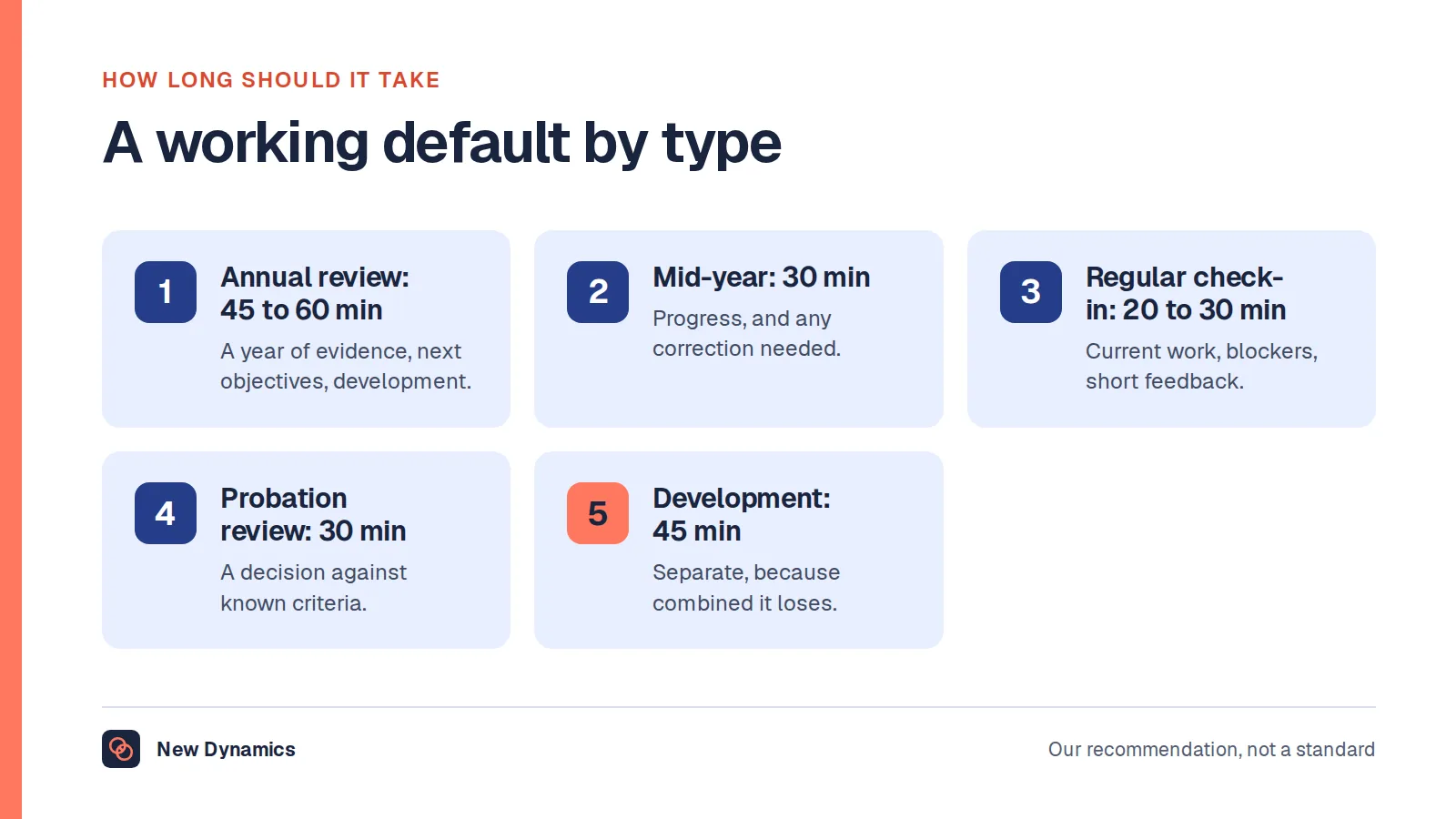
A monthly check-in is not a monthly appraisal. It has no rating, no form worth the name and no sign-off. It asks what is in the way, what changed, and what happens next, and it takes twenty to thirty minutes. The moment it acquires a scoring scale it becomes an administrative event, attendance drops and it is quietly abandoned within two cycles.

Moving from annual reviews to continuous feedback
The failure mode is predictable: the annual review is abolished, the continuous part never quite starts, and a year later nobody can evidence a pay decision or a capability case. Keep the record while you change the rhythm.
- Decide what the annual event is still for, and keep that much. Usually it is the written record, the objectives for the year and any rating that pay or progression depends on.
- Start the rhythm before you shrink the event. Get one-to-ones happening reliably for a full quarter first. A rhythm that does not exist yet cannot absorb the work.
- Shorten the form rather than deleting it. A short, dated record after each check-in replaces most of what the long annual form was collecting.
- Train managers on the conversation, not the tool. The skill that makes continuous feedback work is saying something useful in the moment, which is harder than filling in a form once a year.
- Keep the written record whatever you do. Acas asks for it, and it is the part you will need if a decision is ever challenged.
Our continuous performance management playbook sets out the rhythm in detail.

Frequently asked questions
How often should performance reviews happen?
At least once a year for the formal review, which is what Acas calls a good idea, with regular informal conversations about performance in between — feedback, coaching and check-ins. Many organisations add a mid-year or quarterly point to reset objectives. The right answer depends on how fast the work changes and how many reports each manager has.
Is an annual performance review enough?
Only if something else is happening in between. Acas expects managers to talk about performance informally and regularly as well as formally. An annual review on its own means feedback arrives up to twelve months late, which is the complaint behind most of the criticism of annual appraisals.
What is a quarterly performance review for?
Resetting objectives before they go stale and marking a real decision point, such as a project ending or a changed priority. It is working if the objectives would genuinely be out of date after another three months, and failing if it is simply the annual form repeated four times.
What is a monthly performance check-in?
A short conversation, usually twenty to thirty minutes, about current work, blockers and what happens next. It has no rating, no sign-off and no scoring scale. Adding those turns it into a monthly appraisal, and it will be abandoned.
Should we replace annual reviews with continuous feedback?
Replace the long form, not the record. Keep whatever the annual event is genuinely for — the written record, the year's objectives, any rating that pay depends on — and build the continuous rhythm first, before shrinking the event. Organisations that do it the other way round lose the evidence they need for pay and capability decisions.
What is the difference between annual review and continuous performance management?
They answer different questions. The annual review asks what happened over the year and produces a record and a decision. Continuous performance management asks what should happen next and changes the work in progress. Most organisations need both, which is why framing it as a choice causes problems.
Your next step: name the job of each rhythm
- Write down what your annual event is genuinely for, in one sentence.
- Write the same sentence for every other rhythm you run, and delete any that cannot justify itself.
- Check each rhythm against manager capacity before adding one.
- Confirm that the written record survives whatever cadence you choose.
For the rhythm itself, read and download our continuous performance management playbook. The guide is free to read, and the PDF uses our short download form.
Want check-ins, feedback and the annual record in one place instead of three? Book a New Dynamics demo and bring your current review calendar. You can also email contact@new-dynamics.com.