TL;DR
- Reviewing a remote employee does not need a different standard, a different form or a different rating scale. What changes is evidence: a manager who sees someone every day collects it passively, and a manager who does not has to collect it deliberately.
- The risk worth naming is proximity bias — rating the people you see above the people you do not. It is unfair, and in Great Britain it can also be a legal problem: Acas describes indirect discrimination as when everyone is treated the same but people with a protected characteristic are put at a disadvantage, and remote working often tracks disability and caring responsibilities.
- Gather evidence from the work itself rather than from signals of presence. Online status, response speed and hours logged measure availability, not contribution, and managing by them produces people who are good at looking busy.
A manager with eight reports, five of them remote, sits down to write eight reviews. Three of those people they have spoken to in a corridor most weeks. Five they have seen in a grid of rectangles. Unless something is done deliberately, those two groups will not be assessed by the same standard, and the manager will not notice.
This article covers what actually changes when you review someone remote, where to get evidence when you cannot see the work, why proximity bias carries a legal risk as well as a fairness one, what never to measure, and how to run the meeting itself. It describes the position in Great Britain and is general information, not legal advice.
Evidence is easier to gather when it is collected as it happens. See how New Dynamics continuous feedback gives every employee a regular voice.
Distance is not the only working pattern that strains a review form: the same gaps open up for part-time employees, shift workers and seasonal staff, where the evidence is split across supervisors rather than across locations.
What changes, and what does not
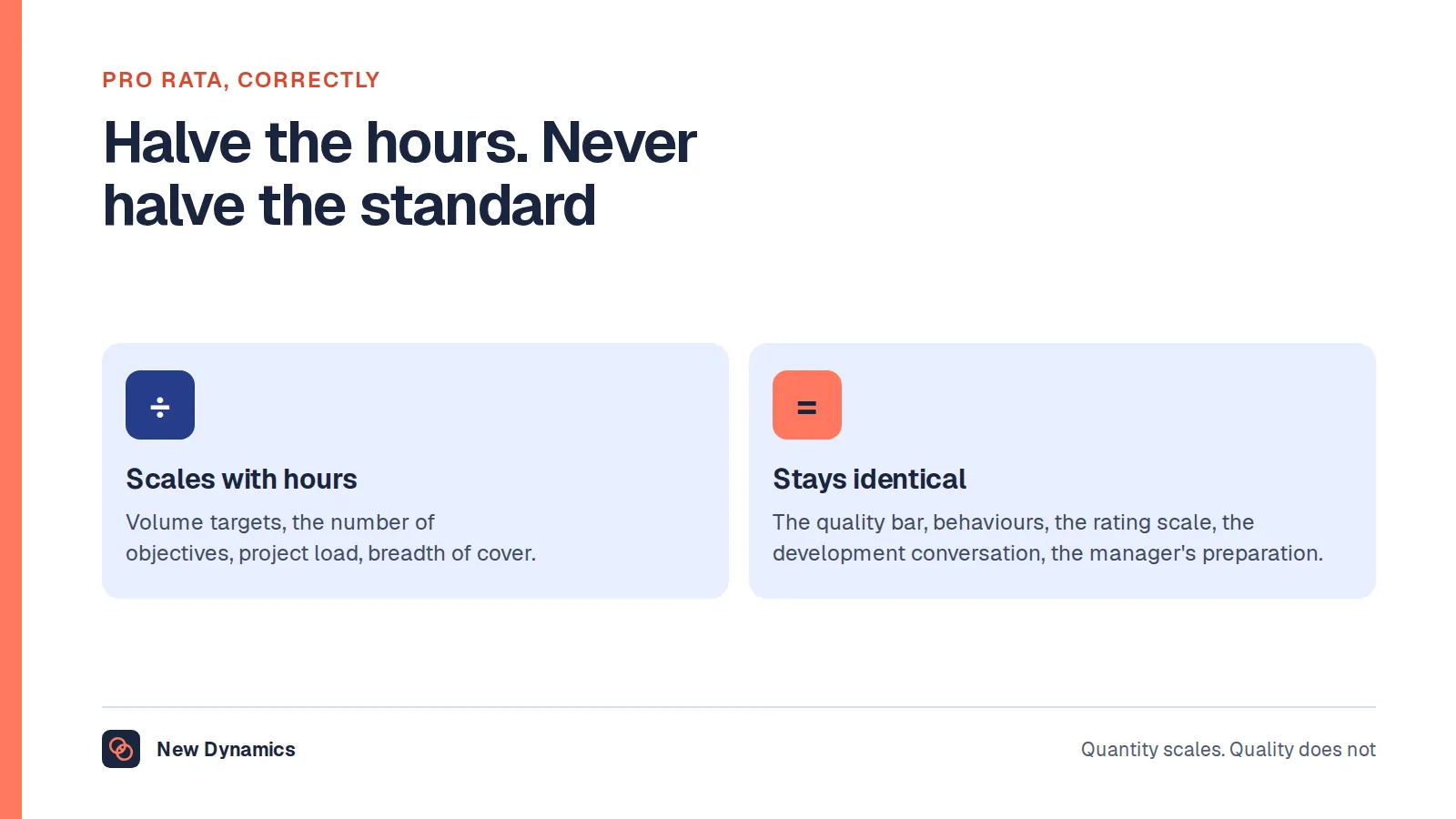
Nothing about the standard changes. The objectives, the rating scale, the form and the expectations should be identical whether someone works in an office, at home or in the split arrangement Acas describes as hybrid working: "splitting your time between: the workplace" and "working remotely, for example from home or another location".
What changes is how the manager knows anything. In an office, evidence arrives without being asked for: the overheard call handled well, the person who stayed to help, the visible effort on a hard week. Remotely, none of that arrives. A manager who does not replace it with something deliberate ends up writing a review from the small sample they happen to have, which is usually the last video call and whatever landed in their inbox.

Proximity bias, and why it is a legal risk
Proximity bias is rating the people you see above the people you do not. It shows up as remote employees getting vaguer reviews, fewer stretch opportunities, slower promotion and lower ratings for the same work.
In Great Britain it can also become a legal problem. Acas explains that discrimination includes "indirect discrimination – when everyone's treated the same but people with a protected characteristic are put at a disadvantage", and that less favourable treatment "can be anything that puts someone with a protected characteristic at a disadvantage", which "might include: excluding someone from opportunities or benefits" or "making it harder for someone to do their job". Disability, sex, and pregnancy and maternity are among the protected characteristics it lists.
The link is not hypothetical. People work remotely disproportionately because of disability, health conditions and caring responsibilities. A review process that systematically scores remote workers lower is therefore capable of disadvantaging those groups even when every manager believes they are applying the same standard to everyone. That is the shape of an indirect discrimination problem, and it is worth testing for rather than assuming away. The law differs in Northern Ireland, and this is general information rather than legal advice.
The practical defence is the same thing that makes the review useful: evidence, recorded as it happens, compared across the team before ratings are final. Our performance calibration guide covers that comparison.
Six places the evidence comes from
- The work itself. Shipped code, closed tickets, documents written, deals signed, cases resolved. The artefact is the evidence, and it does not care where it was made.
- The objectives. Written outcomes with dates beat impressions in any setting, and they are the only thing that lets a remote employee prove their case.
- Notes from one-to-ones. Ten minutes after each conversation is the single highest-value habit for a remote manager.
- Feedback from the people they actually work with. Remote employees often collaborate widely and visibly to their peers while being invisible to their manager. Ask three colleagues.
- The employee's own account. The self-assessment matters more remotely, because it is the main channel for work the manager never saw.
- Customer or stakeholder signals where the role has them: complaints, compliments, renewals, escalations.
Note what is not on that list: anything to do with presence.
What never to measure
- Hours logged or time online. It measures the status indicator, not the work.
- Response speed in chat. Rewarding fast replies punishes deep work and the people in other time zones.
- Camera on. It is a preference, not a performance measure, and insisting on it disadvantages people with disabilities, caring responsibilities or small homes.
- Keystrokes, screenshots or activity scores. Monitoring output in this way measures compliance with being watched. It also raises data protection duties well beyond the scope of a review.
- Visibility in meetings. Some of the best remote contributors write rather than speak.
Each of these produces exactly what it measures: people who look available. If a measure would embarrass you in a tribunal or a team meeting, it does not belong in a review.

Running the review meeting remotely
- Video, not phone, and both cameras on by agreement rather than by instruction.
- Send the draft first, far enough ahead to read. Reading in silence together is worse remotely than in person.
- Leave longer pauses than feel natural. Latency eats the gaps where people decide to say something difficult.
- Watch for the half-sentence that gets dropped when two people start talking. Remotely, the quieter person simply stops.
- Confirm in writing straight afterwards. Acas treats the written record as part of the job, saying it is "important to keep a written record of what is discussed" and that it should be shared with the employee. Remotely it also replaces the shared memory of the room.
- Book longer than you would in person, then end early if you can.
Objectives that survive distance
Remote work exposes vague objectives faster than office work does, because nobody can fall back on having seen the effort. Objectives for a remote employee should name an outcome, a measure and a date, and should be verifiable by someone who was not there. "Improve the onboarding documentation" is an office objective; "rewrite the onboarding guide so a new starter can complete setup without asking, by the end of the quarter" works anywhere.
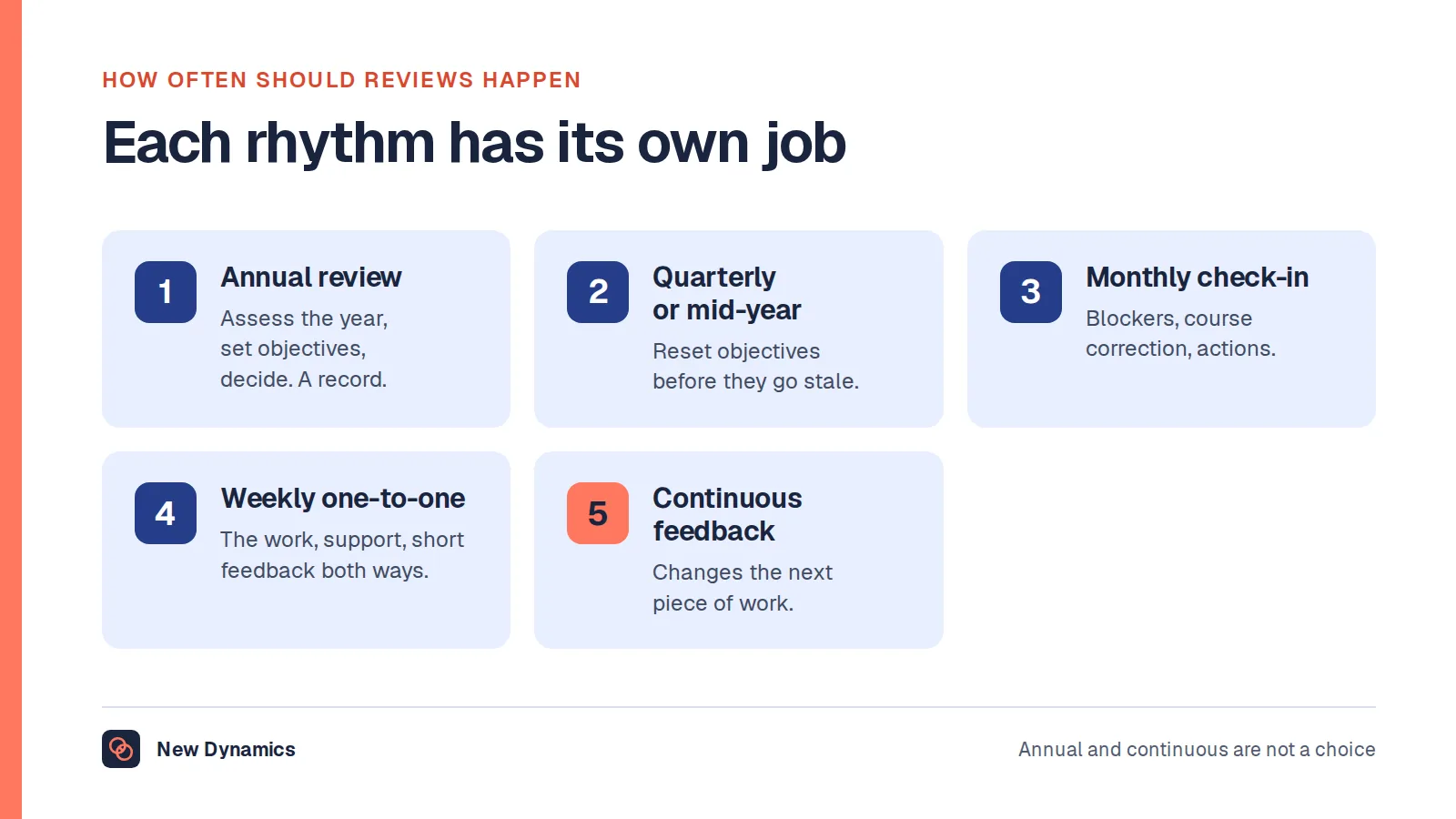
Our guide to performance review frequency covers the rhythm that keeps those objectives current, which matters more when the informal correction of office life is missing.
The hybrid trap
The hardest case is not the fully remote team. It is the half-and-half meeting where three people share a room and two are on a screen. The people in the room get more airtime, finish each other's sentences and leave with a shared understanding that the remote pair do not have. Repeated over a year, that becomes a difference in evidence, and then a difference in ratings.
Two habits help: when anyone is remote, everyone joins individually, and anything decided in a room gets written down before the meeting ends.

Frequently asked questions
How do you conduct a performance review for a remote employee?
Use the same standard, objectives and form as for anyone else, and change only how you gather evidence: the work produced, written objectives, notes from one-to-ones, feedback from colleagues they work with, their self-assessment and any customer signals. Hold the meeting on video, send the draft in advance and confirm what was agreed in writing.
What is proximity bias in performance reviews?
Rating the people you see more often above the people you do not, usually without noticing. It appears as vaguer reviews, fewer opportunities and lower ratings for remote staff doing comparable work. Comparing ratings across a team before they are final is the most reliable way to catch it.
Can treating remote workers differently be discrimination?
It can. Acas describes indirect discrimination as everyone being treated the same while people with a protected characteristic are put at a disadvantage, and lists disability, sex, and pregnancy and maternity among those characteristics. Because remote working often tracks disability and caring responsibilities, a process that consistently scores remote staff lower risks disadvantaging those groups. This is general information about the position in Great Britain, not legal advice.
Should you measure hours online or activity for remote employees?
No. Time online, response speed and activity scores measure availability and compliance with being watched, not contribution, and managing by them produces people who are good at appearing busy. Measure outcomes and the work produced instead.
How do you set objectives for remote workers?
Name an outcome, a measure and a date, and make it verifiable by someone who was not present. Remote work removes the fallback of having seen the effort, so an objective that depends on the manager's observation will not survive the review.
How do you run a fair review in a hybrid team?
Watch the meetings as closely as the ratings. When anyone is remote, have everyone join individually rather than splitting between a room and a screen, write down anything decided in the room, and compare ratings across location before they are final.
Your next step: check your own split
- Sort last cycle's ratings by how often each person is in the workplace, and look at the distribution.
- If remote staff cluster lower, examine the evidence behind those reviews before you examine the people.
- Remove any measure of presence from your form and your habits.
- Add ten minutes of note-taking after every one-to-one, which is where remote evidence comes from.
For comparing ratings fairly across a team before they are final, read and download our performance calibration guide. The guide is free to read, and the PDF uses our short download form.
Want objectives, feedback and notes visible wherever people work? Book a New Dynamics demo and bring your current review form. You can also email contact@new-dynamics.com.