TL;DR
- Most arguments about signing a review are really arguments about what the signature means. A signature can mean received, discussed, or agreed, and almost no form says which, so both people assume the one that suits their fear.
- If someone declines, the review still stands as the manager's assessment. Record that it was shared and discussed, with the date and the reason given, correct anything factually wrong, and attach the employee's own comments rather than editing yours.
- Fix the cause rather than the incident: one line on the form confirming that signing acknowledges the discussion rather than agreement stops nearly every version of this conversation.
The meeting is over, the form is printed, and the employee says no. Not angrily, usually. They just do not want to put their name under a paragraph they think is wrong, because signing looks like agreeing, and nobody has ever told them it is not.
This article covers what the signature actually means, what to do when someone declines, what never to do, the wording that prevents the whole situation, and how the same question applies to a digital acknowledge button. It describes the position in Great Britain and the UK and is general information, not legal advice.
The cleanest version of this problem is a system that records the discussion, the date and the response separately. See how New Dynamics performance reviews keep the record and the employee's response in the same place.
What a signature can mean

There are three possible meanings, and the form almost never says which one applies.
Received. The weakest and most common intended meaning: this document was given to me.
Discussed. Stronger and more useful: this was talked through with me on this date, and I had a chance to respond.
Agreed. The meaning employees assume and employers rarely intend. Almost no organisation actually needs this one, and asking for it guarantees a fight with anyone who disagrees with their rating.
Because the form is silent, the employee reads "agreed" and the manager means "received", and the disagreement is about a word that was never written down.
So, can they refuse?
In practice, yes. Acas's requirement is about the record rather than the autograph: "it's important to keep a written record of what is discussed", and that record "should be shared with the employee afterwards". Sharing it is the employer's job; countersigning it is not something Acas asks of the employee.
A refusal does not erase the review either. The assessment remains the manager's assessment, the record remains the record, and the cycle carries on. What changes is what you write underneath, which is why the next section matters more than the question people arrive with.
Whether a refusal can have any further consequence depends on the contract and the policy rather than on a general rule, and chasing that point is usually a waste of a working relationship. The useful questions are why they will not sign, and whether something in the document is wrong.
Five steps when someone declines

- Ask why, and write down the answer. "I disagree with the rating" and "the second paragraph is factually wrong" lead to completely different responses.
- Correct what is actually wrong. The ICO's accuracy principle says employers "must take all reasonable steps to keep any personal information you hold about your workers accurate and up-to-date" and should "carefully consider any challenges to the accuracy of information". A wrong date, a project they did not work on or a misquoted number gets fixed, and that is not a concession.
- Offer the comments box. A difference of judgement is not an error, and the answer is to record both views. Invite a written response, give a date for it, and attach it to the record unedited.
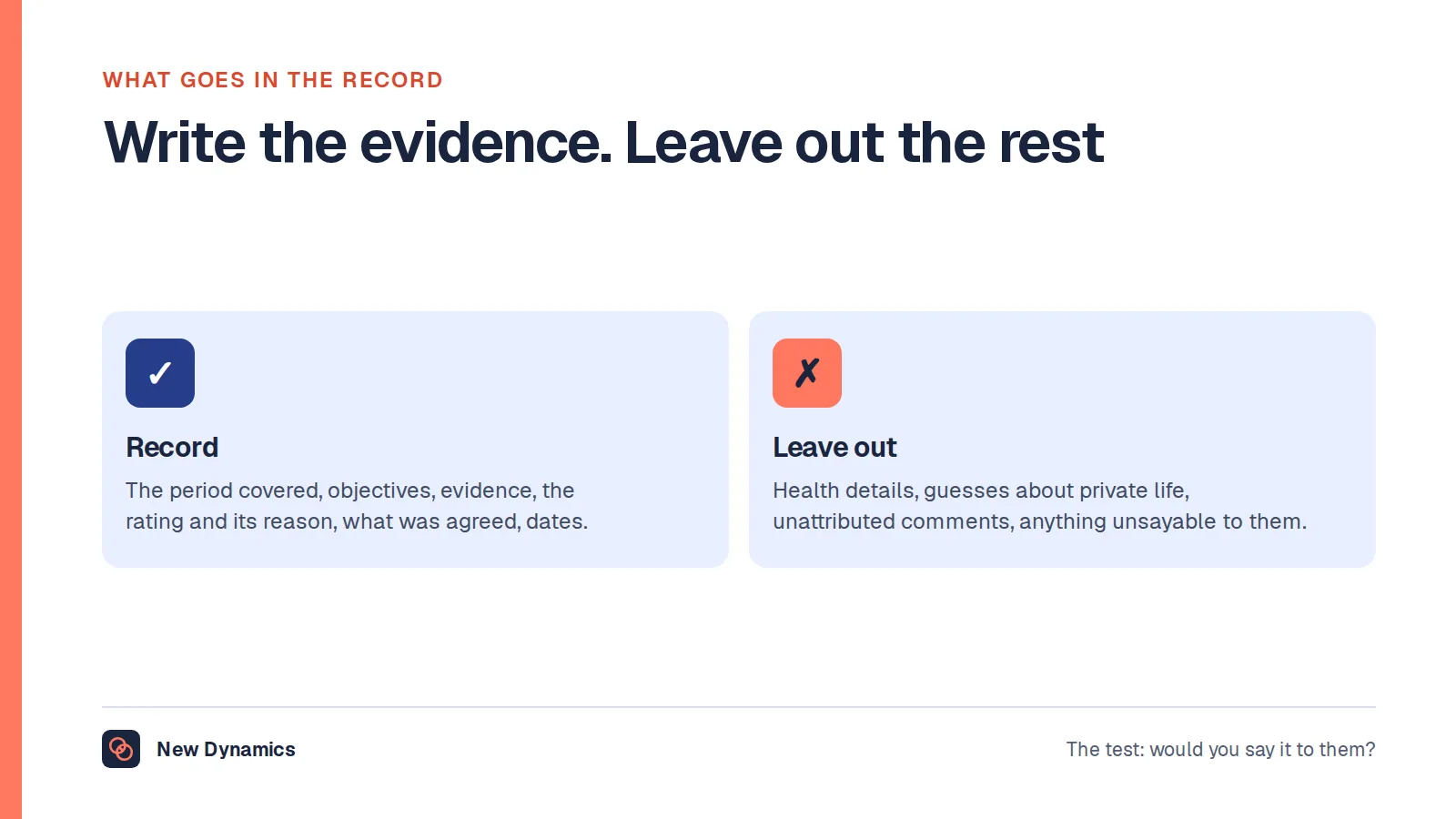
- Record what happened instead of a signature. A line on the file reading that the review was discussed on a given date, shared with the employee, and that they chose not to sign, with their reason, is better evidence than a signature obtained under pressure. Ask for an email acknowledging receipt as an alternative, which most people will send.
- Name the route onwards. Acas suggests that where someone has a problem at work "it's usually a good idea for them to raise it informally first", and that employers "should respond even if the problem's raised informally", with the formal grievance procedure available if that does not resolve it. Telling someone the route exists usually makes it less likely they will need it.
What never to do

Do not change the rating to get the signature. A rating that moves under social pressure was either wrong before or wrong after, and the next person who pushes will get the same result.
Do not treat the refusal as misconduct by reflex. It is information about the review, and escalating it turns a disagreement about last year's work into a disciplinary matter about this afternoon.
Do not make the signature a condition of anything. Holding a pay increase or an objective-setting conversation hostage to a signature converts a records question into a grievance.
Do not write "refused to sign" without telling them. Anything on the file can be read by the employee: the ICO's right of access, usually called a subject access request, must be answered "without delay and within one month". Write the note in front of them, or send it to them afterwards.
Do not leave it blank. An unsigned review with no explanation is the worst of all outcomes, because in a year nobody will remember whether it was discussed at all.
The line that prevents all of this
Put the meaning on the form, immediately above the signature box. Wording to adapt:
"I confirm that this review was discussed with me on (date) and that I have received a copy. Signing does not mean I agree with its contents. If I disagree, I can add written comments, which will be kept with this review."
Then add a second box for the employee's comments, with no length limit, and a line stating how long they have to return it. Most refusals disappear at this point, because the thing people were refusing was never the signature.
The digital version
An acknowledge button is the same question with fewer manners. If your system has one, check three things:
- It says what acknowledging means, in the same words as the paper form would.
- It offers "acknowledged with comments", so disagreement does not require refusal.
- It never acknowledges by timeout. A system that marks a review as accepted because nobody clicked within 14 days has recorded something that did not happen, which is worse than an empty field. The wider point is covered in our post on performance review record keeping.
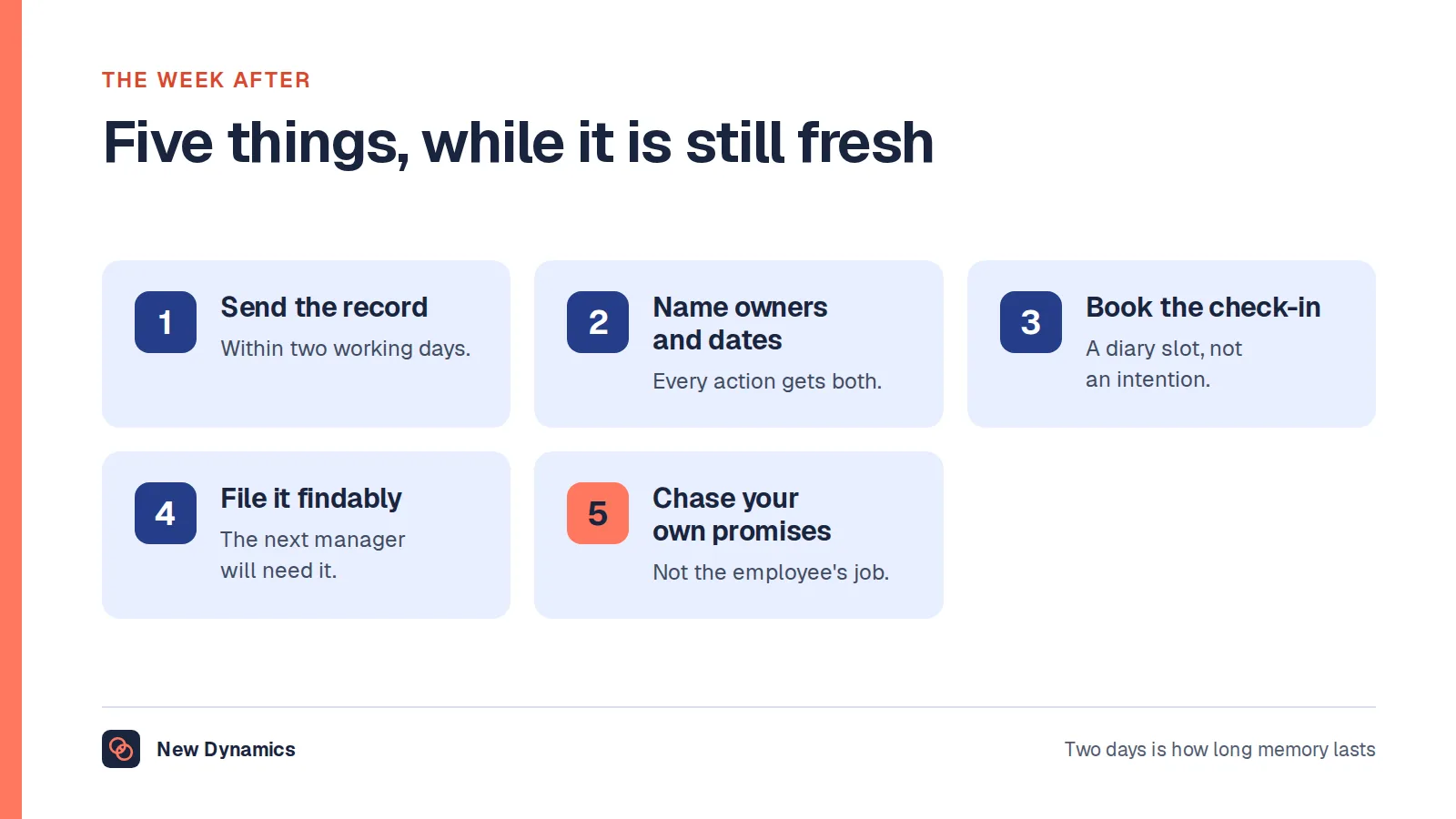
Log the date shared, the date acknowledged and any comments as three separate facts. They answer three different questions later.
If you are the employee
You can decline, and it is worth saying why rather than leaving it at no. Ask what the signature is taken to mean in your organisation, and ask for that to be written on the form. Separate the factual errors, which you can ask to be corrected, from the judgements, which you can respond to in writing and have kept alongside the review.
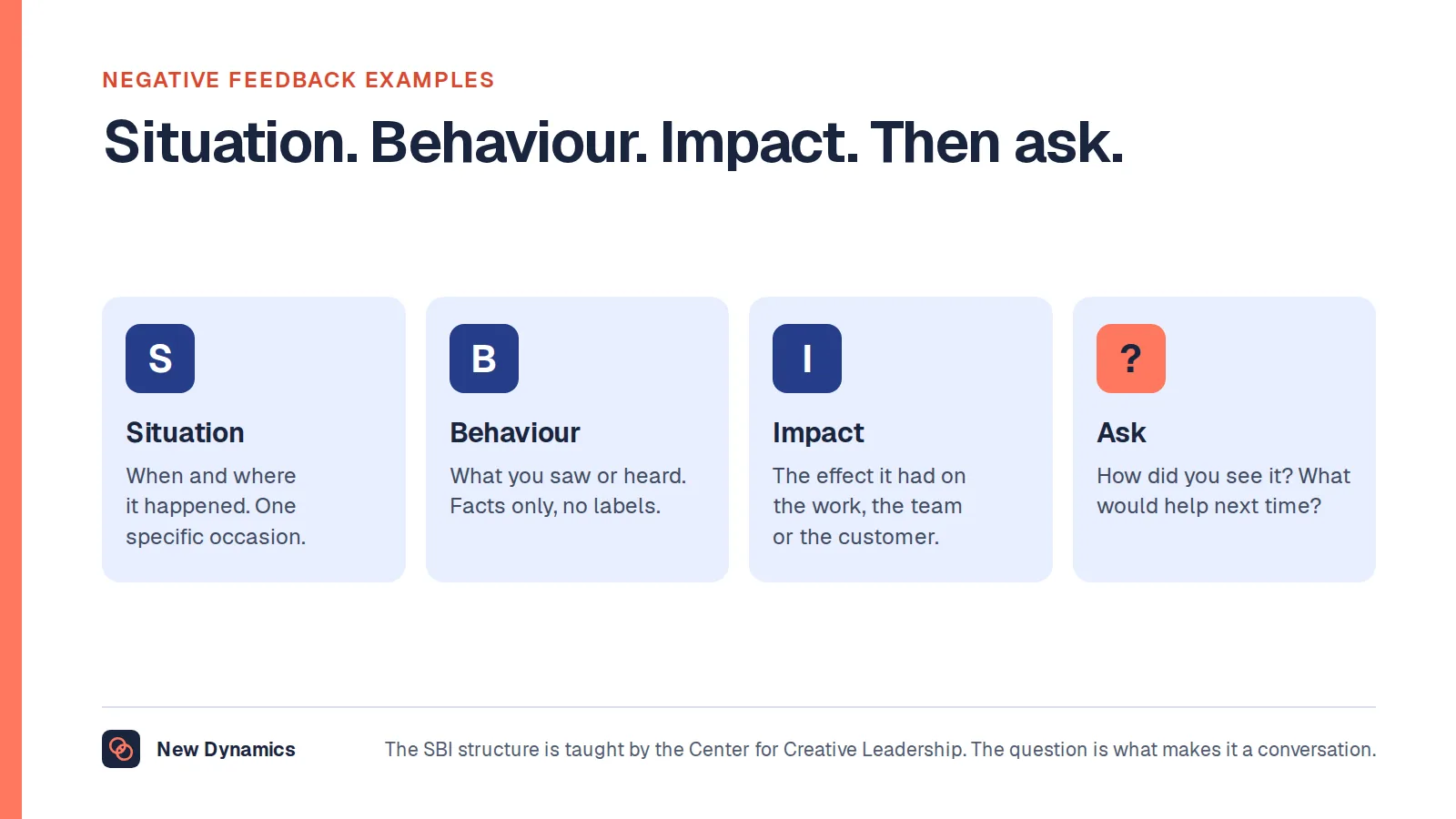
If it matters to you, raise it informally first, then formally if that does not resolve it, and remember you can ask for a copy of what is held about you. How you word a response matters: our post on negative feedback examples covers the language that keeps a disagreement about the work rather than the person.
Frequently asked questions
Can an employee refuse to sign a performance review?
In practice yes, and the review still stands as the manager's assessment. Acas asks employers to keep a written record of the discussion and share it with the employee rather than to obtain a signature. Record that the review was discussed and shared, with the date and the reason given for not signing, and ask for an email acknowledging receipt instead.
Does signing a performance review mean you agree with it?
Only if the form says so, and most organisations do not intend that meaning. A signature usually confirms that the document was received and discussed. The fix is a line above the signature box stating exactly that, together with a comments box for anything the employee disagrees with.
What should a manager do if an employee will not sign?
Ask why and record the answer, correct anything factually wrong, invite written comments and attach them unedited, note on the file that the review was discussed and shared on a given date, and explain the route for raising a concern informally and then formally. Do not change the rating to obtain a signature.
Can an employee add comments to their performance review?
They should be able to, and a record showing two views is more credible than one that shows none. The ICO expects employers to consider challenges to the accuracy of information they hold, and attaching an employee's written response is the simplest way to do that without rewriting the manager's assessment.
Is a performance review valid if it is not signed?
A review is a record of an assessment, not a contract, so the absence of a signature does not void it. What matters is whether it was shared and discussed, whether that is documented, and whether the employee had a chance to respond. Those three things, written down, are stronger than a signature alone.
What if an employee refuses to acknowledge a review in the HR system?
Treat it exactly as a refusal to sign on paper: find out why, fix errors, record the discussion and the date, and allow comments. Check that your system offers an "acknowledged with comments" option and that it never marks a review as acknowledged automatically after a deadline, because that records something that did not happen.
Your next step: change the form, not the conversation
- Look at the signature box on your current form and write down what you intend it to mean.
- Add that sentence to the form, above the box, in the employee's language.
- Add a comments field with a stated deadline for returning it, and a rule that comments are attached unedited.
- Check your HR system for auto-acknowledgement on timeout, and switch it off.
For the rest of the cycle this sits inside, read and download our performance review guide. The guide is free to read, and the PDF uses our short download form.
Want reviews where the employee's response is part of the record rather than an argument about a signature? Book a New Dynamics demo and bring your current form. You can also email contact@new-dynamics.com.