TL;DR
- The classic personality questions are the weakest questions in the interview. “Describe yourself in three words”, “what are your greatest weaknesses” and “what animal would you be” are rehearsed by every prepared candidate, impossible to score consistently, and answered best by people who interview often rather than by people who would do the job well.
- What the interviewer actually wants to know is answerable: how this person works, how they deal with other people, what they do when things go wrong, what motivates them and how well they know themselves. These 30 original questions ask about behaviour, which is what the US Office of Personnel Management describes structured interviews as measuring, “by systematically inquiring about their behavior in past experiences and/or their proposed behavior in hypothetical situations”, and which it notes can assess competencies such as interpersonal skills that other methods miss.
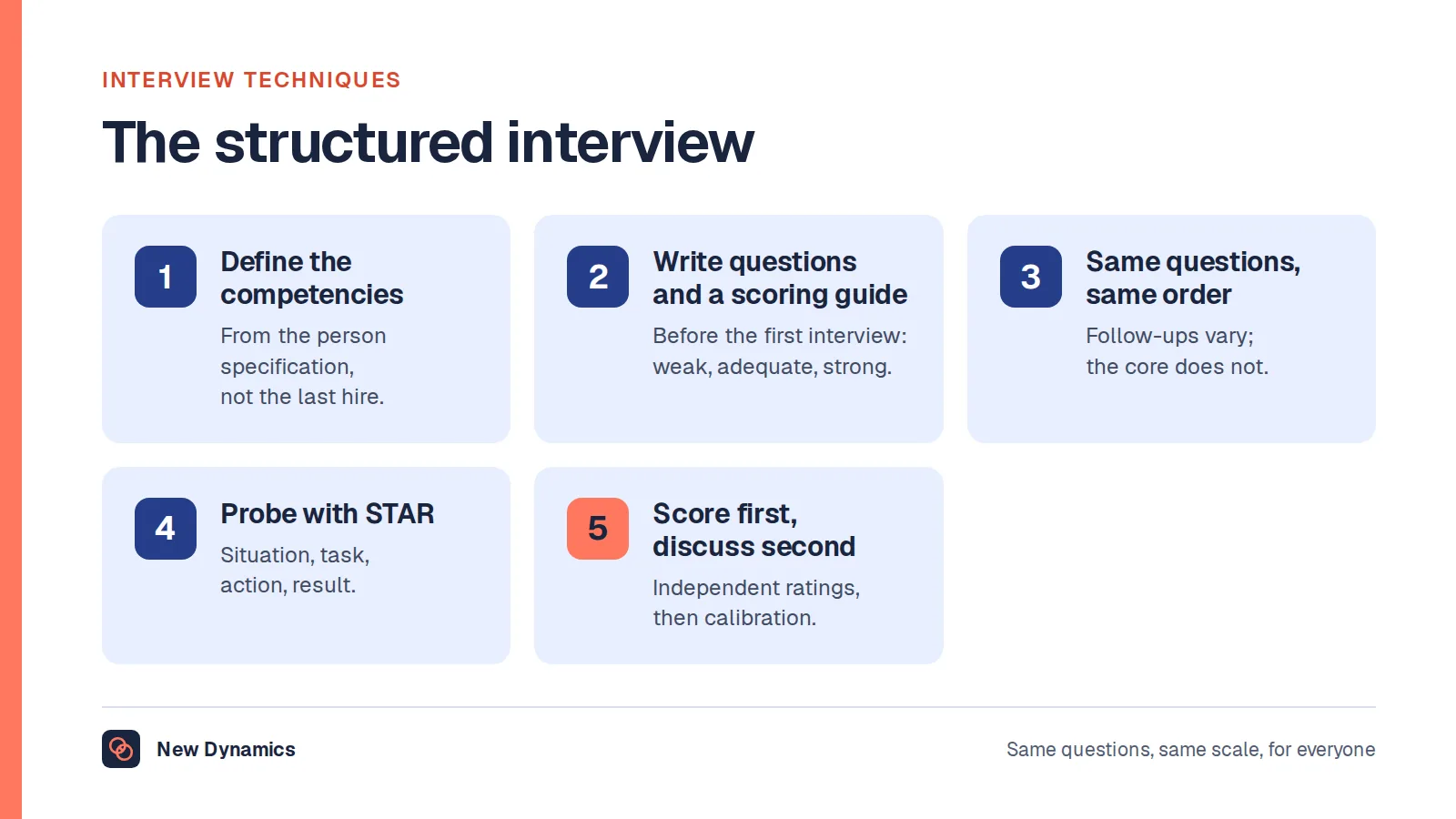
- Score them as you would any structured interview: the same questions in the same order, the same rating scale and an agreed standard for an acceptable answer. Keep to the Acas fairness rules, and avoid the four traps: fishing for protected characteristics, judging personality from social media, which Acas warns against because “you might be breaking the law”, brain-teasers, and using “culture fit” to mean people like us.
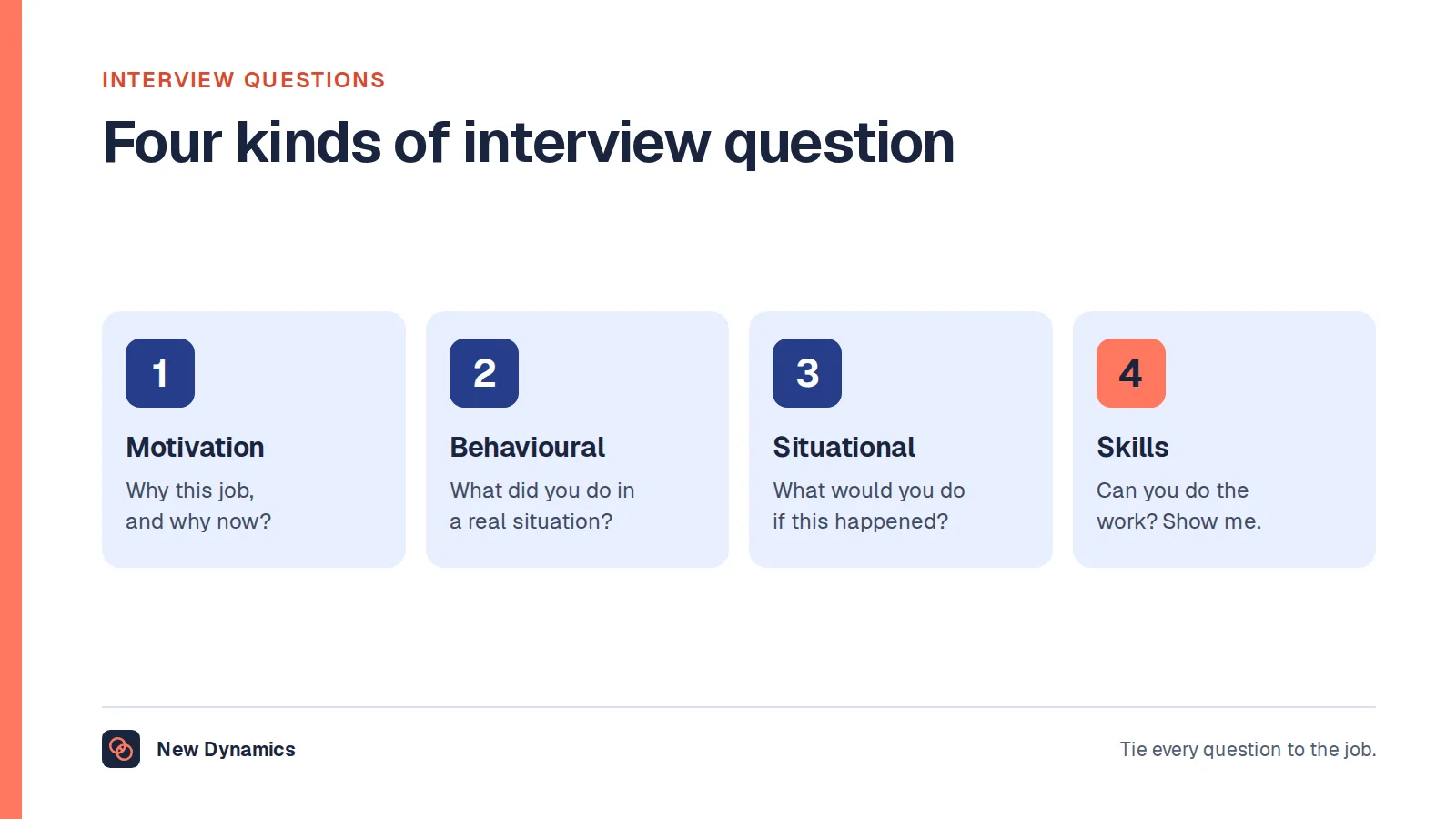
Every interviewer wants to know what a candidate is actually like, and most reach for the same three questions to find out. "Describe yourself in three words." "What is your greatest weakness?" "If you were an animal, what would you be?" Each of them is answered best by whoever has been to the most interviews.
Personality interview questions can be worth asking, but only when they ask about behaviour that the job needs and can be scored against a standard. This article gives 30 original questions in five groups, with what a strong answer contains and the weak answer to watch for; explains the difference between personality questions at interview and a validated assessment; shows how to score; and sets out the four traps. It describes the UK position on fairness and is general information, not legal advice.
What you test at interview should be what you manage afterwards. See how New Dynamics performance reviews keep the behaviours you hired for in the same place as goals, feedback and development.
Why the classic questions fail
Three reasons, and they compound.
- They are rehearsed. "My weakness is that I care too much" is a script. The question measures preparation, not character.
- They cannot be scored. Two interviewers will rate the same three adjectives differently, because there is no agreed standard for a good answer.
- They invite bias. With nothing objective to rate, the interviewer falls back on whether the candidate reminds them of someone who did well before, which is how teams become uniform.
The alternative is not to stop asking about personality. It is to ask about it the way the US Office of Personnel Management describes structured interviews: measuring job-related competencies “by systematically inquiring about their behavior in past experiences and/or their proposed behavior in hypothetical situations”. The OPM notes that structured interviews can evaluate competencies “that are difficult to measure using other assessment methods (e.g., Interpersonal Skills)”, and that they work because “all candidates are asked the same predetermined questions in the same order” and “all responses are evaluated using the same rating scale and standards for acceptable answers”.
30 personality interview questions
Choose six to eight that match what the job actually needs. Ask every candidate the same ones, and follow each with "what did you do?" and "what happened next?".
How they work
- Describe how you organise a week with more work in it than hours. Strong: a real system, and what they drop. Weak: "I just work harder."
- When you start something new, do you read the instructions, ask someone, or try it? Give me an example.
- Tell me about a piece of work you were proud of. What made it good?
- How much detail do you need before you can start? When has that helped, and when has it slowed you down?
- Describe a time you finished something early. What did you do with the time?
- What does a good day at work look like for you, hour by hour?
How they deal with people
- Tell me about a colleague you worked well with. What made it work?
- Describe a time you had to persuade someone who did not report to you.
- How do you prefer to receive bad news at work, and how do you give it?
- Tell me about a time you were the newest person in a team. How did you find your place?
- When did you last change your approach because of something a colleague said?
- How do you know when someone needs help but has not asked?
Pressure and setbacks
- Tell me about the worst week you have had at work. What happened and what did you do?
- Describe something that did not work out. What was your part in it?
- How do you behave when you are stressed, and what do colleagues notice first?
- Tell me about a time you were criticised. What did you do with it?
- When something goes wrong, are you more likely to escalate early or to try to fix it first? Give me an example of each.
- What do you do when you are stuck?
What motivates them
- What part of your last job would you happily do all day?
- What part did you avoid, and how did you make sure it still got done?
- Tell me about a time you kept going with something difficult. Why did you?
- What makes you feel a piece of work was worth doing?
- What would have to be true for you to still be here in three years?
- Tell me about a job or a team you left. What made you leave?
Self-knowledge
- What do people consistently come to you for?
- What do you find harder than most people seem to?
- What feedback have you heard more than once in your career?
- In what kind of environment do you do your worst work?
- If we hired you and it did not work out, what would the most likely reason be?
- What have you changed your mind about in the last two years?

What a strong answer contains
- A specific occasion, not a policy. "Last March, when the system went down" beats "I'm good under pressure".
- What they actually did, in the first person singular, with a decision in it.
- An outcome, including when it went badly.
- Self-knowledge without performance. A real weakness described plainly and managed is worth more than a disguised strength.
- Other people in the story, named and credited.
The weak answers are recognisable too: the hypothetical ("I would always..."), the collective ("we decided..."), the flawless narrator and the rehearsed adjective.

Personality questions, not personality tests
Two different things, and the difference matters.
Personality questions at interview ask a person to describe their own behaviour. They are useful for exploring, for prompting examples and for seeing how someone thinks aloud. They are not a measurement.
Validated personality assessments are structured instruments with published evidence about what they measure and how well. If you use one, it should be chosen for its relevance to the job, administered and interpreted by someone trained to do so, used alongside other evidence rather than as a gate, explained to candidates, and offered with reasonable adjustments. A questionnaire found online and scored by intuition is not an assessment; it is a personality question with a spreadsheet attached.
Neither replaces asking the person what they did last time.
Four traps
- Fishing for protected characteristics. Questions about family, health, age, beliefs or personal circumstances dressed up as getting to know someone. Acas is direct in its guidance on interviewing job applicants: questions “must not discriminate”, interviews should where possible be carried out by more than one person “to reduce the risk of discriminating”, interviewers should be prepared and understand discrimination law, and applicants must be asked about reasonable adjustments.
- Judging personality from social media. Acas's guidance on choosing who to interview says you should use the information you told applicants you would use, and to “avoid using information that's on someone's personal social media profile to decide whether you interview or hire them”, adding that “you might be breaking the law”.
- Brain-teasers and puzzles. They measure practice at brain-teasers and make the interview adversarial.
- "Culture fit" meaning sameness. If a personality question is being used to check whether someone is like the existing team, it is screening for uniformity. Ask instead whether they can work with people who are different from them, which is the thing that actually matters.

How to score
- Pick six to eight questions that match the behaviours the job needs, and use the same set for every candidate.
- Write the standard first: what an acceptable answer contains, agreed with the other interviewer before the first interview.
- Rate immediately, on the same scale, recording the evidence rather than the impression.
- Compare question by question, not overall impression by overall impression, and record the reasons for the decision.
Acas adds that any notes or recordings must be stored securely and confidentially and that data protection rules apply. Our guide to interview techniques covers the mechanics, and interview questions to ask candidates is the wider bank.
Frequently asked questions
What are good personality interview questions?
Questions about how the person actually works: how they organise an overloaded week, how they give and receive bad news, what they do when stuck, what part of their last job they would happily do all day, what feedback they have heard more than once, and what would most likely go wrong if you hired them. Each is specific enough to answer badly, which is what makes it useful.
Why are questions like "what is your greatest weakness" not useful?
Because they are rehearsed, cannot be scored consistently and leave the interviewer rating a performance. A structured question about a real occasion produces evidence; an invitation to self-describe produces a script.
How do you assess personality in an interview fairly?
Ask every candidate the same job-related questions in the same order, agree in advance what an acceptable answer contains, rate each answer on the same scale with the evidence recorded, and use more than one interviewer. Acas says interview questions must not discriminate, that applicants must be asked about reasonable adjustments, and that notes must be stored securely.
Should we use a personality test instead?
Only a validated instrument, chosen for relevance to the job, administered and interpreted by someone trained, used alongside other evidence rather than as a gate, explained to candidates and offered with adjustments. It does not replace asking people what they did last time.
Can we look at a candidate's social media to judge their personality?
Acas advises against it: use the information you told applicants you would use, and avoid using someone's personal social media profile to decide whether to interview or hire them, because you might be breaking the law.
Your next step: replace three questions
- Take your current interview pack and find the three questions that cannot be scored.
- Replace them with three from the groups above that match the behaviours this job needs.
- Write down what an acceptable answer contains for each.
- Book a second interviewer and agree the scale before the first interview.
For the process these questions sit inside, read and download our recruitment and selection guide. The guide is free to read, and the PDF uses our short download form.
Want the behaviours you interviewed for to show up in probation objectives and reviews, on your own form? Book a New Dynamics demo and bring your current interview pack. You can also email contact@new-dynamics.com.