TL;DR
- A piece rate is, in the Cambridge Business English Dictionary's definition, a way of paying for work that is based on a fixed rate for a particular amount done rather than the time it takes to do the job. Workers paid per task or piece are doing what the UK minimum wage rules call output work, and GOV.UK says it can usually only be used in limited situations where the employer does not know which hours the worker does; if the employer sets the start and finish times or a minimum or maximum time, the work counts as time work and the minimum wage applies to every hour.
- For genuine output work, GOV.UK says workers must be paid either at least the minimum wage for every hour worked or a fair rate for each piece. The fair rate is worked out by a set method: test how many pieces an average, typical group of workers completes in an hour, divide that average by 1.2 so new workers are not disadvantaged, and divide the hourly minimum wage by the result. GOV.UK's example is a strawberry farm where an average worker picks 24 kilograms an hour, which becomes 20 after the division, so the rate per kilogram is the hourly minimum wage divided by 20.
- Piece rates reward speed and make labour cost predictable per unit, but they push against quality, safety and fairness to new and slower workers, and they complicate sick pay, holiday pay and overtime. Before setting one, decide what the rate will do to quality and safety, measure the average rate honestly, review it when the work changes, and put the rate, the test and the review in writing. This is general information about the UK rules, not legal advice; other countries have their own.
A fruit farm pays per kilogram picked. A garment workshop pays per piece sewn. A courier pays per parcel delivered, a translation agency per thousand words, a cleaning contractor per room. Each is paying a piece rate, and each has to answer the same question: would someone working at an average speed still earn at least the minimum wage? The piece rates meaning is simple; the rules around it are specific, and employers who copy a rate from a competitor without doing the arithmetic are often paying below the legal floor without knowing it.
This article defines piece rates using the Cambridge Business English Dictionary, explains the UK minimum wage rules for output work from GOV.UK, including the fair rate method and GOV.UK's own example, describes where piece rates are used and their advantages and disadvantages for employer and worker, places them beside time rates, commission and bonuses, and gives a way to set, review and document a rate. It is general information about the rules in the UK, not legal advice; other countries have their own rules for piece work and minimum pay.
Piece rates reward one thing, output, and the work usually needs three: output, quality and safety. See how New Dynamics Goals & OKRs keep a team's output targets beside its quality and safety measures, so the rate does not become the only thing anyone looks at.
Define piece rate
The Cambridge Business English Dictionary defines a piece rate as “a way of paying for work that is based on a fixed rate for a particular amount done rather than the time it takes to do the job”. The adjective is piece-rate, as in piece-rate work or piece-rate workers, and the arrangement is called piece work or piecework.
The distinction is with a time rate, where the worker is paid per hour, day or month regardless of how much is produced. Under a piece rate, two workers on the same shift earn different amounts if one produces more; under a time rate, they earn the same.
Piece rates and the minimum wage in the UK: output work
GOV.UK's guidance on the minimum wage for different types of work says that workers paid per task they perform or piece of work they do, known as piece work, are classed as doing “output work”, and that they must be paid either “at least the minimum wage for every hour worked” or “a ‘fair rate’ for each task or piece of work they do”.
Two conditions limit when the fair rate route can be used:
- The employer must not know the hours. GOV.UK says output work “can usually only be used in limited situations when the employer does not know which hours the worker does (such as with some home workers)”.
- The employer must not set the times. The work is not output work if the employer sets either “a minimum or maximum time the worker must work” or “the start and finish times for a period of work”. If the employer sets the times, it counts as “time work”, and the minimum wage applies to every hour.
In practice, most factory, warehouse and shift-based piece work is time work, because the employer sets the shift. A piece rate can still be used to calculate pay, but the total for the shift must reach the minimum wage for the hours worked. The fair rate route is for the narrower case where the worker chooses their own hours and the employer cannot measure them.

How the fair rate is worked out
GOV.UK sets out a method employers must follow for genuine output work.
- Test the average rate of work. Carry out a fair test to find how many tasks or pieces an average worker completes in an hour. Test some or all of the workers; the group “must be typical of the whole workforce - not just the most efficient or fastest ones”. Divide the pieces completed in a normal working hour by the number of workers to get the average rate.
- Divide by 1.2. GOV.UK says to divide the average rate by 1.2 “so new workers will not be disadvantaged if they're not as fast as the others yet”.
- Divide the hourly minimum wage by that number to get the fair rate for each piece.
- Re-test when the work changes significantly. A new test is not needed if the same work moves to a different environment, for example from a factory to home.
GOV.UK's example: on a farm, workers are paid per kilogram of strawberries picked and can choose their hours within the farm's opening times. An average worker picks 24 kilograms an hour; divided by 1.2 that is 20. A worker eligible for the National Living Wage is paid the hourly rate divided by 20, rounded up to the nearest penny, for each kilogram, and is paid for what they pick rather than the time spent. The hourly rate in the example is the rate current when GOV.UK wrote it; use the current rate and the current guidance when you do the arithmetic.

Where piece rates are used
Piece rates appear wherever output is countable, the unit is uniform and the worker controls the pace: agriculture and fruit picking; garment and light assembly work; home working such as packing, sewing and craft production; translation, transcription and data entry paid per word or record; delivery and courier work paid per drop; some cleaning and hospitality contracts paid per room; and much platform or gig work paid per task. In each, the attraction for the employer is a known cost per unit, and for the fast worker, higher earnings.
Pros and cons of piece rates
| For the employer | For the worker |
|---|---|
| Labour cost is predictable per unit | Effort is rewarded directly; fast workers earn more |
| Output rises without supervision of hours | Pace and, sometimes, hours are the worker's to choose |
| Quality can fall as speed rises; rework and waste rise | Slower, newer, older or disabled workers earn less |
| Safety suffers when speed pays and care does not | Earnings vary with supply, weather, breakdowns and season |
| Holiday, sick and overtime pay need a reference rate | The rate can be cut when workers get faster |
The pattern is consistent: piece rates buy speed at the price of everything speed competes with. An employer who wants quality and safety has to measure and pay for them separately, through inspection, rework charged to the piece, quality bonuses or a hybrid rate.

Piece rates beside time rates, commission and bonuses
- Time rate. Pay per hour or per period. The default in most employment; the employer bears the risk of low output and manages it through supervision and performance management.
- Piece rate. Pay per unit. The worker bears the risk of low output. Lawful in the UK only as time work paid to at least the minimum wage per hour, or as genuine output work at a fair rate.
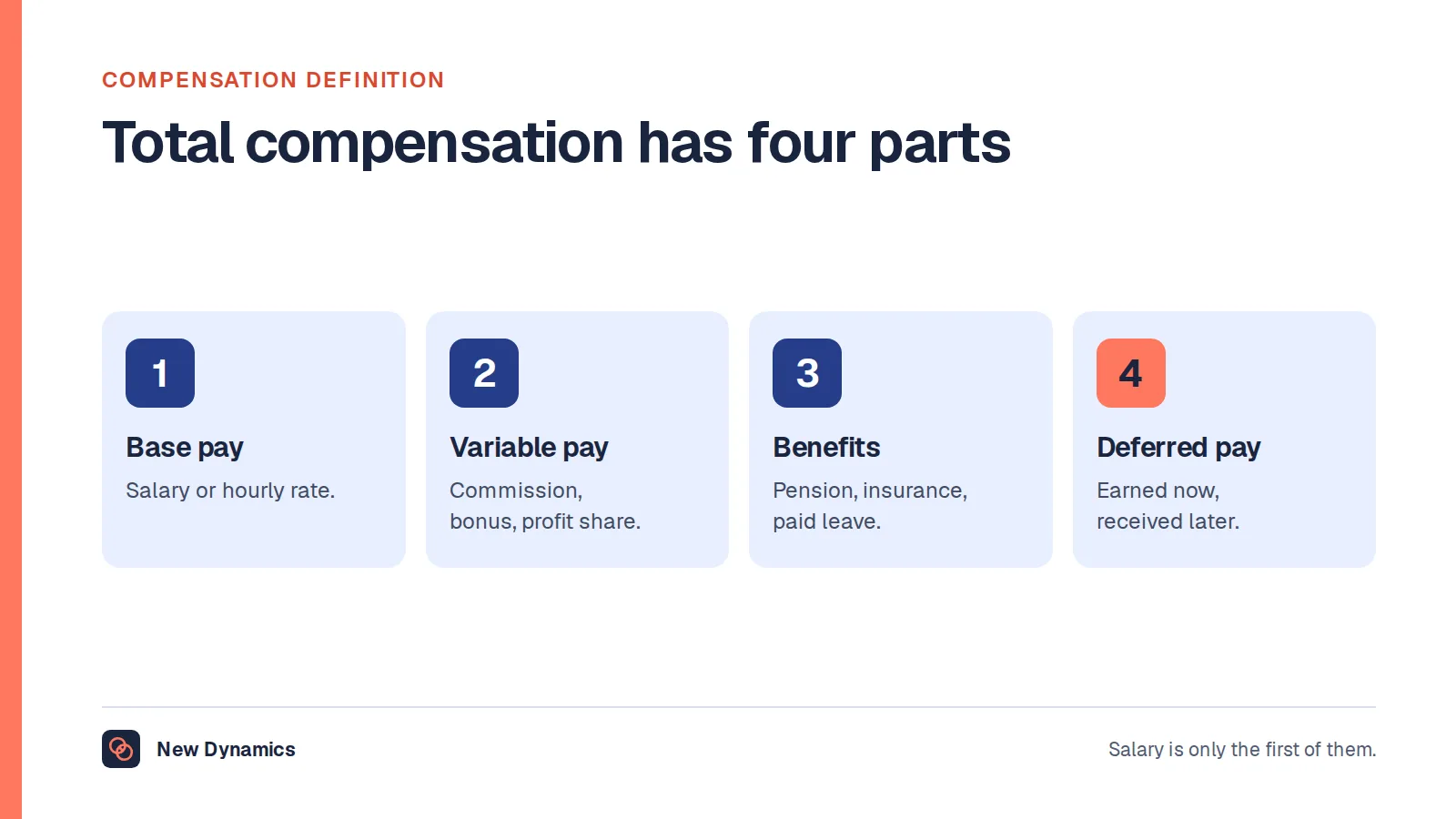
- Commission. A percentage of sales value rather than a fixed sum per unit; common in sales roles. Our definition of compensation places it among the types of variable pay.
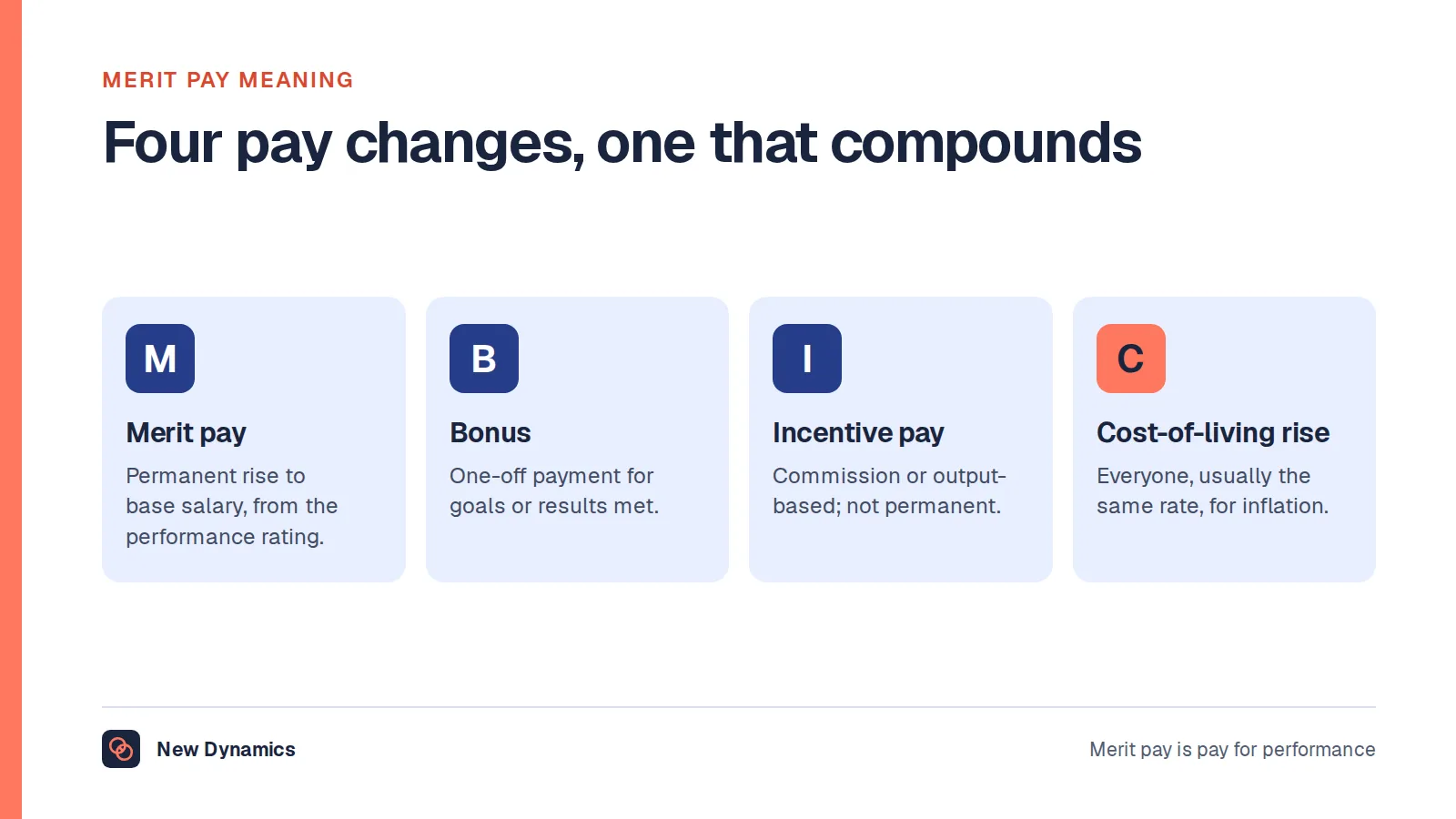
- Production bonus. A time rate plus a payment for output above a threshold. Often the better answer to “we want to reward output”: the floor is the time rate, the incentive is the bonus, and quality conditions can be attached. Merit pay is the equivalent for performance judged at review rather than counted at the bench.
How to set, review and document a piece rate
- Decide whether it is output work or time work. If you set the shift, it is time work: the piece rate is a way of calculating pay, and the shift total must reach the minimum wage for the hours. If the worker genuinely chooses the hours and you cannot measure them, the fair rate method applies.
- Run the test honestly. A typical group, a normal hour, the arithmetic written down and kept. A test on the fastest team sets a rate that underpays everyone else and fails the GOV.UK requirement.
- Decide what the rate does to quality and safety, and pay for them: inspection, rework rules, a quality bonus, protected time for training and breaks.
- Write it down. The rate, the unit, how it was tested, how quality is assessed, how holiday and sick pay are calculated, when the rate will be reviewed and how workers are told of changes. Put it in the contract or a written statement of terms.
- Review when the work changes and at least annually when the minimum wage changes, and re-run the test if the task, the equipment or the materials change significantly.
Frequently asked questions
What is a piece rate?
A way of paying for work based on a fixed rate for a particular amount done rather than the time it takes, in the Cambridge Business English Dictionary's definition. Workers are paid per unit produced, task completed or item handled: per kilogram picked, per garment sewn, per parcel delivered.
Is piece work legal in the UK?
Yes, within the minimum wage rules. GOV.UK classes work paid per task or piece as output work, which can usually only be used when the employer does not know which hours the worker does. Workers must receive either the minimum wage for every hour worked or a fair rate per piece worked out by the set method. If the employer sets start and finish times or a minimum or maximum time, it is time work and the minimum wage applies to every hour.
How is the fair rate for piece work calculated?
Test how many pieces an average, typical worker completes in an hour, divide that average by 1.2, and divide the hourly minimum wage by the result. GOV.UK's example is a strawberry picker: 24 kilograms an hour becomes 20 after the division, so the rate per kilogram is the hourly minimum wage divided by 20, rounded up to the nearest penny. Re-test if the work changes significantly.
What is the difference between a piece rate and a time rate?
A time rate pays per hour, day or month regardless of output; a piece rate pays per unit regardless of time. Under a time rate the employer bears the risk of low output; under a piece rate the worker does. Many employers combine them as a time rate plus a production bonus.
Do piece rate workers get holiday pay and sick pay?
In the UK, workers are entitled to holiday pay and, where they qualify, statutory sick pay whether they are paid by time or by piece; the employer has to calculate a reference rate from earnings. The written terms should say how. This article is general information; check current guidance or take advice for a specific case.
Your next step: do the arithmetic before you set the rate
- Decide whether the work is output work or time work by asking who sets the hours.
- Run the average-rate test on a typical group and keep the record.
- Decide how quality and safety will be measured and paid for.
- Write the rate, the test, the review date and the holiday and sick pay method into the terms.
For a policy that sets out how pay decisions are made and reviewed, read and download our compensation policy guide. The guide is free to read, and the PDF uses our short download form.
Want output targets, quality measures and pay review decisions in one place, with the evidence beside them? Book a New Dynamics demo and bring your current rate sheet. You can also email contact@new-dynamics.com.