TL;DR
- A pipefitter installs, modifies and maintains industrial pipework and the systems it serves. The National Careers Service describes the role as installing “industrial pipework, valves and sprinklers in factories, commercial premises, ships and large buildings like power stations”, with day-to-day work that runs from planning a job based on engineering designs and making or modifying parts in a workshop to installing and joining pipework by bolting and welding, carrying out planned inspections and maintenance, finding and fixing faults, and removing old pipework safely.
- The job is specification-driven rather than layout-driven. O*NET's tasks for the occupation include reviewing blueprints, codes or specifications, laying out full-scale drawings of pipe systems and supports, selecting pipe sizes, types and materials such as supports and hangers, and then inspecting, examining or testing installed systems “using pressure gauge, hydrostatic testing, observation, or other methods”.
- Two safety layers sit on top. Where a system carries a relevant fluid, the Pressure Systems Safety Regulations 2000 apply: HSE states that before using any qualifying pressure equipment, new or otherwise, “a written scheme of examination (WSE) must be in place, and an examination undertaken”. And much of the work happens in enclosed spaces, which HSE says should be avoided where possible and otherwise assessed, controlled and covered by emergency arrangements. The tickets and the safety passport belong in the advert, not in the first week's surprises.
A plumber works to a building's layout. A pipefitter works to a specification: a line number, a material, a schedule, a pressure and a drawing that says exactly where the pipe runs and what holds it up. The system is then tested before anyone signs for it.
This article sets out a pipefitter job description an engineering contractor or manufacturing site can use: eight duties, the drawings the job is built from, the testing, the pressure and confined space rules, the tickets a candidate needs, routes in and a template. It is general information about the role, not safety or engineering advice; every site works to its own procedures and risk assessments.
Pipefitters arrive with tickets, certificates and site-specific inductions to complete, and nothing slows a project like discovering in week two that one of them is missing. See how New Dynamics onboarding gives every new starter the same first weeks.
What is a pipefitter?
A pipefitter installs, modifies, tests and maintains industrial pipework and the valves, supports and controls that go with it.
The National Careers Service's pipe fitter profile, which gives "pipefitter" as the alternative title, describes the role as installing "industrial pipework, valves and sprinklers in factories, commercial premises, ships and large buildings like power stations". Its summary of the day-to-day work is the clearest short version of the job: plan how to do a job based on engineering designs; make or modify parts in a workshop; assemble components ready for installation; install and join pipework, using bolting and welding methods; carry out planned inspections and maintenance; find and fix faults; and remove old pipework and fittings safely.
The working environment matters as much as the tasks. The same profile notes you could work "in a factory, at a manufacturing plant, in an NHS or private hospital, at a power station or on a ship", and that the environment "may be cramped".
Pipefitter, plumber, welder: three different jobs
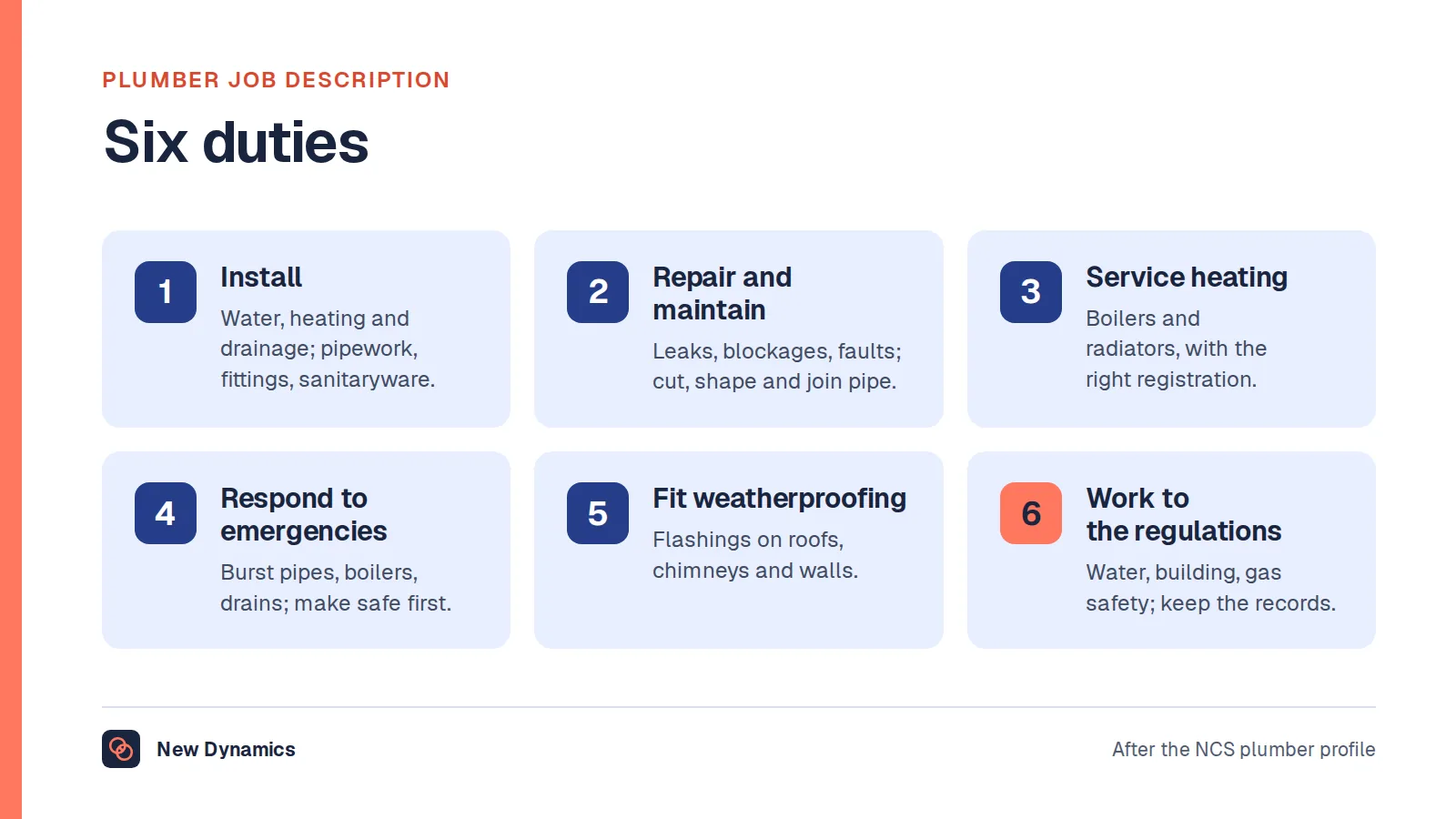
- Plumber. Domestic and commercial water, waste and heating, working largely to a building's layout and to building regulations. See our plumber job description.
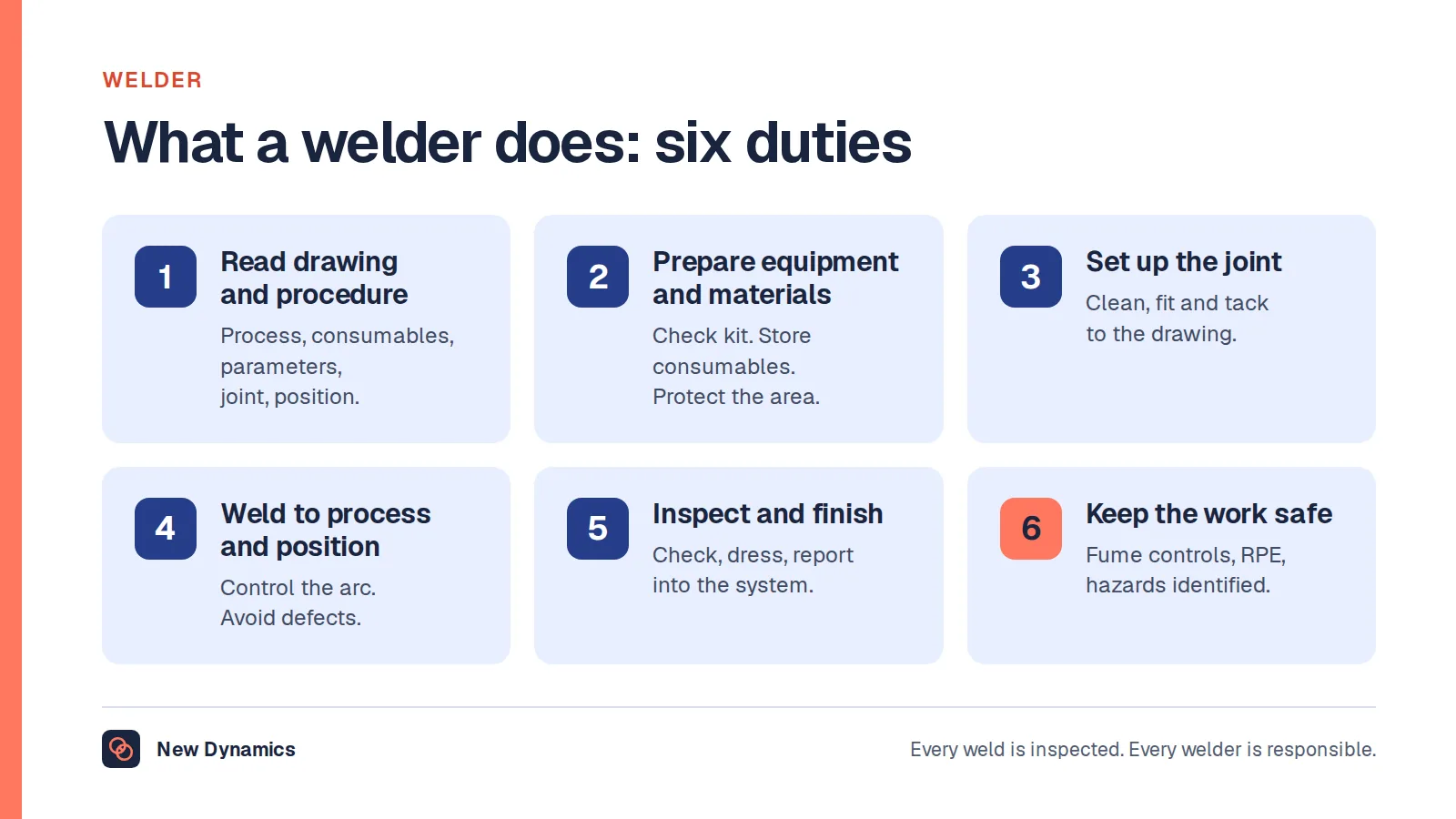
- Welder. Joins metal to a procedure and a qualification, and is judged on the joint. See our welder job description. Many pipefitters weld; many welders never fit.
- Pipefitter. Works out how a specified system gets built and installed: material, route, supports, gradients, expansion, access for maintenance, and the order of assembly. The welding, where there is any, is one step inside that.
A useful test for an advert: if the person must be able to read an isometric and build the system it describes, you are hiring a pipefitter, whatever the site calls them.
Eight duties
O*NET's occupation, Plumbers, Pipefitters, and Steamfitters, lists the tasks. Eight groups cover the fitting side.
- Read and plan. "Review blueprints, building codes, or specifications to determine work details or procedures" and "plan pipe system layout, installation, or repair, according to specifications".
- Set out. "Lay out full scale drawings of pipe systems, supports, or related equipment, according to blueprints", and "locate and mark the position of pipe installations, connections, passage holes, or fixtures in structures, using measuring instruments such as rulers or levels".
- Select materials. "Select pipe sizes, types, or related materials, such as supports, hangers, or hydraulic cylinders, according to specifications", the part an inexperienced fitter gets wrong and nobody notices until the test.
- Fabricate. "Cut, thread, or hammer pipes to specifications, using tools such as saws, cutting torches, pipe threaders, or pipe benders", often as spools made up in a workshop and taken to site.
- Install and support. "Anchor steel supports from ceiling joists to hold pipes in place" and "attach pipes to walls, structures, or fixtures, such as radiators or tanks, using brackets, clamps, tools, or welding equipment".
- Join. "Assemble pipe sections, tubing, or fittings, using couplings, clamps, screws, bolts, cement, plastic solvent, caulking, or soldering, brazing, or welding equipment."
- Test and commission. "Fill pipes or plumbing fixtures with water or air and observe pressure gauges to detect and locate leaks", "inspect, examine, or test installed systems or pipe lines, using pressure gauge, hydrostatic testing, observation, or other methods", and "install automatic controls to regulate pipe systems".
- Maintain and record. "Modify, clean, or maintain pipe systems, units, fittings, or related machines or equipment", "shut off steam, water, or other gases or liquids from pipe sections, using valve keys or wrenches", and "keep records of work assignments".

Senior fitters also "direct helpers engaged in pipe cutting, preassembly, or installation" and "estimate time, material, or labor costs for use in project plans", which is where the job turns into supervision.
The drawings, the spool and the order of work
Three habits separate a fitter who finishes on time from one who reworks.
- Read the whole drawing before cutting anything. Line numbers, materials, sizes, insulation allowance, the direction of flow and the fall.
- Think about the order of assembly and the access. A joint that cannot be welded in position, or a valve whose handwheel ends up against a wall, is a fitting error, not a design error, if the drawing allowed for it.
- Prefabricate what you can. Spools made in a workshop are faster, safer and better than the same joints made overhead in a plant room.
The regulated layer: pressure systems
A system that carries a relevant fluid is not just pipework. HSE's guidance on the Pressure Systems Safety Regulations 2000 states that the aim of the regulations "is to prevent serious injury from the hazard of stored energy as a result of the failure of a pressure system or one of its component parts", and that "before using any qualifying pressure equipment (new or otherwise), a written scheme of examination (WSE) must be in place, and an examination undertaken".
HSE defines a pressure system as a system comprising "one or more pressure vessels of rigid construction, any associated pipework and protective devices", the pipework and protective devices connected to a transportable pressure receptacle, or "a pipeline and its protective devices". A relevant fluid is:
- "steam at any pressure";
- "compressed or liquefied gas, including air, at a pressure greater than 0.5 bar above atmospheric pressure; pressurised hot water above 110 °C";
- "a gas dissolved under pressure in a solvent (acetylene)".
HSE notes that relevant fluids "do not include hydraulic oils", because hydraulic systems do not store energy in the system in the same way. There are many exceptions, set out in the regulations' schedules, and HSE points to the Approved Code of Practice to work out which rules apply.

For the job description, the point is not that the pipefitter owns the written scheme, the duty holder does. It is that the person must understand why the system is examined, work in a way that keeps it examinable, and never quietly modify a system that someone has certified.
Confined spaces and the site safety layer
Much of the work is in plant rooms, tanks, ducts, trenches and vessel interiors.
HSE's introduction to working in confined spaces defines a confined space as one that is "both enclosed or largely enclosed and has a reasonably foreseeable specified risk to workers of" fire, explosion, loss of consciousness, asphyxiation or drowning. It says that "wherever possible, you should avoid carrying out tasks in confined spaces", and where that is not possible you must assess the risks of that particular space and plan how to control them, ventilating or removing harmful fumes, establishing whether valves can be locked shut where there is a risk of liquids or gases flooding in, and providing breathing apparatus or ventilation where there is not enough oxygen.
It also puts two questions to anyone supervising the work: "how will you know they are okay and have not been overcome by fumes?" and "how will you get them out if they are overcome?", adding that "it's not enough to rely on the emergency services". And it says plainly: make sure the person doing the work "is capable and trained in both the work and the use of any emergency equipment".
That sentence is a job description requirement, not a safety poster. Name the training in the advert.
Tickets, passports and what the advert must state
The National Careers Service notes under registration that "you'll need an industry safety certificate like the Client Contractor National Safety Group (CCNSG) Safety Passport Scheme for many jobs".
In practice a pipefitter advert should be explicit about:
- The safety passport and whether it is required on day one or funded.
- Welding qualifications, if the role includes welding: which processes, materials and positions, and whether coupon tests are part of the selection.
- Confined space and other site training the role needs, and who pays for it.
- Site conditions: shift pattern, shutdown work, working away from home, and the travel arrangements.
The last one is the most common omission and the most common reason a good fitter leaves in month three.
Skills
The profile lists what employers look for: knowledge of building and construction; knowledge of engineering science and technology; the ability to work well with your hands; thoroughness and attention to detail; design skills and knowledge; the ability to work well with others; the ability to use your initiative; the ability to use, repair and maintain machines and tools; and the ability to carry out basic tasks on a computer or hand-held device.
Add one the list implies but does not say: spatial reasoning. Turning an isometric into a route through a congested plant room is the skill the job is actually paid for.
Routes in and progression
The National Careers Service gives three routes:
- College. Engineering, welding, plumbing and heating, building services engineering, or a T Level in Building Services Engineering for Construction, which may help in getting a trainee pipe fitter's job.
- Apprenticeship. A level 3 advanced apprenticeship such as Pipe Welder, Engineering Fitter, Maritime Pipeworker or Engineering Construction Pipe Fitter.
- Work. Starting as a general engineering operative and training on the job.
Progression, per the same profile: promotion to supervisor or engineering workshop manager, or moving into welding inspection and quality control; with further training, into thermal insulation work, building services engineering, or engineering design "where you'll draw up pipework installation plans".
Because so much of the progression runs through tickets and certificates, it pays to keep a proper matrix of who holds what and what expires when. Our skills gap analysis guide sets out how to build one without turning it into a spreadsheet nobody updates.
A pipefitter job description template
Job title: Pipefitter
Reports to: Site supervisor / piping supervisor
Work: [industrial process pipework / building services / marine / shutdown maintenance], [materials and sizes], [site or sites]
Purpose: Install, modify, test and maintain pipework systems to specification, drawing and programme, safely and without rework.
Responsibilities
- Work from isometrics, general arrangement drawings, line lists and specifications.
- Set out, measure and mark installations, allowing for supports, gradients, expansion, insulation and access.
- Select and verify materials, fittings, supports and hangers against the specification.
- Fabricate spools and modify components in the workshop or on site.
- Install and support pipework, valves and equipment; join by bolting, threading, welding or approved mechanical methods within your qualifications.
- Assist with pressure and leak testing, flushing and commissioning, and record the results.
- Carry out planned inspection, maintenance and fault finding on existing systems.
- Work to permits to work, risk assessments and method statements, including confined space procedures.
- Keep accurate records of work completed and materials used, and report deviations from drawing.
You will need: [safety passport]; [welding qualifications, if applicable]; the ability to read and work from engineering drawings; [confined space training]; [driving licence].
Hours and conditions: [shifts, shutdown working, travel and accommodation].
What the advert should say
- The work. Process pipework, building services, marine or maintenance; materials and sizes.
- The qualifications. Safety passport, welding tickets and any site-specific training, with who funds what.
- The conditions. Shifts, shutdowns, working away from home, travel and accommodation.
- The progression. Supervisor, inspection, design, and what training is paid for.

Frequently asked questions
What does a pipefitter do?
Installs, modifies, tests and maintains industrial pipework and the valves, supports and controls that go with it. The National Careers Service describes the day as planning a job from engineering designs, making or modifying parts in a workshop, assembling components ready for installation, installing and joining pipework by bolting and welding, carrying out planned inspections and maintenance, finding and fixing faults, and removing old pipework safely.
What are a pipe fitter's duties and responsibilities?
Eight groups cover it: read the drawings and plan, set out the work, select materials to specification, fabricate, install and support, join, test and commission, and maintain and record. O*NET's tasks for the occupation include laying out full-scale drawings of pipe systems and supports, selecting pipe sizes, types and related materials, and inspecting or testing installed systems using pressure gauges, hydrostatic testing or observation.
What is the difference between a pipefitter and a plumber?
A plumber works mainly on water, waste and heating in buildings, to the building's layout and to building regulations. A pipefitter works on industrial and process pipework to an engineering specification and drawing, often in factories, power stations, hospitals or ships, and on systems that are pressure tested before handover.
What qualifications does a pipefitter need?
No single one. The National Careers Service lists college courses including a T Level in Building Services Engineering for Construction, level 3 advanced apprenticeships such as Pipe Welder, Engineering Fitter, Maritime Pipeworker or Engineering Construction Pipe Fitter, or starting as a general engineering operative. It also notes that an industry safety certificate such as the CCNSG Safety Passport is needed for many jobs. Welding qualifications are separate and role-specific.
What are the pressure rules a pipefitter works under in the UK?
Where a system carries a relevant fluid, the Pressure Systems Safety Regulations 2000 apply. HSE states that the aim is to prevent serious injury from the stored energy released if a pressure system fails, and that before using any qualifying pressure equipment a written scheme of examination must be in place and an examination undertaken. A relevant fluid includes steam at any pressure, compressed or liquefied gas including air above 0.5 bar above atmospheric, pressurised hot water above 110 °C, and acetylene; hydraulic oils are not included. This is general information, not legal advice, and there are exceptions set out in the regulations.
Do pipefitters work in confined spaces?
Often. HSE defines a confined space as one that is enclosed or largely enclosed with a reasonably foreseeable risk of fire, explosion, loss of consciousness, asphyxiation or drowning, says the work should be avoided where possible, and requires the risks of that particular space to be assessed and controlled with emergency arrangements in place. It also says the person doing the work must be capable and trained in both the work and the use of any emergency equipment.
Your next step: put the tickets in the advert
- Say which kind of pipework the job is, and on what materials and sizes.
- List the safety passport, welding qualifications and site training, and who funds each.
- State the shift pattern, shutdown work and travel before the offer stage.
- Keep a live matrix of who holds which certificate and when it expires.
For building that matrix without creating a spreadsheet nobody updates, read and download our skills gap analysis guide. The guide is free to read, and the PDF uses our short download form.
Want inductions, certificates and check-ins in one place, so a new fitter is productive in week one? Book a New Dynamics demo and bring your current induction checklist. You can also email contact@new-dynamics.com.