TL;DR
- A welder joins metal parts permanently by melting them together, usually with an electric arc, to a written welding procedure and to a quality standard that is checked by inspection. Welders work in construction, automotive, marine, rail, fabrication and many other sectors.
- The job has six duties: read the drawing and the welding procedure, prepare the equipment and materials, set up the joint, weld in the process and position specified, inspect and finish the weld, and keep the work safe. A welder's coding, a test to an international standard, is treated as a licence to practise.
- Employers look for manual dexterity, concentration, a questioning attitude and care for quality and safety. Welding fume is a recognised health risk, so a job description should say what controls, training and protective equipment are provided.
A welder's work is easy to see and hard to judge. The bead on a bridge girder, a car chassis or a stainless steel tank looks like a line of metal. Whether it is a structurally sound joint or a defect waiting to fail depends on the process, the position, the preparation, the parameters and the hands that held the torch.
This welder job description explains what a welder does, sets out six duties, describes the arc processes, materials and positions that a job advert should specify, summarises the health and safety rules that apply in Great Britain, explains welder coding, lists the skills and qualifications employers look for, gives a template that you can adapt and suggests how to describe the work on a CV.
Welders are assessed on the quality of every joint, and their goals should be as precise. See how New Dynamics Goals & OKRs keep targets and progress in one place, for a fabrication team as much as for an office.
What is a welder?
The Cambridge Dictionary defines a welder as “a person whose job is welding”, and to weld as “to join two pieces of metal together permanently by melting the parts that touch”. Skills England's general welder apprenticeship standard, a level 2 standard, adds the how and the why: “Welding is a way to make high strength joints between two or more parts. General Welders use high electrical energy to form an arc. Manual dexterity is essential in controlling the arc, which is used to melt metals, allowing them to fuse together to form a structurally sound weld.”
The standard is clear about the responsibility that comes with the job: “Welding is a safety critical occupation and every welder takes responsibility for the quality and accuracy of their work.” It lists the sectors that need welders, including automotive, marine, transport, general fabrication and construction, and the things they make: components for cars, ships and rail vehicles, containers, and steelwork for bridges, buildings and gantries.
Welder duties: six responsibilities
- Read the drawing and the procedure. Work from engineering drawings and the welding procedure specification, which sets the process, consumables, parameters, joint type and position for each weld.
- Prepare the equipment and materials. Position, prepare and check the welding equipment, receive and store consumables correctly, and prepare, check and protect the materials and the work area.
- Set up the joint. Clean, fit and tack the parts to the drawing, in the joint type specified, such as a fillet, lap or butt joint, with the right gap and alignment.
- Weld to process and position. Produce the weld using the specified arc process, on the specified material, in the specified position, controlling the arc and the parameters to avoid defects.
- Inspect and finish. Complete and check the finished weld ready for inspection, dress it where the procedure requires, identify defects and their causes, and report into the production control system.
- Keep the work safe. Identify the hazards, use the fume controls and protective equipment provided, and make sure health and safety requirements are met in everything above.

Processes, materials and positions: what the advert must say
“Welder” describes a family of skills, and Skills England's standard shows how wide it is. A general welder must produce good quality welds using two combinations of process and material, from these lists, in two positions:
| What | The options in the level 2 standard |
|---|---|
| Arc process | TIG, MMA, MIG/MAG or FCAW |
| Material | Carbon and low alloy steel; high alloy ferritic or martensitic steel; austenitic stainless steel; nickel and nickel alloys; aluminium and aluminium alloys |
| Position | Downhand, horizontal, vertical or overhead |
| Joint | Fillet, lap, butt and others named in the procedure |
A job description that says only “experienced welder” will attract a MIG welder of mild steel plate to a job that needs TIG welding of stainless pipe in the overhead position. Name the process, the material, the positions and the joint types, and say whether the work is plate or pipe. In England the level 3 standards for plate welder and pipe welder, listed by Skills England, cover the higher-skill end of each.

Welder coding: the licence to practise
The standard requires a general welder to attain a qualification under one of the international welder standards, ISO 9606, ASME IX, BS 4872 or AWS D1.1, chosen by the employer, and notes: “These qualifications are regarded as licences to practice in welding.” In the trade this is called being coded. A coding is specific to a process, material, thickness range and position, it is proved by a test piece that is inspected, and it expires unless it is kept up. A job description should say which codings the job needs on day one, which the employer will pay for, and how they will be maintained.
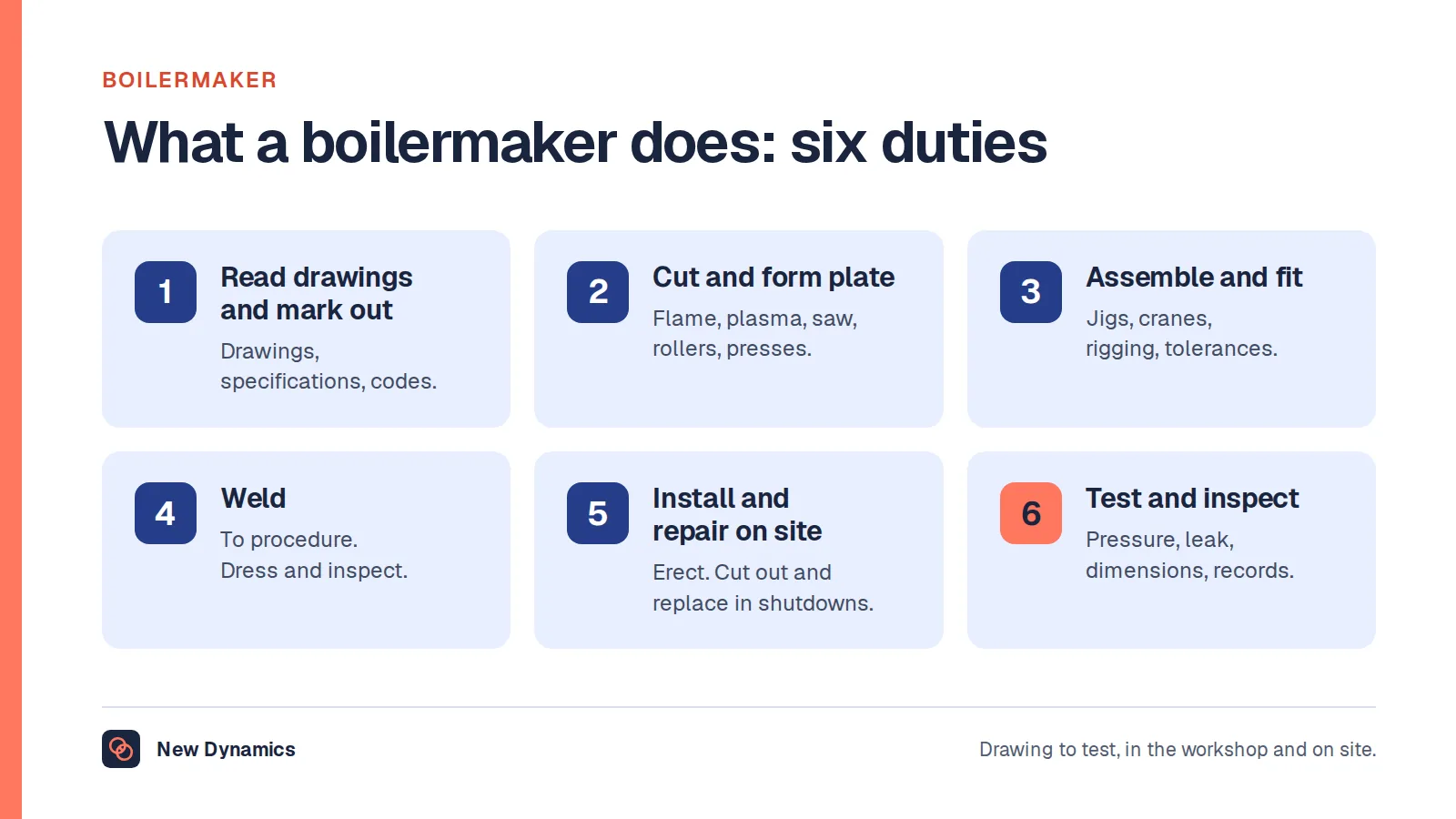
The standard also expects a welder's work to meet international standards for dimensional and surface inspection, by visual inspection, magnetic particle inspection and dye penetrant inspection. Welds on safety-critical work may go on to radiographic or ultrasonic testing by inspectors. For a related trade that works alongside coded welders on vessels and structures, see our boilermaker job description.
Health and safety: welding fume and the employer's duties
Welding carries specific health risks, and the job description should be honest about them and about the controls. The Health and Safety Executive's guidance on health risks from welding, which applies in Great Britain, says: “Both acute and chronic health risks are associated with welding fume. Occupational lung disease, including lung cancer, is the most common health risk, but welding can also affect the eyes and skin. There is also a significant risk from asphyxiation when welding in confined spaces.” HSE estimates that breathing metal fume at work leads to 40 to 50 welders a year being hospitalised, and describes metal fume fever, acute irritation and an increased risk of pneumonia among the acute effects.
HSE's guidance on controlling the risks from welding sets out what employers must do. In summary: use suitable local exhaust ventilation where possible, such as on-torch extraction, extracted benches or booths or movable extraction units; where that cannot achieve adequate control, or is not reasonably practicable, provide suitable respiratory protective equipment; provide RPE for any welding outdoors, where extraction cannot be relied on; protect other workers nearby; and run an RPE programme with face-fit testing, spare parts, clean storage and compatibility with the welding visor. HSE says a powered or supplied air respirator that combines respiratory, eye and face protection “is the best option for arc welders”.
A job description for a welder in Great Britain should therefore say what fume controls are in place, what RPE is provided and fit-tested, what training is given, and that health surveillance is arranged where required. This is general information about GB health and safety law, not legal advice, and the rules differ in other countries.
Skills employers ask for
Skills England's standard describes the knowledge and behaviours of a competent welder. Employers look for:
- Manual dexterity and a steady hand, which the standard calls essential to controlling the arc.
- Understanding of the processes: how each arc process, joint type and position works, the equipment and its parameters.
- Knowledge of materials and consumables: their weldability, and the correct selection, storage and handling of consumables.
- Defect awareness: the causes of typical welding defects and how to reduce them.
- Ability to work to a procedure and to complete quality documents and reports.
- A questioning attitude, the first behaviour the standard names, to understand the processes and the risks.
- Care for quality and safety, because the finished product's safety depends on every joint.
- Concentration and stamina, in heat, noise, awkward positions and protective equipment, often on shifts.
Qualifications and training
In England the general welder apprenticeship is a level 2 standard, typically 18 months, and the plate welder and pipe welder standards are level 3. Colleges offer welding qualifications, and many welders learn on the job and take codings as the work requires. The coding, not the certificate, is what most employers ask to see. Other countries have their own qualification routes and standards.
Welder job description template
Adapt the processes, materials, positions and codings to the work.
Job title: Welder (MIG/MAG and TIG, plate and pipe)
Reports to: Fabrication supervisor or welding supervisor
Hours: Full time, [days or rotating shifts], with overtime at busy periods
Purpose of the role: To produce welds to the welding procedure specification and the quality standard, on time and safely, on [structural steelwork, stainless pipework, aluminium components].
Main duties:
- Read drawings and welding procedure specifications and weld to them
- Prepare and check equipment, consumables, materials and the work area
- Fit, tack and weld joints in the specified process, material and position
- Inspect and finish welds, identify defects and report into the production system
- Maintain codings by completing test pieces as required
- Follow the fume control, RPE and other safety procedures at all times
Skills and experience:
- Coded to [ISO 9606 or the standard the work requires] in [process, material, positions]
- Experience of [plate or pipe] welding in [sector]
- Able to read engineering drawings and welding procedures
- Careful, questioning and quality-minded
- Level 2 or level 3 welding apprenticeship or equivalent [desirable]
We provide: Local exhaust ventilation and fit-tested RPE, PPE, health surveillance, paid coding tests and renewals, and a route to senior welder, welding inspector and supervisor roles.
For the layout of the whole document, use our job description template.
How to describe welding on a CV
Employers want processes, materials, positions, codings and sectors. The lines below are invented examples, to show the form.
- List your codings. “Coded to ISO 9606-1 in MIG/MAG and TIG, carbon steel and stainless, positions PA to PF.”
- Name the work. “Four years welding structural steelwork for bridges and buildings.”
- Show the standard. “Welds inspected by MPI and dye penetrant with a first-time pass rate above 98%.”
- Show the range. “Plate up to 30 mm and pipe from 50 mm to 300 mm diameter.”
- Show safety. “Face-fit tested; trained in confined space working.”
Common mistakes in welder adverts
“Experienced welder” and nothing else. Name the process, material, positions and joints, and whether it is plate or pipe.
No mention of coding. Say which codings are needed, which you will fund and how they are renewed.
Silence on fume. Candidates know the risks. Say what extraction and RPE you provide.
No route onward. Senior welder, welding inspector, supervisor and welding engineer are real careers. Say so.

Frequently asked questions
What does a welder do?
A welder joins metal parts permanently by melting them together, usually with an electric arc, following a welding procedure that specifies the process, consumables, parameters, joint and position. The welder prepares the equipment and materials, sets up the joint, welds it, inspects and finishes it, and keeps the work safe.
What are the duties and responsibilities of a welder?
Reading drawings and welding procedures, preparing equipment, consumables and materials, fitting and tacking joints, welding in the specified process and position, inspecting and finishing welds and reporting defects, maintaining codings, and following fume control and safety procedures. Skills England's standard says every welder takes responsibility for the quality and accuracy of their work.
What is a welder coding?
A coding is a welder qualification test to a standard such as ISO 9606, ASME IX, BS 4872 or AWS D1.1, proved by a test piece that is inspected. It is specific to a process, material, thickness and position, and Skills England's standard notes that these qualifications are regarded as licences to practise in welding.
What qualifications do you need to be a welder?
In England the general welder apprenticeship is a level 2 standard and the plate welder and pipe welder standards are level 3. College qualifications and on-the-job training are common routes. Most employers ask for codings in the processes and materials the job needs, and will often fund them.
Is welding dangerous?
It carries specific risks. The Health and Safety Executive says welding fume is associated with acute and chronic health risks, including lung disease and lung cancer, and that there is a significant asphyxiation risk in confined spaces. Employers in Great Britain must control exposure with extraction and respiratory protective equipment. This is general information, not legal advice.
What should a welder job description include?
The processes, materials, positions and joint types, whether the work is plate or pipe, the codings required and who pays for them, the drawings and procedures the welder will work to, the inspection standard, the shifts, the fume controls and protective equipment provided, and the route to senior and inspection roles.
Your next step: specify the weld before you advertise the welder
- Write down the processes, materials, positions and joint types the job needs.
- List the codings required on day one and the ones you will fund.
- Describe the fume controls, RPE and health surveillance you provide.
- Name the next steps: senior welder, inspector, supervisor.
A welder's first week should cover the procedures, the inspection standard and the safety controls. Read and download our employee onboarding guide. The guide is free to read, and the PDF uses our short download form.
Want quality, safety and training goals visible for every welder and supervisor? Book a New Dynamics demo and bring your current approach. You can also email contact@new-dynamics.com.