TL;DR
- A production assistant keeps a television, film or other production organised: in the UK, the National Careers Service describes the film version as an assistant production coordinator who helps run the production office, hires facilities and equipment, books travel and accommodation, distributes schedules and scripts, manages production meetings, clears copyrighted material and deals with accounts and expenses, and the television version as a gallery role that monitors show timings, calls camera shots, cues pre-recorded material, logs shots and checks continuity after breaks.
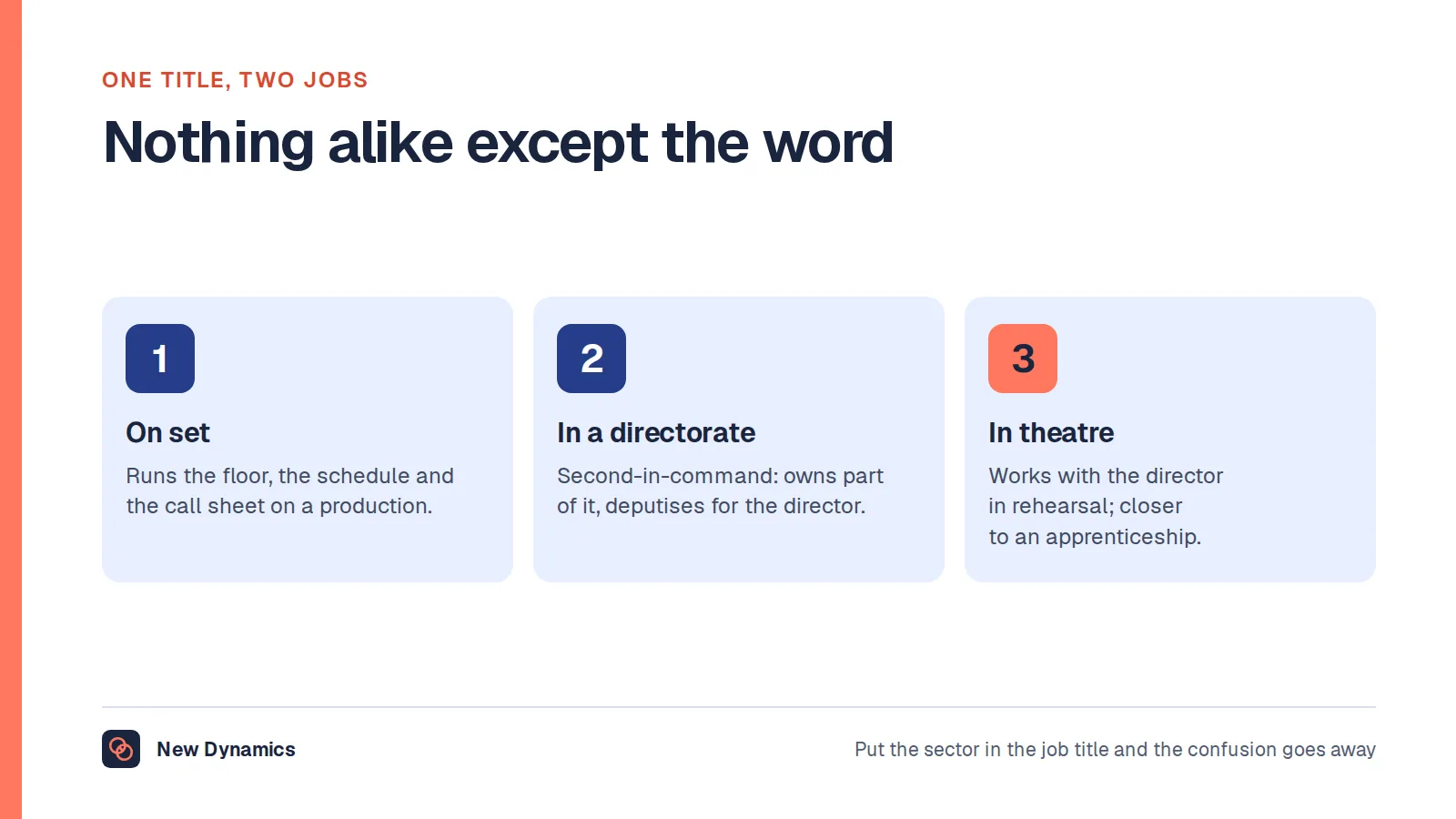
- The title covers three jobs. Besides the UK TV or film PA, Prospects notes that runners may also be known as production assistants, which is the American usage, where the PA is the entry-level general assistant on set; and manufacturing, theatre and live events use the title for the person who supports a production manager. The advert has to say which job it is, because the candidates and the duties differ.
- Across the versions, the duties fall into seven groups: the production office, schedules and paperwork, people and logistics, the studio gallery or the floor, clearances and compliance, money, and post-production handover. The National Careers Service gives the route as production coordinator, production manager and producer; Prospects notes that most coordinators are freelance and that progression depends on networking, persistence and being in the right place. A written first week matters more in this industry than in most, because the person may only be with you for the length of the production.
The advert says production assistant. One applicant has spent two years timing a live magazine show from a studio gallery. Another has a summer of fetching coffee on a film set. A third has coordinated a factory's production schedule. Each of them is a production assistant somewhere, and only one of them is the person the advert wants. What does a production assistant do? The honest answer is that it depends which production assistant, and the job description has to say.
This article sets out the duties and responsibilities of a production assistant using the UK National Careers Service and the Prospects graduate careers service, names the three jobs the title covers, groups the work into seven duties, separates the PA from the runner, the production coordinator and the assistant director, lists the skills, routes in, hours and freelance terms, and gives a job description template with a first-week plan.
Productions hire fast and the first week decides whether a new PA is useful by the second. See how New Dynamics onboarding gives a new starter clear tasks, a named person and planned check-ins from day one, even on a short contract.
The department a PA most often supports is the one that runs the floor: see our assistant director job description.
The three jobs the title covers
- The UK TV or film production assistant. The National Careers Service profiles the role as an assistant production coordinator in film and as a gallery role in television. It is a skilled organisational job, one rung below the production coordinator.
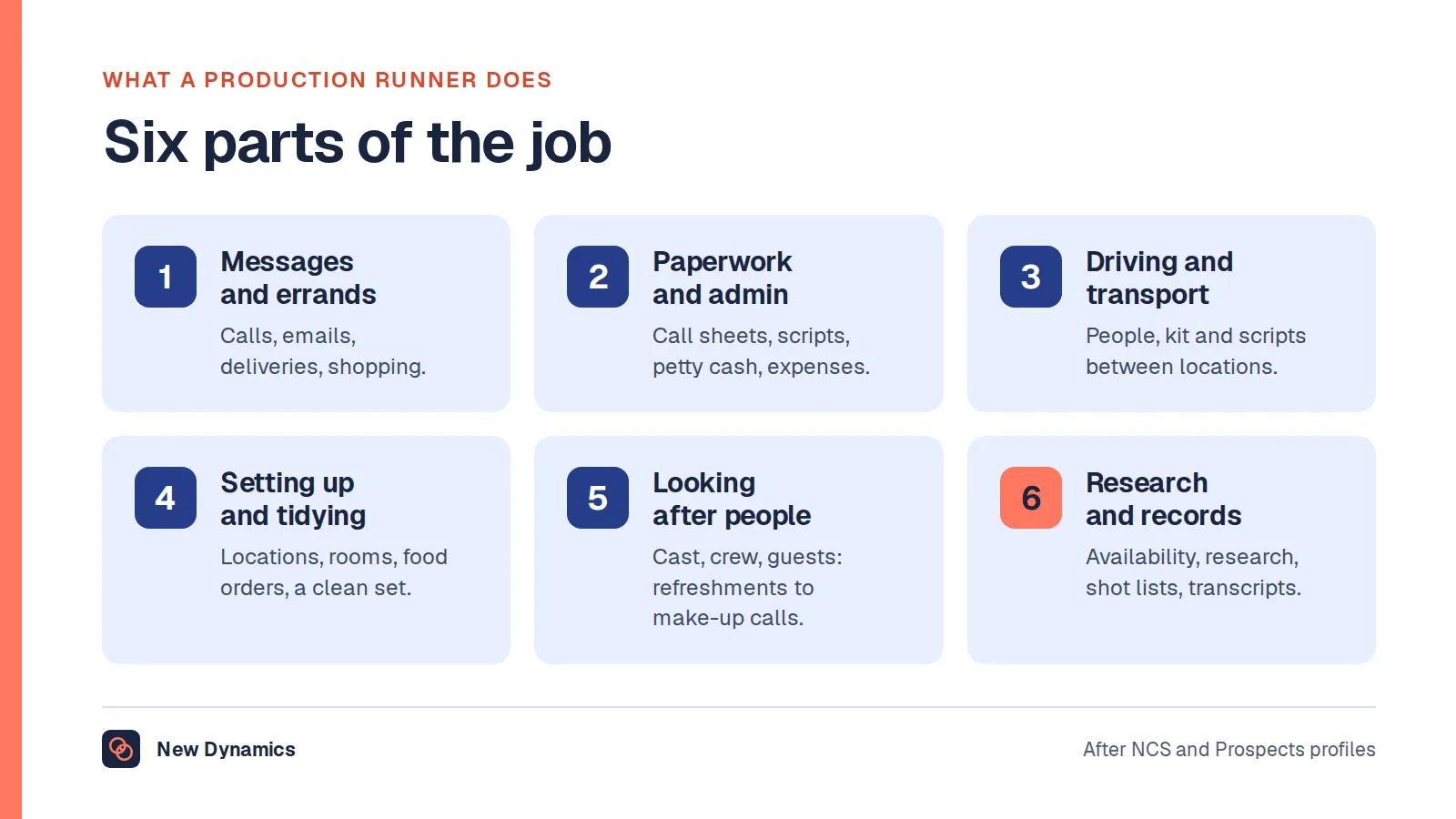
- The runner, under an American name. Prospects' profile of the runner in broadcasting, film and video says runners “may also be known as production assistants or production runners”. In the United States, production assistant is the standard title for the entry-level general assistant on set. Our runner career post covers that job.
- The production assistant outside screen. In manufacturing, theatre, live events and print, the title means the person who supports a production manager with schedules, materials, suppliers and paperwork.
The Prospects television production coordinator profile adds a fourth wrinkle: “job titles can vary, and you may be known as a television production assistant”, so the coordinator and the PA are sometimes the same seat. Say which job the advert is for in the first line.

What a production assistant does: seven duties
Grouped from the National Careers Service's tasks and the Prospects coordinator profile, the UK TV or film PA's work has seven parts. The other two versions use a subset.
- The production office. Help to run the office: set it up with supplies, as Prospects lists; hire studio facilities and equipment; keep the office working while the production is on.
- Schedules and paperwork. Prepare and distribute filming schedules, call sheets and scripts to cast and crew; type, edit and copy scripts; check running orders; keep the paperwork current as the plan changes, which it does daily.
- People and logistics. Book accommodation and make travel arrangements for cast, crew and production executives; organise and manage production meetings; arrange work permits and visas; run errands between the office and other departments.
- The gallery or the floor. In television, monitor show timings in the studio gallery, call camera shots, cue pre-recorded material, keep a log of shots taken and make sure shots match after breaks in filming. On a film set, the equivalent is continuity notes and the daily log.
- Clearances and compliance. Get permission to use copyrighted music or film clips; sort out insurance and other enquiries; keep the release forms and permissions filed.
- Money. Deal with accounts and expenses; track spend against the production budget; close accounts with suppliers and deal with surplus stock when the production finishes, as Prospects describes.
- Post-production handover. Prepare schedules, shot lists, logs and other paperwork for post-production, so the edit starts with what it needs.

Production assistant vs runner vs coordinator vs assistant director
| Role | Owns | Where |
|---|---|---|
| Runner | Whatever basic task keeps the production moving | Set, location, office; entry level |
| Production assistant | The paperwork, logistics and, in TV, the gallery timings and logs | Production office and gallery |
| Production coordinator | The production office and its budget lines | Production office; often freelance |
| Assistant director | The set: the schedule on the day, the crew and the cast's movements | The floor |
Prospects says the industry is competitive and that many coordinators work their way up “by starting as a runner or trainee”, and the National Careers Service gives the PA's progression as production coordinator, production manager or producer. The runner does; the PA organises; the coordinator owns; the assistant director runs the floor. In small productions one person does two of the four, and the advert should say which.
Skills employers look for
The National Careers Service lists knowledge of media production and communication, attention to detail, flexibility and openness to change, the ability to organise time and workload, initiative, patience and calm under stress, business management and maths skills for the budget work, and confident use of computers and the main software packages.
For the advert, add:
- Accuracy under a changing plan. The call sheet is right at 6pm and wrong by 7pm; the PA reissues it and everyone gets the new one.
- Discretion. Cast contracts, fees and personal details pass through the PA.
- Composure in the gallery. Calling shots and timings in a live show is done in seconds, with the director talking in one ear.
- Persistence with suppliers and clearances, where the answer is often slow.
Routes in, hours and terms
Routes in. The National Careers Service lists a degree in creative media, film and television production or film and TV studies, though not essential; college courses including the T Level in media, broadcast and production; apprenticeships; volunteering; applying directly; and specialist private courses. It notes that a course in business management or finance helps, because part of the job is budgets. Most people arrive from a runner or trainee post.
Hours and environment. The National Careers Service describes work at a film or TV studio, on set or in an office, sometimes outdoors, with nights away from home. Prospects notes that most coordinators are freelance and that progression depends on networking, persistence and motivation “even during times of unemployment”. State in the advert whether the post is employed or freelance, the length of the contract, the hours and the overtime terms.
Production assistant job description template
Job title: Production Assistant (state the version: TV Production Assistant, Film Production Assistant, Production Runner, or Production Assistant to the Production Manager in manufacturing or events)
Reports to: Production Coordinator, Production Manager or Producer
Scope: State the production or programme, the length of the contract, whether the post is employed or freelance, the size of the production team and whether the role includes gallery work.
Purpose: Keep the production organised from the office to the gallery: schedules, scripts, travel, meetings, clearances, accounts and logs, accurate and on time, so cast and crew always have what they need.
Responsibilities:
- Help run the production office: supplies, facilities and equipment hire, enquiries.
- Prepare and distribute schedules, call sheets and scripts; keep them current as plans change.
- Book travel and accommodation; arrange permits and visas; organise and minute production meetings.
- In television, monitor timings in the gallery, call shots, cue pre-recorded material, keep the shot log and check continuity.
- Obtain clearances for music and clips; keep release forms and insurance paperwork filed.
- Process accounts and expenses; track spend; close supplier accounts at wrap.
- Prepare shot lists, logs and paperwork for post-production.
Skills and experience:
- Experience as a runner, trainee or production assistant on comparable productions; a media production qualification desirable.
- Organised and accurate under a changing plan; calm under pressure; discreet.
- Confident with scheduling, spreadsheet and production software; comfortable with budgets.
- For gallery roles, experience of live or as-live studio production.
Working pattern: State the contract length, hours, overtime, nights away and whether the post is employed or freelance.
Progression: Production coordinator, production manager, producer.
The first week
- Day one. The production's structure, the people, the schedule and the systems; a named person to ask.
- Days two and three. Shadow the coordinator on the call sheet and the schedule; take over distribution.
- Days four and five. Own one area, travel or clearances, with a check-in at the end of the week.
- End of week one. A conversation about what is working, what is not and what the second week will add.

Frequently asked questions
What does a production assistant do?
In UK television and film, keeps the production organised: runs the production office, prepares and distributes schedules and scripts, books travel and accommodation, manages meetings, clears music and clips, handles accounts and expenses and, in television, times the show from the gallery, calls shots, cues material and logs shots, in the National Careers Service's description. In the United States the title usually means the runner, the entry-level assistant on set.
What is the difference between a production assistant and a runner?
In UK usage, the runner is the entry-level general assistant and the production assistant is a step up, organising paperwork, logistics and gallery timings. Prospects notes that runners may also be known as production assistants, which is the American usage, so the advert should say which job it means.
What is the difference between a production assistant and a production coordinator?
The coordinator owns the production office and its budget lines; the production assistant supports the coordinator and, in television, works the gallery. Prospects says job titles vary and a coordinator may be known as a television production assistant, so in small productions the two can be the same seat.
What qualifications do you need to be a production assistant?
None is essential. The National Careers Service lists degrees in creative media or film and television production, college courses including the T Level in media, broadcast and production, apprenticeships, volunteering and direct application, and notes that business or finance study helps with the budget work. Most people start as a runner or trainee.
Is a production assistant job freelance?
Often. Prospects notes that most television production coordinators are freelance, and production assistants are commonly hired for the length of a production. The advert should state whether the post is employed or freelance, the contract length, hours and overtime terms.
Your next step: say which production assistant
- Put the version in the job title: TV, film, runner or production support.
- State the contract length, hours, freelance or employed, and whether the role includes gallery work.
- List the seven duties the post actually covers and cut the rest.
- Write the first week before the person starts.
For a plan that turns a new starter's first week into a confident first month, even on a short contract, read and download our employee onboarding guide. The guide is free to read, and the PDF uses our short download form.
Want every new starter on every production to get the same first week and the same check-ins, without the coordinator chasing? Book a New Dynamics demo and bring your current crew induction. You can also email contact@new-dynamics.com.