TL;DR
- Assistant director is two unrelated jobs sharing a name. On a film or television production, the first assistant director runs the floor: the schedule, the call sheet, the order of shots and the safety of everyone on set. In an organisation, an assistant or deputy director is second-in-command of a directorate, common in councils, charities, the NHS and universities.
- On set, the AD organises the work that O*NET describes for producers and directors, who are “responsible for creative decisions, such as interpretation of script, choice of actors or guests, set design, sound, special effects, and choreography” and who establish “pace of programs and sequences of scenes according to time requirements and cast and set accessibility”. The director decides what the scene is; the AD decides how the day gets there.
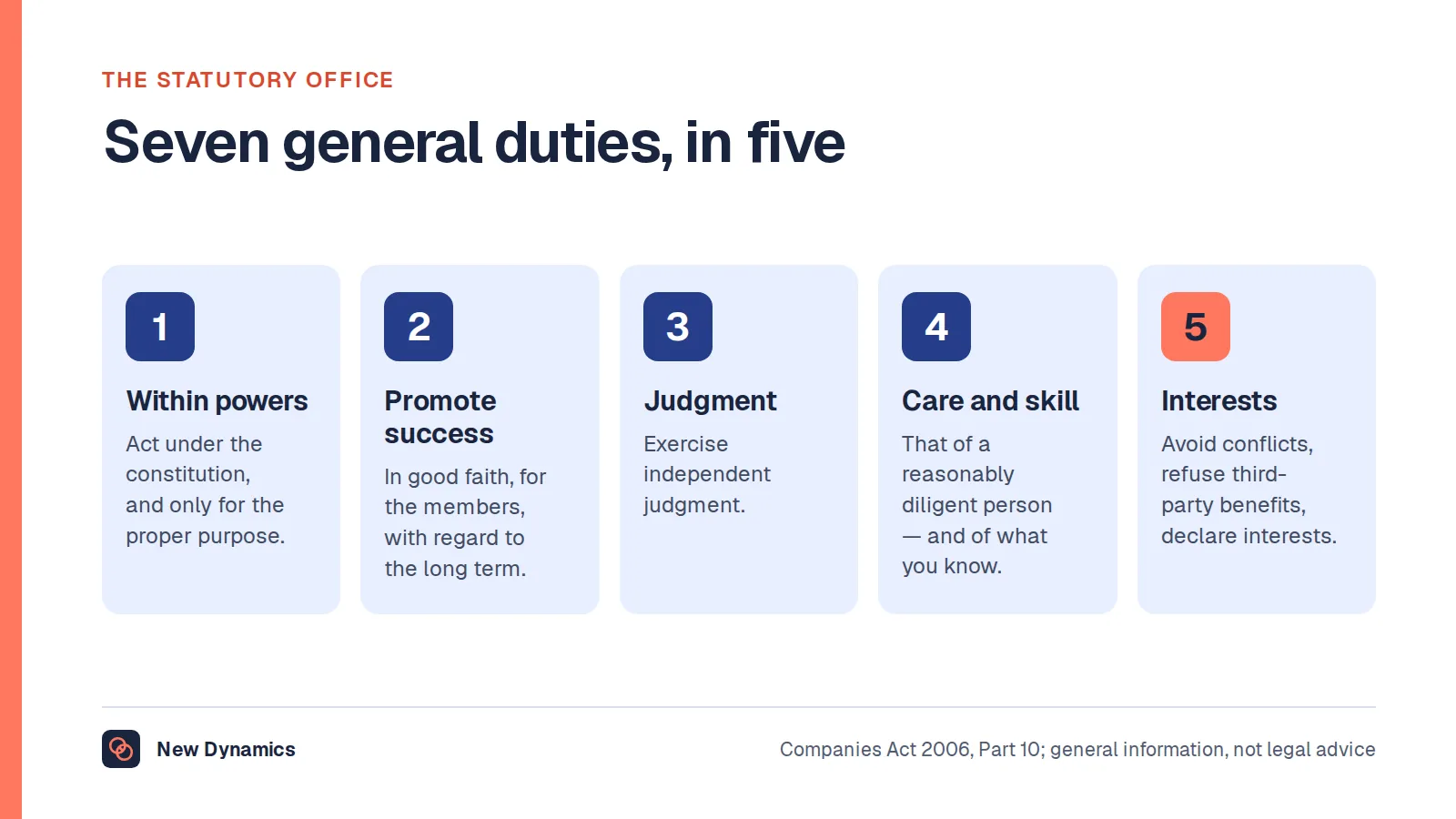
- The safety part is real and often misunderstood. HSE states that in film and television “in the majority of cases, the employer will be the producer or production company”, and that “legal duties under health and safety law cannot be delegated”. The first AD runs safety on the floor; the duty stays with the production.
Two people introduce themselves as an assistant director. One spent the day getting a crew of sixty through eleven set-ups before the light went. The other spent it covering a director's meetings and rewriting a committee paper. The word is all they have in common.
This article covers both: what a first assistant director does on a production, what an assistant or deputy director does in an organisation, and how to write and read each advert. It is general information about the roles, not legal or safety advice.
Second-in-command roles are where structure charts and reality most often disagree. See how New Dynamics org charts keep reporting lines and roles current in one place.
Two jobs, one title

- On a production. The first assistant director runs the floor and the schedule on a film, television or commercial shoot. It is an operational leadership job, not a junior directing job, and it is not a route to directing in the way outsiders assume.
- In an organisation. An assistant or deputy director is second-in-command of a directorate, a title common in local government, the NHS, universities, charities and larger agencies. It is a management level, described in our director job description as the rung below a functional director.
- Occasionally, in theatre. An assistant director works with the director in rehearsal, which is closer to the apprenticeship model the film title is often mistaken for.
The first assistant director
What the role is
The director decides what the scene is. The first AD decides how the day gets there: the order of work, the time each set-up gets, when the crew break, and what has to move when something overruns.
O*NET's Producers and Directors occupation describes the work the AD is organising around: directors are "responsible for creative decisions, such as interpretation of script, choice of actors or guests, set design, sound, special effects, and choreography", they "plan details such as framing, composition, camera movement, sound, and actor movement for each shot or scene", they "supervise and coordinate the work of camera, lighting, design, and sound crew members", and they "establish pace of programs and sequences of scenes according to time requirements and cast and set accessibility".
That last phrase (time requirements and cast and set accessibility) is the AD's whole job.
The day

- Before the shoot: break down the script, work out how long each scene takes, build the schedule, and agree it with the producer and director.
- The night before: issue the call sheet, who is needed, where, when, with what, and what the weather and the risks are.
- On the floor: run the set. Call the roll, keep the crew moving between set-ups, manage background artists, hold the noise, and keep the director supplied with a set that is ready.
- All day, quietly: protect the schedule and say the unpopular thing early, that a scene is not going to happen today, while there is still time to do something about it.
The other ADs
- Second AD. Call sheets and movement orders, cast wrangling, liaison with costume and make-up, and running the base.
- Third AD and assistant directors below that: background artists, cueing, and getting people to the right place at the right time.
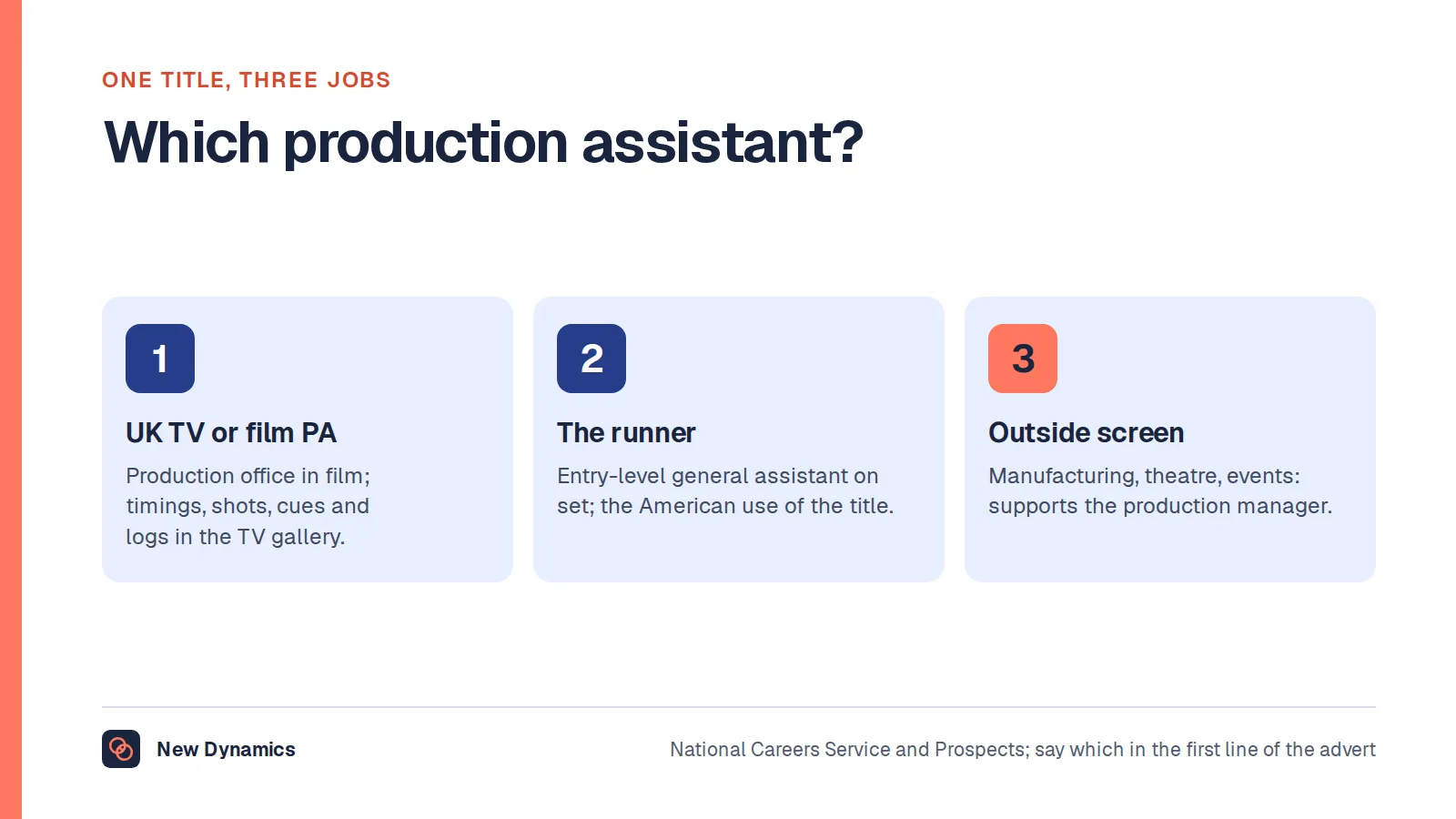
- Floor runners support the department and are usually where people start; our production assistant post covers the adjacent entry route.
Safety, and who actually carries it
This is the part worth getting right in any advert or contract.
HSE's guidance on safety in film, TV and broadcasting states that "health and safety legislation applies to all work activities in the UK, whether conducted by UK nationals or foreigners, even if they are not being paid", and that "legal duties under health and safety law cannot be delegated".
On who the employer is, it is direct about the industry's structure: the industry "uses large numbers of independent companies and freelancers and it is sometimes difficult to decide who the employer is. However, in the majority of cases, the employer will be the producer or production company." Employers must "define responsibilities and duties", "have a system for managing health and safety", "assess and manage risks", and "regularly review the process and procedures for managing risk". HSE adds that an employer's legal duty "cannot be delegated to a consultant or to anyone else".
In practice the first AD is the person delivering safety on the floor: briefings, risk assessments read and applied, hazards called out, and the authority to stop. But the duty sits with the production, which means the production has to give the AD the time, the information and the authority to do it. An advert that expects the AD to "own health and safety" without any of those three is describing a liability rather than a job.
The assistant or deputy director
What the role is
Second-in-command of a directorate: running part of it, deputising for the director, and holding things together across the boundary between strategy and delivery.
O*NET's General and Operations Managers is the closest occupational description, duties including "formulating policies, managing daily operations, and planning the use of materials and human resources" that are "too diverse and general in nature to be classified in any one functional area", usually managing "through subordinate supervisors". Its tasks include reviewing "financial statements, sales or activity reports, or other performance data to measure productivity or goal achievement", directing or coordinating "financial or budget activities", performing "personnel functions, such as selection, training, or evaluation", and establishing departmental policies and objectives "in conjunction with board members, organization officials, or staff members".

What makes it work
- A defined half of the directorate, owned outright, rather than "supporting the director" in general.
- Explicit deputising. What the person may decide when the director is away, and what waits.
- A place at the table. If the deputy does the work of the meeting but does not attend it, the arrangement leaks.
- A route onwards. Deputy roles are succession positions whether or not anyone says so; our succession planning guide covers making that deliberate rather than accidental.
What makes it fail
- Undefined scope. Two people doing the same job, one of them anxious.
- Responsibility without authority. Accountable for delivery, unable to commit money or people.
- A permanent understudy. Years of deputising with no decision rights of their own is the most common reason good deputies leave.
How to write each advert
For a first AD: the production type and scale, the shoot length and locations, the department size, who the second and third ADs are, the schedule's current state, and what authority the AD has over the shooting day. Say plainly what support exists for safety, risk assessments, a nominated adviser, time in the schedule.
For a deputy director: the directorate, the half of it being owned outright, the budget and headcount, what is decided without the director, which meetings the role attends in its own right, and what happens when the director is absent.
Frequently asked questions
What does an assistant director do?
It depends which one. On a film or television production, the first assistant director runs the floor and the schedule: breaking down the script, building the shooting schedule, issuing call sheets, running the set, managing background artists and delivering safety briefings. In an organisation, an assistant or deputy director is second-in-command of a directorate, running part of it and deputising for the director.
Is a first assistant director a trainee director?
No. It is an operational leadership role in its own right, responsible for the schedule, the floor and the safety of the crew. The director makes the creative decisions; the AD makes the day happen. Some ADs move into directing, but the job is not structured as an apprenticeship for it.
What is the difference between a first, second and third AD?
The first AD runs the floor and the shooting schedule. The second AD handles call sheets and movement orders, cast wrangling and liaison with costume and make-up, and runs the base. Third ADs and assistant directors below them handle background artists, cueing and getting people where they need to be.
Who is responsible for safety on a film set?
The employer, which HSE says is in the majority of cases the producer or production company. HSE is explicit that legal duties under health and safety law cannot be delegated. The first AD typically delivers safety on the floor (briefings, applying risk assessments, calling out hazards) but the duty remains with the production, which must define responsibilities, have a management system, assess and manage risks and review the process. This is general information, not legal advice.
What does a deputy director do in an organisation?
Runs a defined part of a directorate and deputises for the director: managing through subordinate managers, owning budgets and performance for their area, handling personnel matters, and contributing to the directorate's policies and objectives. The good versions own something outright; the poor versions have responsibility without decision rights.
Should I take a deputy director role?
Ask three questions first: what do I own outright, what may I decide when the director is away, and which meetings do I attend in my own right. If the answers are vague, the role is a permanent understudy rather than a step.
Your next step: name which assistant director you mean
- Put the sector in the job title: first assistant director, or assistant director of [function].
- For a production role, state the shoot, the department, the authority over the day and the safety support.
- For a deputy role, state what is owned outright, the budget and headcount, and the deputising rules.
- Treat deputy roles as succession positions and say what the next step is.
For making that succession deliberate rather than accidental, read and download our succession planning guide. The guide is free to read, and the PDF uses our short download form.
Want reporting lines, roles and objectives visible in one place, so a deputy's scope is written down rather than assumed? Book a New Dynamics demo and bring your current structure chart. You can also email contact@new-dynamics.com.