TL;DR
- A purchasing manager plans and directs the buying: suppliers, contracts, specifications, the team and the spend. O*NET describes the occupation as planning, directing or coordinating “the activities of buyers, purchasing officers, and related workers involved in purchasing”.
- Prospects notes that the role “may also be known as a purchasing manager” alongside procurement manager, and covers “evaluating suppliers and supply chains, contract drafting, negotiation, and managing suppliers through the whole process”, including sustainability, risk and ethical issues.
- The line most job descriptions miss is authority: what the manager may commit without approval, and who signs above it. In the public sector there is a further layer, with high value contracts (usually above £139,688 including VAT) advertised through the Find a Tender service.
Every purchasing manager job description lists negotiation. Almost none says what the person may sign. The second is the document that settles arguments; the first is decoration.
This article sets out a purchasing manager job description: how the title relates to buyer and procurement manager, twelve duties in four groups, the authority line, what changes in the public sector, how the role is measured and a template.
Purchasing runs on requisitions, approvals and thresholds that live in email. See how New Dynamics workflows let you define stages, forms and approvals with a completion view instead.
Buyer, purchasing manager, procurement manager
- Buyer or purchasing officer. Places and manages orders within an agreed framework, usually for named categories.
- Purchasing manager. Directs that work and owns the policy behind it. O*NET's Purchasing Managers plan, direct or coordinate "the activities of buyers, purchasing officers, and related workers involved in purchasing".
- Procurement manager. Usually the same job with a broader remit, taking in tendering, contract management and supplier strategy. Prospects notes plainly in its procurement manager profile that the role "may also be known as a purchasing manager", and that in some organisations it resembles a supply chain manager.
Pick one title, then describe the work, because candidates read the duties rather than the noun.
Twelve duties, in four groups

Sourcing
- Forecast demand and prices. Prospects lists forecasting "levels of demand and price trends for services and products" first, and it is the difference between buying well and reacting.
- Find and assess suppliers. Locate vendors "of materials, equipment or supplies, and interview them to determine product availability and terms of sales", and research "the best value products and suppliers in both quality and delivery schedules".
- Shape specifications. Participate "in the development of specifications for equipment, products, or substitute materials", the earliest and cheapest point to influence cost.
Contracting
- Run tenders and evaluate bids, making recommendations "based on commercial and technical factors", and review, evaluate and approve "specifications for issuing and awarding bids".
- Negotiate and agree contracts, then monitor "the quality of service provided", keeping records for future reference.
- Prepare awards for approval, including "bid awards requiring board approval", and review purchase order claims and contracts "for conformance to company policy".
Supplier management
- Manage relationships with new and existing suppliers, which is mostly about being predictable rather than being friendly.
- Handle failures. Resolve "vendor or contractor grievances and claims against suppliers" before they become legal matters.
- Protect supply. Ensure "the security and sustainability of sources of essential products and services", and analyse "market and delivery systems to assess present and future material availability".
The department
- Write the rules. Develop and implement "purchasing and contract management instructions, policies, and procedures", and administer the purchasing system.
- Lead the team. Direct the buyers, interview and hire staff, oversee training, and control "purchasing department budgets".
- Report. Analyse data and produce "reports and statistics on spending and saving", against cost and supplier performance targets.
Duty three is the one organisations under-use. By the time a specification reaches purchasing, most of the cost is already decided.
The authority line

Write four numbers and two names into the job description:
- What the manager may commit alone, per order and per contract.
- What needs a second signature, and whose.
- What goes to the board, since O*NET lists preparing "bid awards requiring board approval" as a task in its own right.
- What they may not do at all, vary a contract, waive a tender, accept a supplier's terms without review.
Add who owns the policy when operations wants to bypass it, because that argument happens in every organisation with a deadline.
The public sector difference
If the employer is a public body or a utility, the rules sit above the job description. Contracts have to be advertised and awarded through defined procedures, and GOV.UK's Find a Tender service is used "to search and apply for high value contracts in the UK's public and utilities sectors", where high value contracts "are usually above £139,688, including VAT". The service "replaced the EU's Tenders Electronic Daily for high value contracts in the UK on 1 January 2021".
Two practical consequences for the document: say whether the role operates under public procurement rules, and if it does, make compliance an explicit responsibility rather than an assumption. This is general information rather than legal advice, and the applicable rules depend on the organisation.
What the job description must state
- The spend: annual value, number of suppliers, and the categories owned.
- The authority, as above.
- The sectors and standards that apply: regulated industry, public procurement, food safety, quality standards, modern slavery reporting.
- The team: how many buyers, and whether they report to this role.
- The systems, named, including the ERP or purchasing platform.
- Where sustainability and ethics sit, since Prospects lists sustainability, risk management and ethical issues as part of the role, and they need an owner rather than a mention.
How the role is measured

- Savings, measured honestly. Against the previous price actually paid, with the specification held constant. Quoting high and buying lower is the easiest number in business to manufacture.
- Supplier performance: on-time delivery, quality, and credit notes raised.
- Contract coverage: the proportion of spend under a current, signed contract. Usually the most revealing measure in the whole function.
- Maverick spend: buying that bypasses the process, which tells you whether the process is usable.
- Lead time and availability for the items the operation depends on.
- Payment terms and disputes, because a saving cancelled by a dispute is not a saving.
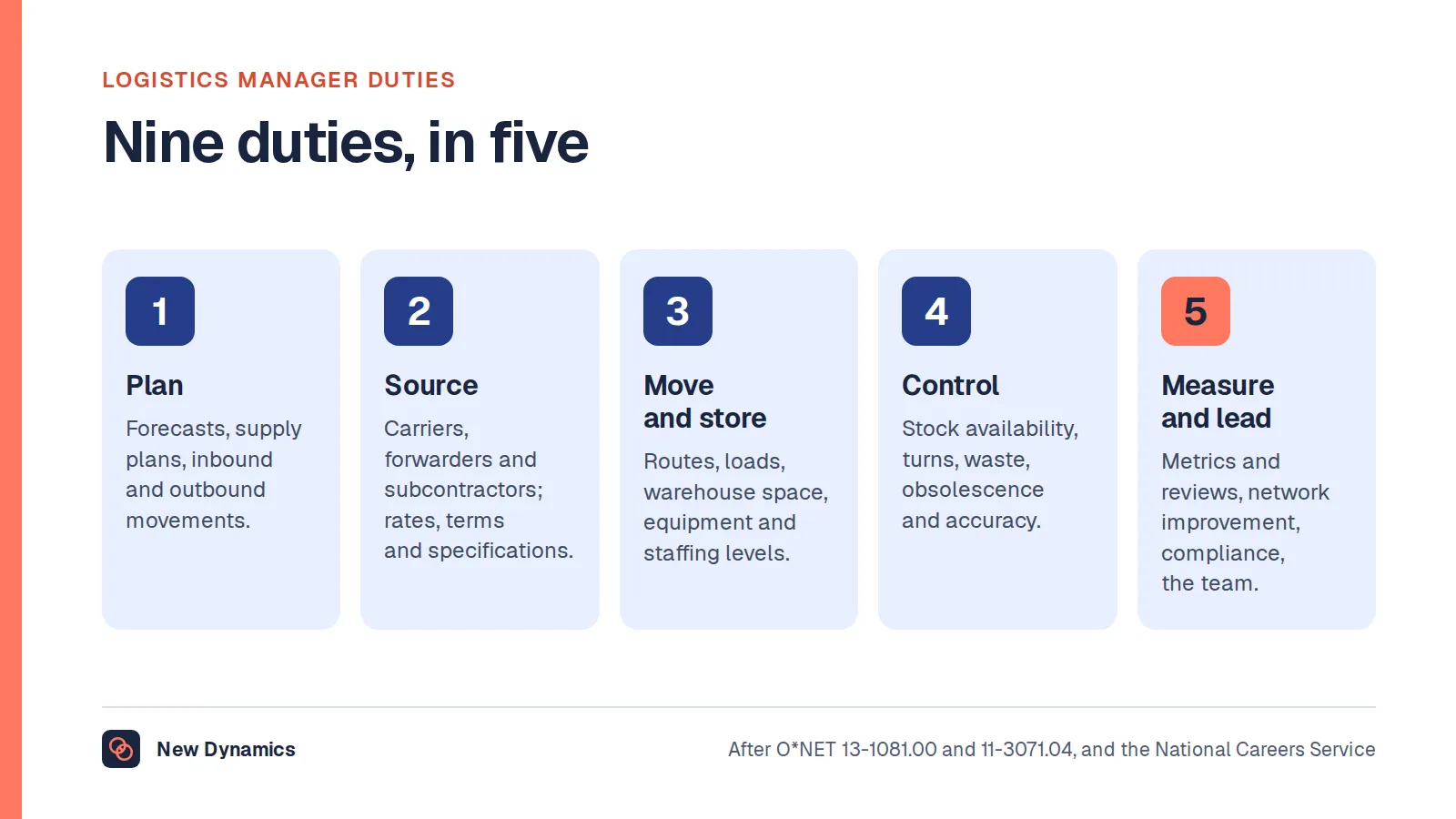
Our inventory specialist job description covers the role that finds out first when supply goes wrong, and our logistics manager job description the one that moves it.
A purchasing manager job description template
Job title: Purchasing manager [categories]
Reports to: [operations director / finance director]
Spend: [annual value], [number] suppliers, categories: [list]
Team: [number] buyers, [number] assistants
Systems: [ERP / purchasing platform]
Purpose: Secure the goods and services the organisation needs, at the right quality, price and reliability, within agreed policy and authority.
Responsibilities
- Forecast demand and price trends for the categories owned.
- Source, assess and approve suppliers, and maintain the approved list.
- Contribute to specifications before they are fixed.
- Run tenders, evaluate bids and recommend awards on commercial and technical grounds.
- Negotiate contracts and manage them through their life, including reviews.
- Monitor supplier performance and resolve claims and disputes.
- Maintain purchasing policy, procedures and system data.
- Lead, develop and resource the purchasing team.
- Control the department budget and report on spend and savings.
- Protect continuity of supply for critical items.
- Own sustainability and ethical sourcing requirements for the categories.
Authority: may commit up to [£x] per order and [£x] per contract; above that requires [role]; awards above [£x] go to [board or committee].
May not: waive a tender, vary a signed contract, or accept supplier terms without [review].
Frequently asked questions
What does a purchasing manager do?
Plans and directs an organisation's buying: forecasting demand, finding and assessing suppliers, contributing to specifications, running tenders and evaluating bids, negotiating and managing contracts, monitoring supplier performance, maintaining purchasing policy and systems, leading the buying team, controlling the department budget and reporting on spend and savings.
What is the difference between a purchasing manager and a procurement manager?
Often nothing but the title; the procurement manager role may also be known as a purchasing manager. Where organisations distinguish them, procurement covers the wider strategy (tendering, contract management, supplier development) and purchasing covers ordering and supplier management within it. Describe the duties rather than relying on the noun.
What should a purchasing manager job description include?
The annual spend, supplier numbers and categories owned; the authority to commit money and what needs a second signature; the standards and rules that apply, including public procurement if relevant; the team; the systems; and where sustainability and ethical sourcing sit.
How is a purchasing manager measured?
On savings measured against the price previously paid with the specification unchanged, supplier on-time delivery and quality, the proportion of spend under a current signed contract, the amount of buying that bypasses the process, lead times for critical items, and payment terms and disputes.
What qualifications does a purchasing manager need?
Employers commonly ask for experience in buying or supply chain plus a professional procurement qualification, with a degree in business, supply chain or a technical subject related to what is bought. Sector knowledge often matters more than the specific qualification, particularly where specifications are technical.
Do public sector purchasing roles work differently?
Yes. Public bodies and utilities award contracts under defined procedures, and high value contracts (usually above £139,688 including VAT) are advertised through the Find a Tender service. If the role sits in that environment, make compliance an explicit responsibility in the job description.
Your next step: write the authority before the duties
- State the spend, the categories and the supplier count.
- Write the commitment limits and who signs above each one.
- Say whether public procurement rules apply to the organisation.
- Give sustainability and ethical sourcing a named owner.
For grading the role consistently against others in the organisation, read and download our job evaluation guide. The guide is free to read, and the PDF uses our short download form.
Want requisitions, approvals and thresholds in a defined workflow rather than an email chain? Book a New Dynamics demo and bring your current approval matrix. You can also email contact@new-dynamics.com.