TL;DR
- Three titles share this work at different points on the same chain. O*NET's Logisticians “analyze and coordinate the ongoing logistical functions of a firm or organization” and are “responsible for the entire life cycle of a product, including acquisition, distribution, internal allocation, delivery, and final disposal of resources”. Supply Chain Managers “direct or coordinate production, purchasing, warehousing, distribution, or financial forecasting services or activities to limit costs and improve accuracy, customer service, or safety”. The logistics manager sits between them, running the movement and storage day to day.
- The National Careers Service describes the UK version of the day: working with procurement managers and buyers, negotiating and managing supplier contracts, planning how goods get from suppliers to distribution centres and retailers, tracking shipments and stock levels, making sure retailers receive goods on time and in the right condition, improving the network, monitoring performance against targets, preparing forecasts and inventories, and recruiting, training and managing a team.
- One UK detail catches employers out. GOV.UK states that “vehicle operators with a standard national or international operator's licence need to have a transport manager”, that the role requires a Transport Manager Certificate of Professional Competence, and that the person must be approved by a traffic commissioner before starting. If the job includes that responsibility, the advert has to say so.
Logistics is the part of a business nobody notices until it fails, and then notices for a week. The manager's job is to make the failure rare, cheap and visible early.
This article sets out a logistics manager job description a manufacturer, retailer or third-party provider can use: what separates a logistician, a logistics manager and a supply chain manager, nine duties, the measures that decide whether the job is being done, the UK transport manager requirement, routes in and a template. It is general information about the role, not legal or regulatory advice.
Logistics runs on defined stages, owners and hand-offs, and so should the review cycle that judges the people running it. See how New Dynamics workflows let you define your own stages, forms and approvals, with a completion view instead of a spreadsheet.
Three titles, one chain

- Logistician. O*NET's Logisticians "analyze and coordinate the ongoing logistical functions of a firm or organization" and are "responsible for the entire life cycle of a product, including acquisition, distribution, internal allocation, delivery, and final disposal of resources". Reported titles include Logistician and Production Planner. The emphasis is analysis and coordination rather than line management.
- Logistics manager. Runs the movement and storage of goods day to day: transport, warehousing, stock, carriers, the team and the service level. This is the role most adverts mean.
- Supply chain manager. O*NET's Supply Chain Managers "direct or coordinate production, purchasing, warehousing, distribution, or financial forecasting services or activities to limit costs and improve accuracy, customer service, or safety". Wider scope, reaching back into purchasing, planning and supplier strategy.
A quick test for an advert: does the person own the flow of goods, or the design of the chain that the goods flow through? The first is logistics management. The second is supply chain management, and it costs more.
Nine duties
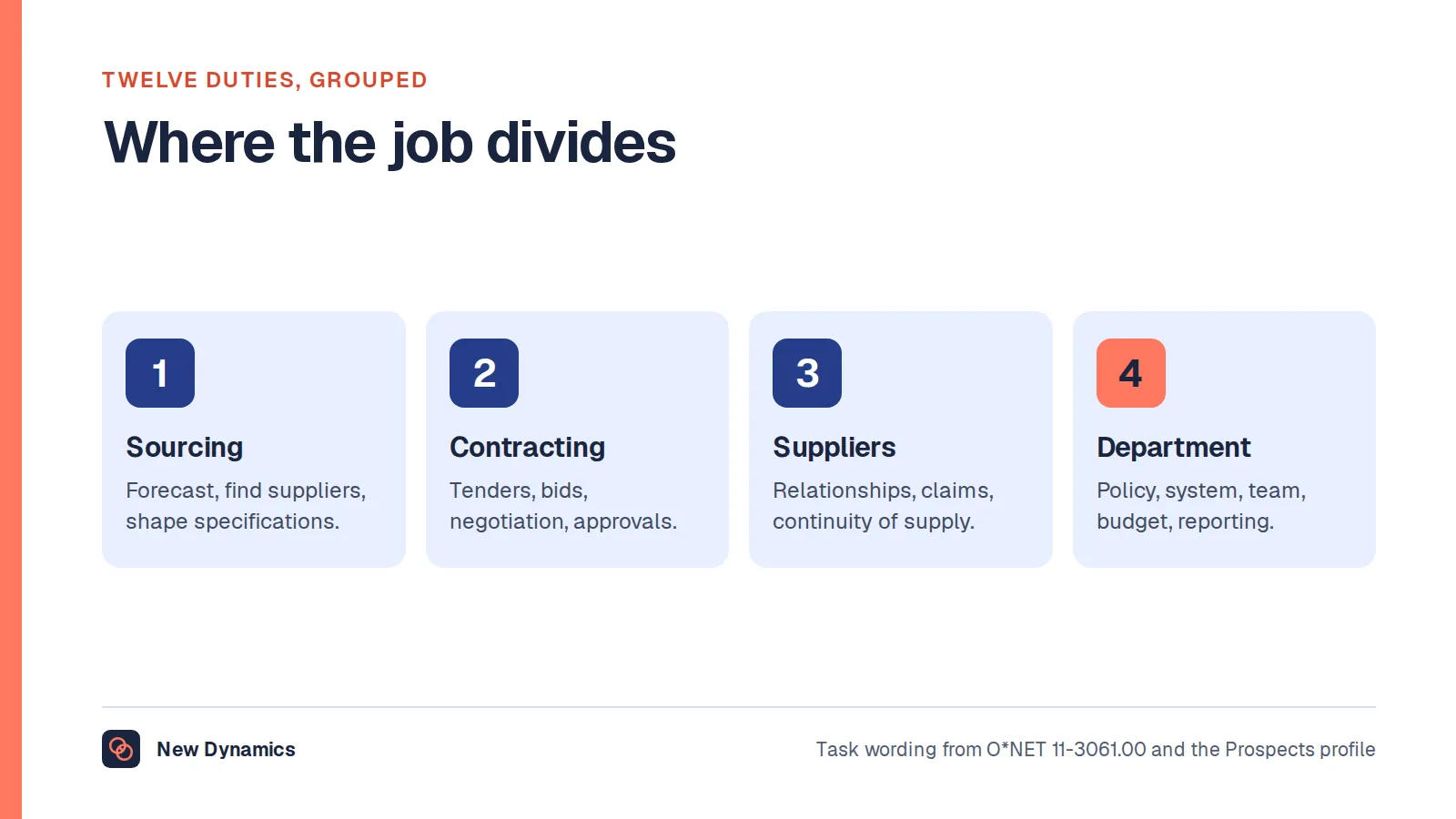
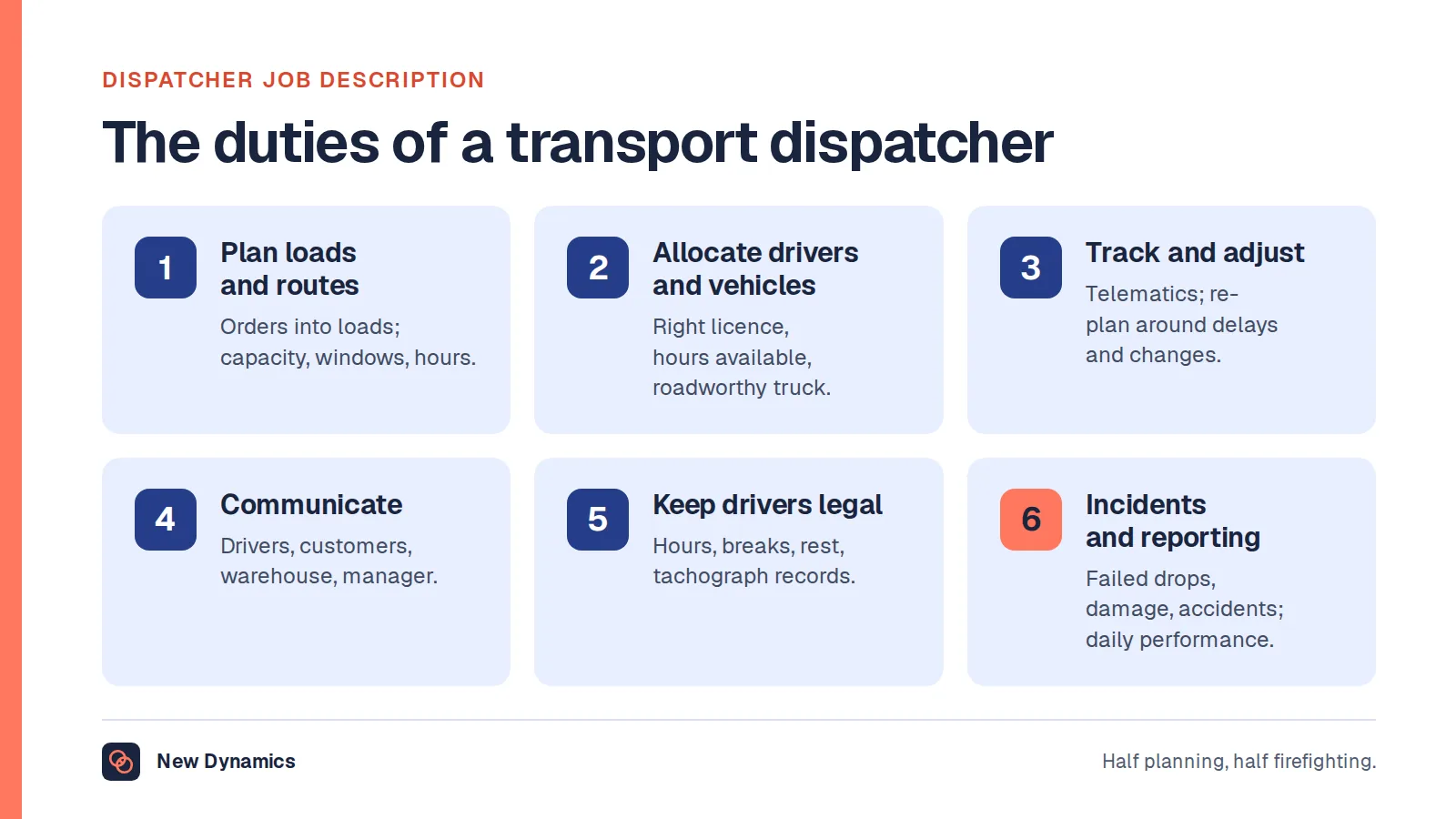
- Plan. "Confer with supply chain planners to forecast demand or create supply plans that ensure availability of materials or products", prepare forecasts and inventories, and plan how goods get from suppliers to distribution centres and customers.
- Source and contract. "Negotiate prices and terms with suppliers, vendors, or freight forwarders", and manage subcontractor activities, "reviewing proposals, developing performance specifications, and serving as liaisons between subcontractors and organizations".
- Move. "Select transportation routes to maximize economy by combining shipments or consolidating warehousing and distribution", and track shipments.
- Store. "Design or implement plant warehousing strategies for production materials or finished products", and "determine appropriate equipment and staffing levels to load, unload, move, or store materials".
- Control inventory. "Direct availability and allocation of materials, supplies, and finished products", and "analyze inventories to determine how to increase inventory turns, reduce waste, or optimize customer service".
- Measure. "Define performance metrics for measurement, comparison, or evaluation of supply chain factors, such as product cost or quality", and "review logistics performance with customers against targets, benchmarks, and service agreements".
- Improve. "Redesign the movement of goods to maximize value and minimize costs", "implement new or improved supply chain processes to improve efficiency or performance", and "stay informed of logistics technology advances and apply appropriate technology".
- Comply and control risk. Work within transport, safety and customs requirements, monitor supplier performance "in meeting quality or delivery requirements", and run reverse logistics so that products "are recycled, reused, or responsibly disposed".
- Lead the team. "Direct team activities, establishing task priorities, scheduling and tracking work assignments, providing guidance, and ensuring the availability of resources", and "perform managerial duties such as hiring and training employees".

What the job is actually judged on
Logistics is unusually measurable, which is a gift and a trap. Four families of measure, and the tension between them is the job:
- Service. On-time and in-full delivery, order accuracy, damage rates, complaints.
- Cost. Cost per order, per case or per mile; transport cost as a share of sales; overtime and agency spend.
- Working capital. Stock cover, inventory turns, obsolescence and write-off.
- Safety and compliance. Accidents, vehicle defects, drivers' hours infringements, audit findings.

Pick one and the others suffer. Service alone produces expensive expediting and too much stock; cost alone produces late deliveries and tired drivers. A good objective set names the trade-off explicitly rather than pretending it does not exist, which is what our OKR guide is for when a function has several measures pulling against each other.
The transport manager layer
This is the requirement that surprises employers writing a logistics advert in the UK.
GOV.UK's guidance on becoming a transport manager states that "vehicle operators with a standard national or international operator's licence need to have a transport manager". The transport manager must make sure that:
- "drivers have a valid licence";
- "vehicles are taxed and insured";
- "vehicles have a valid MOT and are properly maintained";
- "vehicles are loaded safely and not overloaded";
- "drivers do not speed or break the drivers' hours rules";
- "the vehicle operator does not break safety rules".
The role carries personal consequences. GOV.UK says you "can be called to appear before a traffic commissioner's public inquiry if the vehicle operator breaks the law", and that you "can be permanently or temporarily banned from being a transport manager if the traffic commissioner finds that you're responsible, for example, if staff loaded a vehicle in an unsafe way because they were not properly trained". The commissioner can also require further training before the person works in the role again.
Qualification and approval are both required: a Transport Manager Certificate of Professional Competence (GOV.UK notes that "you do not need a driving licence") after which the operator applies to add the person to its licence, and the traffic commissioner must approve them before they start. In Northern Ireland the equivalent body is the Transport Regulator.
So the advert needs to answer one question plainly: is this role the named transport manager on the operator's licence, or not? If it is, say so, say whether the CPC is required at application or funded, and expect a smaller field of candidates.
The people part adverts forget
Most logistics managers spend more of the week on people than on routes: shift cover, agency staff, absence, training records, performance conversations with drivers and warehouse operatives who are rarely at a desk.
Three things make that easier and belong in the job description:
- Who they manage, directly and indirectly, including agency and subcontractors.
- How team communication actually happens for people without a company laptop.
- What they are expected to do about training records, licences and expiry dates, which in this function are a compliance matter rather than an HR nicety.
Routes in and progression
The National Careers Service's supply chain manager profile describes the UK routes:
- University, with a degree then a management or graduate scheme.
- Apprenticeship. A Supply Chain Practitioner level 3 advanced apprenticeship, "which could lead to an assistant manager position", or a level 6 degree apprenticeship such as Supply Chain Leadership Professional, Express Delivery Manager or Senior Procurement and Supply Chain Professional.
- Work. Starting in a junior role such as transport clerk and working up through training and promotion, often studying work-based qualifications alongside.
Progression runs to senior supply chain management, strategic planning or consultancy, or specialisation such as e-commerce.
The skills the profile lists are a good checklist for an advert: business management skills, leadership skills, knowledge of transport methods, costs and benefits, knowledge of manufacturing production and processes, thoroughness and attention to detail, customer service skills, the ability to work well with others, the ability to organise your time and workload, and confident use of a computer and the main software packages.
A logistics manager job description template
Job title: Logistics manager
Reports to: Operations director / head of supply chain
Scope: [sites], [own fleet or carriers], [volumes], [team size including agency]
Purpose: Get the right goods to the right place at the right cost, safely and on time, and improve how that is done.
Responsibilities
- Plan inbound and outbound movements and maintain forecasts and stock plans.
- Select and manage carriers, freight forwarders and third-party providers, and negotiate rates and terms.
- Plan routes, loads and schedules, and track shipments through to delivery.
- Manage warehouse space, equipment and staffing levels.
- Control inventory accuracy, stock cover, waste and obsolescence.
- Define and report the service, cost, working capital and safety measures for the function.
- Improve the network, the processes and the systems used to run them.
- Ensure compliance with transport, health and safety and customs requirements, and keep training and licence records current.
- Recruit, train, schedule and manage the team, including agency and subcontract labour.
You will need: [experience and qualifications]; [transport manager CPC, if the role is the named transport manager]; comfort with data and systems; and the ability to manage people who are rarely at a desk.
Hours: [shifts, weekends, bank holidays, on-call].
What the advert should say
- The scope. Sites, volumes, own fleet or carriers, team size, and whether purchasing is included.
- The licence position. Whether the role is the named transport manager, and whether the CPC is required or funded.
- The measures. Which service, cost and stock measures the person owns, and the trade-off between them.
- The hours. Shifts, peak season, weekends and on-call arrangements.
Frequently asked questions
What does a logistics manager do?
Plans and runs the movement and storage of goods: forecasting and planning, selecting and managing carriers and suppliers, routing and scheduling, warehousing, inventory control, measuring service and cost, improving the network, keeping the function compliant, and managing the team. The National Careers Service's version of the day includes negotiating and managing supplier contracts, planning how goods get from suppliers to distribution centres and retailers, tracking shipments and stock levels, and making sure customers receive goods on time and in the right condition.
What are a logistician's duties?
Logisticians analyse and coordinate an organisation's ongoing logistical functions and are, in O*NET's description, responsible for the entire life cycle of a product including acquisition, distribution, internal allocation, delivery and final disposal. Their tasks include directing the availability and allocation of materials and finished products, redesigning the movement of goods to maximise value and minimise costs, reviewing performance against targets, benchmarks and service agreements, managing subcontractors, and reporting plans, progress and results.
What is the difference between a logistics manager and a supply chain manager?
Scope. A logistics manager owns the flow of goods: transport, warehousing, stock and service. A supply chain manager owns more of the chain the goods flow through, including purchasing, material requirements planning, supplier selection and the design of the network, and is described by O*NET as directing or coordinating production, purchasing, warehousing, distribution or financial forecasting to limit costs and improve accuracy, customer service or safety.
Does a logistics manager need a transport manager CPC?
Only if they are the named transport manager on a standard operator's licence. GOV.UK states that operators with a standard national or international licence need a transport manager, that the role requires the Transport Manager Certificate of Professional Competence, and that the traffic commissioner must approve the person before they start. Many logistics manager roles use carriers and never touch this; the advert should make clear which kind it is. This is general information, not legal advice.
What qualifications do you need to be a logistics manager?
No single one. Routes include a degree and a graduate or management scheme, a Supply Chain Practitioner level 3 advanced apprenticeship, a level 6 degree apprenticeship such as Supply Chain Leadership Professional or Senior Procurement and Supply Chain Professional, or starting in a junior role such as transport clerk and studying work-based qualifications while progressing.
How is a logistics manager measured?
On four families of measure that pull against each other: service (on time, in full, accuracy, damages), cost (cost per order or mile, transport as a share of sales), working capital (stock cover, inventory turns, obsolescence) and safety and compliance. Naming the trade-off between them is the difference between a useful objective set and an argument at review time.
Your next step: say which job it is
- State the scope in the advert: sites, volumes, fleet or carriers, team size.
- Say whether the role is the named transport manager, and who pays for the CPC.
- Write the objectives as a set with the trade-off named, not as four separate targets.
- Treat licence and training expiry dates as a compliance schedule, not a spreadsheet.
For writing objectives that hold together when several measures pull against each other, read and download our OKR guide. The guide is free to read, and the PDF uses our short download form.
Want stages, owners and check-ins in one place, so a shift-based team's objectives are visible rather than chased? Book a New Dynamics demo and bring your current scorecard. You can also email contact@new-dynamics.com.