TL;DR
- An inventory specialist keeps the recorded stock and the physical stock saying the same thing. O*NET's nearest occupation covers people who “verify and maintain records on incoming and outgoing shipments involving inventory”, and every duty in the role exists to protect that record.
- The work runs from receiving and checking deliveries against manifests, invoices and orders, through recording damages, shortages and discrepancies, to counting, investigating variances and reordering. The National Careers Service profile for the UK entry role adds updating stock information on computer systems and carrying out “regular inventory checks and stock audits”.
- Records are not only an internal matter. To operate a customs warehouse, HMRC requires an applicant to “be able to keep inventory records”, and to supply written procedures explaining what happens to goods entering and leaving, inventory records with screenshots of the warehouse or duty management system, and details of any anticipated losses.
An inventory specialist is measured on a number that nobody can see. If the system says 412 and the shelf holds 407, everything downstream, the order that is promised, the production run that is planned, the accounts that are signed, is wrong by five.
This article sets out an inventory specialist job description: nine duties, how counting actually works, why records drift, what regulated stock adds, how the role is measured, and a template. The UK title is often stock controller or stock control assistant, and the work is the same.
Accuracy targets belong in someone's objectives rather than in a folder. See how New Dynamics Goals & OKRs keep targets and progress in one place.
The role that decides what arrives in the first place is next door: our purchasing manager job description covers the duties, the authority line and how buying is measured.
The short answer
The specialist's product is the record. O*NET's Shipping, Receiving, and Inventory Clerks occupation covers those who "verify and maintain records on incoming and outgoing shipments involving inventory", and the National Careers Service profile for stock control assistant describes the UK entry version: checking "stock levels and order new supplies", updating "stock information on computer systems", receiving deliveries and checking "labelling and paperwork is correct", replacing "out of date items on shelves and racks", and carrying out "regular inventory checks and stock audits".
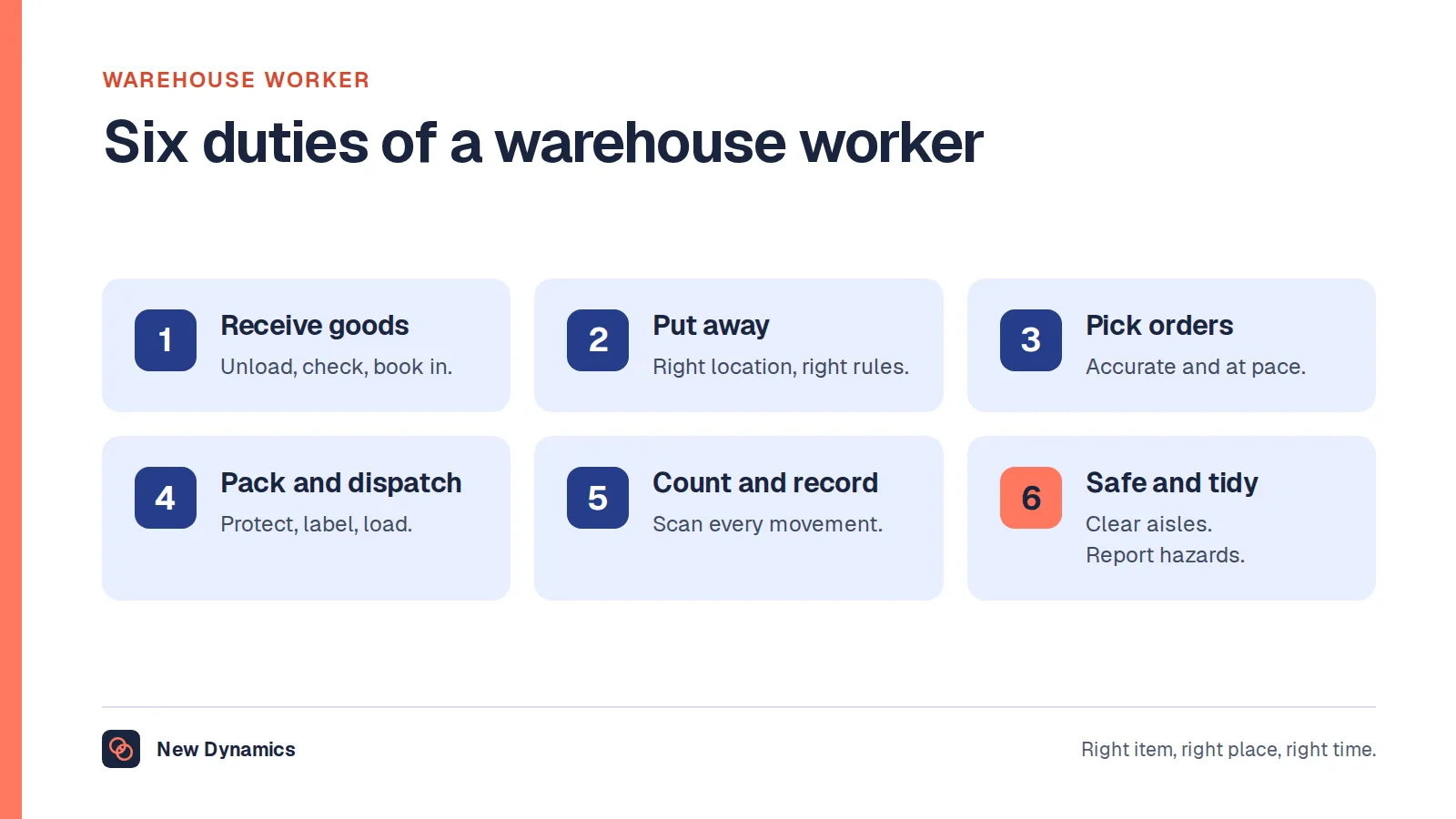
Moving the goods is a warehouse job. Knowing what is there, where it is and what it is worth is this one. Our warehouse worker job description covers the first.
Nine duties

- Receive and verify. Examine "shipment contents and compare with records, such as manifests, invoices, or orders, to verify accuracy". The most valuable five minutes of the day: an error accepted here becomes a mystery next month.
- Record what arrived, including what was wrong. Record data such as "damages, or discrepancies, for reporting, accounting, or recordkeeping purposes".
- Put away and locate. Move stock into storage, with a powered pallet truck or forklift where the role requires it, and record the location. A found item in the wrong location is still a variance.
- Count. Regular inventory checks and stock audits, covered in its own section below.
- Investigate variances. Confer or correspond with representatives "to rectify problems, such as damages, shortages, or nonconformance to specifications", and find the cause rather than adjusting the number.
- Reorder and maintain levels. Check stock levels and order new supplies, and requisition and store materials "to maintain inventory of stock".
- Manage date-sensitive and slow-moving stock. Replace out-of-date items, rotate by date where that applies, and flag obsolescence before it becomes a write-off.
- Handle returns, damages and disposals, with a documented route for each.
- Report. Availability, variance, ageing and the counts completed, to whoever is accountable for the stock's value.
Duty five is where the job is won or lost. Adjusting a figure closes a ticket; finding out why it was wrong stops the next twenty.
The count
Two methods, and most organisations need both.
- The annual stocktake. Everything counted at once, usually with the building stopped. It satisfies the accounts and it is disruptive, slow and (because it is done by people who do not normally count) often less accurate than it looks.
- Cycle counting. A rolling programme in which a portion of lines is counted every day or week, weighted so that fast-moving and high-value lines are counted more often. It finds errors while the cause is still traceable, and it does not stop the operation.
A specialist's counting programme should state which lines are counted, how often, who counts them, who recounts before an adjustment, and who may authorise an adjustment. Someone who counts, investigates and adjusts entirely alone is a control weakness rather than an efficient team.
Why the numbers drift

Almost never because someone counted badly. The usual causes:
- Receiving. Goods booked in by quantity ordered rather than quantity delivered, or booked to the wrong code.
- Unrecorded movement. Stock taken for samples, repairs, production trials or a customer emergency without paperwork.
- Returns and damages. Items back on the shelf but never back on the system, or written off twice.
- Units of measure. Cases counted as singles, or a supplier changing pack size without telling anyone.
Every one of those is a process fault rather than a counting fault, which is why an inventory specialist who only counts will never fix the accuracy. Give the role the standing to change how goods are received and returned.
Regulated and bonded stock
Where duty, excise, food dates or controlled goods are involved, the record stops being an internal matter. HMRC's guidance on applying to operate a customs warehouse requires an applicant to "be able to keep inventory records and run the warehouse to health and safety standards", and to provide with the application:
- "Written procedures, that explain what happens to goods when they enter and leave the warehouse, listed in the order they happen."
- "Inventory records with screenshots of your Warehouse Management System (WMS) or Duty Management System (DMS)."
- Site plans, a list of signatories authorised to contact HMRC, and "details of any anticipated losses in warehouse".
If any of that applies to your stock, say so in the job description, because it changes the role from a diligent one into a controlled one. This is general information rather than customs advice; take your own on the authorisations that apply.
Systems
The job is done inside a warehouse management or ERP system, with barcodes or RFID, handheld terminals and a spreadsheet nobody admits to. Name the actual systems in the advert: experience of the specific system is worth more than the general claim, and candidates self-select accurately when you name it.
One warning worth putting in the job description: the system's numbers are only as good as the transactions behind them. Hiring someone to "fix the system" when the problem is untrained receiving will disappoint everyone.
What the job description must state
- The stock. What it is, how many lines, the value, and whether it is date-sensitive, serialised, hazardous or bonded.
- The counting programme, and who authorises an adjustment.
- The systems, named.
- The equipment and conditions. Forklift or pallet truck licences, cold store, heights, shift pattern.
- The authority. What the specialist may reject at goods-in, what they may write off, and who they escalate to.
How the role is measured

- Inventory record accuracy: the proportion of counted lines matching the system, by line rather than by value alone.
- Net and gross variance. Gross matters more: a positive and a negative that cancel out are two errors, not none.
- Count coverage: the proportion of the planned cycle count programme actually completed.
- Time to close a variance, because an investigation left for a month cannot succeed.
- Availability and stockouts for the lines the operation depends on.
- Ageing and obsolescence, flagged early rather than discovered at year end.
Avoid measuring adjustments made. It rewards tidying the system rather than fixing what breaks it. Our SMART goals guide covers writing measures that do not backfire like that.
An inventory specialist job description template
Job title: Inventory specialist [site]
Reports to: [warehouse manager / operations manager]
Stock: [number of lines], [value], [date-sensitive / serialised / bonded / hazardous]
Systems: [WMS / ERP], [scanning equipment]
Purpose: Keep the recorded stock and the physical stock in agreement, and find and fix the causes when they are not.
Responsibilities
- Receive deliveries and verify contents against manifests, invoices and orders.
- Record receipts, damages, shortages and discrepancies accurately and on the day.
- Maintain locations so that stock can be found where the system says it is.
- Run the cycle count programme and support the annual stocktake.
- Investigate variances to root cause and propose process changes.
- Maintain stock levels, raise replenishment and monitor lead times.
- Manage date-sensitive stock, returns, damages and disposals to the documented route.
- Report accuracy, availability, ageing and count coverage to [role].
- Follow the written procedures for [bonded / controlled] stock where applicable.
Decides alone: [rejecting a delivery, adjustments up to £x, recount requirements]
Escalates: adjustments above [£x], suspected theft, any discrepancy in controlled stock.
You will need: attention to detail, concentration, confidence with systems, and the persistence to keep asking why a number is wrong.
Frequently asked questions
What does an inventory specialist do?
Keeps the recorded stock and the physical stock in agreement. That means receiving and verifying deliveries against paperwork, recording damages and discrepancies, maintaining locations, running counts, investigating variances to their cause, reordering, managing date-sensitive stock and returns, and reporting accuracy and availability.
What is the difference between an inventory specialist and a warehouse worker?
A warehouse worker moves, picks and packs goods. An inventory specialist is accountable for the accuracy of the record of those goods: counts, variances, locations, reorder levels and reporting. The two work closely, and most accuracy problems are solved by changing how goods are received rather than by counting harder.
What skills does an inventory specialist need?
Thoroughness and attention to detail, concentration, initiative, confidence with computer systems, and communication with suppliers and colleagues. The National Careers Service also lists the ability to accept criticism and work well under pressure, which matters in a role that finds other people's mistakes.
What is cycle counting?
Counting a portion of stock lines on a rolling basis (daily or weekly) weighted so that high-value and fast-moving lines are counted more often, instead of counting everything once a year. It finds errors while their cause can still be traced, and it does not stop the operation.
How is inventory accuracy measured?
Usually as the proportion of counted lines that match the system, reported by line as well as by value, alongside gross variance rather than only net, the proportion of the planned count programme completed, and the time taken to close an investigation. Counting adjustments made is a poor measure, because it rewards tidying rather than fixing.
What should an inventory specialist job description include?
The stock itself (lines, value and whether it is date-sensitive, serialised, hazardous or bonded) the counting programme and who authorises adjustments, the named systems, the equipment and conditions including any forklift requirement, and the authority the role carries at goods-in and for write-offs.
Your next step: write the authority line
- Describe the stock honestly: lines, value and anything that makes it controlled.
- Set out the counting programme and who may authorise an adjustment.
- Name the systems rather than asking for "systems experience".
- Give the role the standing to change receiving and returns, not only to count.
For measures that drive accuracy rather than tidy numbers, read and download our SMART goals guide. The guide is free to read, and the PDF uses our short download form.
Want stock accuracy targets, count coverage and the actions behind them in one place? Book a New Dynamics demo and bring your current count programme. You can also email contact@new-dynamics.com.