TL;DR
- A quantified selfer is someone who records data about their own life (sleep, movement, mood, focus, time, spending) and uses it to understand or change something. It is a personal experiment with one participant, and that is both its appeal and its limit.
- At work the same activity changes character. The ICO defines monitoring workers as “any form of monitoring of people who carry out work on your behalf”, including monitoring “on particular work premises or elsewhere” and “during or outside work hours”, and notes that employers increasingly use “data analytics to infer worker performance and wellbeing”.
- The trap is consent. The ICO warns that consent “is not usually appropriate in the employment context, due to the imbalance of power between you and your workers. Workers are likely to feel that they have no choice but to give you consent.”
Someone in your team has a spreadsheet of their own sleep. Someone else has three years of runs, a mood log and a note of every coffee after two o'clock. They are quantified selfers, and mostly this is a harmless and interesting hobby.
It stops being a hobby the moment an employer holds the data. This article covers what quantified selfers do, the honest limits of self-tracking, and where voluntary measurement becomes monitoring with duties attached.
Measurement is useful when it is attached to a decision. See how New Dynamics Goals & OKRs keep targets and progress in one place rather than in a private spreadsheet.
What a quantified selfer is
Someone who deliberately records data about their own life and uses it to understand or change something. The records can be automatic (a watch, a phone, an app) or written by hand in a notebook, which is where most of the interesting ones start.
Common things people track:
- Body and health: sleep, resting heart rate, steps, weight, symptoms, medication.
- Mind: mood, energy, anxiety, focus, what preceded a bad afternoon.
- Work: hours, interruptions, meetings, deep work, tasks finished, time to first reply.
- Life admin: money, travel, reading, food, habits kept or dropped.
The common feature is not the technology. It is the loop: record something, look at it later, change one thing, look again.
The four honest limits

Self-tracking is worth doing and worth being sceptical about at the same time.
- One participant. Whatever you find applies to you, this year, in these circumstances. It is not evidence about your colleagues, and it is certainly not advice for them.
- No control group. You changed your bedtime in the same month the project ended. Which one fixed your sleep?
- Measuring changes the thing measured. Counting steps makes people walk more, which is often the point, and also means the first month's data describes an unusual month.
- Most of it is noise. Daily variation swamps small effects. If a chart has no obvious pattern after eight weeks, the honest conclusion is usually that there is nothing there.
None of that makes tracking pointless. It makes it a personal experiment rather than a finding.
Where it meets work
Three routes, in increasing order of risk:
- A voluntary challenge. Steps, cycling, hydration, a reading month. People opt in and the organisation sees a total.
- Employer-provided devices or apps, where the employer pays and the data flows somewhere the employee did not choose.
- Productivity analytics, where the tracking is not self-tracking at all: keystrokes, active hours, calls, screen time, dashboards of "focus".
The first can be good for a team. The third is monitoring with a friendlier name, and the ICO's guidance treats it as such.
Whose data is it?

The ICO's guidance on monitoring workers (which the ICO notes is under review following the Data (Use and Access) Act) defines monitoring workers as "any form of monitoring of people who carry out work on your behalf". That includes monitoring "on particular work premises or elsewhere", and "during or outside work hours". It observes that "increasingly, employers are using data analytics to infer worker performance and wellbeing", and says monitoring must be carried out "in a way that is lawful".
Three points matter most for anything that started as self-tracking:
- Consent is a weak basis at work. "A person must freely give their consent for it to be valid. This means that consent is not usually appropriate in the employment context, due to the imbalance of power between you and your workers. Workers are likely to feel that they have no choice but to give you consent."
- Proportionality is judged, not assumed. The ICO gives an example: an employer that discovers a timesheet discrepancy and responds by rolling out webcam monitoring "is likely to infringe data protection law because it is disproportionate, and there are less intrusive ways to check start times", such as checking log-on times and letting people explain.
- Health data is special category data. Monitoring "often includes capturing sensitive information. This is called 'special category data' in the UK GDPR", which carries extra conditions.
This is general information rather than legal advice, and the guidance itself may change.
Five questions before an employer tracks anything

- What decision will this data change? If the answer is "we will have a dashboard", stop.
- Is there a less intrusive way to answer the same question?
- What is the lawful basis, and is it something other than consent?
- Who sees the individual-level data, and who only sees totals?
- What are people told, before it starts rather than afterwards, and what happens if they object?
Add a sixth for anything wellbeing-related. Acas's guidance on health and wellbeing at work says "employers and workers should work together to promote positive wellbeing at work", and that "employers must do all they reasonably can to protect workers' health, safety and wellbeing at work". A challenge that quietly pressures people, or that publishes who is bottom of a leaderboard, works against that.
Wearables and biometrics
Handing out wearables looks generous and is legally heavier than it looks. Anything that identifies someone by a physical, physiological or behavioural characteristic is biometric data, which the ICO's guidance on biometric data for time and access control quotes the UK GDPR as defining: "personal data resulting from specific technical processing relating to the physical, physiological or behavioural characteristics of a natural person, which allow or confirm the unique identification of that natural person such as facial images or dactyloscopic [fingerprint] data". Fingerprints, iris scanning, retinal analysis, facial recognition templates and voice are on its list.
Practical version: if you want to support activity, contribute to whatever device someone already owns or to a club, and do not receive the data. The benefit survives; the duty does not arrive.
How to self-track usefully
For the individual, four rules save months:
- Start with a question, not a device. "Does an afternoon walk change how I sleep?" beats "let me collect everything."
- Track one thing plus one outcome, for a fixed period. Eight weeks is usually enough.
- Decide in advance what would change your behaviour, and what result would make you stop.
- Keep the data yours. Think about where it is stored, who else can see it, and whether you would mind if an employer or insurer could.
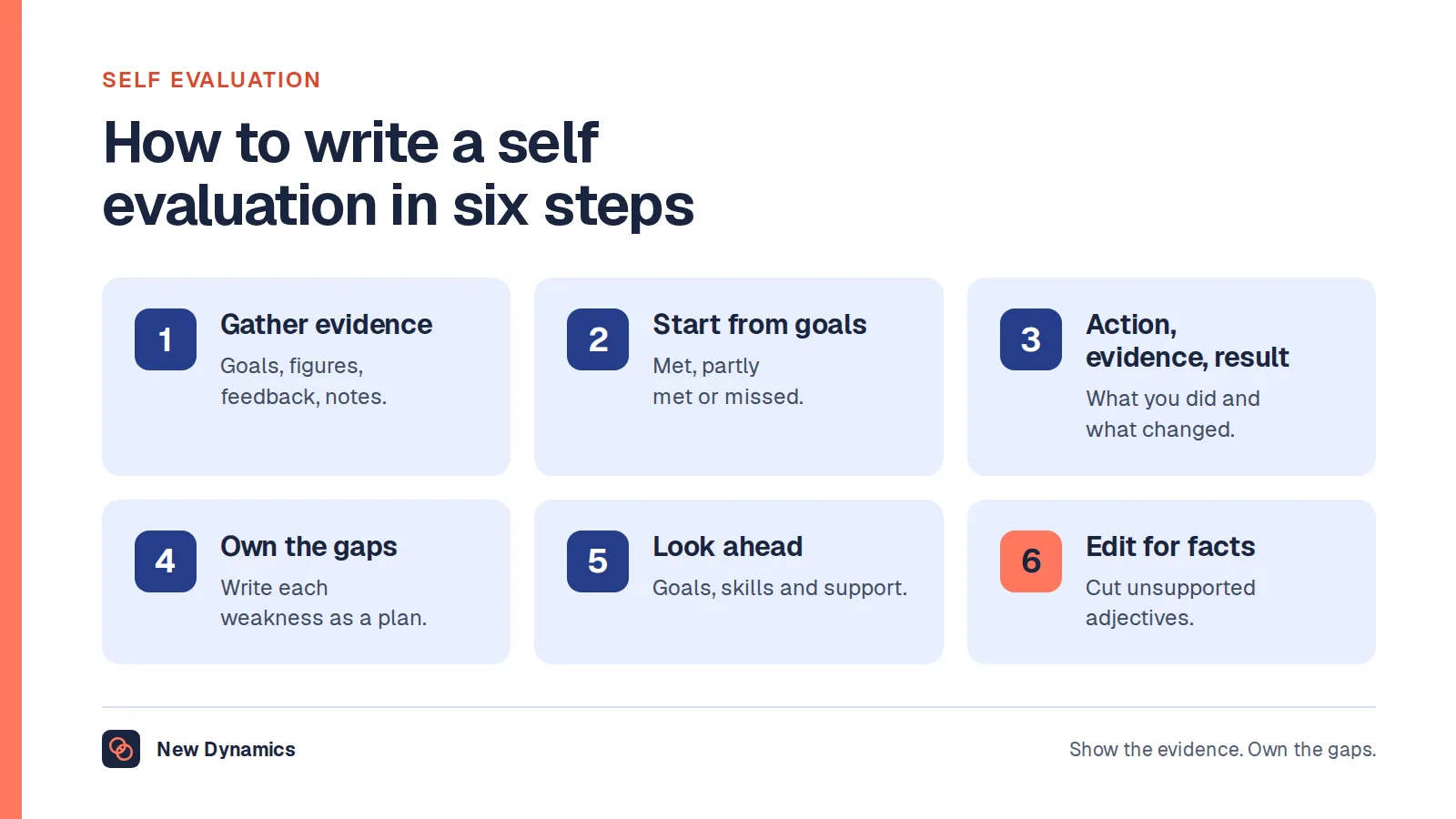
Our self-evaluation examples cover the other kind of personal measurement, the sort you write in your own words for a review, where evidence beats a chart.
Frequently asked questions
What is a quantified selfer?
Someone who records data about their own life (sleep, activity, mood, focus, time or spending) and uses it to understand or change something. The tracking can be automatic through a device or app, or written by hand, and the point is the loop of recording, reviewing and adjusting.
What do quantified selfers track?
Most commonly sleep, movement and heart rate; mood, energy and focus; working hours, meetings and interruptions; and money, food or habits. The specific measures matter less than whether they are tied to a question the person actually wants answered.
Is self-tracking useful?
For an individual, often, as long as it is treated as a personal experiment rather than evidence. It has one participant, no control group, measurement itself changes behaviour, and daily noise hides small effects, so conclusions should be modest and specific to the person.
Can an employer make staff wear a fitness tracker?
That question is about monitoring rather than wellbeing. UK data protection guidance treats any form of monitoring of people who work for you as regulated processing, warns that consent is not usually an appropriate lawful basis because of the imbalance of power at work, and notes that health data is special category data with extra conditions. Take advice before doing it; this is general information only.
What is the difference between self-tracking and employee monitoring?
Who holds the data and who decides. Self-tracking is voluntary, individual and private. Monitoring is carried out by the employer, on people who work for it, and brings duties: a lawful basis, proportionality, transparency and often a data protection impact assessment.
How do you run a wellbeing challenge well?
Make entry genuinely optional, offer an alternative for anyone who cannot take part in a physical challenge, report totals rather than individual league tables, do not receive personal health data if you can avoid it, and say at the start what will be published and what will not.
Your next step: decide what the number is for
- Write the question before choosing the measure, personally or organisationally.
- For anything at work, identify the lawful basis, and do not lean on consent.
- Keep individual-level data away from managers unless there is a stated reason.
- Publish totals, not leaderboards of people.
For handling employee data properly, including monitoring and wellbeing information, read and download our employee data protection guide. The guide is free to read, and the PDF uses our short download form.
Want measures tied to decisions instead of dashboards nobody acts on? Book a New Dynamics demo and bring the numbers you currently report. You can also email contact@new-dynamics.com.