TL;DR
- A culture survey asks employees what they observe: how decisions are made, what gets rewarded, whether it is safe to speak up and whether stated values show in daily behaviour.
- It differs from an engagement survey, which asks how people feel about their work. Culture questions describe the environment. Engagement questions describe the person's response to it.
- Ask 25 to 40 questions in plain words, keep results confidential above a minimum group size, share them within weeks and act visibly on two or three findings. A survey followed by silence does harm.
Most organisations can tell you what their culture is supposed to be. It is printed on the wall and the careers page. Far fewer can tell you what it is: what people do when nobody is checking, what gets rewarded and what happens to the person who brings bad news. A culture survey is one way to find out.
This article explains what a culture survey measures and how it differs from an engagement survey. It gives 40 culture survey questions in eight themes, and sets out how to run the survey and act on what you learn.
Surveys tell you what people think a few times a year. For what they think week by week, see how New Dynamics continuous feedback keeps the conversation going.
What is a culture survey?
A culture survey asks employees to describe the working environment as they experience it: the behaviours they see, the norms they follow and the gap, if any, between the organisation's stated values and daily reality.
The open textbook Principles of Management, published by OpenStax, describes culture in its section on corporate cultures as “both the personality and glue that binds an organization”. It notes that culture is based on values, and that it is generally framed and influenced by the top-level leader or founder, whose example sets the “tone at the top”.
That gives a culture survey its job. It tests whether the tone set at the top is the one heard further down.
Culture survey or engagement survey?
| Culture survey | Engagement survey | |
|---|---|---|
| Asks about | The environment: what people observe | The person: how they feel about their work |
| Typical item | “Decisions here are explained.” | “I would recommend this as a place to work.” |
| Best for | Understanding norms, values and behaviour | Tracking commitment, satisfaction and intent to stay |
| Changes | Slowly, over years | Faster, with events and managers |
| Usual rhythm | Every one to two years, or around a big change | Annually, with short pulses between |
The two overlap, and many organisations combine them. If you do, be clear which questions are which when you analyse the results. Our workplace engagement survey questions cover the other half.
When to run one
- Before and after a merger, a restructure or a change of leadership.
- When the organisation is growing fast and the founders can no longer see everything.
- When you have rewritten your values and want to know whether they describe reality.
- When turnover, complaints or exit interviews suggest a problem that you cannot yet name.
- When you want a baseline before a programme of culture change.
Do not run one if leaders are not prepared to hear the answers and act on some of them.
40 culture survey questions in eight themes
Use a five-point agreement scale, from “strongly disagree” to “strongly agree”, with a “don't know” option. Word every item as something people can observe. The questions are ours. Adapt the wording to your organisation.
1. Values in practice
- I can describe what this organisation stands for.
- The way we work day to day matches our stated values.
- People who live our values are the ones who get on here.
- When values and short-term results conflict, values usually win.
- I would be comfortable if customers could see how we make decisions.
2. Leadership behaviour
- Senior leaders do what they ask others to do.
- Leaders explain the reasons for their decisions.
- Leaders admit it when they get something wrong.
- I see senior leaders often enough to know what they care about.
- Poor behaviour is dealt with, whoever it comes from.
3. Speaking up
- I can raise a concern without fear of the consequences.
- If I make a mistake, it is treated as a chance to learn.
- People here say what they think in meetings, not afterwards.
- Bad news travels upwards quickly.
- When I have raised an issue, something has happened as a result.
Item 12 is close to one that Google used in its research into what makes teams effective: “If I make a mistake on our team, it is not held against me.” Google found psychological safety to be the most important of the five dynamics it identified.
4. Decisions and pace
- I know who makes which decisions.
- Decisions are made at the right level, without needless escalation.
- We make decisions in good time.
- Once a decision is made, people get behind it.
- Our processes help me to do good work more than they get in the way.
5. Collaboration
- Teams here share information freely.
- Other departments help when we ask.
- We work towards shared goals, and teams do not compete against each other.
- Credit is given to the people who did the work.
- Conflicts between teams are resolved openly.
6. Fairness and inclusion
- People are treated with respect here, whatever their role or background.
- Promotions go to those who deserve them.
- Rules apply equally to everyone, including senior people and high performers.
- I feel that I belong here.
- Different opinions and backgrounds are valued.
For a fuller set, see our inclusion survey questions.
7. Learning and improvement
- We take time to review what went well and what did not.
- We are encouraged to try new ways of doing things.
- Lessons from one team reach other teams.
- I have learned something useful at work in the past month.
- Feedback here is honest, and it is given to help.
8. Customers and quality
- We make decisions with the customer in mind.
- I am proud of the quality of what we deliver.
- When a customer has a problem, people take ownership of it.
- We tell customers the truth, including when it is unwelcome.
- We would rather do the right thing than the quick thing.
Open questions
Add two or three of these. The written answers are often the most useful part.
- What three words describe what it is like to work here?
- What is one unwritten rule that a new starter should know?
- What behaviour is rewarded here that should not be?
- What is one thing we should never change?

How to run a culture survey in six steps
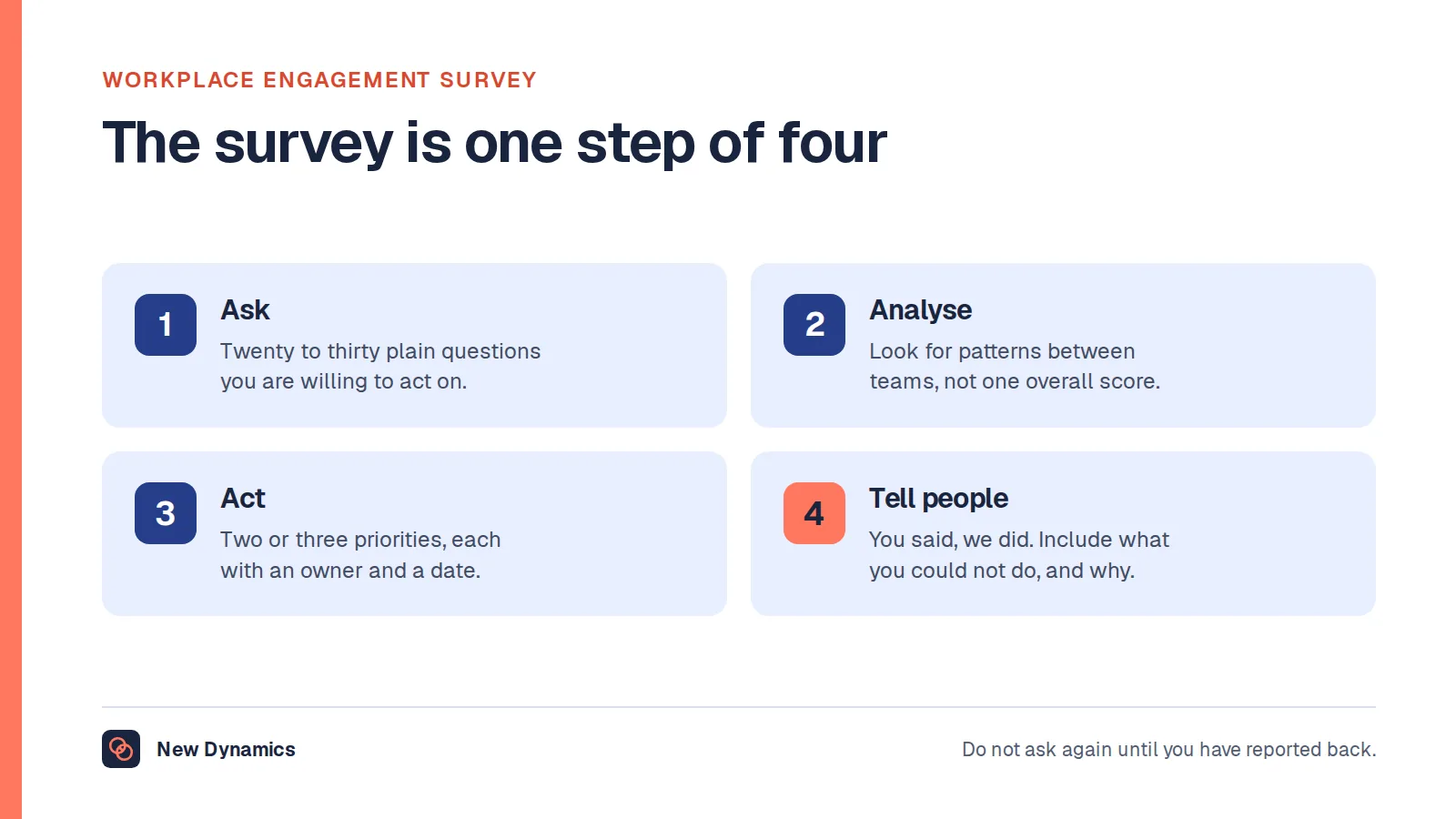
- Decide what you want to learn, and what you are prepared to change. Agree with senior leaders, before the survey opens, that results will be shared.
- Choose 25 to 40 questions. Fewer, and you miss themes. More, and people rush.
- Protect confidentiality. Use a tool or a third party that employees trust. Show results only for groups above a minimum size, and publish that number in advance. If you ask about personal characteristics in order to compare groups, take care. In the UK, the Information Commissioner's Office explains that some kinds of information are special category data and need more protection. This is general information, not legal advice.
- Explain it. Say why you are asking, who will see what, and when people will hear the results.
- Share results within a few weeks, including the uncomfortable ones. Hold discussions in teams so that people can explain what lies behind the scores.
- Act on two or three things, name an owner for each and report progress. Then tell people, “You said this, and we did that.”

How to read the results
Look at gaps more than averages. The most revealing findings are often differences: between senior leaders and everyone else, between departments, between head office and sites, and between newer and longer-serving staff. When leaders score “leaders explain their decisions” at 4.5 and the front line scores it at 2.5, you have learned something important.
Read the comments. Numbers tell you where to look. Words tell you what is going on.
Compare with other evidence. Turnover by team, exit interviews, grievances, customer complaints and absence often point to the same places. See our exit interview questions.
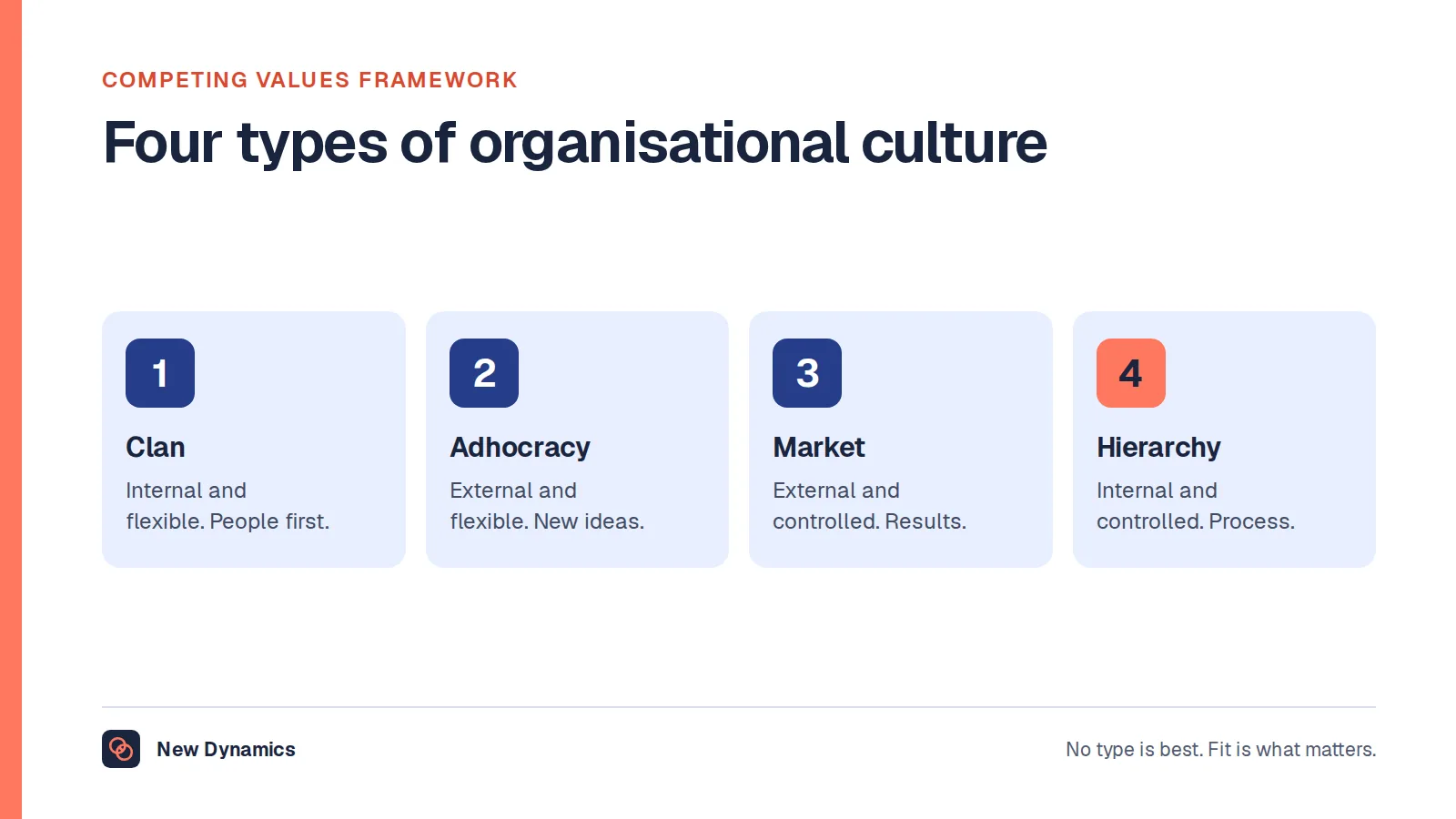
Name the type of culture, if it helps. Frameworks such as the Competing Values Framework can give leaders a shared vocabulary. Our guide to hierarchy culture explains the four types. Treat labels as an aid to conversation, and do not let them replace the detail.
Be careful with benchmarks. A score above an external average can still hide a serious problem in one department.
From results to change
Culture changes through what leaders do, reward and tolerate. A survey cannot change it, and neither can a poster.
- Start at the top. If the survey says that leaders do not explain decisions, the first action belongs to the leaders.
- Pick visible symbols. Who gets promoted, what gets celebrated and what happens to a high performer who behaves badly all speak louder than a values statement.
- Change one or two systems. Reward, promotion criteria, meeting habits or the way decisions are communicated.
- Give managers help. Most culture is experienced through the immediate manager. See our good manager qualities.
- Measure again in twelve to eighteen months, with the same questions.
Our HR change management guide sets out a fuller method.
Common mistakes
Asking and then going quiet. A survey followed by silence teaches people that speaking up is pointless, which is itself a finding about your culture.
Leading questions. “How much do you love our amazing culture?” produces the answer you deserve.
Asking about feelings when you want to know about behaviour. “I feel valued” belongs in an engagement survey. “Credit is given to the people who did the work” belongs here.
Breaking confidentiality. If a manager tries to work out who said what, trust can be lost for a long time.
Averaging away the problem. One unhappy site disappears in a company-wide mean.
Treating the score as the goal. Managers who are judged on survey scores learn to manage the survey.
Surveying too often. Culture moves slowly. Asking every quarter measures noise.

Frequently asked questions
What is a culture survey?
A culture survey asks employees to describe the working environment as they experience it: how decisions are made, what behaviour is rewarded, whether people can speak up and whether the organisation's stated values show in daily life.
What questions should a culture survey ask?
Ask about observable behaviour in themes such as values in practice, leadership, speaking up, decision-making, collaboration, fairness, learning and customer focus. For example: “Leaders explain the reasons for their decisions” and “Poor behaviour is dealt with, whoever it comes from.”
What is the difference between a culture survey and an engagement survey?
A culture survey describes the environment: the norms and behaviours that people observe. An engagement survey describes the person's response: how committed, satisfied and likely to stay they are. Many organisations combine the two.
How often should you run a culture survey?
Every one to two years is usually enough, because culture changes slowly. It is also worth running one before and after a major change, such as a merger, a restructure or a new leadership team.
Should a culture survey be anonymous?
It should at least be confidential, with results shown only for groups above a published minimum size. People describe the culture honestly only when they are confident that their answers cannot be traced back to them.
What do you do with culture survey results?
Share them within a few weeks, including the uncomfortable findings. Discuss them in teams, look at the gaps between groups, choose two or three actions with named owners, report progress and measure again after twelve to eighteen months.
Your next step: test three questions
- Choose three questions from the list that you suspect would score badly.
- Ask them, informally, of five people at different levels.
- Compare their answers with what senior leaders would say.
- If the gap is wide, you have the case for a proper survey.
For a full method from design to action, read and download our employee engagement guide. The guide is free to read, and the PDF uses our short download form.
Want to hear from your people between surveys as well? Book a New Dynamics demo and bring your latest results. You can also email contact@new-dynamics.com.