TL;DR
- The strengths half of a review is usually the weakest writing in the document, and it is the half that travels: it feeds pay decisions, promotion cases, internal moves and references, long after the person who wrote it has moved on.
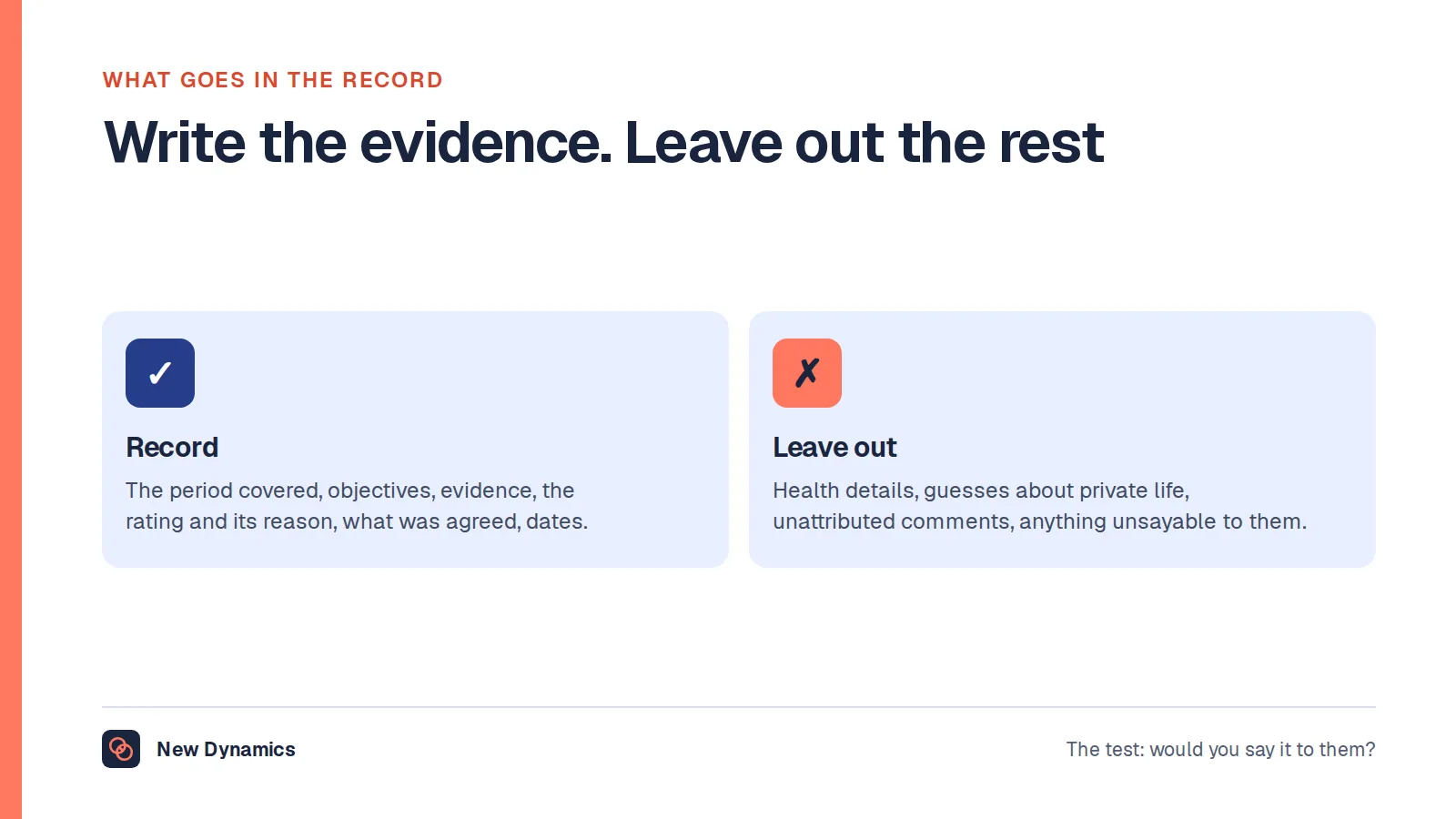
- Write recognition the way you would write a criticism. What they did, the evidence, the effect it had, and what it tells you about what comes next. Four parts, two or three sentences, no adjectives doing the work.
- Watch two traps at the rating. Inflating a rating because the praise was warm leaves you unable to justify it in calibration, and withholding the praise so the rating stays defensible is the same error with the harm pointed at the employee.
Open ten completed reviews and count the words. In most of them the development section runs to two paragraphs with dates and examples, and the strengths section says "a reliable member of the team who always delivers". One of those will be quoted back in a promotion case in eighteen months, and it will not be the useful one.
This article covers why the recognition half matters more than it looks, a structure for writing it, rewrites of the lines managers actually use, how to notice the people whose work is invisible, and the two traps that sit between praise and the rating.
Recognition lands better when it is not stored up for an annual document. See how New Dynamics recognition makes it visible as it happens.
Why the rushed half is the one that travels
Acas describes a review as a chance to discuss someone's work, "including: what they are doing well", before it mentions areas for improvement, and asks employers to keep a written record of what is discussed and share it with the employee. In practice the order is reversed: the criticism gets the evidence and the praise gets the adjectives.
That matters because the written recognition is the part with a long life. It is read in calibration by people who have never met the person. It becomes the promotion case, the argument for a pay decision, the reason someone is considered for an internal move, and sometimes the basis of a reference. Our post on performance review record keeping covers how long those records live and who reads them.
There is a fairness dimension too. Acas says less favourable treatment "can be anything that puts someone with a protected characteristic at a disadvantage" and that it "might include: excluding someone from opportunities or benefits", adding that "it can still be discrimination even if the less favourable treatment was not intended". Written recognition is one of the things that unlocks opportunities, so who gets it, and in what detail, is worth looking at across a team rather than one review at a time.
Four parts, two or three sentences

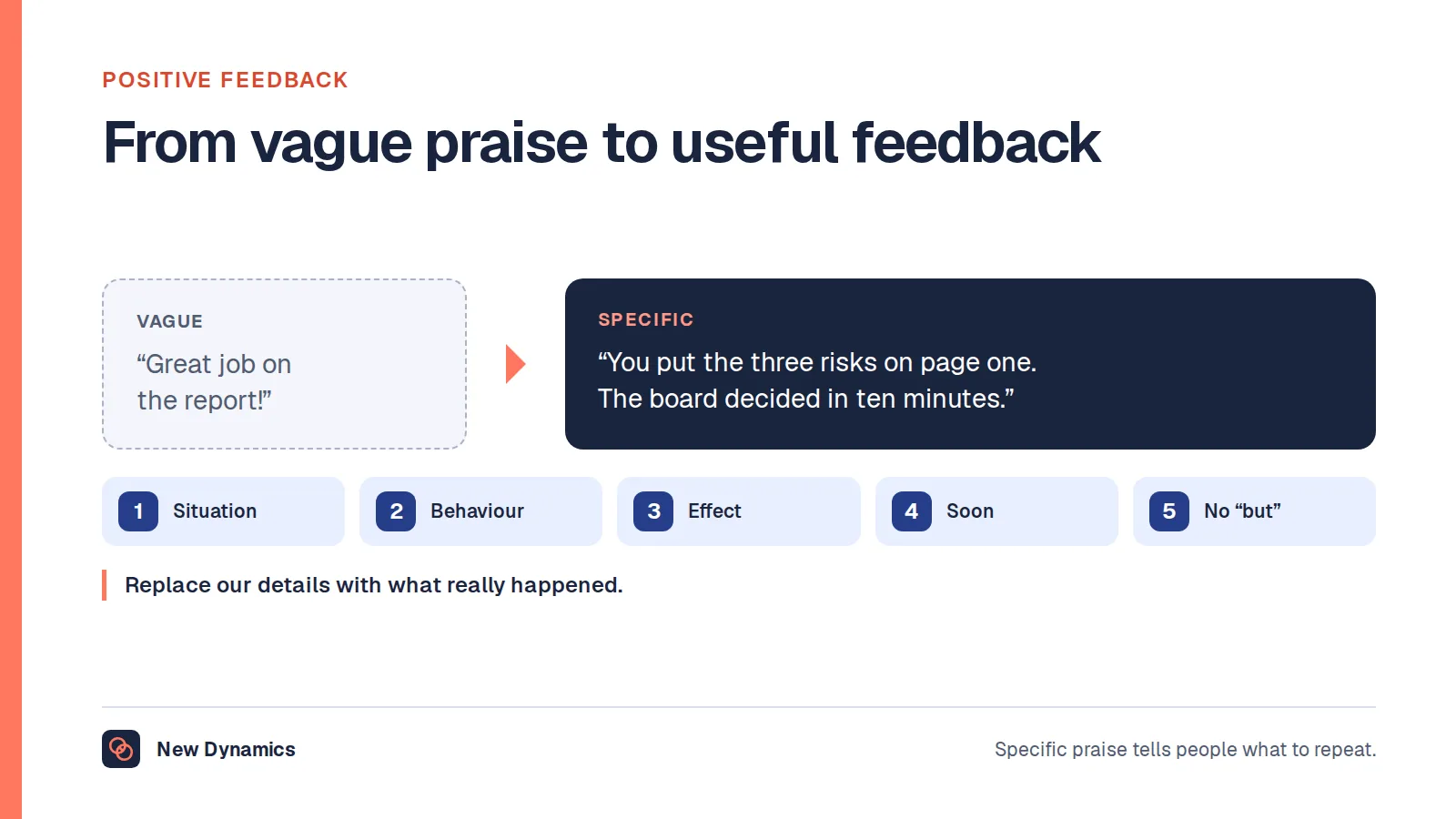
1. What they did. The specific thing, not the quality it demonstrates. "Rebuilt the onboarding checklist" rather than "showed initiative".
2. The evidence. When, how often, what scale. Dates and numbers do the same work here that they do in a criticism.
3. The effect. On the team, the customer, the cost, the risk. This is the part that makes a line usable by someone who was not there.
4. What it means next. What this makes them ready for, or what you want more of. Recognition without a forward sentence reads as a full stop, which is not what a strong performer wants to hear.
Two or three sentences per strength, and three strengths is plenty. Six vague ones carry less weight than three specific ones, and nobody has ever been promoted on volume of adjectives.
Rewrites

- "A great team player" becomes "picked up the client handover when two people were off in August, which kept the migration on schedule; the handover notes are now what we give new starters."
- "Always reliable" becomes "delivered all twelve monthly reports on the second working day, including through the system change in March when the source data moved."
- "Good communicator" becomes "rewrote the incident updates so non-technical teams could follow them; support stopped forwarding queries to engineering during incidents."
- "Shows initiative" becomes "noticed that two teams were duplicating the same reconciliation and proposed the split that ended it, without being asked."
- "Hard working" becomes "took on the second region for five months while we recruited, and flagged early what would have to drop, which is why nothing did."
The pattern is the same every time: replace the adjective with the thing that earned it. If you cannot name the thing, the adjective was a guess.
The people who never get written up

Some work is invisible by design, and the people doing it are systematically under-recognised. Prevention leaves no trace. The project that never went wrong, the conflict that got handled in week one, the documentation that stopped the questions: none of these produce an artefact for a review.
HSE names Support among the six areas of work design that managers control, describing it as "the encouragement, sponsorship and resources provided by the organisation, line management and colleagues", and notes that these areas, badly managed, are associated with lower productivity. The colleague everyone asks for help is holding up part of that, usually unrecorded.
Three habits find this work:
- Ask the team, not just the person. "Who made your year easier?" produces names that never appear in a delivery report.
- Look for the absence of problems in areas that used to have them, and find out who changed that.
- Check the quiet ones. Sort your drafts by length. The shortest reviews often belong to people who never ask for anything.
The two traps at the rating
Inflating the rating to match the praise. The strengths section is warm, so the rating goes up a notch to be consistent with it. In calibration you then have to defend a level you cannot evidence, and the rating usually comes back down, which is a worse conversation than the one you avoided.
Withholding the praise to protect the rating. The more damaging version. The work was good, but writing it up fully might look like a case for a higher rating, so the recognition gets trimmed. The rating survives and the person's record does not, and the record is what the next manager, the promotion panel and the reference reader will see.
Both come from the same confusion. Recognition describes what happened. The rating is a judgement about the whole period against a standard. A person can do genuinely excellent work in one area and still sit at the middle rating because the rest of the period was steady, and a review that says exactly that is more credible than one that smooths it.
Saying it in the meeting
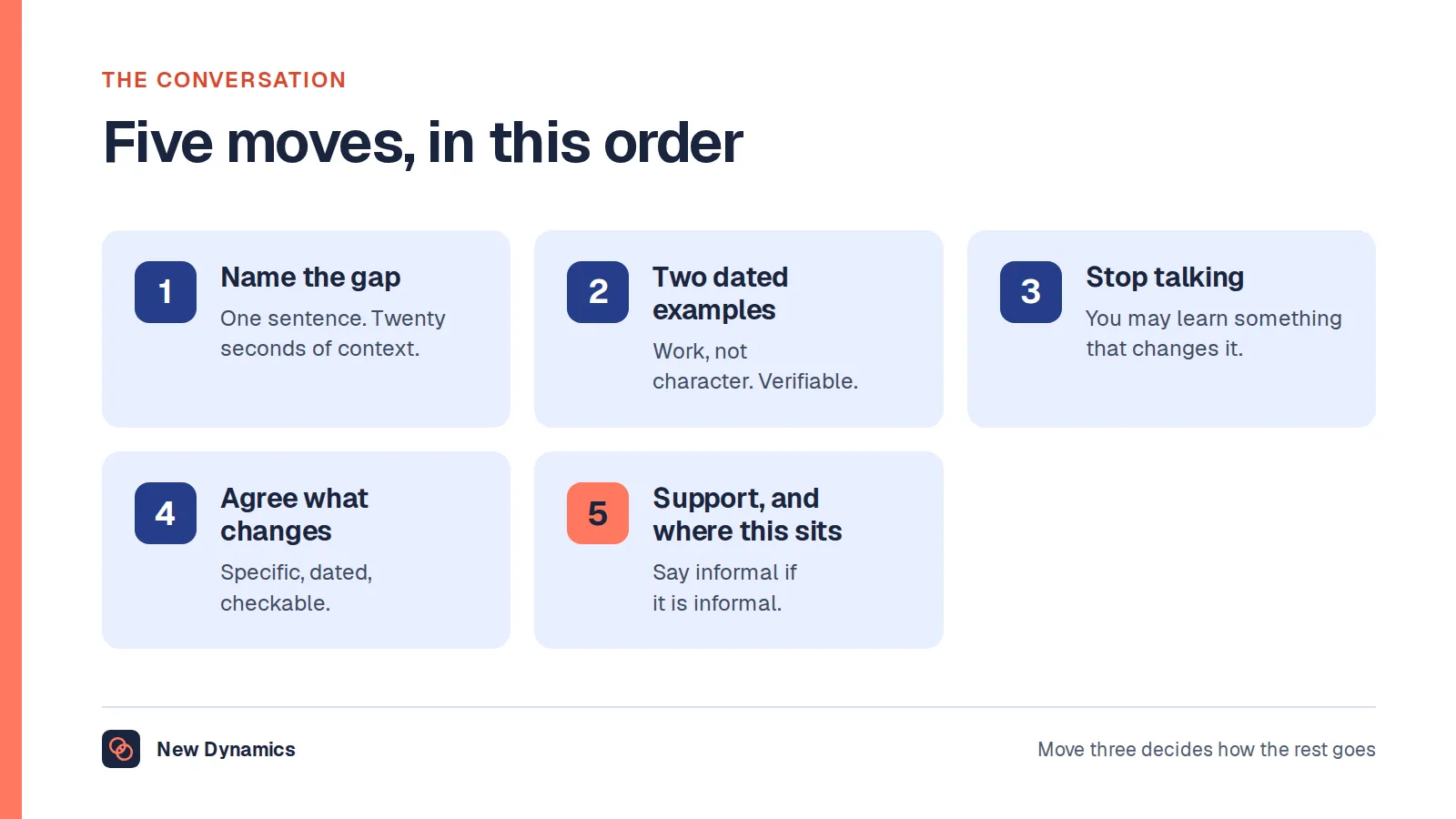
Write it first, then say it. Three practical points:
- Do not open with praise if you are about to criticise. That turns recognition into a warning sign, and after two cycles people stop hearing the first two minutes of any review. Our post on the underperformance conversation covers why the sandwich fails.
- Give the recognition its own airtime. Thirty seconds of specific praise, then a pause, before moving on.
- Ask what they want more of. The answer tells you what to put people forward for, and it is often not the thing they are best known for.
For more wording, our positive feedback examples post has fifty lines grouped by situation, written for day-to-day use rather than for the form.
Afterwards: make it count
Recognition that stays in the document helps nobody. Pass the two best examples to your own manager before calibration, so the evidence is in the room. Name the person when the work comes up in front of others. If your organisation runs recognition schemes, use the review to feed them rather than treating them as separate systems, which is what our employee recognition guide sets out.
Then check the pattern across your team once a year: who got detailed recognition, who got adjectives, and whether that tracks the work or tracks how often you see each person.
Frequently asked questions
How do you write the strengths section of a performance review?
Use four parts for each strength: what the person did, the evidence with dates or numbers, the effect it had, and what it means for what comes next. Two or three sentences each, and three strengths is enough. Replace every adjective with the specific thing that earned it.
What are good examples of recognising performance in a review?
Specific ones. "Delivered all twelve monthly reports on the second working day, including through the March system change" carries weight; "always reliable" does not. The test is whether someone who was not there could understand what happened and why it mattered.
Should praise in a review affect the rating?
Not automatically. Recognition describes what happened in a particular area; the rating is a judgement about the whole period against a standard. Inflating the rating to match warm praise leaves you unable to defend it in calibration, and trimming the praise to protect the rating damages the person's record for no good reason.
How do you recognise work that nobody sees?
Ask the team who made their year easier, look for problems that stopped happening and find out who changed that, and check whether your shortest reviews belong to the people who ask for least. Prevention leaves no artefact, so it has to be gathered deliberately.
Why does recognition in a review matter if you already say thank you?
Because the written record travels. It is read in calibration by people who have never met the person, and it becomes the promotion case, the argument in a pay round, the reason for an internal move and sometimes the basis of a reference. Day-to-day praise does none of that.
Should you give praise and criticism in the same review?
Yes, but not in a sandwich. Give the recognition its own time and its own evidence, and raise any concern separately and plainly. Alternating them teaches people that praise is a prelude to bad news, after which the recognition stops working.
Your next step: audit the half you rush
- Open your last five reviews and count the words in the strengths section against the development section.
- Find every adjective in those strengths sections and replace it with the thing that earned it, or delete it.
- Ask your team who made their year easier, and write down the names that surprise you.
- Before calibration, pick two specific examples per person that someone else could repeat out loud.
For connecting review recognition to how your organisation says thank you the rest of the year, read and download our employee recognition guide. The guide is free to read, and the PDF uses our short download form.
Want recognition captured as it happens, so the review half writes itself? Book a New Dynamics demo and bring last cycle's reviews. You can also email contact@new-dynamics.com.