TL;DR
- Positive feedback tells someone what they did well and why it mattered, so that they know to do it again. “Great job” is pleasant. A specific example is useful.
- Use three parts: the situation, the behaviour you saw and the effect it had. The 50 examples here follow that pattern, across quality, reliability, teamwork, customer service, growth and leadership.
- Give it soon, give it often and keep it separate from criticism. Praise that arrives only as the opening to a “but” teaches people to brace when they hear it.
In our experience, managers tend to think they give plenty of praise, and their teams tend to remember rather less. The gap is rarely about generosity. It is that “great job, team” slides past without landing, because nobody knows what exactly was great.
This article gives 50 positive feedback examples you can adapt for employees and colleagues, a simple structure that makes praise specific, six steps for giving it well and the mistakes that weaken it.
If you want praise and coaching to happen in the flow of work, where the whole team can see it, explore New Dynamics continuous feedback.
What is positive feedback?
Positive feedback tells someone what they did well and why it mattered, so that they understand what to keep doing. It is sometimes called reinforcing feedback, because its job is to reinforce good work.
It differs from a compliment. “You are brilliant” is a compliment about the person. “The way you laid out the three options made the decision easy” is feedback about the work. The second one can be repeated next week.
It also differs from formal recognition, such as awards and thank-you schemes. Recognition is public and occasional. Positive feedback is an everyday habit. For the formal side, see our employee recognition ideas.
Why positive feedback matters
It shows people what good looks like. Criticism tells someone what to stop. Only positive feedback tells them what to repeat. People who never hear it have to guess.
It is part of a healthy workplace. The UK Health and Safety Executive's Management Standards for work-related stress include a Support standard. One of the things that should be happening, it says, is that “employees receive regular and constructive feedback”.
It should not wait for the annual review. Acas describes performance reviews as a chance to discuss “what they are doing well” along with areas for improvement, and adds in its guidance on performance management that managers should still talk to employees informally about their performance on a regular basis.
It makes the harder conversations easier. People accept criticism more readily from someone who has clearly noticed their good work too. That is our view, from experience, and most managers will recognise it.
A simple structure for positive feedback
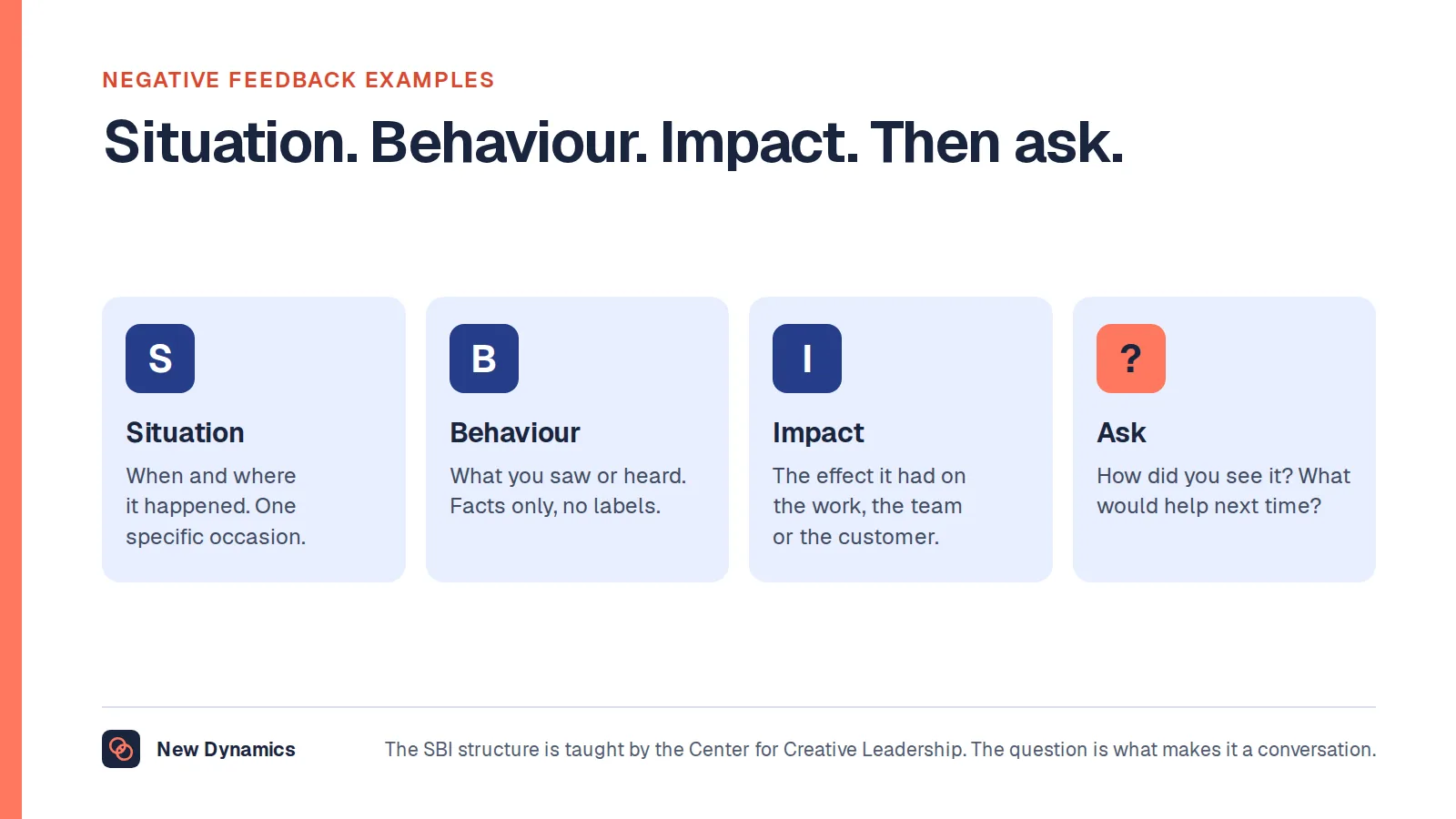
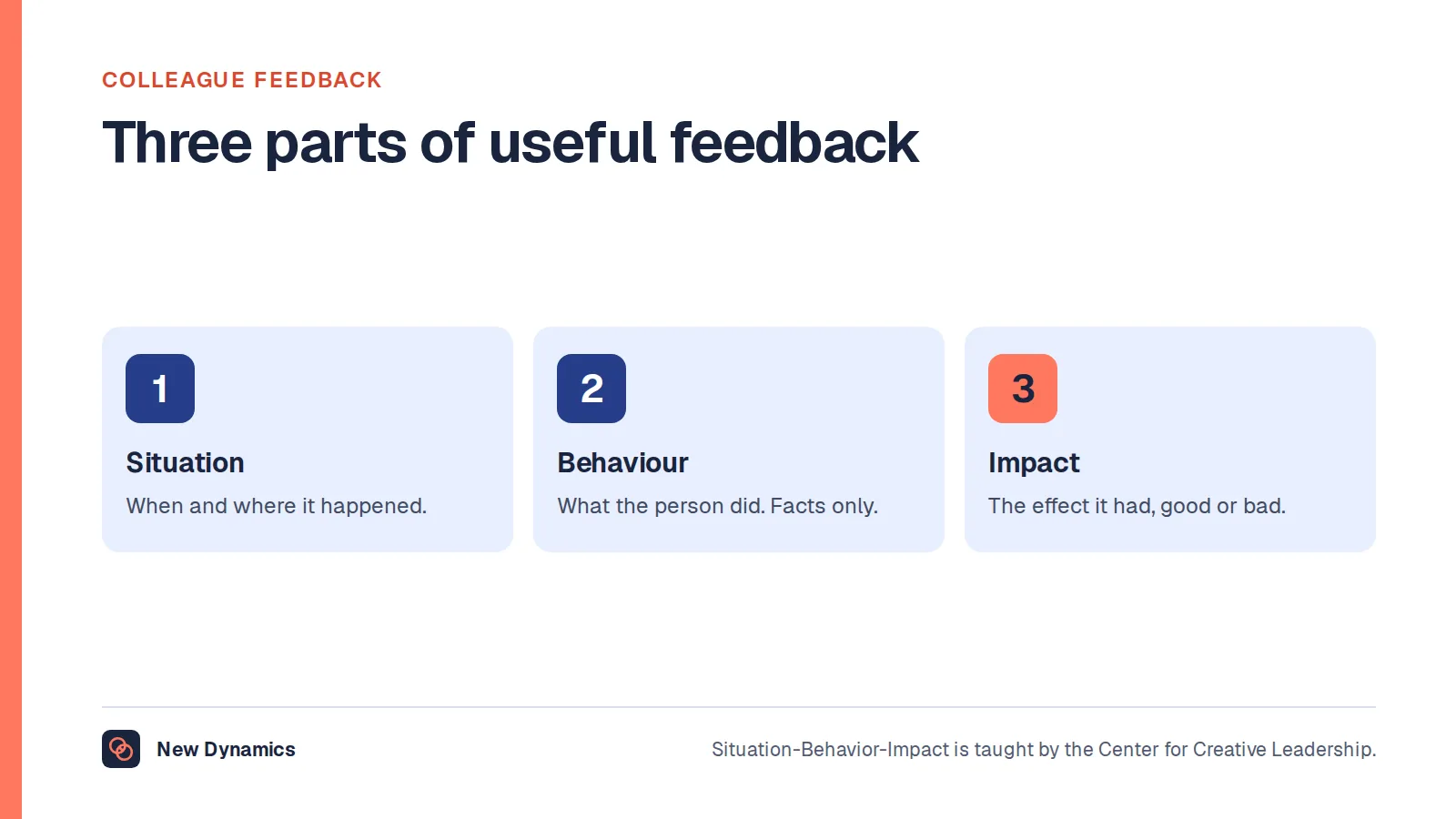
The Center for Creative Leadership teaches a three-part model called Situation-Behavior-Impact. The Center is clear that it works for praise as well as criticism: the impact step asks you to describe the results of the behaviour, “whether the effect was positive or negative”.
- Situation. When and where did it happen?
- Behaviour. What did the person do, in terms someone could observe?
- Impact. What difference did it make, to you, the team or the customer?
Compare two versions.
- Vague: “Nice work on the report.”
- Specific: “In Tuesday's board report, you put the three risks on the first page with a recommendation for each. The board made its decision in ten minutes, and the chair asked for every report in that format.”
The second takes fifteen seconds longer to say, and it tells the person exactly what to do again.

50 positive feedback examples
Every example is an original line written by the New Dynamics team. The details in them are illustrative. Replace them with what really happened, because the real detail is what gives feedback its value.
Quality of work
- “The analysis you sent on Friday answered the question I asked and the two I should have asked. It saved a second round of work.”
- “I checked your figures against the source and found no errors in forty pages. That care is why the finance team trusts our numbers.”
- “Your handover notes were so clear that Priya picked the project up without one call to you. That is rare.”
- “The proposal was half the length of the last one and twice as persuasive. The client mentioned how easy it was to read.”
- “You tested the edge cases nobody asked you to test. One of them would have failed in front of the customer.”
Reliability and delivery
- “You said Thursday, and it arrived on Thursday, for the sixth month running. I plan around your dates without worrying.”
- “When the supplier slipped, you told me the same day with a revised plan. I had time to warn the client.”
- “You kept the launch on track while two people were off sick, by cutting the right things and saying so early.”
- “Your weekly update takes me two minutes to read, and I always know where things stand.”
- “You finished the audit a week early, which gave us time to fix the findings before the deadline.”
Teamwork and helping others
- “You stayed on the call to help Marcus with his query when yours was already done. He told me it got him unstuck.”
- “In yesterday's meeting you asked Amara what she thought, when she had been quiet. Her point changed the plan.”
- “You shared your template with the whole team without being asked. Three people are using it already.”
- “You gave the credit for the fix to the support team in front of the director. They noticed, and so did I.”
- “When the two teams disagreed, you wrote up both positions fairly. It took the heat out of the discussion.”
Initiative and problem solving
- “You noticed the same fault reported three times and went looking for the cause. The fix removed a whole category of tickets.”
- “Nobody asked you to document that process. Now new starters can follow it on day two.”
- “You brought me the problem with two options and a recommendation. I could decide in five minutes.”
- “You ran a small trial before proposing the change, so we argued about evidence and not opinions.”
- “You spotted that the invoice did not match the contract and queried it before payment. That was a real saving.”
Communication
- “Your email to the whole company explained a complicated change in six sentences. I have had no confused replies.”
- “In the client meeting you said, ‘I don't know, and I will find out by Friday.’ They trusted everything else you said because of it.”
- “You summarised the decision and the actions at the end of the meeting. Everyone left knowing what to do.”
- “You raised your concern with me directly and privately. It was easy to fix because you told me early.”
- “Your presentation had one idea per slide, and you stopped for questions. People were still talking about it afterwards.”
Customer service
These lines work as feedback to customer service colleagues, from a manager or a team leader. When a customer sends praise, pass it on word for word and add your own.
- “On that difficult call yesterday, you let the customer finish before you replied, and then repeated the problem back. I could hear them calm down.”
- “You followed up two days later to check that the fix had held. The customer wrote in to thank you by name.”
- “You explained the refund policy in plain words and offered the alternative. The customer accepted it without escalating.”
- “You noticed the customer was on the wrong plan for their needs and told them, though it cost us a little now. That is how we keep customers.”
- “Your notes on the account meant the next agent did not have to ask the customer to repeat anything.”
Our performance review phrases include more wording for customer-facing roles.
Learning and growth
- “Three months ago you asked me to review every report. The last four needed no changes. You have made that skill your own.”
- “You asked for feedback after the presentation and used it in the next one. The difference was obvious.”
- “You volunteered for the project that scared you. Whatever the result, that is how people grow here.”
- “You taught yourself the new system and then ran a session for the team. Everyone benefited from your evening of frustration.”
- “When the pilot failed, you wrote up what you learned within a day. The next team started from your notes.”
For more on this, see our growth mindset examples.
New starters
- “In your second week you asked why we do the monthly report that way. Nobody could answer, so we have simplified it.”
- “You have met everyone on your list of introductions already. People keep telling me how well prepared your questions were.”
- “Your first piece of work followed the style guide exactly. That tells me you read what we sent you.”
- “You said when you did not understand, which saved us both from a week of wasted effort.”
- “You have settled into the team's way of working faster than I expected. The 30-60-90 day plan is well ahead.”
Leadership and managing others
- “Your team told me they always know their priorities. That clarity comes from you.”
- “You gave Dan the client presentation and coached him beforehand. He did well, and he has grown.”
- “You dealt with the behaviour issue in your team the same week. I know that was uncomfortable.”
- “You protected your team from three changes of direction last month and passed on only the one that mattered.”
- “You disagreed with me in the leadership meeting, with evidence, and you were right. Please keep doing that.”
Under pressure
- “During the outage you kept the updates calm and regular. Customers knew what was happening, and so did we.”
- “You told me you were at capacity before anything slipped. That gave me the chance to move work.”
- “When the client was sharp with you, you stayed courteous and stuck to the facts. They apologised the next day.”
- “You made a judgement call on Saturday with nobody to ask, and you wrote down your reasoning. It was the right call.”
- “It was a hard quarter, and you were steady throughout. The team took its mood from you.”
How to give positive feedback: six steps
- Notice. Keep a note of good work as you see it. You will forget by Friday.
- Give it soon. The same day is best. The link between the action and the feedback weakens with every week.
- Be specific. Name the situation, the behaviour and the effect.
- Choose the setting. Some people love public praise, and some dislike it. If you do not know, ask.
- Keep it clean. Do not attach a criticism. If you have one, give it separately.
- Spread it fairly. Check now and then who has heard nothing from you lately. Quiet, reliable people are the easiest to overlook.

What is worth praising?
Results are the obvious answer, and they are only part of it. Look for five things.
- Results: the goal met, the customer won, the problem fixed.
- Effort and persistence, especially when the result was outside the person's control.
- Behaviour: how they worked, such as the honesty in example 22 or the inclusion in example 12.
- Growth: the skill that was weak in spring and strong in autumn.
- Help given to others, which is easy to miss because it shows up in someone else's results.
If only results are praised, people can learn to avoid hard things. Praising effort, behaviour and growth as well shows them that how they work counts.

Common mistakes with positive feedback
Staying vague. “Good job” is kind, and it teaches nothing.
The compliment sandwich. Praise used as the wrapping for criticism teaches people to brace when they hear it. Give each its own moment. See our negative feedback examples for the other half.
Praising the person in place of the work. “You are a natural” suggests that talent did it. “You rehearsed that three times and it showed” credits something the person controls.
Saving it all for the review. By then the detail has gone, and so has much of the value.
Praising only your stars. The steady majority carry most of the work.
Overdoing it. Praise for everything becomes noise. Keep it honest and specific, and it keeps its value.
Forgetting to pass it on. When a customer or a senior leader praises someone in your team, tell the person, and tell them exactly what was said.
Positive feedback from colleagues and for managers
Positive feedback does not have to flow downwards.
- Between colleagues, it builds trust and is often more credible than praise from the boss, because peers see the work up close. See our colleague feedback examples.
- Upwards, managers hear little honest praise and often cannot tell what is working. “When you explained the reason for the change, the team accepted it much more easily” helps a manager to do it again. See our manager feedback examples.
How to receive positive feedback
Many people deflect praise: “It was nothing,” or “the team did it all.” Deflecting is modest, and it also tells the giver that they were wrong.
Try this:
- Say thank you.
- If it was vague, ask what in particular was useful. You will learn what to repeat.
- Share the credit accurately, by name, where others contributed.
Frequently asked questions
What is an example of positive feedback?
“In Tuesday's board report, you put the three risks on the first page with a recommendation for each. The board decided in ten minutes.” It names the situation, the behaviour and the effect, so the person knows what to repeat.
How do you give positive feedback to an employee?
Give it soon after the event, and be specific. Describe the situation, what the person did and the difference it made. Choose a setting that suits them, keep it separate from any criticism and make sure that quiet, reliable people hear it too.
What is the difference between positive feedback and praise?
Praise expresses approval, such as “great job”. Positive feedback explains what was good and why it mattered. Praise is pleasant and quickly forgotten. Specific positive feedback tells the person what to keep doing.
How often should managers give positive feedback?
Give it whenever you see good work that you want repeated, which for most managers means several times a week across a team. Regular, specific comments are worth more than a long list saved for the annual review.
What positive feedback can you give to customer service staff?
Describe a specific call or message, what the person did and how the customer responded. For example: “You repeated the problem back before answering, and I could hear the customer calm down.” Pass on customers' own praise word for word.
Should positive feedback be given in public or in private?
It depends on the person. Public praise shows the team what good looks like, and many people enjoy it. Others find it uncomfortable. If you do not know someone's preference, ask them, or start in private.
Your next step: give three pieces of feedback this week
- Write down three good things you have seen in your team in the last fortnight.
- For each one, note the situation, the behaviour and the effect.
- Tell each person today or tomorrow, in your own words.
- Put a reminder in your calendar to do the same next week.
For a fuller method covering praise, criticism and requests for feedback, read and download our employee feedback guide. The guide is free to read, and the PDF uses our short download form.
Want feedback to be frequent, specific and visible across your teams? Book a New Dynamics demo and bring your current approach. You can also email contact@new-dynamics.com.