TL;DR
- Answer four questions in writing first: what specifically is below standard, what the standard is and where it is written, what the person has already been told, and whether this is about ability or behaviour. Acas says the kind of problem changes how an employer should respond.
- The conversation has five moves: name the gap in one sentence, give two or three dated examples, stop and listen, agree what changes and by when, then say what support exists and where this sits. Acas describes resolving a problem informally first as often the quickest and easiest solution.
- Plan for the reaction rather than hoping for agreement. Defensiveness, silence, distress, deflection and polite agreement with no change each need a different next line, and the last one is the most common.
You have known for about six weeks. You have rehearsed it in the car twice. The meeting has moved in the diary three times, and in the meantime the person has carried on doing the thing, because from where they sit nothing is wrong.
This article covers what to settle before the meeting, a five-move framework, a script you can adapt, what to say to each of the five reactions you are likely to get, and what to write down afterwards. It describes the position in Great Britain and is general information, not legal advice.
The conversation is easier when it is not the first one in eleven months. See how New Dynamics continuous feedback makes small corrections normal, so the big ones are rare.
Four questions to answer in writing first
What exactly is below standard? Write the sentence. If it contains the word "attitude", you have not finished: find the behaviour underneath it. "Three deadlines missed without telling anyone in advance" is a conversation. "Not committed enough" is an argument waiting to happen.
What is the standard, and where is it written? An objective, a job description, a service level, a team norm everyone else follows. If it exists nowhere, the first conversation is about setting it, not about missing it.
What have they already been told, by whom, and when? If the answer is nothing, this is the first conversation and should be framed as one. A concern that surfaces for the first time at a formal stage is a failure of the months before it.
Is it capability or conduct? Acas separates capability, "someone's ability to do their job", from conduct, "someone's behaviour at work", and says "what kind of problem it is affects how employers should respond". It also sets a floor on the employer's side: employers "must provide 'adequate resources' to enable an employee to do their job. This might include giving them training." Check that floor has been met before you ask anyone to clear a bar. It is worth checking the workload too: HSE lists "workload, work patterns and the work environment" among the areas of work design that, managed badly, lower productivity.
The five moves

1. Name the gap in one sentence. Twenty seconds of context at most. Long warm-ups do not soften anything; they just move the moment and raise the heart rate.
2. Give two or three dated examples. Specific, verifiable, and about work rather than character. Two good examples beat a list, because a list sounds like a case being built.
3. Stop talking. This is the hardest move and the one that decides how the rest goes. Acas lists "listening to their point of view" among the steps of resolving a problem informally, and you may learn something that changes your view: a dependency you did not know about, an instruction from somebody else, a reason the standard was never met because it was never possible.
4. Agree what changes, and by when. Acas names "agreeing improvements to be made" and "setting up a training or development plan, if it's a performance issue". Make it specific, measurable, achievable, relevant and time-bound, which is the test Acas applies to objectives generally.
5. Say what support exists, and where this sits. For a capability issue Acas suggests "mentoring or coaching" and "training", and says employers "should try these things first before starting a formal disciplinary procedure". Then say plainly whether this conversation is informal or the start of something formal. Leaving that unsaid is the cruellest option, because people assume the worst version.
A script to adapt
Wording to make your own, not to read aloud.
Opening. "I want to talk about the reporting work, because the last three monthly packs have gone out late and with figures that had to be corrected afterwards. I think there is a gap between what the role needs and what has been happening, and I want to understand it and fix it with you."
Evidence. "The March pack went out two days late with the regional totals wrong. April was a day late. In May the figures were right but it arrived after the board had met. I have not raised each one at the time and that is on me."
The pause. "That is how it looks from here. What am I missing?" Then wait. Count to ten in your head if you have to.
Agreement. "So we agree the pack goes out by the second working day with the totals checked against the source. You will have the new template by Friday and a session with the finance lead on the reconciliation on Monday. We will look at the next two packs together and then you run them."
Where it sits. "This is an informal conversation. I am not starting a formal process. I will write up what we agreed and send it to you today, and we will review it after the August pack."
Note what is missing: no sandwich, no adjectives about the person, no vague threat about what happens if things do not improve. If a formal step is genuinely the next thing, say so explicitly and follow your organisation's procedure. If it is not, do not hint at it.
Five reactions, and the next line

Defensive: "that is not fair." Do not argue about fairness, because that is a debate about your judgement rather than about the work. Return to one specific example and ask a question. "Take the March pack. It went out on the fourth and the regional totals were corrected afterwards. How did that look from where you were sitting?" If they produce facts you did not have, say so and check them. If they produce reasons rather than facts, note them and come back to the gap: "I understand the system is slow. The pack still has to be right on the second. What would make that possible?" Defensiveness is usually fear, and it falls away fastest when the conversation gets more specific rather than more general.
Silence. Let it run longer than is comfortable, then ask one open question: "I would rather hear what you think, even if you disagree." If the silence continues, say what happens next and offer a second conversation in two days. Some people process in private and come back with something useful.
Distress. Stop the agenda. "Let us pause. Do you want to take ten minutes, or carry on another day?" Do not continue through tears to finish on time, and do not treat the upset as agreement. If something personal surfaces, switch to supporting them and handle the performance point separately and later.
Deflection: "everyone does it." Acknowledge without accepting. "If that is happening more widely, I will deal with that separately, and I will. Today I am talking about your three packs." Then come back to the example. If the deflection is at another person, write down the claim and check it rather than ruling on it in the room.
Agreement with no change. The most common and least dramatic outcome: "yes, you are right, I will sort it", and six weeks later nothing has moved. The fix is at move four. Vague agreement is a sign the specifics were not agreed, so finish with a dated, verifiable action and a check-in in the diary before anyone leaves the room.
What never to say

- "Everyone has been saying..." Anonymous collective evidence cannot be answered and sounds like a conspiracy. Speak for yourself, or bring a named, checked example.
- "I have been meaning to mention this for a while." True, probably, and it tells the person you have been judging them silently for months.
- "It is not a big deal, but..." If it is not a big deal, do not hold the meeting. If it is, do not open by denying it.
- "You have an attitude problem." Not a behaviour, not actionable, and uncomfortably close to judging the person rather than the work.
- Praise, criticism, praise. The sandwich does not protect anyone. It makes the middle sound optional, and people reliably remember the bread.
- A vague warning. "If this carries on we will have to think about next steps" leaves someone to imagine the worst. Either name the formal step properly or leave it out.
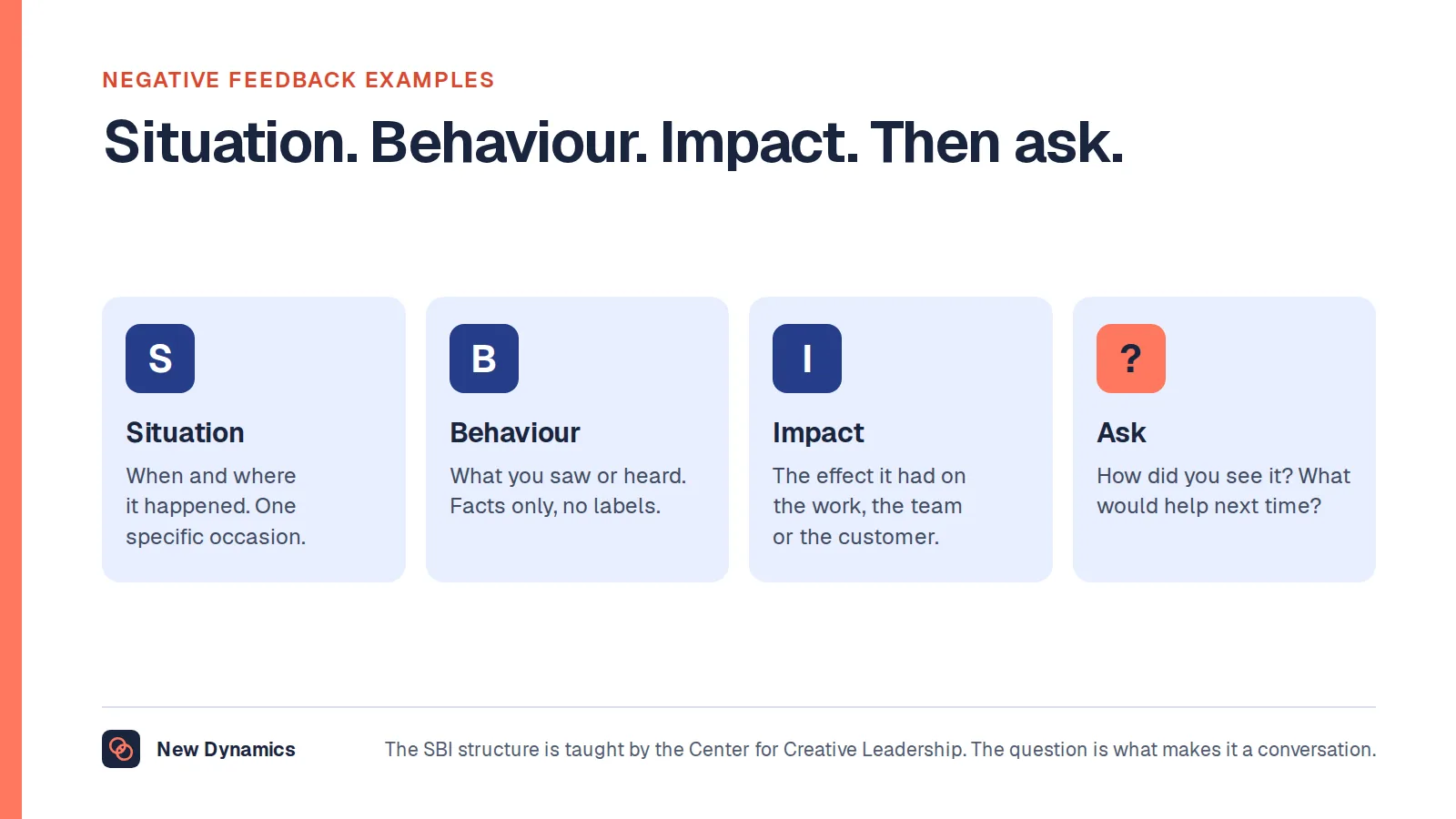
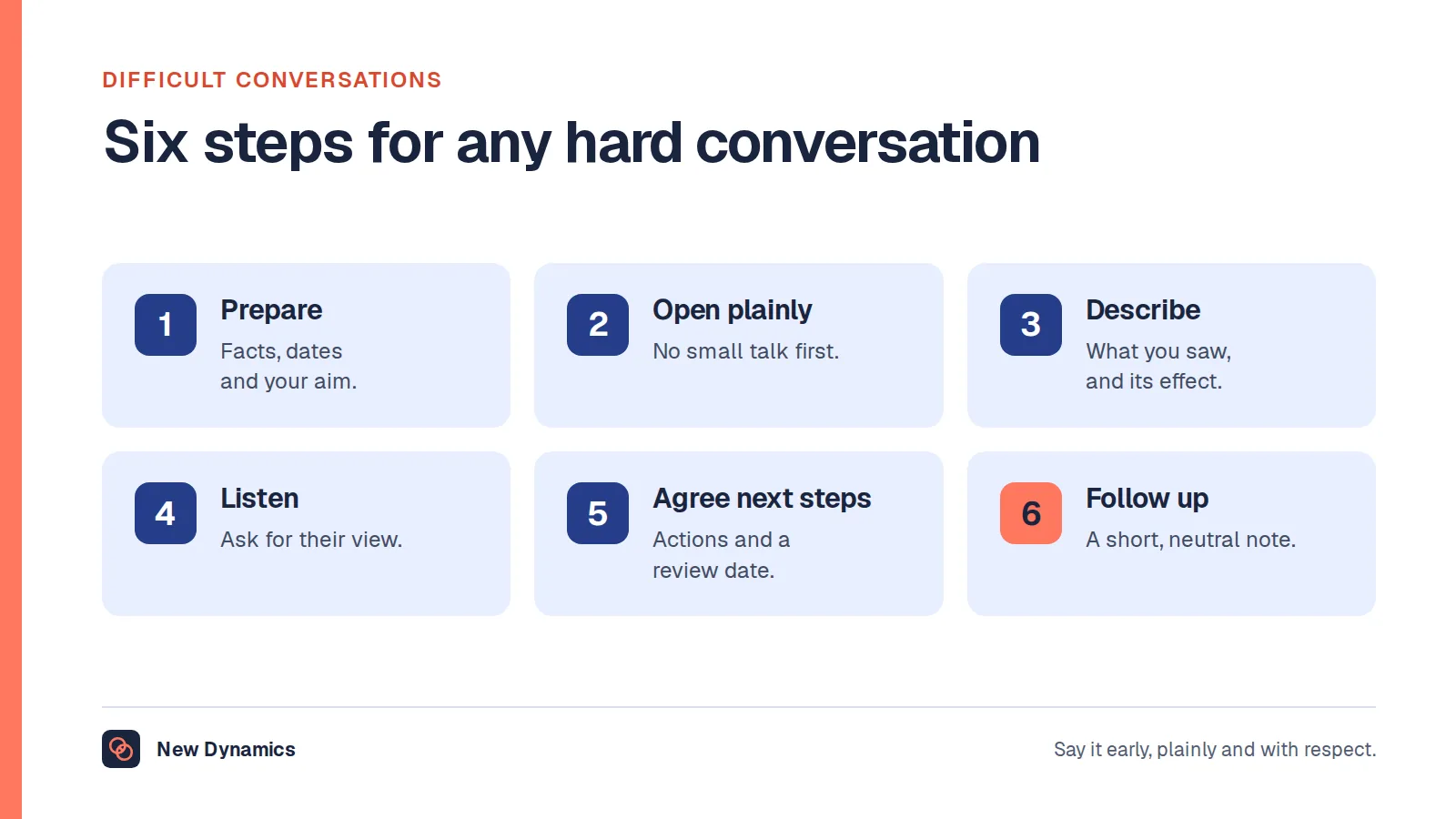
Our post on negative feedback examples has more wording by situation, and difficult conversations at work covers the other conversations managers avoid.
Afterwards
Write it up the same day and send it. Acas says "it's important to keep a written record of what is discussed" and that the record should be shared with the employee. Keep it to what was said and agreed, with dates, and without adjectives.
Then do the two things most managers skip. Put the check-in in the diary before you forget, and do your own half: the training you promised, the template, the introduction, the decision you said you would get. If the support does not arrive, the next conversation is not about them.
If the improvement does not come, the route is the one your organisation already has, and Acas's position is that an employer should first see whether a problem can be resolved informally, because that "can often be the quickest and easiest solution". When that has genuinely been tried and has not worked, take advice before starting anything formal.
Frequently asked questions
How do you tell an employee they are underperforming?
Name the gap in one sentence, give two or three specific dated examples, then stop talking and listen. Agree what will change and by when, say what support is available, and state plainly whether the conversation is informal. Write it up the same day and send it to them.
What is a good framework for a performance conversation?
Five moves: name the gap, evidence it, listen, agree a specific and dated improvement, then set out the support and where the conversation sits. It follows what Acas describes for resolving a problem informally, which is talking privately, listening to the employee's point of view, agreeing improvements and setting up training or development where it is a performance issue.
How do you give feedback to a defensive employee?
Get more specific, not more general. Do not debate whether the feedback is fair; return to a single dated example and ask how it looked from their side. Check any facts they offer, and separate reasons from the standard: the explanation may be valid and the work still has to meet the bar. Defensiveness usually eases as the conversation becomes concrete.
Should you have an underperformance conversation informally first?
Usually yes. Acas says that before starting a disciplinary procedure an employer should first see whether the problem can be resolved informally, and that this is often the quickest and easiest solution. For capability issues it suggests trying mentoring, coaching and training first. Tell the person which kind of conversation they are in.
What should you not say when telling someone they are underperforming?
Avoid anonymous collective evidence, the admission that you have been thinking it for months, minimising it in the opening line, judgements about attitude, the praise sandwich, and vague warnings about unnamed consequences. Each one either weakens the message or makes it harder to answer.
What should you do after the conversation?
Send a written record the same day covering what was discussed and agreed, with dates. Put the follow-up in the diary before you leave the room, and deliver whatever support you promised. If the agreed improvement does not happen and the support did, follow your organisation's procedure and take advice before any formal step.
Your next step: have the one you are avoiding
- Write the one-sentence version of the gap. If it names a trait rather than a behaviour, rewrite it.
- Find two dated examples. If you cannot, the next two weeks are for gathering them, not for the meeting.
- Check what support was promised and never delivered, and fix that first.
- Book thirty minutes this week, and write the follow-up date in before the meeting happens.
For more wording and a method you can hand to managers, read and download our employee feedback guide. The guide is free to read, and the PDF uses our short download form.
Want feedback to be a habit rather than an annual ordeal? Book a New Dynamics demo and bring the conversation you are putting off. You can also email contact@new-dynamics.com.