TL;DR
- A recruiter finds, assesses and secures people for vacancies: takes the brief, advertises and searches, screens applications, runs interviews and shortlists, checks references, negotiates the offer and keeps candidates informed. O*NET lists corporate recruiter and recruiter among the reported titles of human resources specialists, whose tasks include searching for qualified candidates, reviewing applications against job requirements, interviewing applicants, informing them of duties, pay and conditions, and developing recruiting strategies to meet staffing needs.
- The job comes in two versions. The in-house or corporate recruiter works for one employer and serves its hiring managers; the agency recruitment consultant serves client companies and, as Prospects describes, must also win the business, working towards targets for placements, billings or leads. The seven duties are the same; the targets, the pressure and the relationship with the candidate differ, and the advert should say which version it is.
- Employers ask for communication and negotiation skills, organisation across many vacancies at once, resilience, knowledge of employment law and the applicant tracking system, and, for specialist markets, knowledge of the sector. Write the position description around the vacancies the recruiter will own, and set objectives that measure the quality of the hire, the time taken and the candidate's experience, not the number of CVs sent.
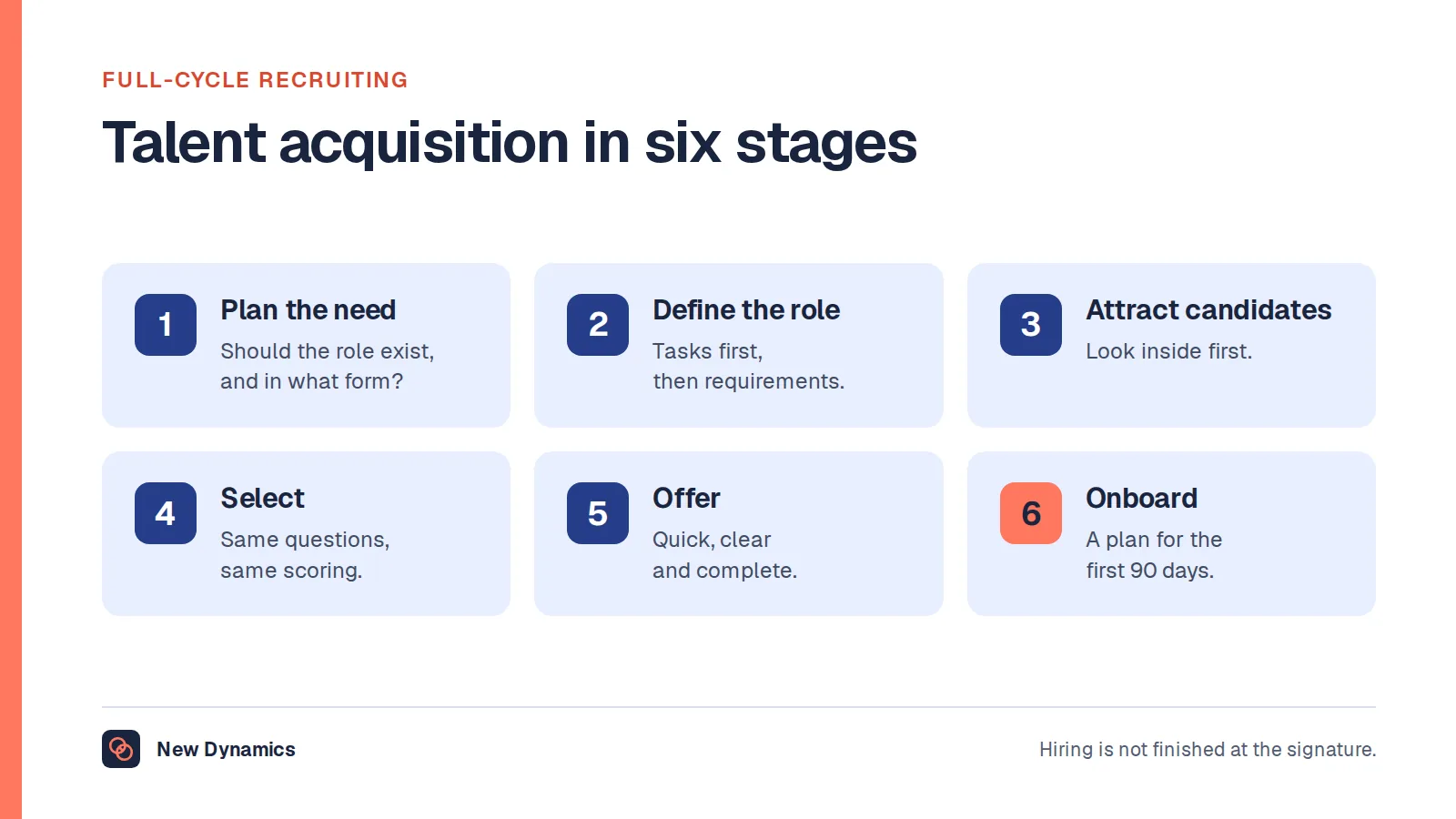
Every vacancy has a journey: a manager decides they need someone, an advert goes out, applications arrive, some people are interviewed, one is offered the job and, if the journey went well, accepts it. The recruiter owns that journey. A recruiter position description should describe it stage by stage, and say something most adverts leave out: whether the recruiter serves one employer or many, and what the recruiter will be measured on. The two questions decide what the job is like.
This article gives a recruiter job profile using three primary sources, the US O*NET occupational database, the Prospects graduate careers service and the UK National Careers Service, sets out seven duties across the vacancy's life, compares the in-house recruiter with the agency consultant, separates the recruiter from the hiring manager and the sourcer, lists the skills and qualifications, and gives a position description template with objectives.
A recruiter's targets shape the recruiter's behaviour more than any other part of the job description. See how New Dynamics Goals & OKRs keep a recruiter's objectives, progress and review in one place, so the targets can be about the hire and not only the volume.
Recruiter job profile: what a recruiter does
A recruiter finds, assesses and secures people for vacancies. In-house, the recruiter works for one employer and serves its hiring managers; in an agency, the recruiter, usually titled recruitment consultant, serves client companies and is paid by them for each placement.
O*NET lists “Corporate Recruiter” and “Recruiter” among the sample of reported job titles for human resources specialists. Its tasks for the occupation include “perform searches for qualified job candidates, using sources such as computer databases, networking, Internet recruiting resources, media advertisements, job fairs, recruiting firms, or employee referrals”, “review employment applications and job orders to match applicants with job requirements”, “interview job applicants to obtain information on work history, training, education, or job skills”, “inform job applicants of details such as duties and responsibilities, compensation, benefits, schedules, working conditions, or promotion opportunities”, “select qualified job applicants or refer them to managers, making hiring recommendations when appropriate”, “contact job applicants to inform them of the status of their applications”, and “develop or implement recruiting strategies to meet current or anticipated staffing needs”.
The National Careers Service describes the agency version's day-to-day tasks: contacting companies to generate new business, handling enquiries from companies looking to use the service, interviewing, testing and matching candidates to suitable jobs, coordinating pre-employment checks, meeting targets for the number of people placed, keeping accurate records of clients, employers and vacancies, promoting the agency online, negotiating fees, and headhunting for executive or specialist jobs.
Recruiter duties: seven responsibilities across a vacancy
Grouped from the O*NET tasks and the two UK profiles, the recruiter's work follows the vacancy's life in seven parts.
- The brief. Meet the hiring manager or client; understand the role, the team, the must-haves and the nice-to-haves, the pay and the timetable; agree the process. Prospects' first responsibility for a consultant is to understand client companies, their industry, their culture and the type of employee they are after.
- Attraction and search. Draft and place adverts on job boards and social media; search databases and networks; headhunt people who are already in work; run referral schemes and attend job fairs. This is the part most adverts call sourcing.
- Screening. Receive and review applications against the job requirements; hold screening calls; test where the process includes it; keep the record of every decision.
- Interviews and shortlists. Organise interviews with the hiring manager or client; brief candidates on the role, the pay and the process; create the shortlist with the reasons; inform every candidate of the outcome. O*NET's task is to contact applicants to inform them of the status of their applications, which is the duty recruiters most often neglect.
- Checks and references. Request references; coordinate pre-employment checks such as right to work and, where the role needs it, background checks; verify qualifications.
- The offer. Negotiate salary and terms between the candidate and the employer; finalise the arrangements; keep the candidate warm until the start date.
- The market and the numbers. Advise managers or clients on pay rates, availability and the realism of the brief; keep the applicant tracking system accurate; report on time to fill, source of hire and pipeline; in an agency, generate new business and work to placement and billing targets.

In-house recruiter vs agency recruitment consultant
| Aspect | In-house or corporate recruiter | Agency recruitment consultant |
|---|---|---|
| Serves | One employer's hiring managers | Client companies, won and kept |
| Paid by | Salary, sometimes a bonus on hires | Basic salary plus commission on placements, as Prospects describes |
| Targets | Time to fill, quality of hire, candidate experience, cost | Placements, billings, business leads |
| Also does | Employer brand, workforce planning, onboarding handover | Business development, client visits, fee negotiation |
| Pressure | Hiring managers' deadlines | Sales targets; Prospects notes the role can be challenging because of them |
The Prospects recruitment consultant profile lists using sales, business development and marketing techniques to attract business from client companies as the consultant's first responsibility, and working towards and exceeding targets for candidates placed, value billed or leads generated as another. The in-house recruiter has none of that and all of the rest. Say which version the advert is for in the first line.

Recruiter vs hiring manager vs sourcer
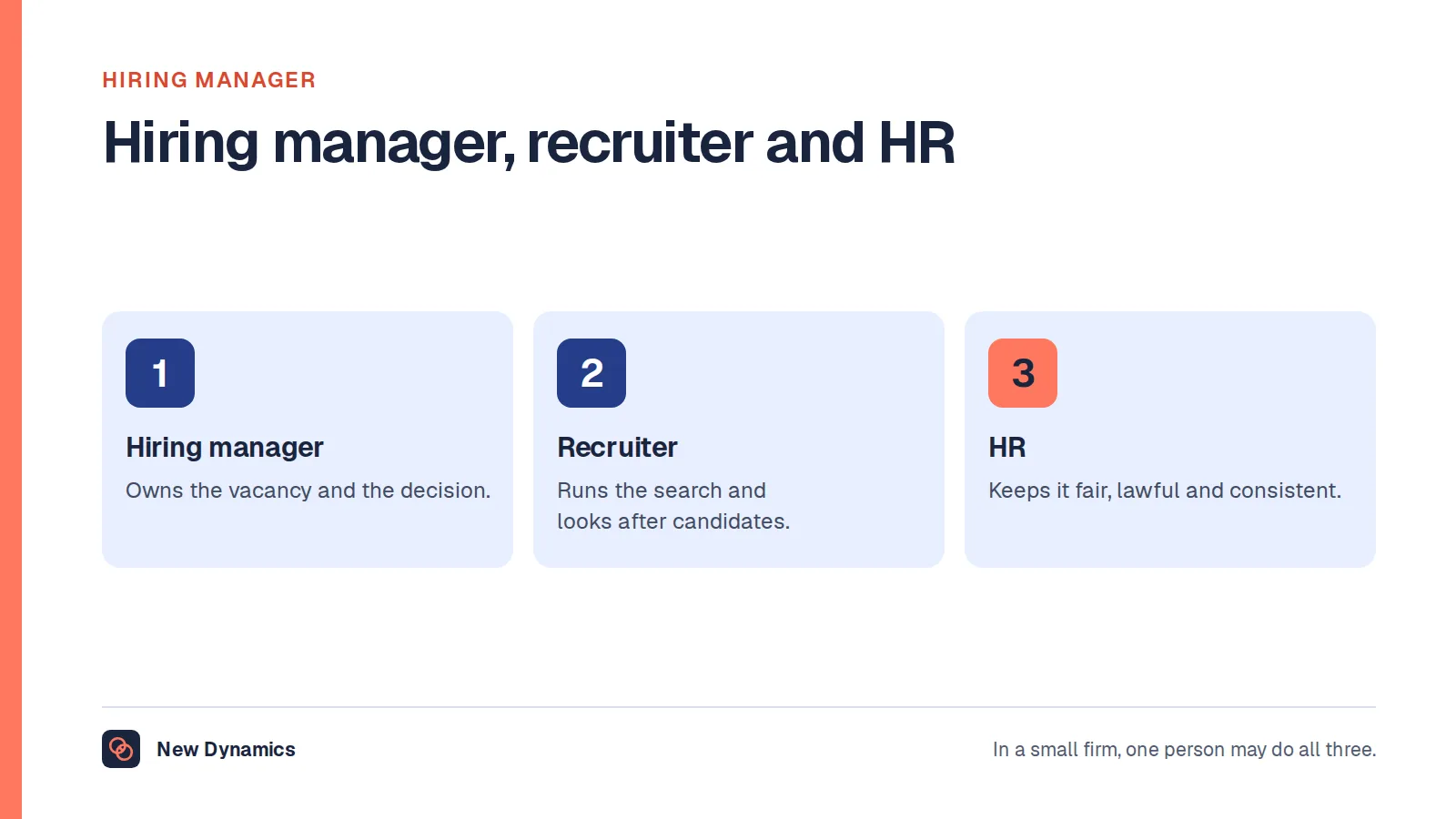
- The hiring manager owns the vacancy, the decision and the new starter. The recruiter runs the process and advises; the manager decides. Our post on the hiring manager sets out the division.
- The sourcer does duty two only: finds and approaches candidates, then hands them to a recruiter. Larger teams split the job this way; the talent acquisition post describes who does what in a team.
- The HR coordinator or recruitment coordinator schedules the interviews, sends the letters and keeps the records; the recruiter owns the vacancy.
Skills employers look for
Prospects lists excellent interpersonal and communication skills, sales and negotiation abilities, a goal-oriented approach, the ability to handle multiple priorities, problem solving, the ability to meet deadlines and targets, ambition, confidence and self-motivation, time management and organisation, teamworking and creativity, and adds that the consultant must enjoy a high-pressure environment. The National Careers Service adds knowledge of human resources and employment law, administration skills, attention to detail, sensitivity and understanding, and customer service skills.
For the in-house recruiter, add:
- Influence without authority. Getting a hiring manager to shorten a wish list, free up interview time or make a decision.
- Judgement about fit and fairness. Assessing against the requirements, not against the manager's picture of the last person in the job.
- Candidate care. Every candidate is a future customer, applicant or referrer, and most of them will not get the job.
- Data discipline. An applicant tracking system is only as useful as its records.
Qualifications and progression
Entry. Prospects says you can become a recruitment consultant with any degree, that business, HR, marketing and public relations are useful, that entry with an HND or foundation degree is possible, and that employers may value drive, experience and determination over specific qualifications; it is also possible to start in an agency administration role and work up. The National Careers Service points to the recruiter apprenticeship in England and to on-the-job training through a recruitment professional body. O*NET places human resources specialists in Job Zone four, usually a bachelor's degree, though in-house recruiters are hired on experience as often as on degrees.
Progression. In an agency, Prospects gives the route as senior consultant or account manager, then team leader or branch manager, then area and regional management, or setting up an agency; it notes that progression depends largely on achieving and exceeding targets. In-house, the route is senior recruiter, talent acquisition lead or manager, and head of talent, or a move into the wider HR function.
Recruiter position description template
Job title: Recruiter (or Talent Acquisition Partner, In-house Recruiter; Recruitment Consultant for the agency version)
Reports to: Head of Talent Acquisition, HR Manager or, in an agency, Branch Manager
Scope: State the business areas or client sectors covered, the number of vacancies open at a time, the levels recruited for, the applicant tracking system and, for an agency role, the market and the commission scheme.
Purpose: Fill the vacancies you own with the right people, in the agreed time, through a process that is fair, well recorded and respectful of every candidate.
Responsibilities:
- Take and challenge the brief; agree the requirements, the pay, the process and the timetable with the hiring manager or client.
- Attract and search: adverts, job boards, social media, databases, networks, referrals and direct approaches.
- Screen applications against the requirements; hold screening calls; record decisions and reasons.
- Organise and take part in interviews; brief candidates; build shortlists; inform every candidate of the outcome.
- Coordinate references and pre-employment checks.
- Negotiate and close offers; keep the candidate engaged to the start date and hand over to onboarding.
- Advise on pay rates and market availability; keep the system accurate; report on time to fill, source of hire and pipeline.
- Agency version: generate new business, manage client relationships and work to placement and billing targets.
Skills and experience:
- Experience recruiting for comparable roles, in-house or in an agency; sector knowledge where the market is specialist.
- Clear, persuasive communication; negotiation; organisation across many vacancies at once.
- Judgement in assessing candidates against requirements; knowledge of employment law as it applies to recruitment.
- Confident with the applicant tracking system, job boards and search tools; accurate records.
- Resilience and courtesy under deadline pressure.
Working pattern: State the hours; Prospects notes that early mornings and evenings are common; say whether the role is hybrid and how much travel to clients or sites it involves.
Progression: Senior recruiter, talent acquisition lead or manager; in an agency, senior consultant, account manager, team leader.
Objectives for the recruiter's appraisal
Volume targets are easy to set and shape the wrong behaviour. Set four:
- Time. Vacancies filled within the agreed timetable, with the reasons for any overrun recorded.
- Quality. New starters passing probation and hiring managers' assessment of the shortlist quality.
- Candidate experience. Every applicant informed of the outcome within the promised time; feedback from interviewed candidates.
- Process. Requirements agreed before advertising; decisions and reasons recorded; checks complete before start.

Frequently asked questions
What does a recruiter do?
Finds, assesses and secures people for vacancies: takes the brief, advertises and searches, screens applications, organises interviews and shortlists, checks references, negotiates the offer and keeps candidates informed at every stage. The US occupational database lists recruiter among the titles of human resources specialists, with tasks including searching for qualified candidates, reviewing applications against requirements and developing recruiting strategies.
What is the difference between an in-house recruiter and a recruitment consultant?
An in-house or corporate recruiter works for one employer and serves its hiring managers, measured on time to fill, quality of hire and candidate experience. A recruitment consultant works for an agency, serves client companies, must win the business as well as fill the vacancy, and is measured on placements and billings, usually with commission.
What is the difference between a recruiter and a hiring manager?
The hiring manager owns the vacancy, the decision and the new starter. The recruiter runs the process, finds and assesses candidates, advises the manager and keeps the process fair and well recorded. The recruiter recommends; the manager decides.
What qualifications do you need to be a recruiter?
No specific qualification. Prospects says any degree can lead to recruitment consultancy, with business, HR and marketing useful, and that employers may value drive and experience over qualifications; the National Careers Service points to the recruiter apprenticeship in England. In-house recruiters are usually hired on recruiting experience in a comparable market.
How should a recruiter be measured?
On the outcome of the vacancy rather than the volume of activity: vacancies filled in the agreed time, new starters passing probation, hiring managers' view of shortlist quality, every candidate informed on time, and a complete record of the process. Placement and billing targets belong to the agency version.
Your next step: say which recruiter and which targets
- State whether the role is in-house or agency in the first line.
- Name the vacancies, levels and sectors the recruiter will own, and the system they will use.
- Set objectives for time, quality, candidate experience and process, and review them each quarter.
- Give the recruiter the authority to challenge a brief.
For a fair and consistent process for the recruiter to run, read and download our recruitment and selection guide. The guide is free to read, and the PDF uses our short download form.
Want a recruiter's objectives, quarterly reviews and the handover to onboarding in one place? Book a New Dynamics demo and bring your current targets. You can also email contact@new-dynamics.com.