TL;DR
- A shift manager runs a site or a department for the length of a shift: opening or closing it, staffing it to demand, keeping service and standards up, handling what goes wrong, and handing over cleanly. O*NET lists Shift Manager among the reported job titles for First-Line Supervisors of Retail Sales Workers, whose duties “may include management functions, such as purchasing, budgeting, accounting, and personnel work, in addition to supervisory duties”.
- What separates it from a team leader role is not seniority but isolation: for part of the week there is nobody more senior on site. That only works if the authority is written down (what the shift manager may refund, discount, send home, close, or escalate) and if the escalation route answers the phone.
- Shifts bring a duty most adverts ignore. HSE states that “fatigue needs to be managed, like any other hazard”, that accidents and injuries are more frequent “on night shifts, after a succession of shifts, when shifts are long and when there are inadequate breaks”, and that “the legal duty is on employers to manage risks from fatigue, irrespective of any individual's willingness to work extra hours”.
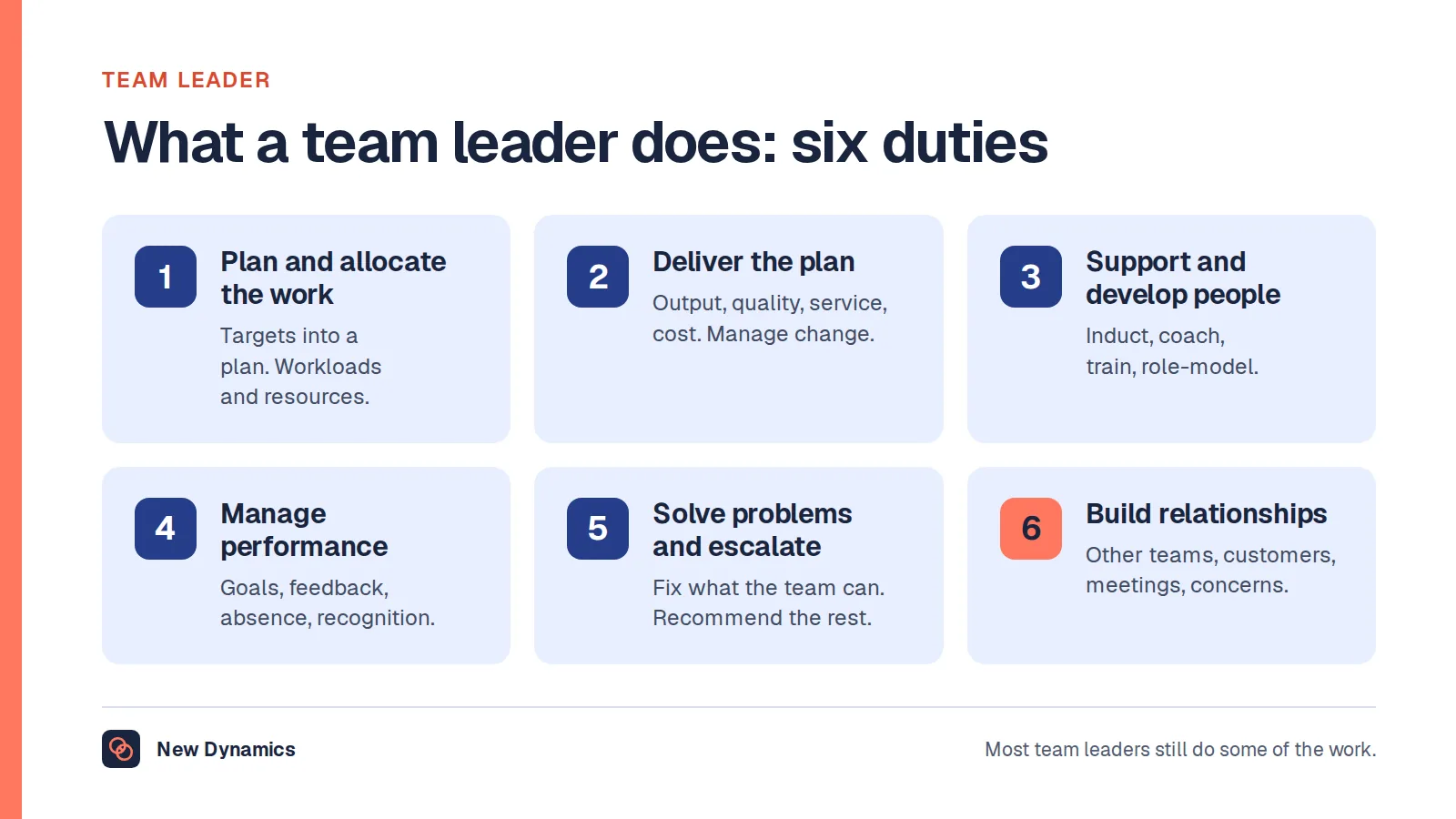
A team leader leads a team. A shift manager runs a place, for eight or twelve hours, often with nobody more senior in the building, and then hands it to somebody else.
This article sets out a shift manager job description: the shape of a shift, eight duties, the decisions the role has to be allowed to make, the handover, the fatigue duties that come with working outside normal hours, and a template. It is general information about the role, not legal advice.
A shift runs on the same sequence every time (open, run, hand over, close) which is exactly the kind of process that should not live in somebody's head. See how New Dynamics workflows let you define your own stages, forms and approvals, with a completion view instead of a spreadsheet.
What a shift manager is
O*NET lists Shift Manager among the reported job titles for First-Line Supervisors of Retail Sales Workers, who "directly supervise and coordinate activities of retail sales workers in an establishment or department", with duties that "may include management functions, such as purchasing, budgeting, accounting, and personnel work, in addition to supervisory duties". In hospitality the equivalent occupation is First-Line Supervisors of Food Preparation and Serving Workers.
The distinction from our team leader job description is worth stating plainly. A team leader leads people, usually while a manager is around. A shift manager is the person in charge of the site for the duration of the shift, and everything that happens in those hours is theirs.
The shape of a shift

- Open. Security and access, equipment and systems on, floats and tills, stock checks, staffing against the plan, brief the team on what matters today.
- Run. Move people to where the demand is, keep service and standards up, deal with the queue, the complaint, the delivery, the breakdown and the person who did not turn up.
- Hand over. Tell the next shift what they need to know, not what happened, but what is still open.
- Close. Cash, waste, cleaning, security, records, and the walk-round that stops tomorrow starting badly.
The good shift managers are made in steps one and three, which are the two everybody rushes.
Eight duties

- Staff the shift. "Assign employees to specific duties", "plan and prepare work schedules and keep records of employees' work schedules and time cards", and in hospitality "assign duties, responsibilities, and work stations to employees in accordance with work requirements".
- Run the floor. "Direct and supervise employees engaged in sales, inventory-taking, reconciling cash receipts, or in performing services for customers", and pitch in: O*NET explicitly includes performing "work activities of subordinates, such as cleaning and organizing shelves and displays and selling merchandise".
- Serve customers and fix complaints. "Provide customer service by greeting and assisting customers and responding to customer inquiries and complaints", "resolve customer complaints regarding food service", and "instruct staff on how to handle difficult and complicated sales".
- Handle money. "Perform various financial activities, such as cash handling, deposit preparation, and payroll", reconcile at the end, and investigate the difference rather than writing it off.
- Keep standards. "Examine merchandise to ensure that it is correctly priced and displayed and that it functions as advertised", "inspect supplies, equipment, and work areas to ensure efficient service and conformance to standards", and "observe and evaluate workers and work procedures to ensure quality standards and service".
- Manage stock and waste. "Inventory stock and reorder when inventory drops to a specified level", "control inventories of food, equipment, smallware, and liquor, and report shortages", and "analyze operational problems, such as theft and wastage, and establish procedures to alleviate these problems".
- Keep people safe. "Enforce safety, health, and security rules", "train workers in food preparation, and in service, sanitation, and safety procedures", and deal with the incident, the accident book and the difficult customer.
- Record and report. "Keep records of purchases, sales, and requisitions" and "review inventory and sales records to prepare reports for management", plus the shift report that the day manager reads in the morning.
The decisions nobody else is there to make

This is the part that makes or breaks the role, and most job descriptions skip it. During a shift a manager will have to decide whether to:
- refund, replace or discount for an unhappy customer, and up to what value;
- send someone home who is unwell, unfit to work or behaving unacceptably;
- call time on a service (close a till, stop a line, shut an area) when something is unsafe or unworkable;
- spend money, for a taxi, an emergency repair or cover;
- escalate, and to whom, at two in the morning.
Write all five into the job description with figures and names attached. A shift manager without stated authority will either freeze or guess, and both are worse than a limit that is occasionally too low.
Two more things have to be true: the escalation contact actually answers, and the person is not second-guessed afterwards for a reasonable decision made with the information they had. Nothing erodes a shift management team faster than being overruled the next morning by someone who was asleep at the time.
The handover
A handover is not a summary of the shift. It is a list of what is still open:
- what is broken, what has been reported, and what the workaround is;
- who is short, late or unwell, and what has been agreed;
- what the next shift has been promised, by whom;
- what stock, cash or deliveries are outstanding;
- anything about a customer, an incident or a colleague that the next manager needs to know.
Written, in the same place every time, and read before the previous manager leaves.
Fatigue, the rota and whose duty it is
Working outside normal hours brings a duty that adverts rarely mention, and shift managers are usually the people designing or flexing the rota.
HSE's guidance on fatigue notes that "more than 3.5 million people are employed as shift workers in the UK", and that "poorly designed shift-working arrangements and long working hours that do not balance the demands of work with time for rest and recovery can result in fatigue, accidents, injuries and ill health".
It defines fatigue as "a decline in mental and/or physical performance that results from prolonged exertion, sleep loss and/or disruption of the internal clock", adding that it "is also related to workload, in that workers are more easily fatigued if their work is machine-paced, complex or monotonous", and that it "results in slower reactions, reduced ability to process information, memory lapses, absent-mindedness, decreased awareness, lack of attention, underestimation of risk, reduced coordination".
Three points from the same guidance belong in any shift-based job description:
- "Fatigue needs to be managed, like any other hazard."
- "The incidence of accidents and injuries has been found to be higher on night shifts, after a succession of shifts, when shifts are long and when there are inadequate breaks."
- "The legal duty is on employers to manage risks from fatigue, irrespective of any individual's willingness to work extra hours."
That last line matters for a shift manager specifically. Someone volunteering for a double is not a defence, and a manager who is asked to cover the gaps every week is a rota problem rather than a willing colleague.
What the advert should say
- The shift pattern, including nights, weekends and how far ahead the rota is published.
- What the person is in charge of, and whether anyone more senior is on site during their shifts.
- The authority, with figures: refunds, discounts, spend, sending people home, closing an area.
- The escalation route and who is actually contactable out of hours.
Say these and you will lose some applicants at the advert stage, which is the cheapest place to lose them.
Routes in and progression
Most shift managers come up from the floor (team member to team leader to shift manager) which is why the transition needs support rather than a set of keys. The first three months are about authority and difficult conversations, not about tasks they already know.
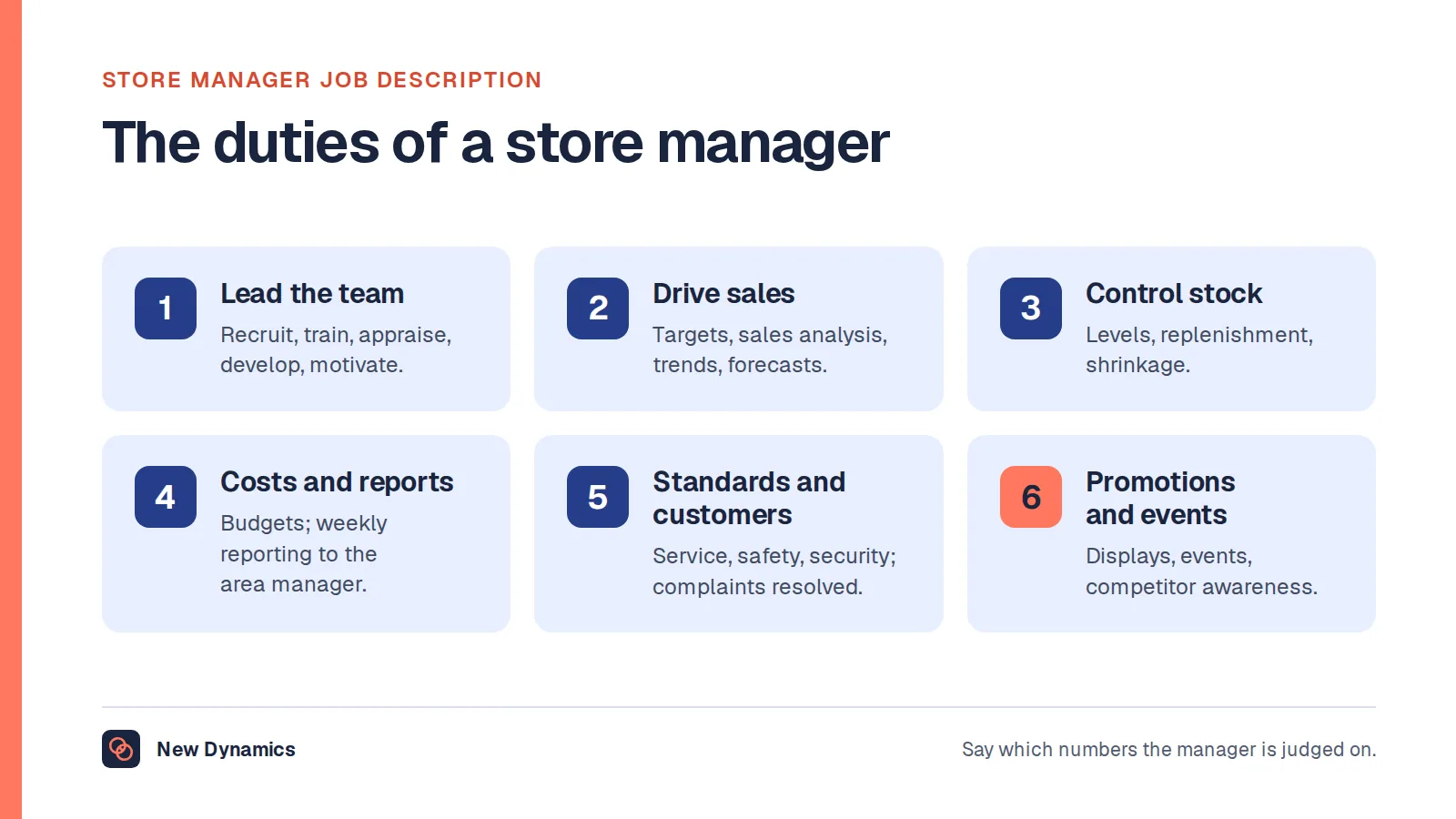
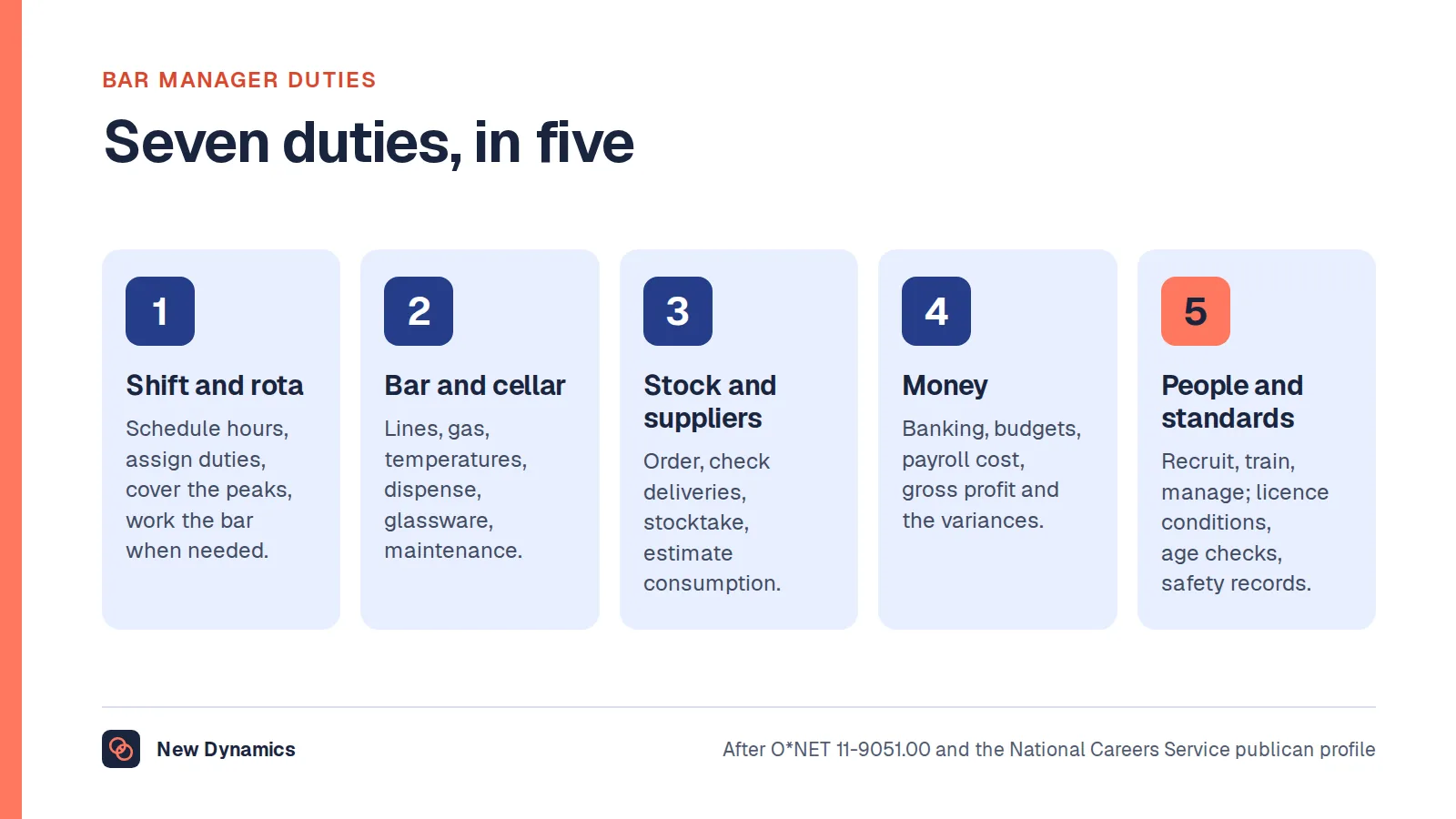
Progression runs to assistant manager, store, branch or site manager, and onwards into multi-site or area roles. Our store manager and bar manager posts describe two of the destinations.
Shift-based roles also lose people faster than day roles, often to a rota rather than to a competitor. Our employee retention guide covers the reasons and what actually helps.
A shift manager job description template
Job title: Shift manager
Reports to: [store / site / general manager]
Shifts: [pattern, including nights and weekends], [rota notice], [is anyone more senior on site?]
Purpose: Run the site safely and well for the length of the shift, and hand it over in a state the next team can work in.
Responsibilities
- Open or close the site, including security, systems, cash and stock procedures.
- Plan and adjust staffing across the shift to match demand and cover absence.
- Lead and support the team on shift, including briefing, coaching and in-the-moment feedback.
- Deliver service standards, and resolve customer complaints within your authority.
- Handle cash, banking and till reconciliation, and investigate discrepancies.
- Maintain stock, control waste and record shortages.
- Enforce health, safety, hygiene and security rules, and respond to incidents and accidents.
- Complete shift records and reports, and deliver a written handover to the next shift.
Your authority: refunds and discounts up to [amount]; emergency spend up to [amount]; sending a colleague home; closing an area or service on safety grounds; [anything else].
Escalation: [named role, contact method, expected response time].
Frequently asked questions
What does a shift manager do?
Runs a site or department for the duration of a shift: opening or closing it, staffing it against demand, leading the team on duty, delivering service standards, handling cash and stock, enforcing safety and security rules, resolving complaints and incidents, and handing over to the next shift. In many businesses they are the most senior person present for part of the week.
What are the responsibilities of a shift manager?
Eight groups: staffing the shift, running the floor, serving customers and resolving complaints, handling money, keeping standards, managing stock and waste, keeping people safe, and recording and reporting. O*NET's task list for retail supervisors adds that they also perform the work of their team when needed, which is a fair description of most shifts.
What is the difference between a shift manager and a team leader?
A team leader leads a team, usually with a manager available. A shift manager is in charge of the site for the shift, which means making decisions (refunds, sending someone home, closing an area) that nobody else is there to make. The difference is authority and isolation rather than seniority alone.
What authority should a shift manager have?
At minimum, a stated limit for refunds, discounts and emergency spend, the ability to send a colleague home, the ability to close an area or service on safety grounds, and a named escalation contact who is reachable out of hours. Without written authority a shift manager either freezes or guesses.
Do shift managers have responsibilities around fatigue and rotas?
They usually build or flex the rota, but the duty is the employer's. HSE states that fatigue needs to be managed like any other hazard, that accidents are more frequent on night shifts, after a succession of shifts, when shifts are long and when breaks are inadequate, and that the legal duty is on employers to manage the risks "irrespective of any individual's willingness to work extra hours". This is general information, not legal advice.
How do you write a good shift manager advert?
State the shift pattern including nights and weekends and how far ahead the rota is published, say whether anyone more senior is on site, publish the authority limits with figures, and name the escalation route. Losing an applicant at the advert stage is much cheaper than losing them in month two.
Your next step: write the authority down
- Put the shift pattern and rota notice in the advert.
- List the five decisions a shift manager may take alone, with figures.
- Name the escalation contact and the expected response time, and test it.
- Make the handover written, in one place, read before the previous manager leaves.
For why shift-based teams lose people faster and what actually helps, read and download our employee retention guide. The guide is free to read, and the PDF uses our short download form.
Want opening, closing and handover routines in one place, with completion visible instead of chased? Book a New Dynamics demo and bring your current shift checklist. You can also email contact@new-dynamics.com.