TL;DR
- A shipping and receiving clerk verifies and maintains records on incoming and outgoing shipments involving inventory, in O*NET's words. The Bureau of Labor Statistics groups the role with material recording clerks, who record items shipped, received or transferred, prepare materials for shipment, examine products for damage and verify inventory accuracy, using barcode scanners and warehouse systems.
- The duties fall into six groups: checking goods in against the paperwork, recording and putting away, preparing and packing orders, arranging carriers and shipping, resolving damage and discrepancies, and keeping the records the business runs on. The job differs from a warehouse operative, who moves and picks stock, and a dispatcher, who plans routes and drivers; in a small operation one person does all three.
- Write the job description around the site's volume and systems, the split between inbound and outbound, the physical demands and hours, and the accuracy and on-time targets the role is judged on. Entry needs a high school education and short on-the-job training; progression runs to team leader, inventory controller and warehouse or logistics management.
Every pallet that arrives at a warehouse and every parcel that leaves it passes through one person's hands and one person's records. The shipping and receiving job description is for that person: the clerk who checks what came in against what was ordered, records it, prepares what goes out, books the carrier and sorts out the damaged box. Get the role wrong and stock counts drift, customers get the wrong order and suppliers are paid for goods that never arrived.
This article explains the job using two primary sources, the US O*NET occupational database and the Bureau of Labor Statistics handbook, sets out six duties, the systems and skills, the hours and physical demands, how the role differs from a warehouse operative and a dispatcher, and gives a job description template. The sources are American; the job is the same in a British or European warehouse, where it is often called goods in and goods out.
Shipping and receiving is judged on accuracy and time, and both should be visible targets rather than complaints. See how New Dynamics Goals & OKRs keep a team's accuracy, on-time and safety targets in one place, from the site manager down to each shift.
What does a shipping and receiving clerk do?
O*NET describes shipping, receiving and inventory clerks in one line: they “verify and maintain records on incoming and outgoing shipments involving inventory.” Its sample titles include receiver, receiving clerk, shipping coordinator, order fulfilment specialist and materials control associate.
The Bureau of Labor Statistics groups the role with material recording clerks, whose duties include recording items shipped, received or transferred, preparing materials for shipment by labelling and inspecting them, examining products for damage and verifying inventory accuracy. Of shipping and receiving clerks specifically it says they monitor outgoing and incoming shipments, use barcode scanners and RFID technology to manage inventory, verify that orders are processed accurately, calculate freight costs and prepare invoices and reports, and sometimes move goods from the warehouse to the loading dock themselves.
Two words define the job: verify and record. The clerk is the control point. Stock that is not checked in accurately is lost before it is stored; an order that is not checked out accurately becomes a complaint and a credit note.
Shipping and receiving duties: six responsibilities
Grouped from the O*NET tasks and the BLS duties, the work has six parts.
- Check goods in. Compare each delivery with the purchase order and the delivery note: quantities, product codes, condition. O*NET's first task is to compare shipment contents against records to ensure accuracy; the BLS lists examining products for damage.
- Record and put away. Book the receipt into the warehouse or inventory system, label the stock, and put it away or direct it to the right location. Accurate receipt is what makes the stock count true.
- Prepare and pack orders. Pick or receive picked goods, check them against the order, pack and label them, and produce the documentation. O*NET lists packing and labelling and preparing routing documentation and work orders.
- Arrange carriers and ship. Choose the shipping method and route, book the carrier, compute the charges, load or supervise loading and record the dispatch. O*NET lists coordinating with carriers, selecting shipping methods and routes and computing charges; it also lists considering the environmental impact of shipping choices.
- Resolve damage and discrepancies. Short deliveries, wrong items, damaged goods and returns: raise them with the supplier or carrier, record the outcome and adjust the stock. O*NET lists resolving damages and discrepancies with vendors.
- Keep the records. Receipts, dispatches, transfers and stock movements recorded for accounting, and reports produced for the warehouse and finance teams. O*NET lists recording shipment data for accounting purposes; the BLS lists preparing invoices and reports.

Inbound, outbound and the record
Some sites split the job into a receiving clerk on goods in and a shipping clerk on goods out; others combine them. The advert should say which, because the rhythm differs: receiving follows the delivery schedule, shipping follows the carrier's collection cut-off.
| Part | Rhythm | What goes wrong without it |
|---|---|---|
| Receiving | Delivery slots, morning-heavy | Stock counts drift; suppliers paid for short deliveries |
| Shipping | Order cut-offs, afternoon-heavy | Wrong orders, missed collections, credit notes |
| The record | Continuous | Nobody knows what is in the building |

Shipping and receiving clerk vs warehouse operative vs dispatcher
| Role | Focus | Typical work |
|---|---|---|
| Warehouse operative | Moving stock | Unloading, put-away, picking, loading, forklift |
| Shipping and receiving clerk | Verifying and recording stock in and out | Checking, booking in, documentation, carriers, discrepancies |
| Dispatcher | Routing vehicles and drivers | Schedules, routes, driver communication, customer updates |
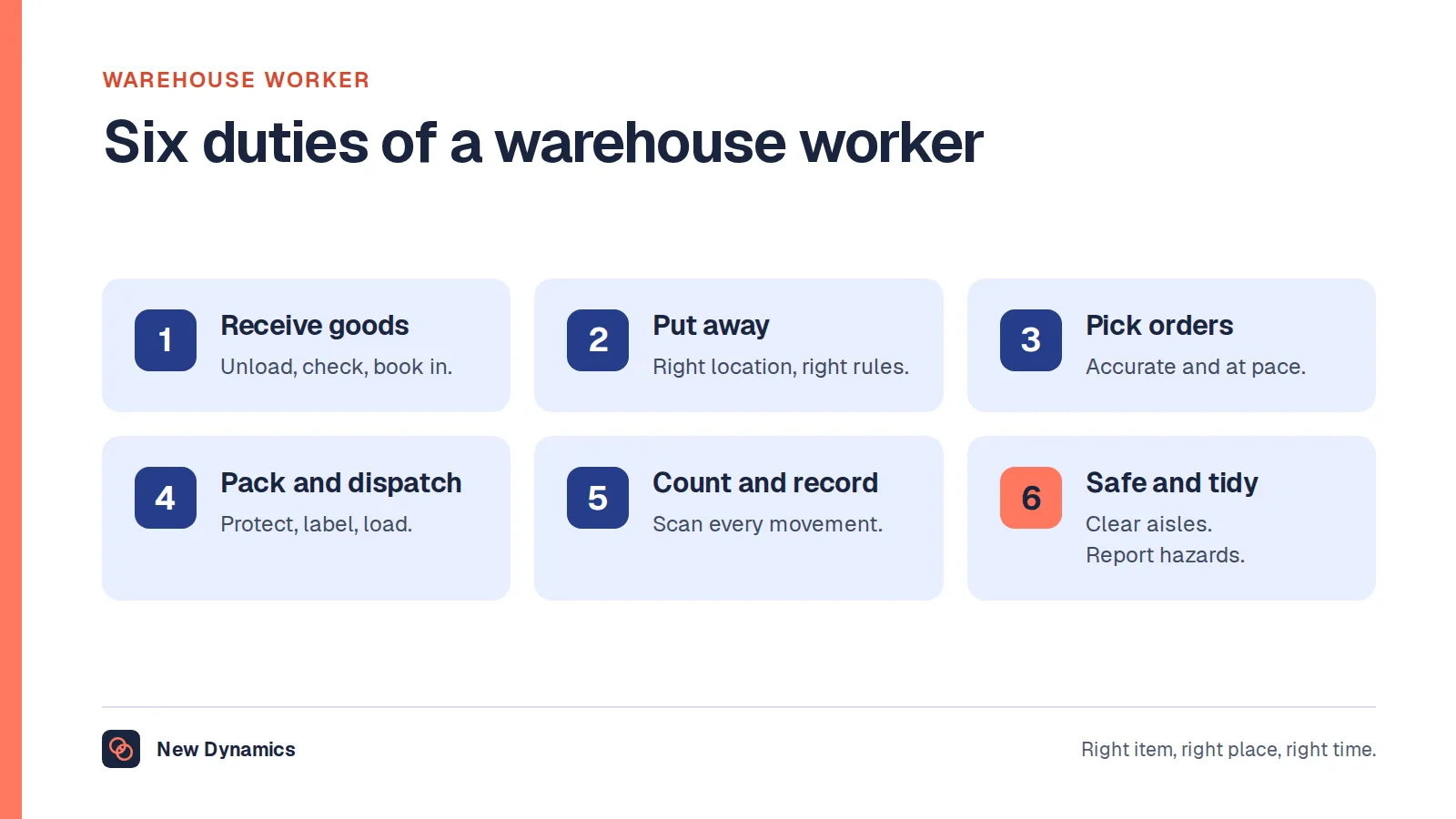
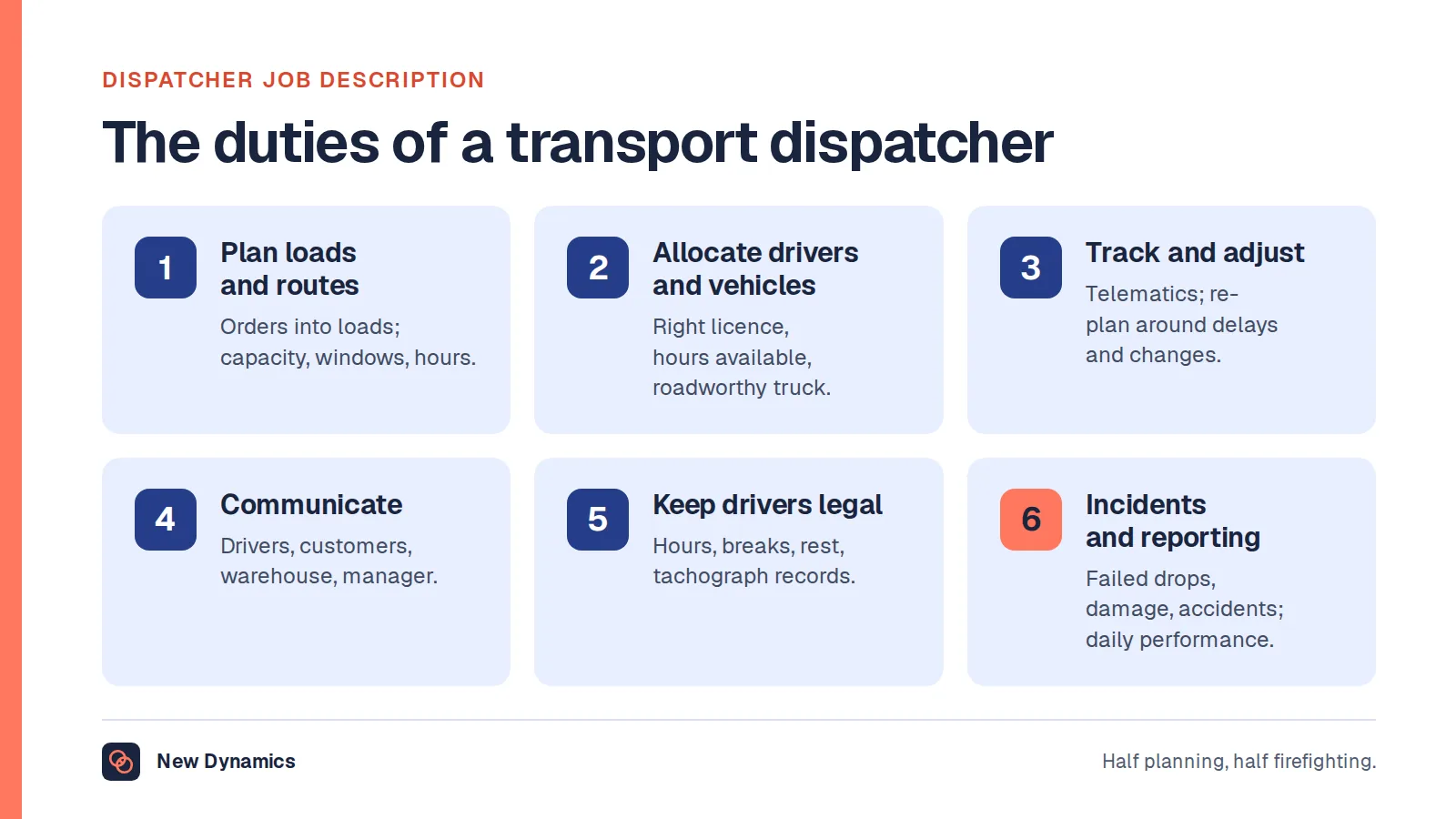
In a large distribution centre the three are separate teams. In a small warehouse one person does all three, and the advert should say so. The warehouse worker job description and the dispatcher job description cover the neighbours.
Systems and skills to ask for
O*NET's technology list includes warehouse management systems, enterprise systems such as SAP, inventory tracking systems, barcode labelling software and Microsoft Office. Its essential skills are speaking, active listening, reading comprehension, critical thinking and monitoring. The BLS names communication skills, customer-service skills, attention to detail and maths skills as the important qualities.
For the advert, the qualities that separate a good clerk from a good pair of hands are:
- Accuracy under time pressure. Counting a mixed pallet correctly while the driver waits.
- System discipline. Booking everything in and out, at the time, not at the end of the shift.
- Documentation. Reading a purchase order, a delivery note and a customs form, and spotting the difference between them.
- Communication with suppliers and carriers. Raising a short delivery politely and getting it resolved.
- Safety awareness. Around forklifts, docks and heavy lifting.
State the systems your site uses and whether a forklift or pallet-truck licence is needed.
Hours, environment and physical demands
The BLS describes full-time work in warehouses or manufacturing plants, partly at a desk and partly on the floor handling packages and equipment, with lifting, bending and a risk of injury, and some evening, weekend and holiday work. State the shift pattern, the lifting expectation and the equipment provided.
Routes in and progression
The BLS says the job needs a high school diploma or equivalent, with on-the-job training that typically lasts up to a month, starting with basic stock counting before moving to record-keeping. O*NET places the occupation in Job Zones one to two, where little or some preparation is needed. Progression runs to senior clerk or team leader, inventory controller or stock analyst, and warehouse, logistics or transport management.
Shipping and receiving job description template
Job title: Shipping and Receiving Clerk (or Goods In and Goods Out Operative, Receiving Clerk, Shipping Clerk)
Reports to: Warehouse Supervisor or Logistics Manager
Scope: State the site, the daily volume of deliveries and dispatches, the systems used and whether the role covers inbound, outbound or both.
Purpose: Verify and record every shipment in and out of the site accurately and on time, so that stock records are true, orders are correct and problems with suppliers and carriers are resolved quickly.
Responsibilities:
- Check deliveries against purchase orders and delivery notes for quantity, product and condition; report and record discrepancies and damage.
- Book receipts into the warehouse system; label stock and direct put-away.
- Prepare, check, pack and label outbound orders; produce dispatch documentation.
- Book carriers, select shipping methods, calculate charges and record dispatches.
- Resolve short deliveries, wrong items, damage and returns with suppliers and carriers; adjust stock records.
- Maintain accurate records of receipts, dispatches and transfers; produce reports for warehouse and finance.
- Keep the receiving and dispatch areas safe, tidy and compliant.
- Support stock counts and audits.
Skills and experience:
- Experience in a warehouse, stores or logistics role, or a strong record of accurate administrative work.
- Confident with warehouse or inventory systems and barcode scanners; state which.
- Attention to detail and accuracy under time pressure; basic maths.
- Clear communication with drivers, suppliers, carriers and colleagues.
- Forklift or pallet-truck licence if required; state which.
Working pattern: State the hours, shifts and any weekend work; lifting expectations and equipment provided.
Targets: Receipt and dispatch accuracy, on-time dispatch, discrepancy resolution time and safety, agreed and reviewed.

Frequently asked questions
What does a shipping and receiving clerk do?
Verifies and records shipments in and out: checks deliveries against orders, books stock into the system, prepares and packs outbound orders, arranges carriers, resolves damage and discrepancies with suppliers and carriers, and keeps the records the business runs on. The US occupational database describes the occupation as verifying and maintaining records on incoming and outgoing shipments involving inventory.
What is the difference between shipping and receiving?
Receiving is goods in: checking, recording and putting away deliveries. Shipping is goods out: preparing, packing, documenting and dispatching orders. Some sites split them into two roles; many combine them, and the advert should say which.
What is the difference between a shipping and receiving clerk and a warehouse worker?
A warehouse worker moves stock: unloading, put-away, picking and loading. A shipping and receiving clerk verifies and records it, handles the documentation and carriers and resolves discrepancies. In a small warehouse one person does both.
What qualifications do you need for a shipping and receiving job?
The BLS says a high school diploma or equivalent, with on-the-job training that typically lasts up to a month. Employers look for accuracy, attention to detail, basic maths, communication skills and experience with warehouse systems and scanners; a forklift licence may be required.
What is a shipping and receiving clerk judged on?
Receipt and dispatch accuracy, on-time dispatch, how quickly discrepancies are resolved, the accuracy of stock records and safety. The advert should say which of these the role owns and what good looks like.
Your next step: state the systems and the targets
- Say whether the role is inbound, outbound or both, and the daily volume.
- Name the warehouse system and the scanning equipment.
- State the shifts, the lifting expectation and any licence required.
- Set the accuracy and on-time targets the clerk will be reviewed against.
For a way to write those targets so they can be measured, read and download our SMART goals guide. The guide is free to read, and the PDF uses our short download form.
Want the accuracy, on-time and safety targets for every shift kept in one place with the reviews behind them? Book a New Dynamics demo and bring your current job descriptions. You can also email contact@new-dynamics.com.