TL;DR
- A dispatcher is the person responsible for sending out people or vehicles to where they are needed. Transport dispatchers plan and control drivers and loads; emergency dispatchers take calls and send ambulances, fire crews or police.
- A transport dispatcher's job has seven duties: plan loads and routes, allocate drivers and vehicles, track and adjust in real time, communicate with drivers and customers, keep drivers legal on hours and breaks, handle problems and incidents, and record and report.
- In the UK, drivers of vehicles over 3.5 tonnes work under assimilated EU rules on driving hours, breaks and rest, and the dispatcher's plan has to fit them. Most truck dispatchers come from driving, transport administration or a logistics apprenticeship.
Every lorry on the road is there because someone decided it should be: which driver, which vehicle, which load, which order of drops, and what to do when the customer changes the delivery window at eight in the morning. That someone is the dispatcher. A dispatcher job description has to capture a job that is half planning and half firefighting.
This article explains what a dispatcher is, separates transport dispatchers from emergency dispatchers, sets out seven duties for a transport or truck dispatcher, lists the skills employers look for, summarises the UK drivers' hours rules the plan must respect, explains how to become a dispatcher for truckers, and gives a template and wording for a CV.
A dispatcher's day is a sequence of decisions with owners and deadlines. See how New Dynamics Goals & OKRs keep targets and progress in one place.
What is a dispatcher?
The Cambridge Dictionary defines a dispatcher as “a person who is responsible for sending out people or vehicles to where they are needed, especially emergency vehicles”, and notes the UK spelling despatcher.
Two jobs share the title.
| Kind | What they send | Where they work |
|---|---|---|
| Transport or truck dispatcher | Drivers, vehicles and loads | Haulage firms, distribution depots, couriers, taxi and bus operators |
| Emergency dispatcher | Ambulances, fire crews, police | Control rooms, taking calls and prioritising responses |
This article is about the first. In the UK the transport version is often titled transport planner, traffic planner, transport controller or, at a senior level, transport manager. The National Careers Service's road transport manager profile describes the function the dispatcher works within: road transport managers “make sure goods and passengers reach their destinations safely, on time and in the most cost effective way”, using “transport management systems to plan routes and delivery times” and making sure drivers follow transport regulations and safety policies.
Dispatcher duties: seven responsibilities
- Plan loads and routes. Take the day's orders and build them into loads and routes that fit vehicle capacity, delivery windows, distances and driver hours.
- Allocate drivers and vehicles. Match each route to a driver with the right licence and hours available and a vehicle that is roadworthy and suitable.
- Track and adjust in real time. Watch progress through the transport management system and telematics, and re-plan when a vehicle breaks down, a customer changes a window or traffic stops.
- Communicate. Brief drivers, update customers, warn the warehouse, and tell the transport manager what is going wrong before it becomes a complaint.
- Keep drivers legal. Plan and monitor so that every driver stays within the rules on driving hours, breaks and rest, and that tachograph and record-keeping duties are met.
- Handle problems and incidents. Failed deliveries, damaged goods, accidents, breakdowns and disputes with customers, recorded and escalated as the company requires.
- Record and report. Daily plans, changes, incidents, driver hours, fuel and performance against targets, in the system and to management.

Skills employers look for
The NCS lists for transport managers knowledge of transport methods, costs and benefits, business management, customer service, leadership, teamwork, thoroughness and attention to detail, excellent verbal communication, the ability to monitor your own performance and that of colleagues, and confidence with computer systems. For a dispatcher, six things.
- Calm under pressure. The plan breaks every day; the dispatcher's job is to fix it without shouting.
- Geography and time sense. Knowing how long a run really takes, and what a delivery window means at a busy site.
- Systems. The transport management system, telematics, routing tools and spreadsheets.
- Communication. Drivers, customers, warehouse and management, often at once, often by phone.
- Rules knowledge. Drivers' hours, working time, weights and vehicle checks.
- Fairness. Drivers notice who gets the good runs. Allocation has to be even and explainable.

The rules a truck dispatcher plans around
A dispatcher who plans a run that cannot legally be driven has planned nothing. GOV.UK's guide to drivers' hours under the assimilated EU rules applies when a vehicle or combination weighs more than 3.5 tonnes. Its main points on driving hours are that a driver must not drive more than “9 hours in a day - this can be extended to 10 hours twice a week”, “56 hours in a week” or “90 hours in any 2 consecutive weeks”, and that all driving under these rules must be recorded on a tachograph.
On breaks and rest, drivers must take “at least 11 hours rest every day”, which can be reduced to 9 hours three times between any two weekly rest periods; “an unbroken rest period of 45 hours every week”, which can be reduced to 24 hours every other week; and “a break or breaks totalling at least 45 minutes after no more than 4 hours 30 minutes driving”.
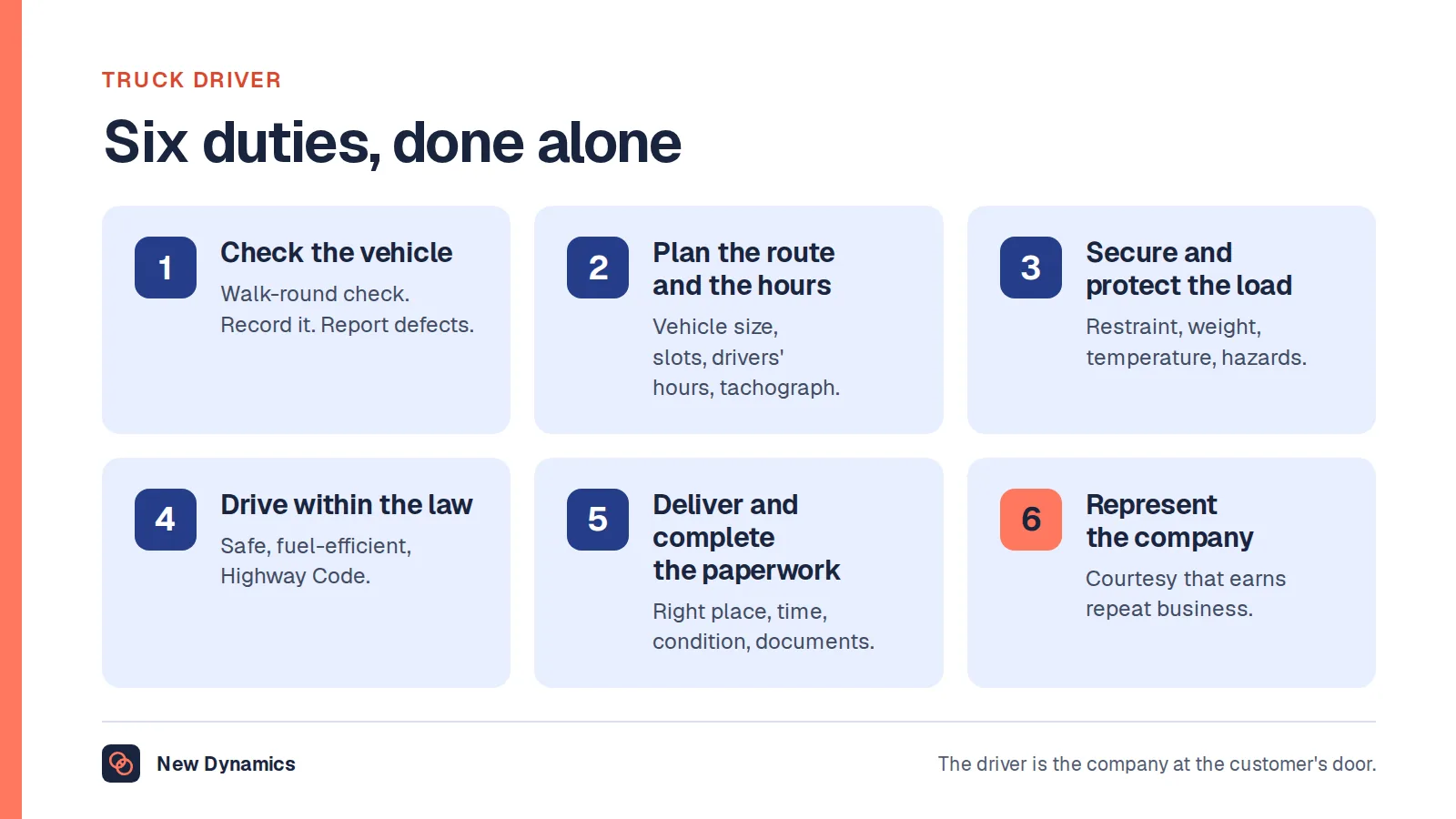
Lighter vehicles and some operations fall under GB domestic rules instead, and working time rules apply alongside. Our truck driver job description covers the rules from the driver's side. This is general information about UK rules as published, not legal advice; check the current guidance for the vehicles and operations you run.
How to become a dispatcher for truckers
There is no single qualification. The usual routes are:
- From driving. Many dispatchers are former drivers who know the runs, the sites and the rules. The NCS notes that transport managers may be asked to provide driver cover, and a dispatcher with a licence is valued for the same reason.
- From transport administration. Starting as a transport clerk or planner's assistant, learning the system and the customers, and taking on planning.
- Apprenticeship or course. The NCS lists a procurement and supply chain practitioner level 4 higher apprenticeship as a route towards assistant transport manager roles, and college and degree courses in logistics, supply chain management and transport management as an advantage.
- Towards transport manager. The NCS says that to be a road haulage or passenger transport operator, a road transport manager needs a Transport Manager Certificate of Professional Competence; dispatchers who want to run the operation work towards it.
With experience, the NCS says, a transport manager could manage regional or national operations, specialise in planning, legislation and compliance, or consultancy, or move into rail, sea or air transport.

Dispatcher job description template
Adapt the template to your operation. Keep every line true.
Job title: Transport dispatcher (traffic planner)
Reports to: Transport manager
Hours: [40] hours a week on a [shift pattern], including [early starts / weekends]; on-call [rota]
Purpose of the role: To plan and control the daily movement of [n] vehicles and [n] drivers so that every load is delivered on time, legally and at the planned cost.
Main duties:
- Build daily loads and routes from orders in [transport management system]
- Allocate drivers and vehicles by licence, hours available and vehicle suitability
- Monitor progress through telematics and re-plan around delays, breakdowns and changes
- Brief drivers, update customers and the warehouse, and escalate issues to the transport manager
- Plan within drivers' hours, working time and tachograph rules, and check compliance daily
- Record incidents, failed deliveries and damage, and follow the incident procedure
- Report daily performance: on-time delivery, utilisation, hours and cost
Skills and experience:
- Experience in transport planning, dispatch or driving [HGV licence an advantage]
- Working knowledge of drivers' hours and working time rules
- Confident with [transport management system], telematics and spreadsheets
- Calm, organised and clear on the phone under pressure
We provide: Training on our systems and compliance, support towards the Transport Manager CPC, and a route to transport manager.
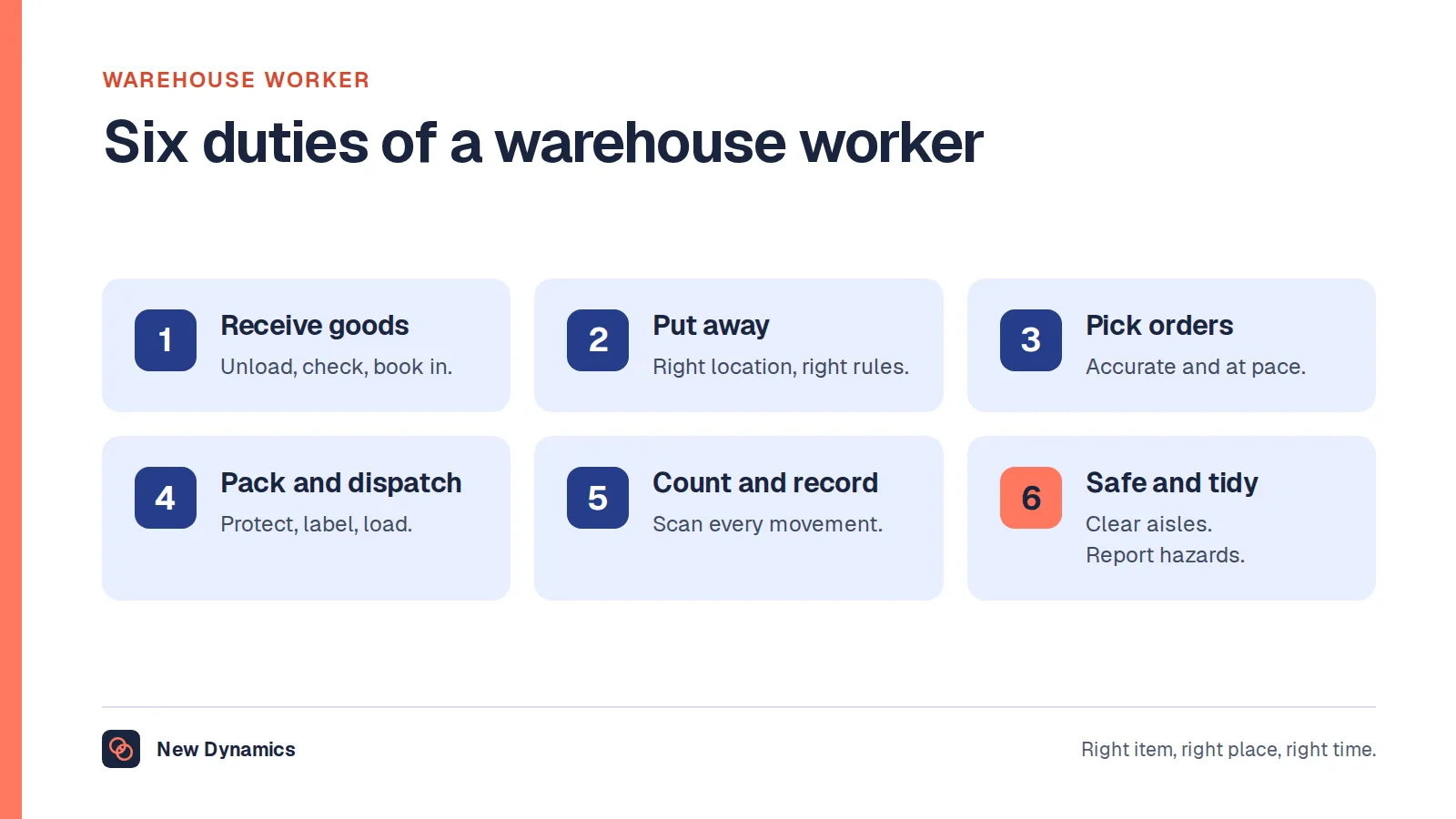
State the fleet size, the shift pattern and the systems. Our job description template explains the overall structure, and our warehouse worker job description covers the team the dispatcher loads from.
How to describe dispatch work on a CV
Write what you controlled and what it achieved. The lines below are our own examples.
- “Planned and controlled [n] vehicles and [n] drivers a day for a regional haulier, delivering [x] percent on time.”
- “Re-planned around an average of [n] same-day changes a shift while keeping every driver within hours.”
- “Reduced empty running by [x] percent through backload planning.”
- “Kept zero drivers' hours infringements over [12] months, with weekly tachograph checks.”
- “Trained two new planners on the transport management system.”
Common mistakes in dispatcher job adverts
Fleet size missing. Ten vehicles and two hundred are different jobs.
Hours hidden. Dispatch starts before the drivers do. Say when.
Compliance treated as the driver's problem. The dispatcher plans the day; the rules belong in the duties.
Systems unnamed. Planners search by the systems they know.
No route to transport manager. The candidate who wants the CPC will go to the operator that supports it.
Frequently asked questions
What does a dispatcher do?
A dispatcher sends people or vehicles to where they are needed. A transport or truck dispatcher plans loads and routes, allocates drivers and vehicles, tracks progress and re-plans around problems, communicates with drivers and customers, keeps drivers within the legal hours rules, handles incidents and records and reports the day. Emergency dispatchers do the equivalent for ambulances, fire crews and police.
What are the duties and responsibilities of a dispatcher?
Seven core duties: plan loads and routes, allocate drivers and vehicles, track and adjust in real time, communicate, keep drivers legal on hours and breaks, handle problems and incidents, and record and report performance.
How do you become a dispatcher for truckers?
Most come from driving, from transport administration, or through a logistics or supply chain apprenticeship or course. Knowledge of drivers' hours rules and the transport management system matters more than any specific qualification. Those aiming to run an operation work towards the Transport Manager Certificate of Professional Competence, which the National Careers Service lists as required for road haulage operators.
What skills does a dispatcher need?
Calm under pressure, a real sense of geography and journey times, confidence with planning and telematics systems, clear communication with drivers, customers and management, knowledge of the drivers' hours and working time rules, and fairness in allocating work.
What is the difference between a dispatcher and a transport manager?
The dispatcher plans and controls the daily operation. The transport manager is accountable for the whole function: contracts, compliance, maintenance, training and cost, and, for a licensed operator, holds the Transport Manager CPC. Dispatchers often progress to transport manager.
What rules does a truck dispatcher have to plan around in the UK?
For vehicles over 3.5 tonnes, the assimilated EU rules: no more than 9 hours' driving a day (10 twice a week), 56 hours a week and 90 hours in two weeks, with daily rest of at least 11 hours, weekly rest of 45 hours and a 45-minute break after 4 hours 30 minutes of driving, all recorded on a tachograph. Lighter vehicles fall under GB domestic rules. Check current GOV.UK guidance.
Your next step
- Write the purpose statement with the fleet size, driver count and delivery promise in it.
- Put the compliance duties into the job, not into a footnote.
- State the shift pattern, on-call arrangement and systems.
- Agree the first quarter's measures: on-time delivery, utilisation, infringements.
For writing those measures well, read and download our SMART goals guide. The guide is free to read, and the PDF uses our short download form.
Want daily targets, check-ins and reviews for planners and drivers in one place? Book a New Dynamics demo and bring your current job description. You can also email contact@new-dynamics.com.