TL;DR
- A skills test asks a candidate to do a piece of the job, or something very like it, and scores the result: a typing test, a spreadsheet task, a coding exercise, a mock call, a sample lesson, a piece of writing. The US Office of Personnel Management defines work sample tests as requiring applicants to perform tasks or work activities that mirror the tasks employees perform on the job, and reports that they relate highly to job performance and that applicants often see them as very fair.
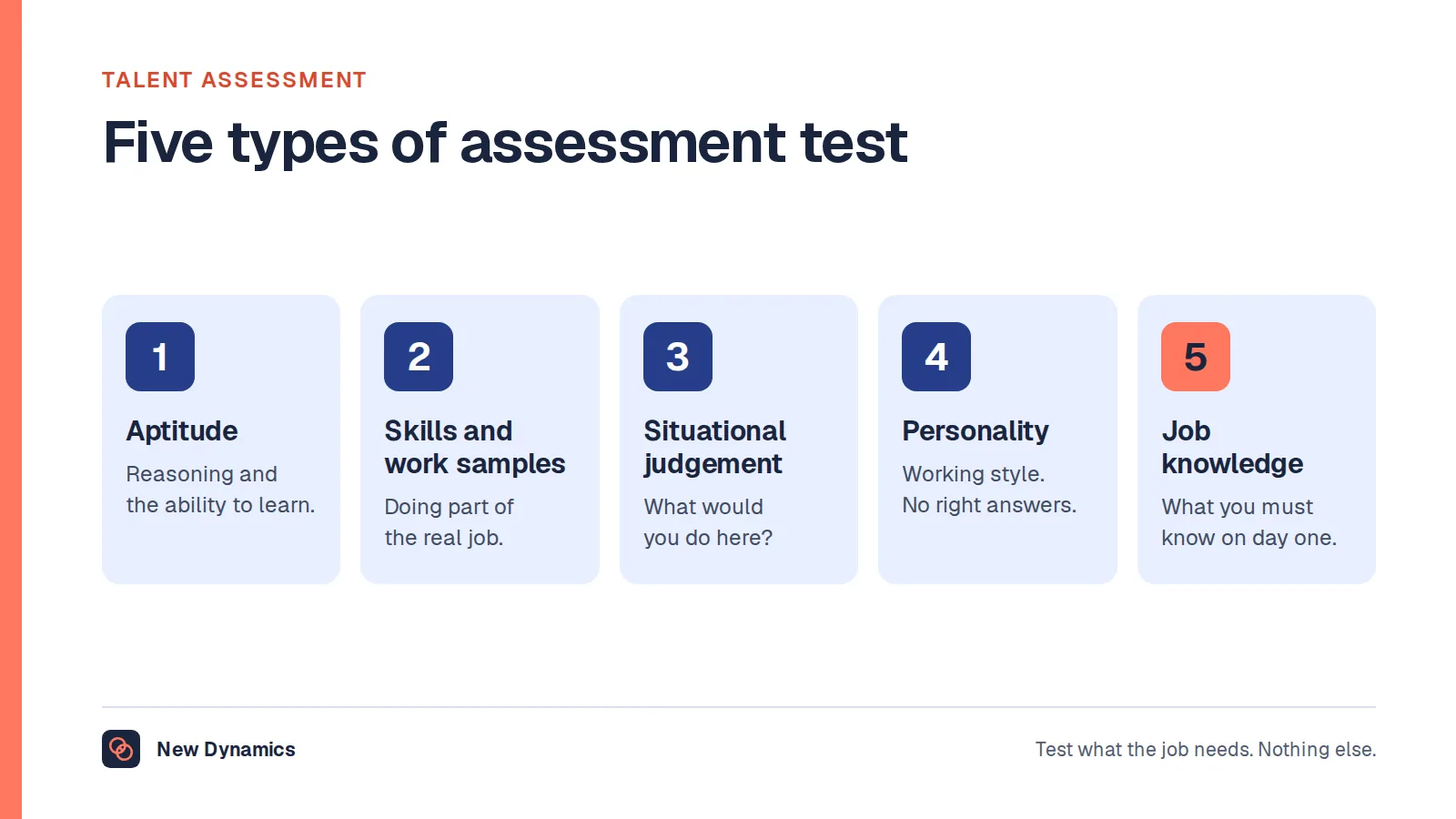
- It differs from an aptitude test, which measures general ability, and a personality questionnaire, which measures working style. Design one in six steps: choose the critical task, build a realistic sample, write the scoring rubric first, set the time and the conditions, train the assessors, and offer adjustments. Keep it short, keep it about the job and never use candidates' work for real.
- The fairness rules are the same as for any selection method: the same test and conditions for everyone, scoring against criteria fixed in advance, adjustments for disabled candidates, which GOV.UK says employers may ask about in order to arrange, and records kept securely. Work samples are costly to build and to run, so use them where the skill is critical and the shortlist is small.
Interviews tell you what a candidate says they can do. A skills test shows you. It is the stage of hiring with the best evidence behind it and the highest approval from candidates, and also the one most often done badly: an unpaid project that takes a weekend, a timed exercise with no rubric, or a test that measures nerves rather than skill.
This article explains what a skills test is and how it differs from other hiring tests, what the evidence says, six steps to design and score one, examples for ten kinds of job, the fairness rules and what candidates should expect. It draws on the US Office of Personnel Management's guidance on work samples and on GOV.UK's guidance for employers on recruitment; the principles apply anywhere, but the law differs by country and this is general information, not legal advice.
A skills test previews the job; the review cycle judges how it is done once the person starts. See how New Dynamics performance reviews bring goals, feedback and evidence into one fair conversation from the first quarter onwards.
What is a skills test?
A skills test is a selection exercise in which a candidate performs a task that is part of the job, or closely resembles it, and the result is scored. The US Office of Personnel Management, which sets assessment policy for the federal workforce, defines the category: “Work sample tests require applicants to perform tasks or work activities that mirror the tasks employees perform on the job.”
OPM distinguishes two kinds. A specific work sample is a task identical or very similar to an actual duty: transcribing a memo for an administrative assistant, for example. A performance test is a broader exercise that measures underlying competencies across several tasks, such as a role-play that assesses problem-solving and communication.
Skills test vs aptitude test vs personality questionnaire
| Test | Measures | Example | Best for |
|---|---|---|---|
| Skills test | What the person can do now, on this job's tasks | A spreadsheet task, a mock call, a sample lesson | Roles where a critical skill must exist on day one |
| Aptitude test | General ability: numerical, verbal, abstract reasoning | A timed reasoning test | Trainee and graduate roles; large applicant pools |
| Personality questionnaire | Preferred working style | A self-report questionnaire | Understanding fit, never as a pass or fail on its own |
The talent assessment test guide compares all the kinds. This article is about the first.

What the evidence says
OPM's summary of the research is unusually clear. Work samples have content validity because “tasks applicants are asked to perform are very representative of the tasks performed on the job”, and criterion-related validity because “performance on the tests relates highly to performance on the job”. Candidates like them: “applicants often perceive work samples as being very fair.” And OPM reports that performance differences between demographic groups are typically smaller than for some other methods.
The costs are equally clear. Work samples “may be costly to develop, both in terms of time and money” and “may require periodic updating”; they “may be time consuming and expensive to administer”; they need trained assessors; they usually have to be run one candidate at a time; and they are unsuitable where the competency can be learned on the job. OPM's conclusion is that they are “best used for positions for which the measured competencies are highly critical for successful performance on the job” and where “there is a limited number of applicants to test”.
In practice: test the skill that the job cannot do without, at the shortlist stage, not the whole applicant pool.
How to design a skills test in six steps
- Choose the critical task. From the job description, pick the one or two tasks the person must be able to do from the start and that cannot be taught quickly. Not the whole job.
- Build a realistic sample. Take a real task and anonymise it: a real customer email with the names changed, a real dataset with the numbers altered, a lesson on your actual curriculum. Make it self-contained, with everything the candidate needs to attempt it.
- Write the scoring rubric before anyone sits the test. For each thing you are measuring, describe what a strong, adequate and weak result looks like, with points. OPM notes that scores are generated by trained assessors observing behaviour or measuring task outcomes; the rubric is what makes their scores consistent.
- Set the time and the conditions. Long enough to show the skill, short enough to respect the candidate. An hour or two is usual for a take-home task; twenty to forty minutes for a test at interview. State whether tools, references and the internet are allowed, and give everyone the same answer.
- Train the assessors. Two where possible, scoring independently against the rubric, then comparing. Run a calibration on a sample answer before the first candidate.
- Offer adjustments and tell candidates what to expect. Say in advance what the test is, how long it takes, how it is scored and how to ask for adjustments. Then keep to it.

Skills test examples by kind of job
Each one is an example. Adapt the task to your own work and keep it short.
- Administrator or coordinator: reorganise a messy inbox and calendar for a fictional manager for one day; draft two replies.
- Customer service: handle a scripted call or chat with an assessor playing a difficult customer; write the follow-up note.
- Sales: prepare and deliver a ten-minute pitch on the company's product to a fictional prospect brief.
- Software developer: a small, self-contained coding exercise on the team's stack, or a review of a short piece of deliberately flawed code.
- Data analyst: clean a small dataset, answer three questions from it and explain the method in a paragraph.
- Writer or marketer: edit a rough draft to house style; write a headline and a short piece to a brief.
- Teacher or trainer: teach a twenty-minute lesson or session to a small group on a topic given in advance.
- Tradesperson or technician: a practical task on a rig or a bench, with safety observed and scored.
- Manager: an in-tray exercise with competing priorities and a difficult staff message; a role-play of a feedback conversation.
- Finance: reconcile a short set of accounts with two planted errors; explain what was found.

Keeping a skills test fair and lawful
- Same test, same conditions. Every candidate for the role gets the same task, the same time, the same instructions and the same permitted tools.
- Score the criteria, not the person. The rubric is fixed before the test and applied by assessors who do not know the candidate's application, where practical.
- Adjustments. GOV.UK says employers must not discriminate in recruitment, and that they may ask about health or disability where it is to find out whether a candidate needs support for selection tests or interviews. Ask everyone the same question in advance, and act on the answers: more time, a different format, assistive software, a quiet room.
- Test the job, not the culture. A task that rewards familiarity with a particular tool, jargon or way of working that the job does not need will screen out people who could do it.
- Never use the work. A skills test that produces something the organisation uses is unpaid labour. Keep tasks fictional or already solved, and say so.
- Keep the records. Tasks, rubrics, scores and adjustments, stored securely for the period your privacy notice sets, so the decision can be explained.
For candidates: what to expect and how to prepare
Ask what the test is, how long it takes and how it is scored; a good employer will tell you. Ask for adjustments if you need them. Prepare by doing the kind of task the role involves, under time, and by practising explaining your method aloud, because many tests score the reasoning as well as the result. Treat a take-home task that would take a working day or more as a warning sign, and say so politely.
Frequently asked questions
What is a skills test in recruitment?
An exercise in which a candidate performs a task that is part of the job, or closely resembles it, and is scored against criteria. Examples are typing tests, spreadsheet tasks, coding exercises, mock calls, sample lessons and in-tray exercises. The US Office of Personnel Management defines work sample tests as requiring applicants to perform tasks that mirror those employees perform on the job.
Are skills tests a good predictor of job performance?
The evidence summarised by OPM says that performance on work samples relates highly to performance on the job, that candidates see them as very fair, and that differences between demographic groups are typically smaller than for some other methods. The limits are cost, the need for trained assessors and their unsuitability where the skill can be learned quickly on the job.
How long should a skills test be?
Long enough to show the skill and short enough to respect the candidate: usually twenty to forty minutes at interview or an hour or two for a take-home task. Tests that require a working day or more shift the cost onto candidates and put off the people you most want.
Can employers ask about disability before a skills test?
In Great Britain, GOV.UK says employers may ask about health or disability where the purpose is to find out whether a candidate needs support for selection tests or interviews. Ask every candidate the same question in advance and arrange the adjustments. Rules differ in other countries.
What is the difference between a skills test and an aptitude test?
A skills test measures what a person can already do on the job's own tasks. An aptitude test measures general ability such as numerical or verbal reasoning, which may predict how quickly someone can learn. Skills tests suit roles where a critical skill must exist from day one; aptitude tests suit trainee roles and large applicant pools.
Your next step: pick one task and write the rubric
- Name the one skill the job cannot do without and that cannot be taught quickly.
- Build a short, self-contained, anonymised task around it.
- Write the scoring rubric, then trial the task and the rubric on a colleague.
- Decide the time, the conditions, the adjustments process and the assessors, and tell candidates all of it in advance.
For the whole selection process from advert to offer, read and download our recruitment and selection guide. The guide is free to read, and the PDF uses our short download form.
Want the evidence from the test, the first-quarter goals and the first review to sit in one place for every new hire? Book a New Dynamics demo and bring your current process. You can also email contact@new-dynamics.com.