TL;DR
- A talent assessment test is a standard exercise that employers use to judge candidates' abilities, skills or working style. The main kinds are aptitude tests, skills tests and work samples, situational judgement tests and personality questionnaires.
- An aptitude test measures natural ability for a kind of work, such as reasoning with numbers or words. A skills test measures what a person can already do. A work sample asks them to do part of the real job.
- Tests help only when they are relevant to the job, given to everyone in the same way, adjusted for disabled candidates, combined with other evidence and checked for unfair effects on particular groups.
A CV tells you what a candidate says that they have done. An interview tells you how well they talk about it. Neither tells you directly whether they can do the work. That gap is why employers use tests, and why candidates meet more of them every year.
This article explains what a talent assessment test is, gives the meaning of aptitude tests and skills assessment tests, compares five types of test, sets out six steps for using them fairly and offers five tips for candidates.
Assessment does not end with the offer. See how New Dynamics performance reviews bring goals, feedback and development into one fair discussion.
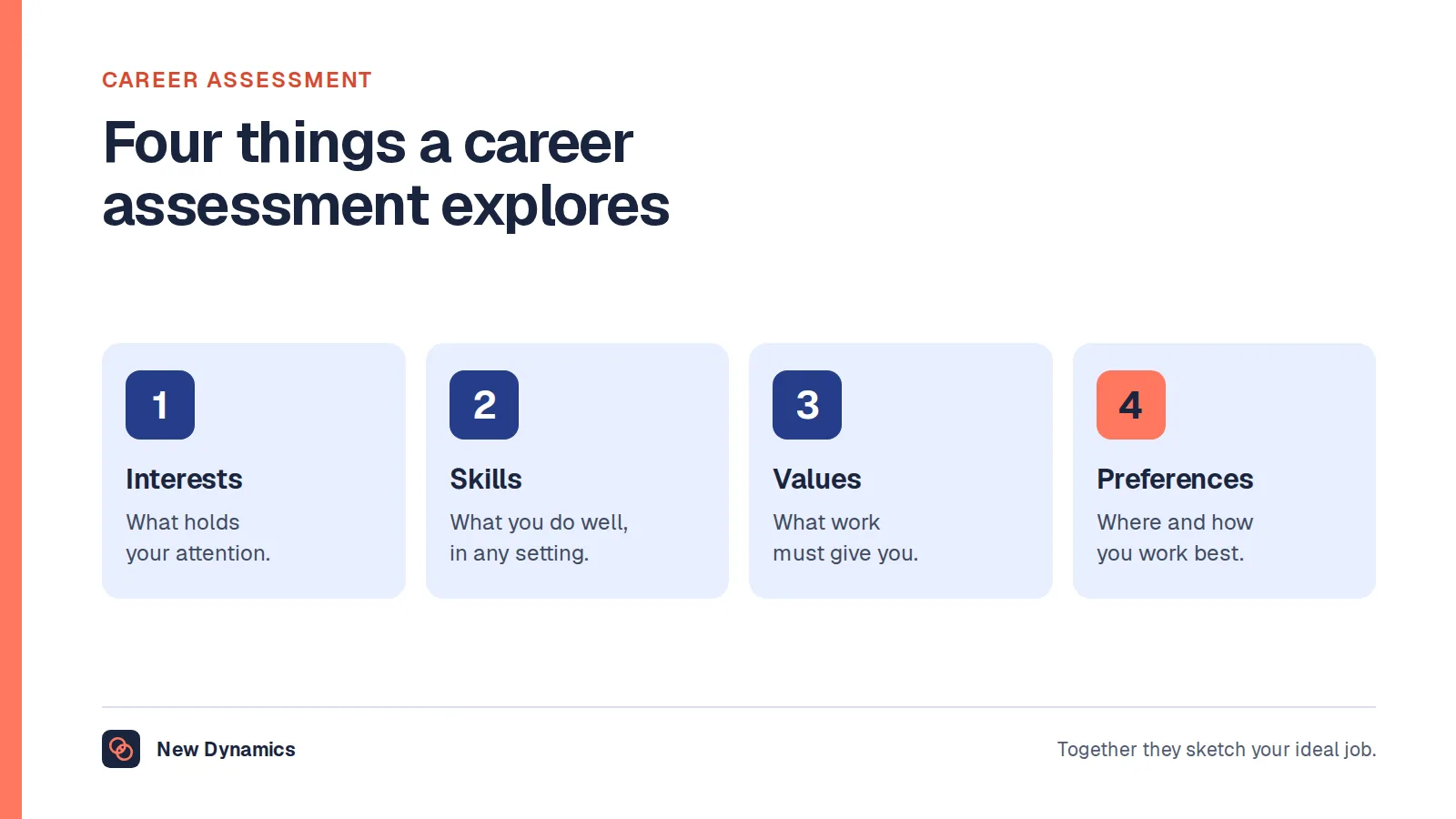
If you want a test to help you to choose a career, not an employer's selection test, see our guide to the career assessment test.
What is a talent assessment test?
A talent assessment test is any standard exercise that an employer uses to measure something about candidates or employees: an ability, a skill, a way of working or knowledge of the job. Standard means that everybody gets the same questions, the same conditions and the same scoring. People also call them pre-employment tests, selection tests or psychometric tests.
The Cambridge Business English Dictionary defines a psychometric test as one “designed to show someone's personality, mental ability, opinions, etc.”, often used by companies when they are deciding whether to employ someone.
The CIPD's factsheet on selection methods places tests beside interviews, skill-based tasks and assessment centres, and states the principle that governs all of them. Employers should ensure “that their selection methods treat candidates fairly, without discrimination or bias, and that selections are made based on the candidate's ability to perform the role”.
Aptitude tests: meaning and examples
The Cambridge Dictionary defines an aptitude test as “a test to find out if someone has a natural ability for a particular type of work”. The key word is ability. An aptitude test tries to measure potential, not what a person has already learned.
Psychologists usually call these cognitive ability tests. The US Office of Personnel Management (OPM), which advises federal agencies on hiring, explains in its guide to cognitive ability tests that they “assess abilities involved in thinking (e.g., reasoning, perception, memory, verbal and mathematical ability, and problem solving)”. Typical items include “arithmetic computations, verbal analogies, reading comprehension, number series completion, and spatial relations”.
So a numerical reasoning test, a verbal reasoning test, a logical or abstract reasoning test and a spatial test are all aptitude tests. They are usually timed, and they have right and wrong answers.
Five types of talent assessment test
- Aptitude or cognitive ability tests. Reasoning with numbers, words, patterns and shapes. OPM says that such tests “are good predictors of job performance and training success for a wide variety of jobs”.
- Skills tests and work samples. A skills assessment test checks what a person can already do: typing, a spreadsheet task, a coding exercise, a piece of writing. OPM defines the purest form, in its guide to work samples: “Work sample tests require applicants to perform tasks or work activities that mirror the tasks employees perform on the job.” It adds that applicants “often perceive work samples as being very fair”.
- Situational judgement tests. OPM explains that these “present applicants with a description of a work problem or critical situation related to the job they are applying for and ask them to identify how they would handle it”. They suit customer-facing and managerial roles.
- Personality questionnaires. OPM describes them as “designed to systematically elicit information about a person's motivations, preferences, interests, emotional make-up, and style of interacting with people and situations”. There are no right answers, but there are profiles that fit a job better or worse. The traits most often measured are the five that OPM lists: extroversion, emotional stability, agreeableness, conscientiousness and openness to experience.
- Job knowledge tests. Questions on the technical or professional knowledge that the job requires from the first day, such as accounting rules or safety procedures.
An assessment centre combines several of these with interviews and group exercises. Our guide to the group interview describes how those days work.

What the evidence says, and a warning
OPM's summaries are unusually frank about both sides.
On cognitive ability tests, it notes that they predict performance well, and adds: “The more complex the job or training demands, the better these tests work”. It also records the drawback: such tests “typically produce racial and ethnic differences larger than other valid predictors of job performance”. Its recommendation is to use them “in combination with” other methods, such as structured interviews, “to lower any potential adverse impact”.
On work samples, OPM reports a high degree of validity, because the tasks are very representative of the job, and notes a limit: they suit only jobs where applicants are expected to have the skills already. If you will train people after hiring, test their ability to learn instead.
On personality questionnaires, OPM advises against relying on a single trait, and observes that the traits that predict performance “will depend on the job in question”.
Standards matter too. In the UK, the British Psychological Society's Psychological Testing Centre “provides information and services relating to standards in tests and testing”, offers qualifications in test use and publishes independent reviews of tests. A questionnaire that has no published evidence behind it is a quiz, however polished it looks.
Six steps to use assessment tests fairly
- Start from the job. List the abilities and skills that the job really requires, from the job description, and test only those.
- Choose a test with evidence. Ask the publisher what the test measures, how it was validated and on whom. OPM reminds employers that most methods “require considerable test development and measurement expertise”.
- Tell candidates in advance. Say what the test is, how long it takes, how it will be used and whether practice material exists.
- Offer adjustments. Acas's guidance on interviewing job applicants gives an example of a reasonable adjustment: “giving someone more time to do a written test that is part of an interview”. Ask every candidate whether they need any.
- Combine, do not rely. Use the score as one piece of evidence beside a structured interview and, where possible, a work sample. Never reject on a personality profile alone.
- Check the results. Review pass rates by group, and ask whether people who scored well went on to perform well. Keep scores secure, and give feedback when candidates ask for it.
The law applies to tests as it does to interviews. GOV.UK's guidance for employers on preventing discrimination in recruitment warns: “You might be breaking the law if any discrimination happens during their recruitment process, even if you use a recruitment agency.” This is general information, not legal advice.

Five tips for candidates
- Find out which kind of test it is. Ask the recruiter for the name of the test and the publisher, and whether there are practice questions.
- Practise aptitude tests. Familiarity with the format and the clock improves scores. Many publishers and university careers services offer free practice.
- Answer personality questionnaires honestly. They often check for consistency, and a job won by pretending is a job that will not suit you.
- Ask for adjustments early. If you are disabled or have a condition such as dyslexia, tell the employer before the test, and say what would help.
- Treat a work sample as the job. Read the brief twice, manage your time and show your reasoning.
Afterwards, ask for feedback. A reputable employer will give at least a summary.

Common mistakes by employers
Testing because a test exists. If the ability is not needed in the job, the test is noise, and possibly unlawful.
A cut-off score with no evidence. A pass mark should come from data about the job, not from a round number.
One test, one decision. Every test has error. Combine sources.
Forgetting the candidate's experience. An hour of unexplained puzzles drives good applicants away.
Ignoring group differences. Monitor outcomes, and act on what you find.
Using personality types as labels. A profile describes tendencies. It does not define a person.
Frequently asked questions
What is a talent assessment test?
It is a standard exercise that an employer uses to measure candidates' abilities, skills, judgement, working style or job knowledge. Everybody gets the same questions, conditions and scoring. Aptitude tests, skills tests, situational judgement tests and personality questionnaires are the main kinds.
What does aptitude test mean?
The Cambridge Dictionary defines an aptitude test as a test to find out if someone has a natural ability for a particular type of work. In hiring, it usually means a timed test of numerical, verbal, logical or spatial reasoning.
What is a skills assessment test?
A skills assessment test measures what a person can already do, such as typing, using a spreadsheet, writing code or drafting a letter. A work sample is the closest form: the candidate performs tasks that mirror the real job.
What is the difference between an aptitude test and a skills test?
An aptitude test measures potential, the ability to reason and to learn. A skills test measures present competence in a specific task. Use aptitude tests when you will train people, and skills tests when they must be able to do the work from the first day.
Are assessment tests accurate?
Well-made tests add useful evidence. The US Office of Personnel Management says that cognitive ability tests are good predictors of job performance, especially in complex jobs. No test is accurate enough to decide alone, and some produce group differences, so they should be combined with other methods.
Can I fail a personality test?
There are no right or wrong answers, so you cannot fail in the usual sense. An employer may judge that your profile fits the job less well than another candidate's. A responsible employer uses the result as one input, never as the sole reason for rejection.
Your next step
If you are hiring, take one vacancy and write down the three abilities that matter most. Then ask whether your current tests measure those three, and nothing else. If you are a candidate, ask which test you will sit, and practise that format this week.
For the whole hiring process, from the advert to the offer, read and download our recruitment and selection guide. The guide is free to read, and the PDF uses our short download form.
Want the evidence that you gather in hiring to carry on into goals, feedback and reviews? Book a New Dynamics demo and bring your current approach. You can also email contact@new-dynamics.com.