TL;DR
- A portfolio manager runs money on someone else's behalf. O*NET describes the occupation, Investment Fund Managers, as planning, directing or coordinating “investment strategy or operations for a large pool of liquid assets supplied by institutional investors or individual investors”, and lists Portfolio Manager among the reported job titles.
- The mandate defines the job: what the money is for, what it may be invested in, what risk is acceptable, what it is measured against and what the manager may do without asking. Within it the manager decides and owns the result. Outside it, nothing. O*NET's tasks run from developing fund investment policies and selecting investments through monitoring performance “to ensure portfolios meet risk goals” to responding to regulatory inquiries.
- In the UK the role usually sits inside the FCA's Senior Managers and Certification Regime, which aims “to reduce harm to consumers and strengthen market integrity by making individuals more accountable for their conduct and competence”. Certification staff are not approved by the FCA; the firm must certify they are fit and proper on appointment and at least once a year.
Two people look at the same company on the same morning. One writes up what they found and recommends a position. The other reads it, weighs it against everything else competing for the same money, and decides. The second person is the portfolio manager, and that single difference (deciding rather than recommending) shapes the hours, the accountability and the way the job is judged.
This article explains what a portfolio manager is and what they actually do: the mandate that defines the role, seven duties, the UK regulatory layer, how the job differs from an analyst, trader, stockbroker or adviser, the routes in, and what a good advert should say. It is general information about the occupation, not investment, legal or regulatory advice.
Results in this job are noisy, long-horizon and easy to mistake for skill or for luck, which makes what you write down at the start of the year matter more than usual. See how New Dynamics Goals & OKRs keep targets and progress in one place.
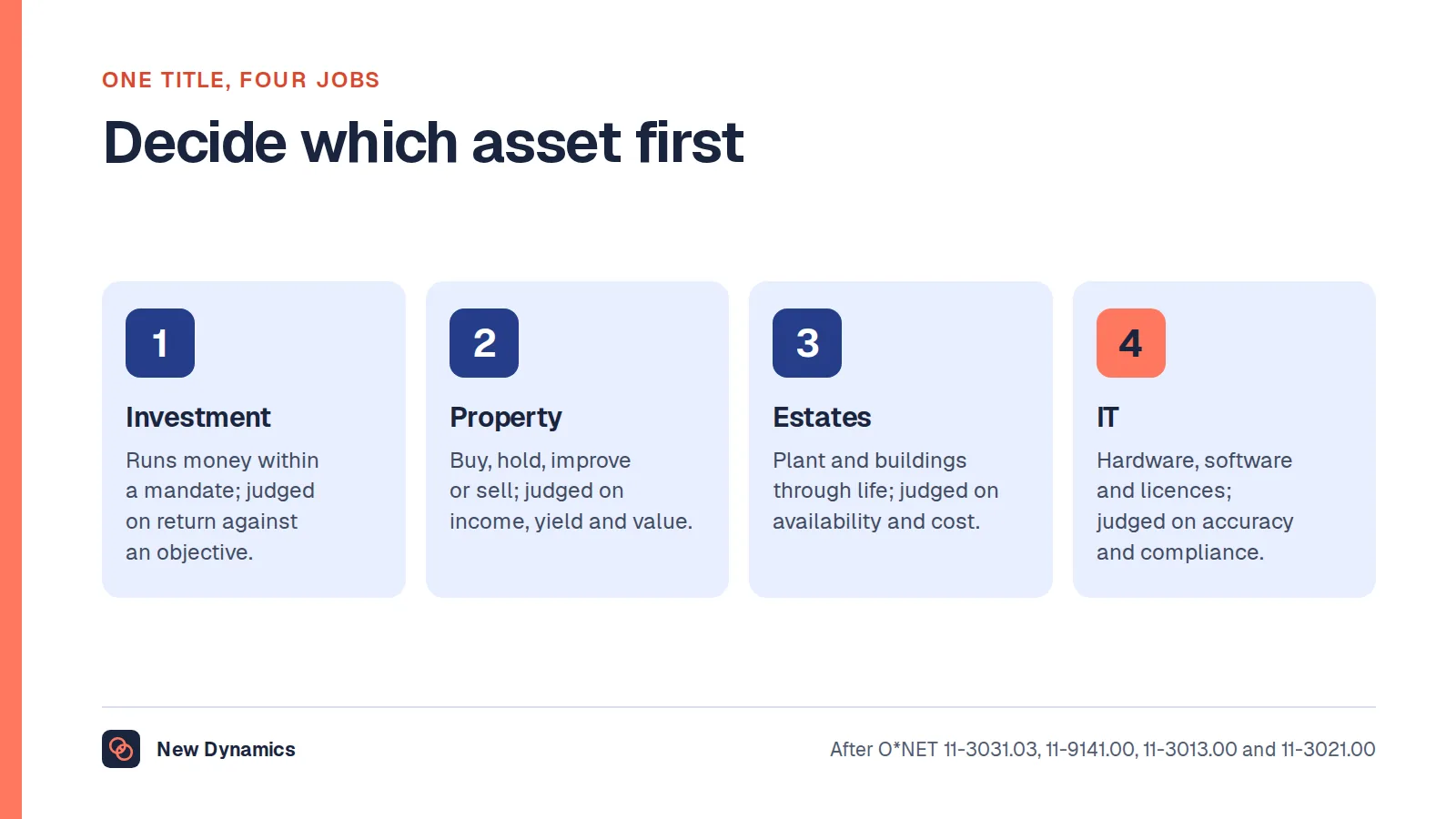
The title causes confusion outside investment too: our asset manager job description separates the four jobs that share the name.
What is a portfolio manager?
A portfolio manager runs money on behalf of other people, within agreed limits, and is accountable for what happens to it.
O*NET's occupation for the role is Investment Fund Managers, described as those who "plan, direct, or coordinate investment strategy or operations for a large pool of liquid assets supplied by institutional investors or individual investors". Among its reported job titles are Portfolio Manager and Fixed Income Portfolio Manager.
"Portfolio" simply means the collection of holdings being managed. The money may belong to a pension scheme, an insurer, a charity, a university endowment, a fund's unit holders or a private client. The manager rarely owns it, which is the whole point: the job is fiduciary before it is analytical.
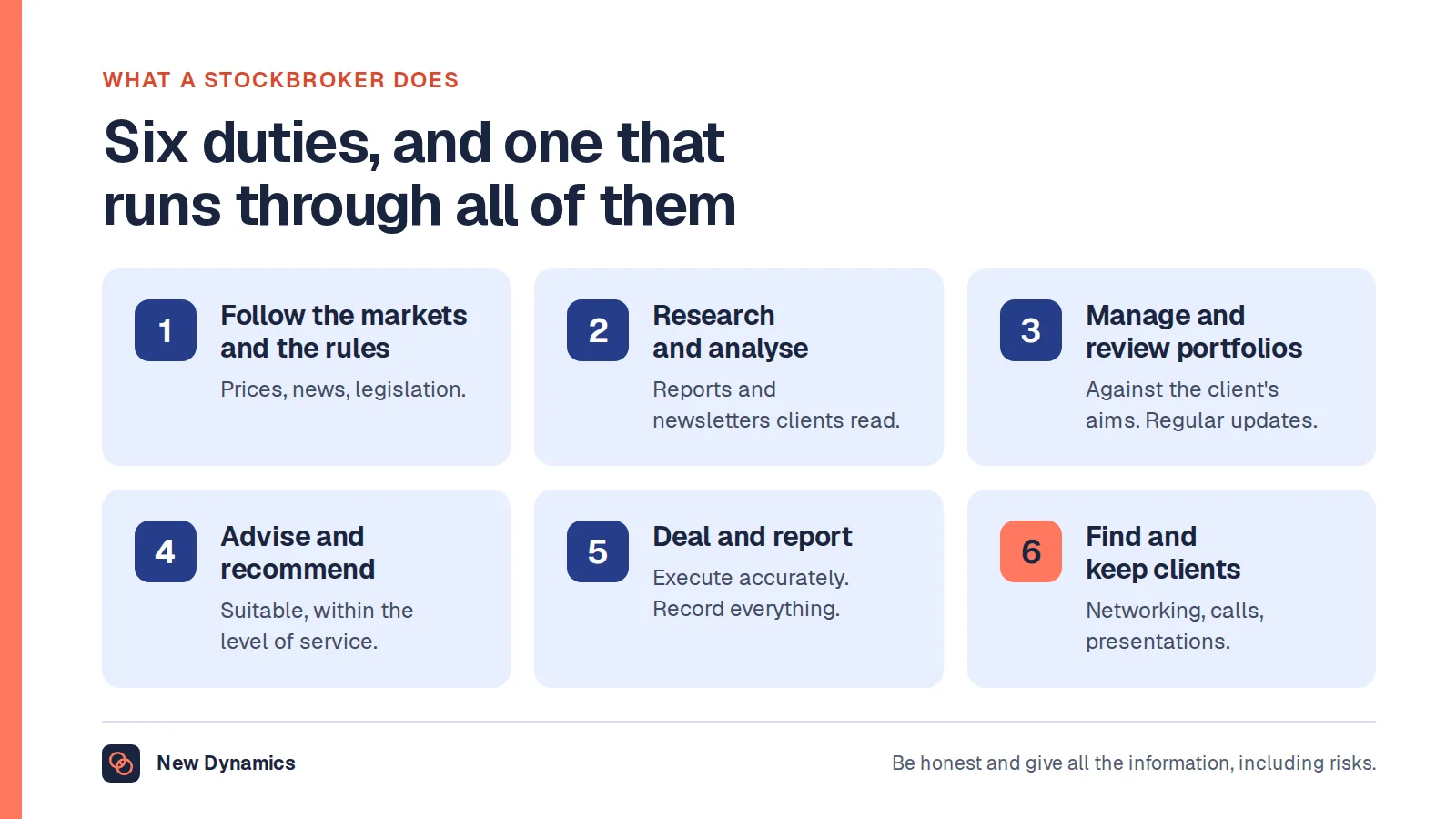
The word people reach for to describe the difference from advice is discretion. A discretionary manager makes and executes decisions without asking each time. An adviser recommends and waits for instruction. Our post on the stockbroker's role sets out the same spectrum from the dealing side.
The mandate is the job
Everything else follows from the mandate: the written statement of what this money is for and what the manager may do with it. Its usual contents:
- The objective. What the money is for and over what horizon: income, growth, matching a pension scheme's liabilities, preserving capital.
- The universe and the limits. What may be held, in what proportions, and what may not: asset classes, geographies, credit quality, concentration limits, currency, leverage, liquidity, exclusions.
- The risk tolerance. How much variation the owner will accept on the way, expressed in whatever measures the mandate chooses.
- The benchmark or reference. What the result will be compared with, which quietly decides what counts as a good year.
- The discretion. What the manager may do without asking, and what needs a conversation first.

Read a mandate carefully and you can predict most arguments the role will have. A vague objective produces disagreement about whether a year went well. A benchmark nobody chose deliberately produces the wrong behaviour. Discretion that is never written down produces either paralysis or a surprise.
Seven duties
O*NET lists twenty tasks for the occupation. They group into seven.
- Strategy and policy. "Develop or implement fund investment policies or strategies", and translate the mandate into a way of working.
- Research. "Perform or evaluate research, such as detailed company or industry analyses, to inform financial forecasting, decision making, or valuation", and "attend investment briefings or consult financial media to stay abreast of relevant investment markets".
- Allocation and selection. "Select specific investments or investment mixes for purchase by an investment fund", and "manage investment funds to maximize return on client investments".
- Dealing. "Select or direct the execution of trades", in most firms directing a dealing desk rather than typing the order.
- Risk and monitoring. "Monitor financial or operational performance of individual investments to ensure portfolios meet risk goals", and "develop, implement, or monitor security valuation policies".
- Clients and reporting. "Meet with investors to determine investment goals or to discuss investment strategies", and "present investment information, such as product risks, fees, or fund performance statistics".
- Compliance. "Prepare for and respond to regulatory inquiries", "monitor regulatory or tax law changes to ensure fund compliance", "verify regulatory compliance of transaction reporting", and review offering documents and marketing material.

Senior managers also "hire or evaluate staff" and "direct activities of accounting or operations departments", which is where the job stops being an individual one.
What the week actually looks like
The rhythm is more repetitive than the job's reputation suggests.
- Daily. Read overnight news and market moves; review positions against limits; deal with anything breaching or approaching a limit; meet the analysts covering what you hold; approve or place orders.
- Weekly. An investment meeting where positions are argued; a check on flows in and out; a look at anything the risk team has flagged.
- Monthly and quarterly. Performance attribution, working out what actually drove the result rather than assuming it was skill; client reporting; committee papers; a valuation and compliance cycle.
- Occasionally and unpleasantly. A position that goes wrong in public, a redemption that forces selling, a regulatory inquiry, a client who wants to know why the benchmark did better.
The regulated layer in the UK
Running other people's money is a regulated activity, and the individuals are regulated as well as the firm.
The Financial Conduct Authority's Senior Managers and Certification Regime "aims to reduce harm to consumers and strengthen market integrity by making individuals more accountable for their conduct and competence". The FCA says it works by encouraging staff "to take personal responsibility for their actions", improving conduct at all levels and making sure firms and staff "clearly understand and can show who does what". It has three parts: the Senior Managers Regime, the Certification Regime and the Conduct Rules.
Most portfolio managers sit in the middle part. The FCA's page on the Certification Regime explains that it "covers specific functions that aren't Senior Management Functions, but can have a significant impact on customers and/or the firm", and that certification staff "are not approved by the FCA. Instead, firms need to check and certify that they are fit and proper to perform their role on appointment and at least once a year". The certification functions listed are CASS oversight, proprietary trader, significant management, functions requiring qualifications, managers of certification employees, material risk takers, client-dealing and algorithmic trading.
Two practical consequences for anyone hiring. First, an annual fitness and propriety assessment is a real piece of work that has to happen on time, with evidence, whatever else is going on. Second, firms must have processes to obtain and provide regulatory references; the FCA expects a reference to be provided "within 4 weeks at most", adding that this "is a limit and not a target". Which functions apply to a given firm and role is a question for that firm's compliance team and the FCA Handbook, not for an article.
Portfolio manager compared with five nearby jobs
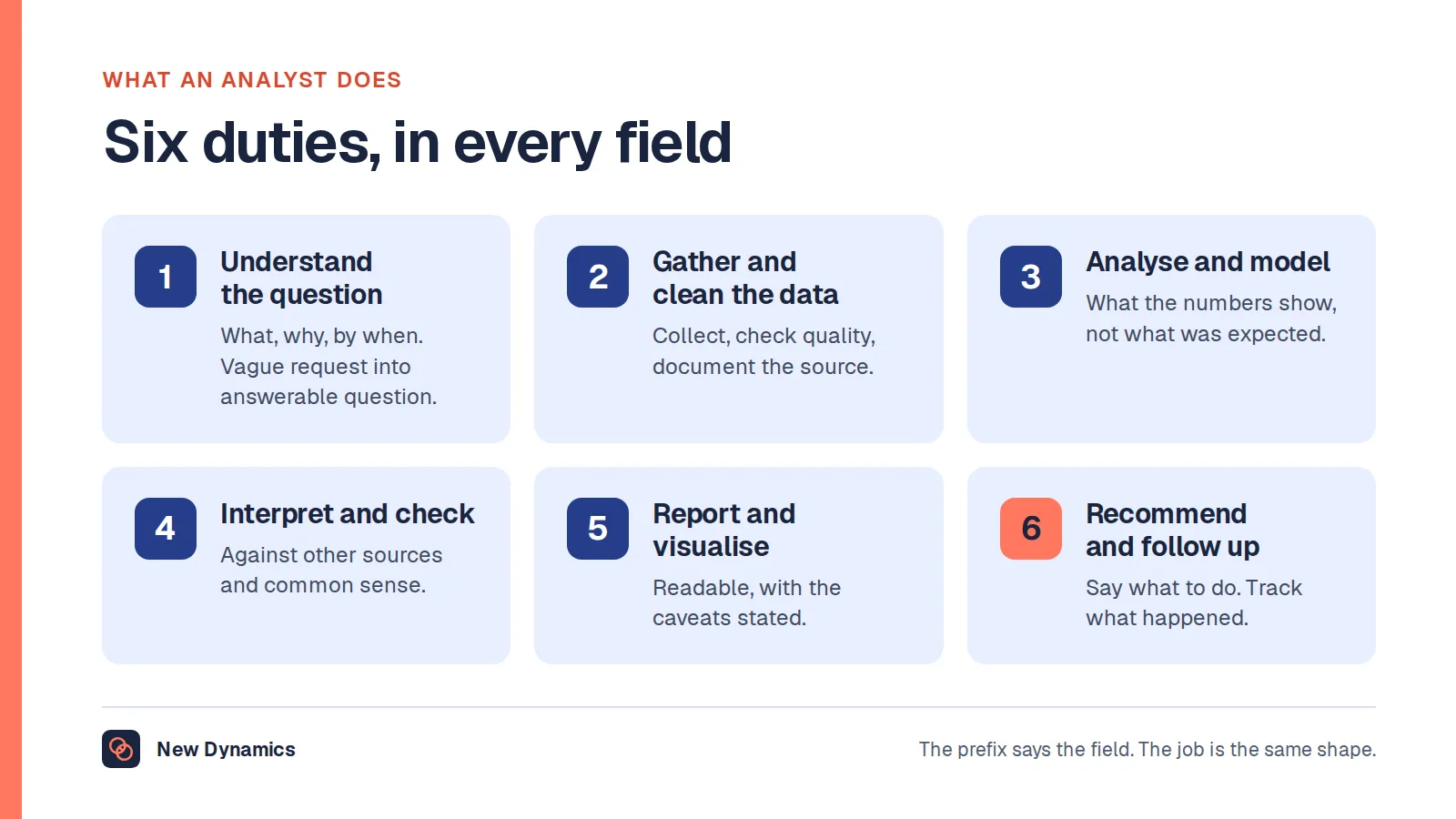
- Analyst. Researches and recommends; does not decide. Our analyst job description covers the wider family of analytical roles. The step up to portfolio manager is a change in accountability, not a promotion in the ordinary sense.
- Trader or dealer. Executes decisions well: price, timing, market impact. A portfolio manager decides what to own; a trader decides how to get it.
- Stockbroker. Buys and sells for clients, on instruction or with discretion depending on the service.
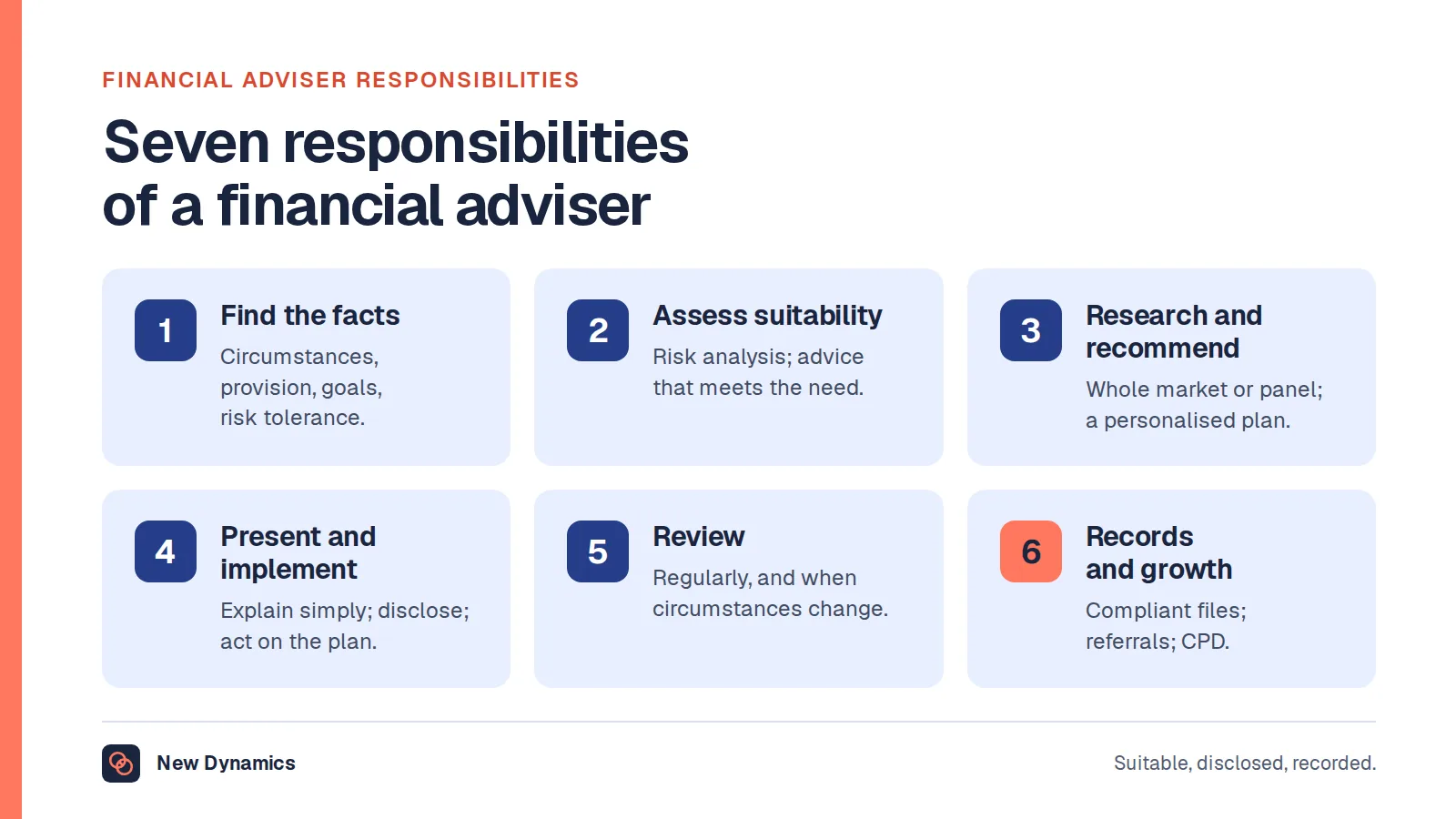
- Financial adviser. Advises a client on their whole financial position and recommends products; see our financial adviser job description. The adviser may then place the money with a portfolio manager.
- Wealth manager. Usually a client-facing role covering planning, tax and investment for private clients, often with the portfolio managed by someone else or by a model.
How the job is judged, and why that is hard
The result is a number, which makes performance management look simple and is exactly why it goes wrong.
- The horizon is longer than the review cycle. A mandate may run for years; the appraisal happens annually. A good year can come from a decision made three years earlier, or from luck.
- Skill and noise look identical in the short run. Attribution helps (separating asset allocation from selection, and both from currency and timing) but it does not settle the question in one year.
- Benchmark-relative numbers reward the wrong thing if the benchmark is wrong. Choose it deliberately and write down why.
- Process is more assessable than outcome. Was the thesis written down? Were the limits respected? Was the position sized to the conviction? Was a mistake admitted and acted on, or defended? These are visible every month.
The workable approach is to judge process continuously and outcome over the full horizon, and to write both down at the start rather than argue about them at the end. Our performance review guide sets out how to keep a review evidence-based rather than recency-driven.

Routes in and progression
There is no single path, and almost nobody starts here.
The National Careers Service's investment analyst profile describes the usual UK entry points to the investment side: a degree, usually at upper second class or higher, in any subject but often economics, maths, business studies, accountancy or finance; an Investment Operations Specialist level 4 higher apprenticeship; a Senior Investment and Commercial Banking Professional level 7 apprenticeship; or a graduate trainee scheme. It notes that trainees must pass an exam recognised by the Financial Conduct Authority, giving the Investment Management Certificate from the CFA Society UK and the Investment Advice Diploma through the Chartered Institute for Securities & Investment as examples, and that background and security checks apply. Progression from analysis runs towards managing money, which the profile describes as becoming a wealth fund manager.
The preparation is long. O*NET places the occupation in Job Zone Five, "Extensive Preparation Needed", and reports that 63% of respondents said a master's degree was required for a new hire and 33% a bachelor's degree.
The typical internal path is analyst, then assistant or co-manager on a strategy, then sole responsibility for a portfolio, then responsibility for a team or a desk.
What the advert should say
Most portfolio manager adverts describe the firm and omit the job. Four things settle it:
- The mandate. Asset class, strategy, client type, approximate size, benchmark or objective, and the limits.
- The decision rights. Sole manager, co-manager or committee; what needs approval; how ideas reach the portfolio.
- The support. Dedicated analysts or shared research, a dealing desk or self-execution, the risk and compliance setup.
- How performance is judged and paid. Over what period, against what, and how discretionary the bonus is.
Say those four and the right applicants recognise themselves. Leave them out and you interview people who are answering a different advert.
Frequently asked questions
What is a portfolio manager?
Someone who runs investments on behalf of other people within an agreed mandate. O*NET's occupation for the role, Investment Fund Managers, covers those who plan, direct or coordinate investment strategy or operations for a large pool of liquid assets supplied by institutional or individual investors, and lists Portfolio Manager among the reported job titles.
What does a portfolio manager do all day?
Reads and reacts to overnight news, reviews positions against the mandate's limits, meets analysts, decides what to buy and sell and directs the execution, watches risk, and spends more time than outsiders expect on client reporting and compliance. O*NET's tasks include developing fund investment policies, selecting investments, monitoring performance to ensure portfolios meet risk goals, presenting information on product risks, fees and fund performance, and responding to regulatory inquiries.
What is the difference between a portfolio manager and an analyst?
The analyst researches and recommends; the portfolio manager decides, sizes the position and owns the result. It is a difference in accountability rather than in subject matter, and it is the reason the two jobs suit different people.
Do portfolio managers need to be authorised in the UK?
Individuals in relevant roles usually sit within the FCA's Senior Managers and Certification Regime. Certification staff are not approved by the FCA; the firm must check and certify that they are fit and proper on appointment and at least once a year. Which certification function applies depends on the firm and the role, and is a question for the firm's compliance team and the FCA Handbook. This is general information, not legal advice.
What qualifications does a portfolio manager need?
There is no single required qualification for the job itself, but the entry routes carry exams. The National Careers Service notes that investment trainees must pass an exam recognised by the Financial Conduct Authority, such as the Investment Management Certificate from the CFA Society UK or the Investment Advice Diploma through the Chartered Institute for Securities & Investment. O*NET places the occupation in Job Zone Five, extensive preparation needed, with 63% of respondents reporting that a master's degree was required for a new hire.
Is a portfolio manager the same as a fund manager?
In everyday use the terms overlap. The two are treated as a single occupation by O*NET. In practice "fund manager" tends to describe someone running a pooled fund, and "portfolio manager" anyone running a portfolio, including segregated mandates for a single client.
Your next step: write the mandate into the role
- Put the mandate summary in the job description, not only in the client contract.
- Write down at the start of the year what will count as good process and what will count as a good outcome, and over what period.
- Separate the two in the review: process monthly, outcome over the mandate's horizon.
- Diary the annual fitness and propriety assessment and the reference obligations rather than leaving them to the quarter they fall due.
For keeping the appraisal itself evidence-based rather than a memory of the last quarter, read and download our performance review guide. The guide is free to read, and the PDF uses our short download form.
Want objectives, check-ins and reviews in one place, so a long-horizon role is not judged on the last month? Book a New Dynamics demo and bring your current review form. You can also email contact@new-dynamics.com.