TL;DR
- In the UK, “director” means two different things. It is a statutory office, a company director, registered at Companies House, owing personal legal duties to the company, and it is a senior management job title. A job description that does not say which one applies has left out the part that matters most.
- The Companies Act 2006 sets out seven general duties owed by a director to the company: to act within powers, to promote the success of the company, to exercise independent judgment, to exercise reasonable care, skill and diligence, to avoid conflicts of interest, not to accept benefits from third parties, and to declare an interest in a proposed transaction. GOV.UK adds that you can hire people to handle things day to day “but you're still legally responsible for your company's records, accounts and performance”.
- The title version is a level, not an office. O*NET describes the neighbouring occupation as covering duties that include “formulating policies, managing daily operations, and planning the use of materials and human resources” but which are “too diverse and general in nature to be classified in any one functional area”, usually managing “through subordinate supervisors”. Level it on scope and decision rights rather than on the word.
Two people in the same company can both be called director and be in entirely different positions. One is a statutory officer with personal legal duties. The other has a senior job title and a bigger budget.
This article sets out both, and how to write a director job description that says which one is meant: the seven general duties under the Companies Act, what GOV.UK says a company director must do, what the management title usually covers, how to level it, and a template. It is general information about the role, not legal advice; anyone being appointed to a board should take advice first.
Where the word sits in your structure is the first thing a reader wants to know. See how New Dynamics org charts keep reporting lines and levels current in one place.
The two meanings

- A statutory directorship. The person is appointed as a director of the company, registered at Companies House, and owes duties to the company personally. This is an office, not a job, and it continues whether or not they are an employee.
- A management job title. "Director of marketing", "regional director", "director of nursing". A level above head of department, usually below the executive board, with a function and a budget.
- Both at once, which is common in smaller companies and in executive teams. This is the case that most needs writing down, because the two sets of accountabilities do not cancel out, they stack.
The test for an advert: would this person be appointed to the board and registered at Companies House? If yes, say so and say what it involves. If no, the word is a level.
The statutory office: seven general duties
The Companies Act 2006 sets out the general duties of directors, owed by a director to the company.
- Act within powers. A director must "act in accordance with the company's constitution" and "only exercise powers for the purposes for which they are conferred".
- Promote the success of the company. A director "must act in the way he considers, in good faith, would be most likely to promote the success of the company for the benefit of its members as a whole", having regard among other matters to "the likely consequences of any decision in the long term", "the interests of the company's employees", and "the need to foster the company's business relationships with suppliers, customers and others".
- Exercise independent judgment. Not infringed by acting in accordance with an agreement the company has properly entered into that restricts directors' future discretion, or in a way authorised by the constitution.
- Exercise reasonable care, skill and diligence. Defined as that "which would be exercised by a reasonably diligent person with (a) the general knowledge, skill and experience that may reasonably be expected of a person carrying out the functions carried out by the director in relation to the company, and (b) the general knowledge, skill and experience that the director has." Both limbs matter: the standard rises with what you personally know.
- Avoid conflicts of interest. A director "must avoid a situation in which he has, or can have, a direct or indirect interest that conflicts, or possibly may conflict, with the interests of the company", which applies "in particular to the exploitation of any property, information or opportunity".
- Do not accept benefits from third parties conferred because of being a director, or because of something done or not done as a director.
- Declare an interest in a proposed transaction or arrangement. A director who is "in any way, directly or indirectly, interested in a proposed transaction or arrangement with the company" must "declare the nature and extent of that interest to the other directors".

Two duties outlast the appointment. Under section 170, a person who ceases to be a director remains subject to the conflicts duty "as regards the exploitation of any property, information or opportunity of which he became aware at a time when he was a director", and to the benefits duty as regards things done before they left.
What GOV.UK says a company director must do
The practical version, from GOV.UK's guidance on directors' responsibilities. As a director of a limited company you must:
- follow the company's rules, shown in its articles of association;
- keep company records and report certain information;
- prepare the annual accounts;
- complete the Company Tax Return;
- file the accounts and the Company Tax Return;
- "tell other shareholders if you might personally benefit from a transaction the company makes";
- pay Corporation Tax.
And the line that catches people out: you can hire others to manage some of it day to day, "for example, an accountant", but "you're still legally responsible for your company's records, accounts and performance". GOV.UK adds that you "may be fined, prosecuted or disqualified from being a company director" if you do not meet your responsibilities.
None of that belongs in a job description as decoration. If the role carries a statutory appointment, the description should say so plainly, and the person should have seen this list before they accept.
The management title
Where "director" is a level rather than an office, the work looks like the occupation O*NET describes as General and Operations Managers: duties including "formulating policies, managing daily operations, and planning the use of materials and human resources", too diverse "to be classified in any one functional area of management or administration", usually managing "through subordinate supervisors". Operations Director is among its reported job titles.
Eight duties cover most functional director roles:
- Set the direction for the function and translate the organisation's strategy into a plan for it.
- Own the budget. "Direct or coordinate financial or budget activities to fund operations, maximize investments, or increase efficiency."
- Run the function through managers, not through individual contributors.
- Measure it. "Review financial statements, sales or activity reports, or other performance data to measure productivity or goal achievement or to identify areas needing cost reduction or program improvement."
- Set policy. "Establish or implement departmental policies, goals, objectives, or procedures in conjunction with board members, organization officials, or staff members."
- Build the team. "Perform personnel functions, such as selection, training, or evaluation", and own succession for the function.
- Work across the organisation, coordinating with other departments on anything that crosses boundaries.
- Represent the function to the executive, the board and outside it.
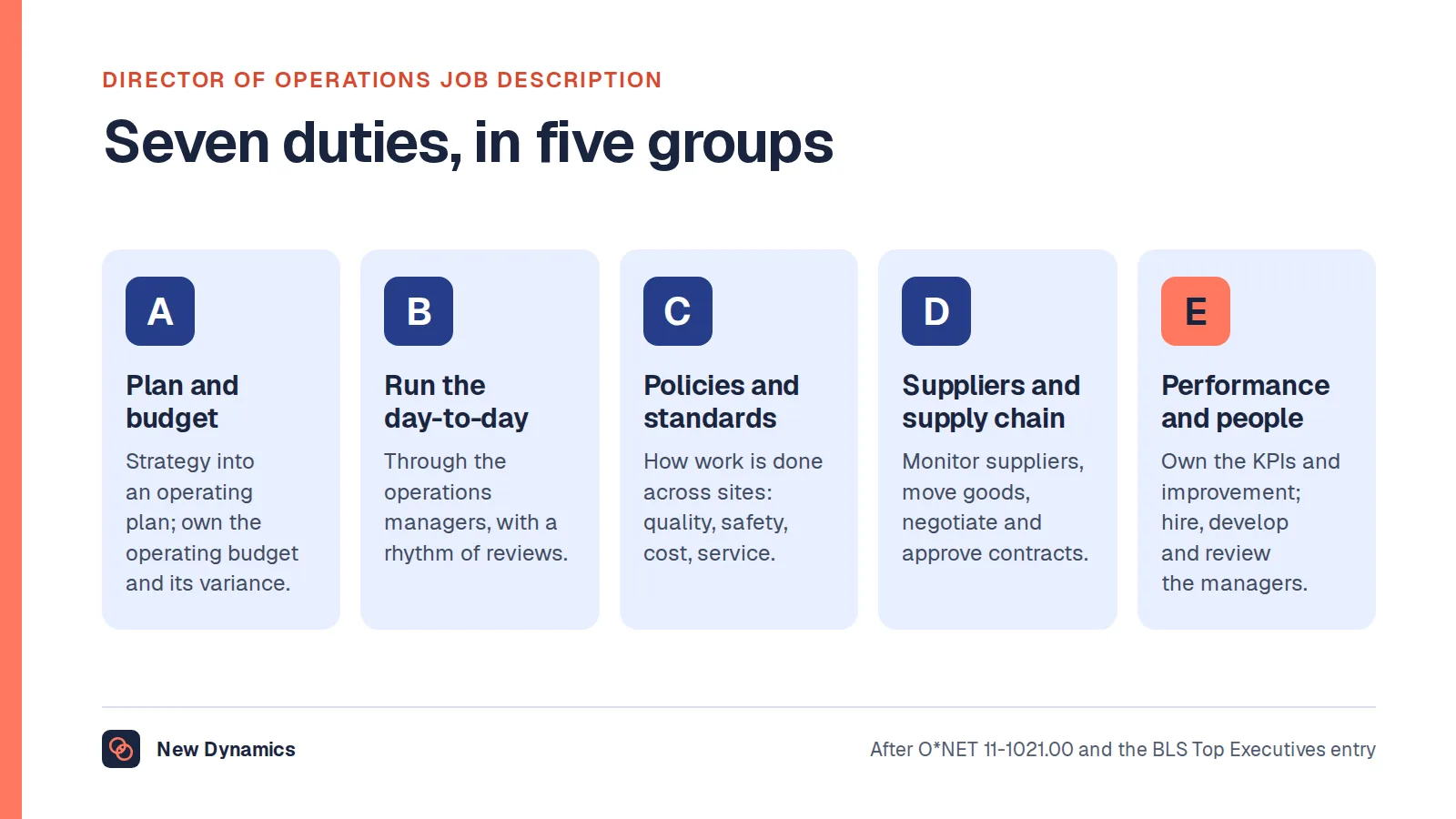
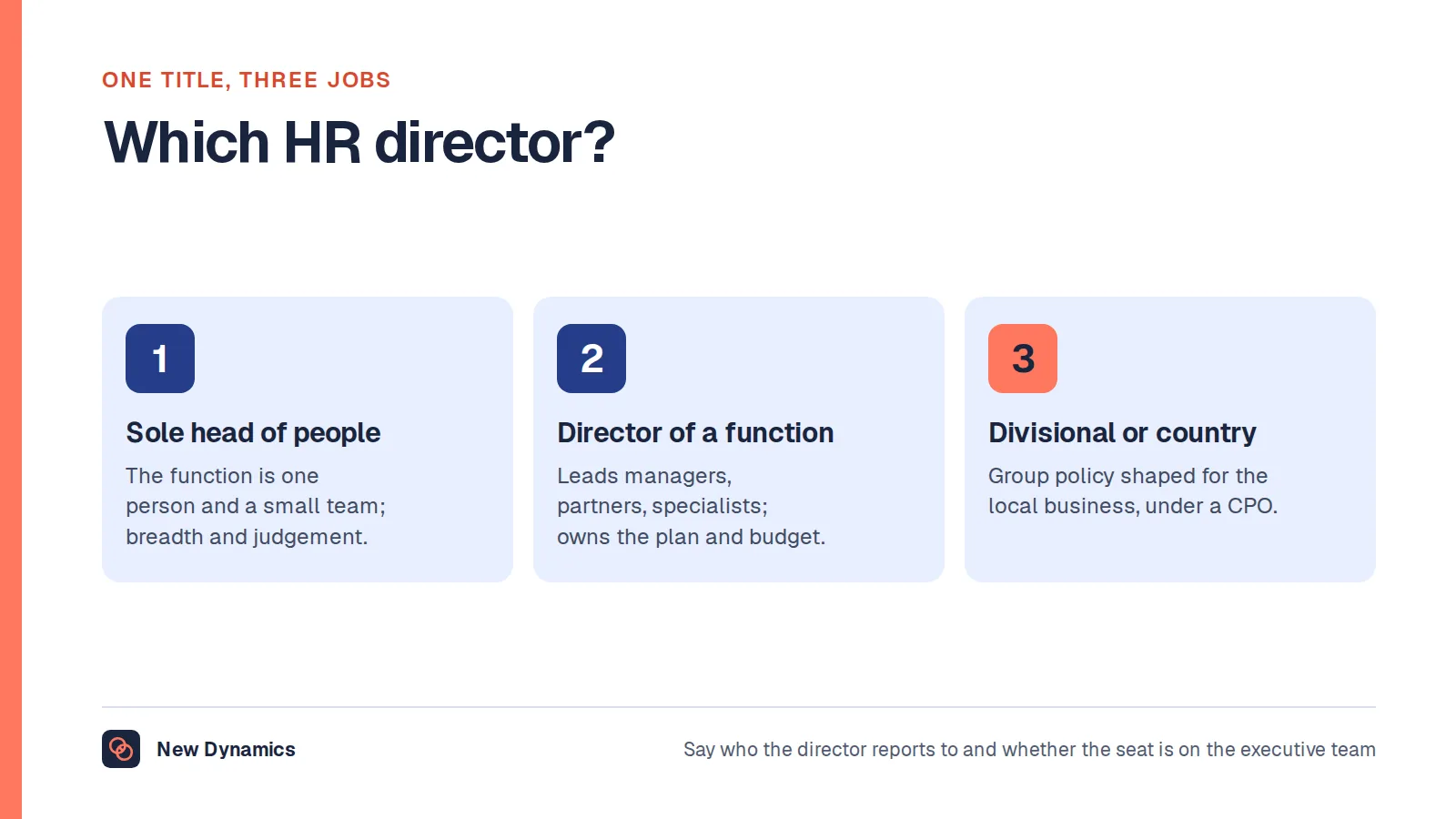
Our posts on the operations director and the HR director show what this looks like inside one function.
Executive, non-executive, and other varieties
- Executive director. On the board and employed in a management role. Carries both sets of accountabilities.
- Non-executive director. On the board, not employed to manage. Same general duties, different job: scrutiny, challenge and governance.
- Designated or nominated positions required by a regulator or a licence (a designated premises supervisor, a transport manager, a nominated individual) which are separate appointments again and should never be assumed to come with the title.
- "Director" as a client-facing title in agencies and professional services, where it may mean neither an office nor a management level. If that is the case, say so internally even if the business card does not.
Levelling the title
Because "director" means different things in different organisations, comparing pay by title alone is meaningless. Level it on what the role actually carries:
- the scope of the function and its budget;
- the decisions taken without approval;
- how many managers report in, and how many people in total;
- whether the role carries a statutory or regulatory appointment;
- the consequence of getting it wrong.
That is what a structured job evaluation does, and our job evaluation guide sets out how to compare roles on factors rather than titles.
A director job description template

Job title: Director of [function]
Reports to: [chief executive / managing director]
Statutory position: [This role does / does not carry appointment as a director of the company registered at Companies House.] [If it does: the appointment carries the general duties under the Companies Act 2006 and the responsibilities set out by GOV.UK; independent advice is available before acceptance.]
Scope: [budget], [headcount and managers reporting in], [sites or regions], [what the function delivers]
Purpose: [one sentence on what the function exists to achieve]
Responsibilities
- Set and deliver the plan for the function, aligned to the organisation's strategy.
- Own the function's budget and report on it.
- Lead the function through its managers, and own recruitment, development and succession.
- Define the measures for the function and report performance to the executive [and the board].
- Set and maintain the function's policies and standards.
- Work with other directors on anything that crosses functional boundaries.
- Represent the function internally and externally.
Decision rights: [what this role decides alone; what needs the executive; what needs the board.]
Governance: [committees attended, board papers owned, regulatory returns.]
Frequently asked questions
What does a director of a company do?
If the question is about the statutory office, a company director runs the company within its constitution and owes it seven general duties under the Companies Act 2006, from acting within powers to declaring interests in transactions. GOV.UK adds practical responsibilities: following the articles of association, keeping records, preparing and filing accounts and the Company Tax Return, telling shareholders about personal benefits, and paying Corporation Tax.
What is the difference between a company director and a job-title director?
A company director holds an office: they are appointed, registered at Companies House and personally subject to statutory duties. A job-title director holds a senior management level with a function and a budget, and has no special legal position from the title alone. Many people are both, and the job description should say so.
What are the seven duties of a director?
To act within powers; to promote the success of the company for the benefit of its members as a whole; to exercise independent judgment; to exercise reasonable care, skill and diligence; to avoid conflicts of interest; not to accept benefits from third parties; and to declare an interest in a proposed transaction or arrangement. They are set out in the Companies Act 2006 and owed to the company. This is general information, not legal advice.
Can a director delegate their responsibilities?
Day-to-day work, yes. Accountability, no. GOV.UK is explicit that you can hire other people, such as an accountant, to manage some things day to day, "but you're still legally responsible for your company's records, accounts and performance", and that failing to meet those responsibilities can lead to being fined, prosecuted or disqualified.
What should a director job description include?
Whether the role carries a statutory directorship; the function, budget, headcount and geography; what the person decides alone and what needs the executive or the board; the measures the function is judged on; the governance the role carries; and the usual responsibilities of leading a function through its managers.
Do duties end when someone stops being a director?
Not entirely. Under section 170 of the Companies Act 2006, a former director remains subject to the duty to avoid conflicts of interest as regards property, information or opportunities they became aware of while a director, and to the duty not to accept benefits from third parties as regards things done before they left.
Your next step: say which kind of director it is
- Put one line at the top of the description stating whether the role carries a statutory appointment.
- If it does, give the person the Companies Act duties and the GOV.UK list before they accept.
- Write the scope in numbers: budget, headcount, managers, sites.
- Level the role on those factors rather than on the word "director".
For comparing roles on what they actually carry rather than what they are called, read and download our job evaluation guide. The guide is free to read, and the PDF uses our short download form.
Want levels, reporting lines and objectives visible in one place, so a title means the same thing across the organisation? Book a New Dynamics demo and bring your current structure chart. You can also email contact@new-dynamics.com.