TL;DR
- Technicians of every kind, maintenance, IT support, engineering and laboratory, share a core: diagnose faults, work to procedures, work safely, keep records and deal with the people whose kit has stopped. The National Careers Service lists attention to detail, problem solving and working well with others for all four.
- The best interview questions for a technician ask for past examples of that core and probe them: what the symptom was, how they narrowed it down, what they checked first, when they stopped and escalated, and what they wrote down afterwards.
- Pair the questions with a short practical task on real kit or a real ticket, ask every candidate the same questions, and score against a guide written before the interviews. This is general guidance, not legal advice.
Technicians are hired for what they can do with their hands and their heads when something has stopped working. An interview cannot watch them do it, but it can ask, in detail, how they did it last time. The right interview questions for a technician are less about knowledge, which a certificate or a test can check, and more about method: how they find a fault, when they stop, what they write down and how they treat the person waiting.
This article gives 30 interview questions for a technician in six areas, with what a good answer shows, notes for maintenance, IT, engineering and laboratory roles, a practical test to add, and how to run the interview fairly. It is general guidance, not legal advice.
A technician's first weeks are spent learning the site's kit and quirks. See how New Dynamics onboarding brings tasks, early goals and manager conversations into a clear path for a new starter.
What all technician roles share
The National Careers Service profiles for technicians differ in the kit and agree on the method. The IT support technician needs analytical thinking, customer service, thoroughness and attention to detail, working well with others, judgement and decision-making. The laboratory technician needs thoroughness, analytical thinking, initiative and teamwork, and follows safety rules. The mechanical engineering technician needs the ability to use, repair and maintain machines and tools, attention to detail, teamwork and verbal communication, and must meet performance and safety targets.
So the interview has six areas to cover, whatever the technician fixes.
- Fault-finding. How they diagnose.
- Safety. How they work without hurting themselves or others.
- Procedures and quality. How they follow the method and check the result.
- Records and communication. What they write down and tell whom.
- Customers and colleagues. How they treat the person whose kit has stopped.
- Learning and judgement. How they keep up, and when they stop and ask.

Fault-finding questions
- Tell me about the last fault that took you longer than expected to find. How did you narrow it down? Good answers describe a method: symptoms, what was ruled out and why, what was checked first. Weak answers jump to the fix.
- Describe a fault you diagnosed correctly that others had missed. Look for observation and reasoning, not luck.
- Walk me through how you would approach a machine, system or test that has stopped with no error message. A structured approach from the obvious to the obscure.
- When a fault is intermittent, what do you do differently? Logging, reproducing, monitoring over time, asking users.
- Tell me about a time you fixed the symptom and the fault came back. What did you learn? Honesty and root-cause thinking.
Safety questions
- What did you check before starting the most hazardous job you did last month? Isolation, permits, PPE, risk assessment, in their own words.
- Tell me about a time you stopped a job because it was not safe. What happened next? Willingness to stop under pressure.
- Describe how you isolate equipment before working on it. Concrete and correct for their trade.
- Have you ever seen a colleague working unsafely? What did you do? Speaking up.
- What safety training or certificates do you hold, and which are current? Ask for dates; verify later.
Procedures and quality questions
- Tell me about a time you followed a procedure you thought was wrong. What did you do? Follows it and raises it, rather than ignoring it.
- How do you check your own work before you hand equipment back? Test, road-test, verify, sign off.
- Describe a job where the drawing, manual or standard operating procedure did not match what you found. Stopping, checking, escalating.
- How do you prioritise when three jobs land at once? Safety first, then impact, then the plan.
- Tell me about a repair or test you had to redo. Why, and what changed? Learning from error.
Records and communication questions
- What do you record after a job, and who reads it? Job cards, tickets, service records, calibration logs.
- Show me, in words, how you would write up the last fault you fixed. Clear, short, useful to the next person.
- Tell me about a time your notes helped someone else, or a time missing notes hurt. Values records.
- How do you hand over a half-finished job at the end of a shift? Status, risks, next steps, in writing.
- How do you tell a manager that a repair will take longer, or cost more, than expected? Early and plainly.
Customer and colleague questions
- Tell me about a user or customer who was angry that their kit had failed. What did you do? Calm, informative, focused on the fix.
- How do you explain a technical problem to someone who does not understand the technology? Plain words, no condescension.
- Describe a time you had to work with a contractor or another team to close a job. Coordination and courtesy.
- How do you decide whether to fix something now or book it for later? Impact, safety, resources.
- What do you do while waiting for a part? Initiative: other jobs, records, preparation.
Learning and judgement questions
- What have you learned to fix or test in the last year that you could not before? Curiosity and growth.
- Tell me about a job you should not have attempted. What did you do? Knows the limits of competence.
- Which fault would you call a specialist for, and why? Judgement about scope: electricians, gas engineers, vendors, senior engineers.
- How do you keep up with new equipment, software or methods? Specific habits, not "I read".
- What is the best piece of kit you have worked on, and what made it good? Reveals what they notice and value.

Notes by kind of technician
| Role | Add questions on | Practical test |
|---|---|---|
| Maintenance technician | Planned maintenance, breakdowns, isolation and permits, contractors | Diagnose a seeded fault on a rig or a real asset |
| IT support technician | Ticket triage, user accounts and security, knowledge base updates, remote support | Work a realistic ticket and write it up |
| Engineering technician | Drawings and CAD, testing to specification, tolerances, performance targets | Interpret a drawing and plan a test |
| Laboratory technician | Sample preparation, calibration, contamination, data recording and presentation | Prepare a solution or calibrate an instrument, with notes |
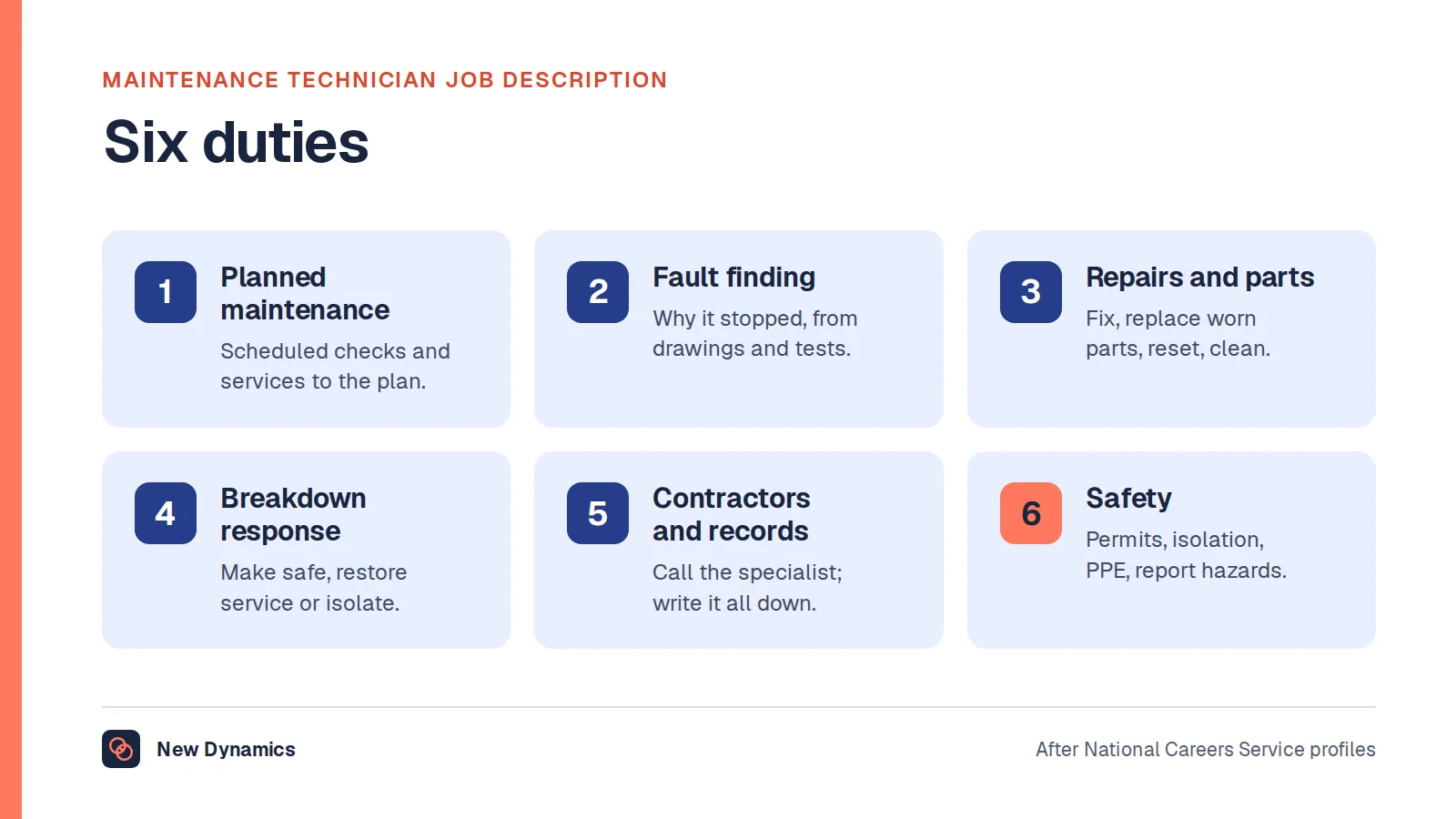
Our maintenance technician job description and mechanic job description give the duties to draw questions from.
Add a practical test
For technicians, a short work sample predicts better than any question. Give every candidate the same task on the same kit: a fault to find, a ticket to work, a drawing to read, a calibration to do. Watch the method as much as the result: do they check before touching, do they isolate, do they explain what they are doing, do they write it up? Keep it to under an hour, tell candidates in advance, and score it against the same guide. Acas notes that a work trial should be for a reasonable amount of time and should not usually last longer than a day; a one-hour task is well inside that.
Running the interview fairly
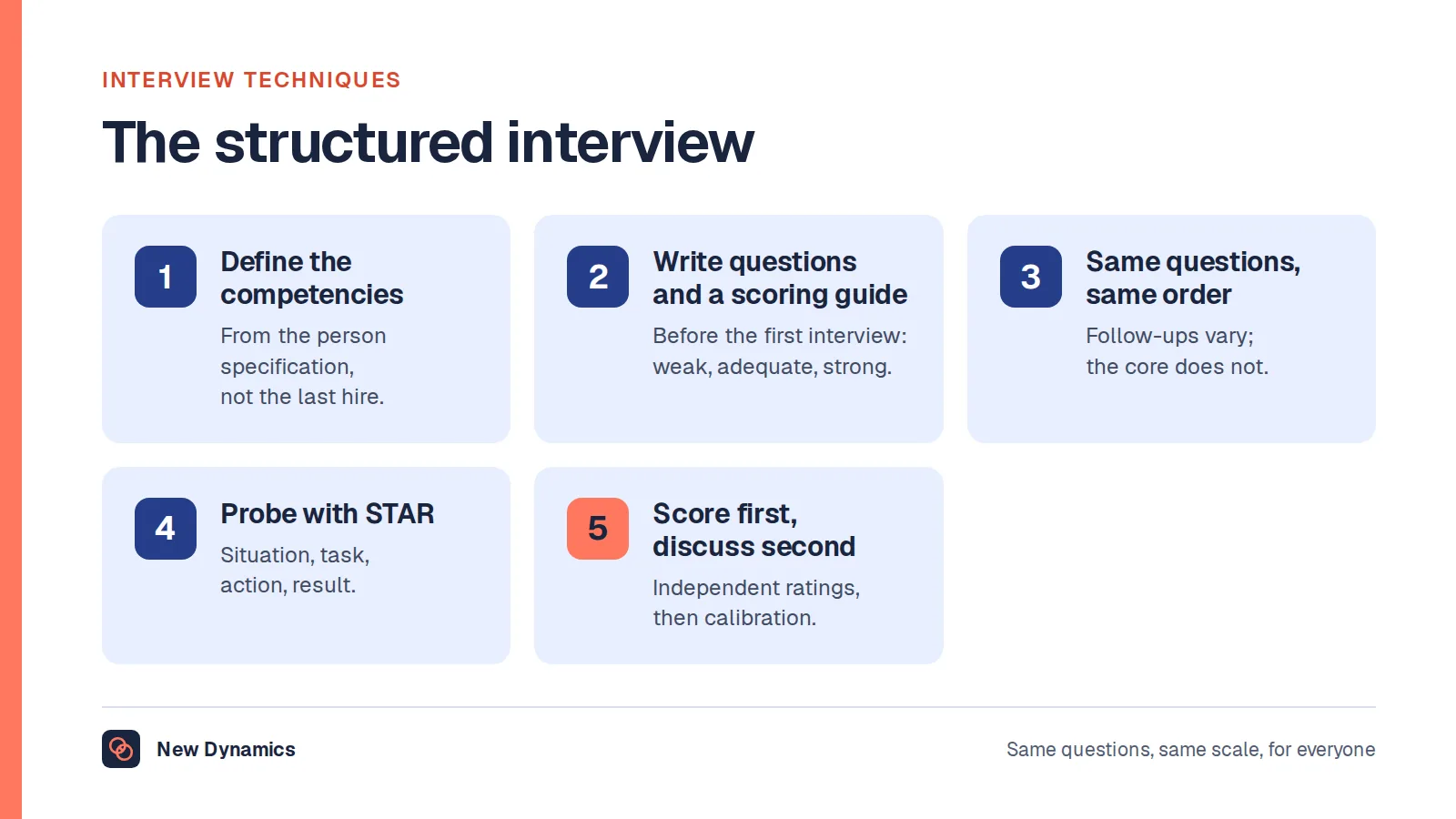
Ask each candidate the same core questions, in the same order, and score each area against a guide written beforehand. The US Office of Personnel Management describes this as the structured interview, in which “All candidates are asked the same predetermined questions in the same order” and “All responses are evaluated using the same rating scale and standards for acceptable answers”. Acas advises interviewing with more than one person where possible and asking every applicant whether they need reasonable adjustments to attend. Our guide to interview techniques explains STAR probing and scoring in full.
Probe every answer for the specifics: which machine, which symptom, which check, what result. A technician who can describe a fault in detail found it; one who cannot may be describing someone else's.

Frequently asked questions
What are good interview questions for a technician?
Questions that ask for past examples of the technician's method: how they found a specific fault, what they checked before a hazardous job, how they verified a repair, what they recorded, how they handled an angry user and when they called a specialist. The 30 questions above cover six areas: fault-finding, safety, procedures, records, people and judgement.
How do you interview a maintenance technician?
Ask for examples of planned and reactive work, isolation and permits, breakdowns and contractors, then give a short practical task on a real asset or a rig with a seeded fault. Score the method as well as the result, and ask everyone the same questions.
What should I ask an IT technician in an interview?
Ask how they triaged a difficult ticket, how they explain problems to non-technical users, how they manage accounts and security, what they record and how they keep the knowledge base current. A realistic ticket to work and write up makes a good practical test.
Should a technician interview include a practical test?
Yes, where possible. A short work sample on the same kit for every candidate is the most predictive part of the process. Keep it under an hour, tell candidates in advance, and score it against a guide.
What skills should a technician interview assess?
The National Careers Service lists attention to detail, analytical thinking, problem solving, working well with others and communication across technician roles, with practical skill on machines, tools or instruments for the hands-on ones. Add safety awareness, record-keeping and knowing the limits of competence.
How do you score technician interview answers?
Write a guide before the interviews describing weak, adequate and strong answers for each of the six areas, score every candidate independently on every area, then discuss. Evidence of specific faults found, checks made and records kept scores; general claims do not.
Your next step: pick six and add a task
- Choose one question from each of the six areas above.
- Write what a strong answer looks like for your kit and your site.
- Design a one-hour practical task every candidate will do.
- Score independently, discuss, and keep the notes.
For the whole process from advert to offer, read and download our recruitment and selection guide. The guide is free to read, and the PDF uses our short download form.
Want the standards you interview for to become the goals you review against? Book a New Dynamics demo and bring your current interview questions. You can also email contact@new-dynamics.com.