TL;DR
- Communication training works when it builds specific, practised behaviours: giving feedback, running a one-to-one, handling a complaint, writing something people act on. It does not fix structures that make communication pointless.
- HSE's Management Standards set the surrounding conditions. The Relationships standard expects that “the organisation promotes positive behaviours at work to avoid conflict and ensure fairness” and that “employees share information relevant to their work”, with systems “to enable and encourage managers to deal with unacceptable behaviour”.
- The conversation most workshops should rehearse is the informal one. Acas says that “many problems at work can be resolved informally, for example through an informal chat”, and that solving a problem “should be a two-way process”.
Every engagement survey has a communication problem in it somewhere, and the usual response is a workshop. Sometimes that is exactly right. Often the workshop is being asked to solve something no workshop can reach.
This article covers communication skills workshops: what training genuinely builds, what it cannot fix, how to run one that changes behaviour, and how to tell afterwards whether it did.
Most workplace communication is a stream of small conversations nobody records. See how New Dynamics feedback keeps that stream in one place instead of in people's memories.
What training cannot fix
Three problems arrive labelled as communication and are not:
- Structure. Two teams rewarded for different things will communicate badly however politely they phrase it.
- Information that does not exist. People cannot cascade a decision nobody has made.
- Distrust. Where previous messages turned out to be untrue, better technique reads as better manipulation.
HSE's Management Standards make the organisational half explicit. The Relationships standard expects that "the organisation promotes positive behaviours at work to avoid conflict and ensure fairness", that "employees share information relevant to their work", that there are "agreed policies and procedures to prevent or resolve unacceptable behaviour", and that "systems are in place to enable and encourage managers to deal with unacceptable behaviour". Those are arrangements, not skills.
The four skills a workshop can build

- Giving feedback. Specific, timely, about behaviour and its effect. HSE's Support standard expects that "employees receive regular and constructive feedback", and most managers have never been taught how.
- Running a one-to-one. Asking a question and then not filling the silence; separating an update from a conversation; ending with something agreed.
- The difficult conversation. Raising a problem early, hearing a complaint without defending, disagreeing without winning.
- Writing that gets acted on. The decision first, the reason second, the detail last; one message with one purpose.
Everything else people put on communication courses (presenting, influencing, storytelling, listening) is a variation of these four applied to a different audience.
The conversation to rehearse
The highest-value scenario in most workplaces is not a presentation. It is a colleague saying "can I have a word" about something that is bothering them.
Acas's guidance on dealing with a problem raised by a worker sets out the shape. "Many problems at work can be resolved informally, for example through an informal chat", and a worker "could raise a problem informally by telling their line manager or someone else at work"; at that stage "it does not have to be in writing". If someone raises a problem informally, "you should still take it seriously", partly because "if you do not, the problem might be raised as a formal grievance later".
Acas describes the good-practice version: set up "an informal chat or meeting to discuss their concerns", agree to any request to bring "someone they work with, a trade union representative or other relevant person", treat solving the problem as "a two-way process" in which you let the worker "explain the problem and any solution – for example, asking them what they would like done about it" and they listen to your side, and "keep a record of how you dealt with the problem".
Rehearsing that sequence, out loud, is worth more than a day of models. This is general information rather than legal advice, and formal grievance procedures are a separate matter.
What a good workshop looks like

- Under twelve people, because everyone has to speak.
- Real scenarios from this organisation, anonymised: the actual conversations people are avoiding.
- Practice, with an observer. Say the sentence, get one specific piece of feedback, say it again. The second attempt is where learning happens.
- One commitment each, with a date: a conversation to have this week.
Three things to cut: personality instruments used as an excuse ("I'm just very direct"), theory that nobody will recall by Thursday, and role-play with invented characters from a manual.
Running one in-house
A two-hour structure that works, and costs nothing:
- Ten minutes. What happened last time communication went badly here, in pairs.
- Twenty minutes. The four skills, briefly, with an example of each done well and badly.
- Fifty minutes. Three rounds of practice on real scenarios, rotating speaker, listener and observer.
- Twenty minutes. What we will change as a team: the meeting that is not working, the update nobody reads, the decision nobody announced.
- Twenty minutes. Individual commitments, written down, with a follow-up date.
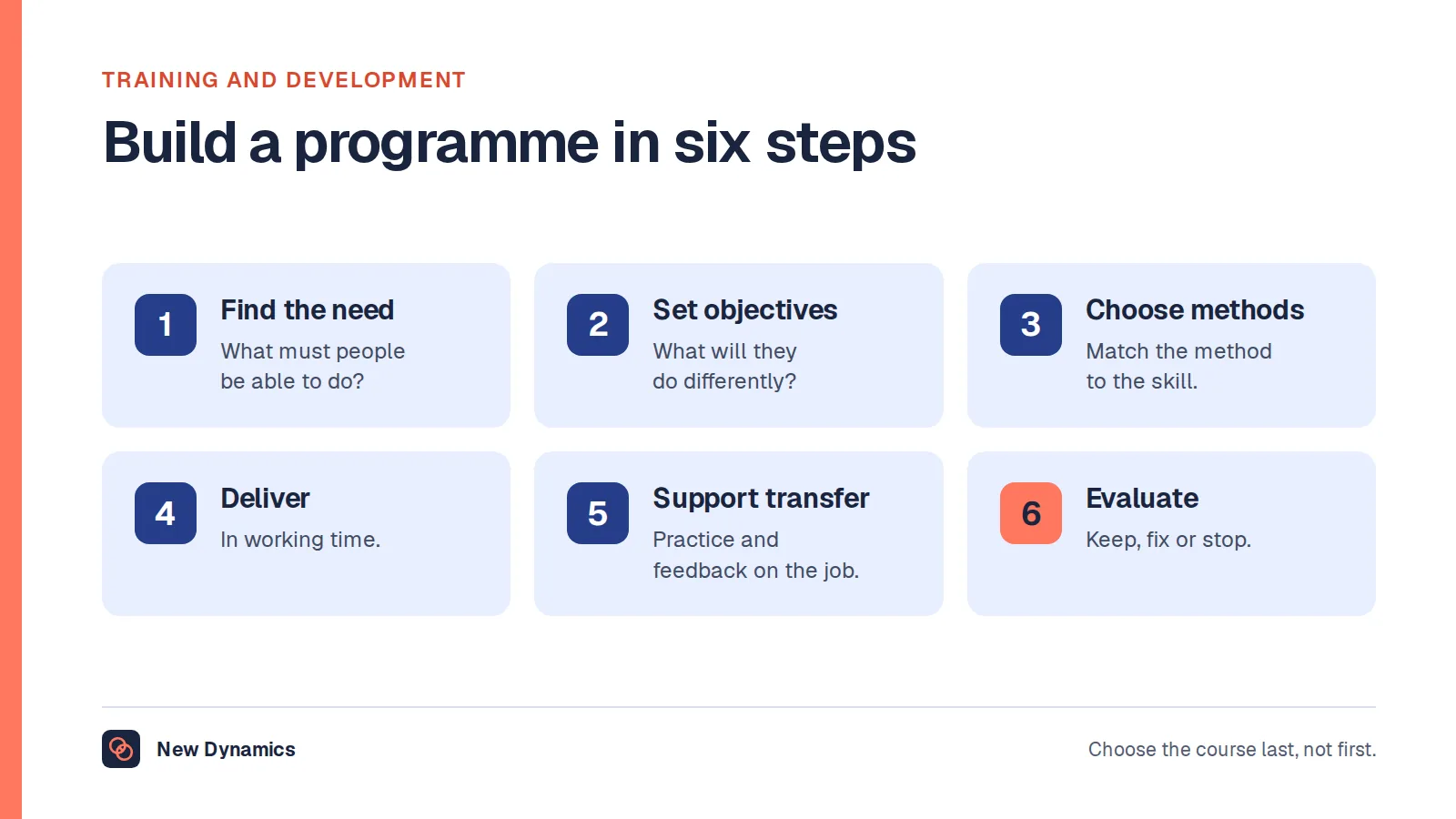
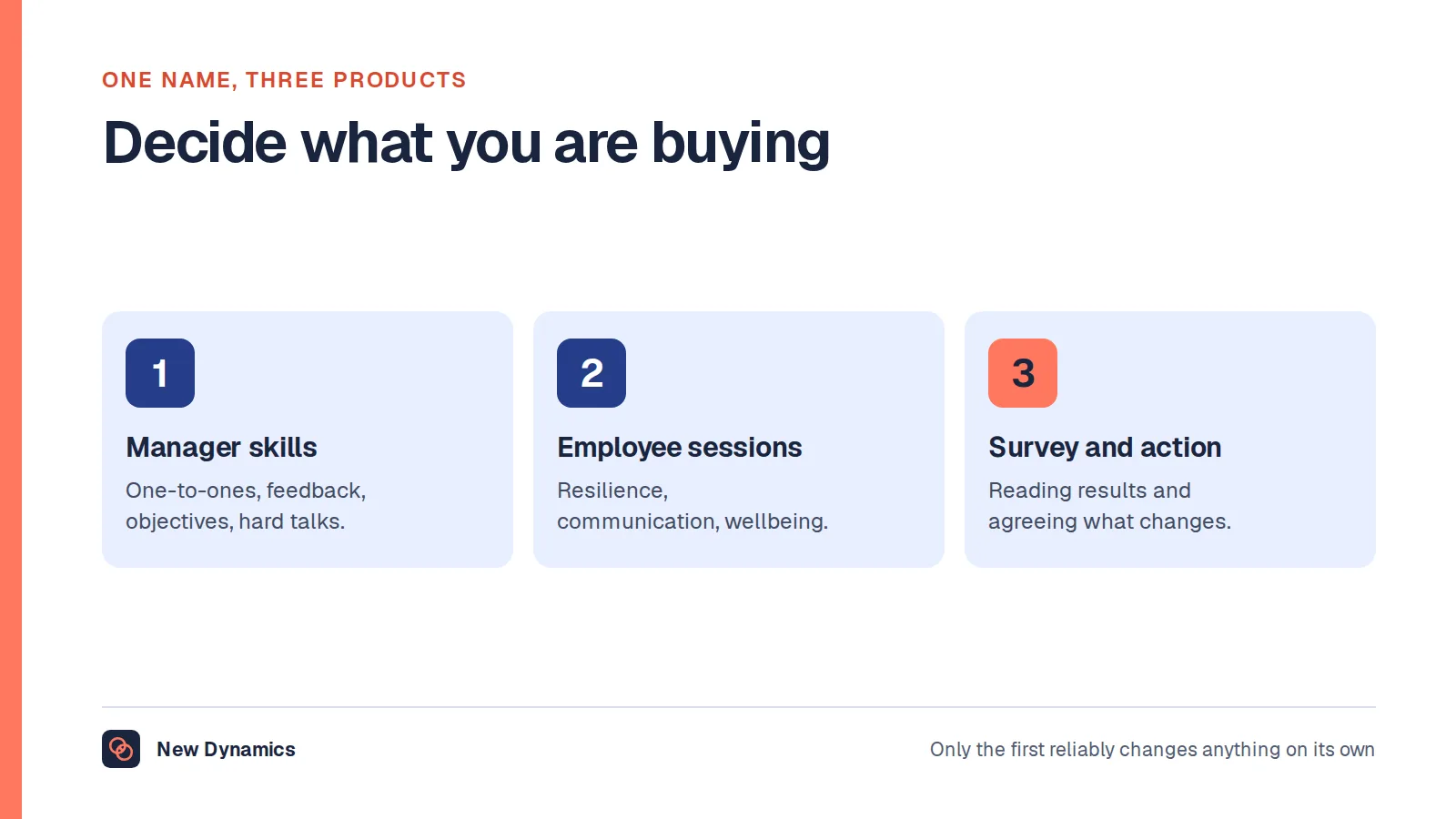
Book the follow-up before anyone leaves the room. Our employee engagement training post covers the sequencing question (measure and diagnose before buying training) and applies here too.
Measuring whether it worked

- Did the conversations happen? Count the commitments made and kept, not satisfaction with the session.
- Are one-to-ones happening, at the agreed frequency, with something recorded?
- Do specific survey items move (on feedback, on knowing what is expected, on being listened to) rather than the overall score?
- Are problems arriving earlier? More small issues raised informally is a good sign, not a bad one.
- Is anything written shorter, and are people acting on it without a follow-up email?
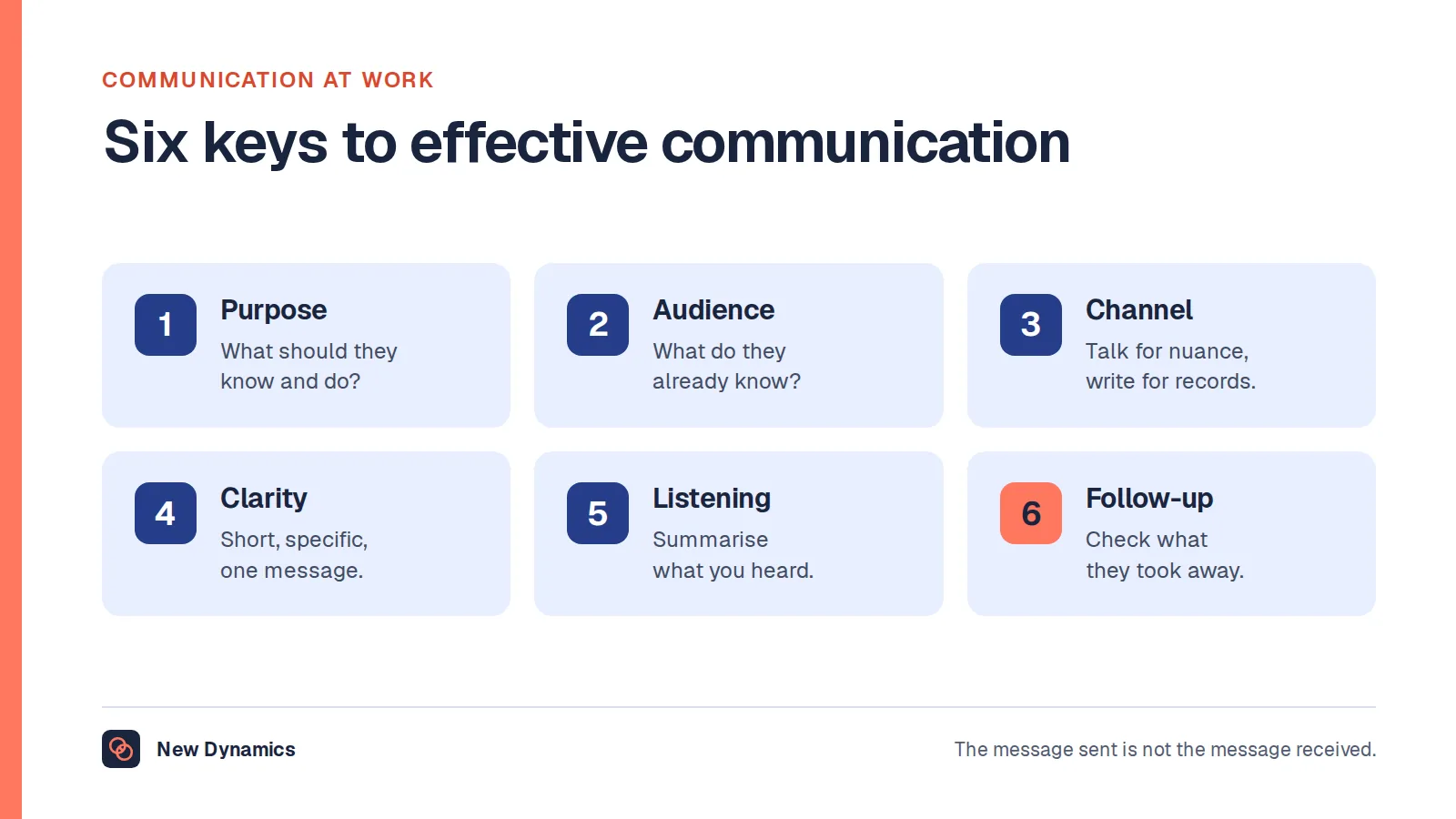
Our employee feedback guide covers the feedback half in more depth, and our post on the keys to effective communication covers the principles a workshop puts into practice.
Frequently asked questions
What do communication skills workshops cover?
The useful ones cover four things: giving specific feedback, running a one-to-one, handling a difficult conversation such as a complaint or a disagreement, and writing messages people act on. Presenting and influencing are variations of the same skills for a different audience.
Do communication workshops actually work?
They work when they teach a specific behaviour, give people repeated practice on real scenarios, and end with a commitment and a follow-up date. They do not fix structural problems: teams pulling in different directions, decisions that have not been made, or a history of messages that turned out to be untrue.
How long should a communication workshop be?
Two hours with fewer than twelve people beats a full day with forty. Most of the time should be practice rather than presentation, and the follow-up session matters as much as the workshop.
What should a manager practise most?
Raising a problem early and hearing one without defending. Acas describes resolving a problem informally as a two-way process in which the worker explains the problem and what they would like done, and the manager listens as well as responding. That exchange is the one most managers avoid.
How do you measure communication training?
By behaviour: whether committed conversations happened, whether one-to-ones are taking place and being recorded, whether specific survey items on feedback and being heard move, and whether problems are arriving earlier and smaller. End-of-course satisfaction measures the session.
Should communication training be for everyone or just managers?
Start with managers, because their habits set the pattern for their teams. Whole-team sessions work well when they address a real, named problem the team is having rather than general skills.
Your next step: pick the conversation nobody is having
- Name the specific communication problem, and check whether it is structural.
- Choose one of the four skills to work on.
- Run a short session with real scenarios and repeated practice.
- Book the follow-up before the session, and measure the conversations rather than the satisfaction.
For the feedback half in depth, read and download our employee feedback guide. The guide is free to read, and the PDF uses our short download form.
Want one-to-ones and feedback recorded where both people can see them? Book a New Dynamics demo and bring your current one-to-one template. You can also email contact@new-dynamics.com.