TL;DR
- Communication succeeds when the other person understands what you meant and knows what to do next. What you said, and how well you said it, matters only as far as it achieves that.
- Six keys prevent most problems: know your purpose, know your audience, choose the right channel, be clear and brief, listen, and check understanding and follow up.
- Culture decides whether people use those skills. Where leaders share information early, welcome bad news and explain their decisions, communication flows. Where they do not, no amount of training helps.
Most workplace problems that get blamed on attitude, competence or “politics” turn out, on inspection, to have started with a message that one person sent and another did not receive. A deadline was assumed. A priority changed in a meeting that half the team missed. “ASAP” meant today to one person and this month to the other.
This article sets out six keys to effective communication at work, with examples. It also covers the barriers that distort messages, how company culture shapes communication and what managers can do about both.
Good communication depends on regular, two-way conversation. See how New Dynamics continuous feedback makes that part of everyday work.
What effective communication means
The open textbook Principles of Management, published by OpenStax, describes a simple model in its section on the process of managerial communication. A communicator encodes an idea into words. A receiver decodes those words into meaning. In its words:
“Decoding is the process by which the recipient of the message interprets it. The receiver attaches meaning to the message and tries to uncover its underlying intent.”
Both steps are shaped by each person's experience and state of mind. OpenStax notes that decoding is “influenced by the receiver's previous experiences and frame of reference”. That is why the same sentence lands differently with different people.
Two more ideas complete the model.
- Feedback is the receiver's response, which OpenStax describes as “the last step in completing a communication episode”. It may be a reply, a nod, a question “or no response at all”.
- Noise is anything that distorts the message. OpenStax gives the example of a manager under pressure who says, “I want this job completed today, and I don't care what it costs,” when the manager does care what it costs.
The practical lesson is that communication is measured at the receiving end. If they did not understand, you have not communicated, however clear you felt.
The six keys to effective communication
1. Know your purpose
Before you write or speak, finish this sentence: “After this, I want them to know… and to do…” If you cannot, you are not ready.
- Unclear: “Just flagging the supplier situation.”
- Clear: “The supplier will deliver two weeks late. I need your decision by Thursday on whether to pay for express freight.”
Put the point first. Busy people often read the first two lines and then decide whether to continue.
2. Know your audience
What does this person already know? What do they care about? What will they do with the information? A finance director, a new starter and a customer need three different versions of the same news.
Avoid jargon and abbreviations that the reader may not share. Remember that people decode through their own worries: an unexplained meeting invitation from a senior manager will be read as bad news.
3. Choose the right channel
OpenStax observes that talking is the predominant channel of managerial communication, while reading and writing are increasing as email and texting grow. Each channel suits different jobs.
| Message | Better channel | Why |
|---|---|---|
| Simple facts, records, decisions | Email or a shared document | It can be found again |
| Quick questions | Chat | Fast and informal |
| Anything complex or open to discussion | Meeting or call | Questions can be asked at once |
| Sensitive, personal or bad news | Face to face or video | Tone and care are visible |
| Praise | Both, where welcome | Spoken for warmth, written to keep |
| Anything agreed verbally | A short written follow-up | Memories differ |
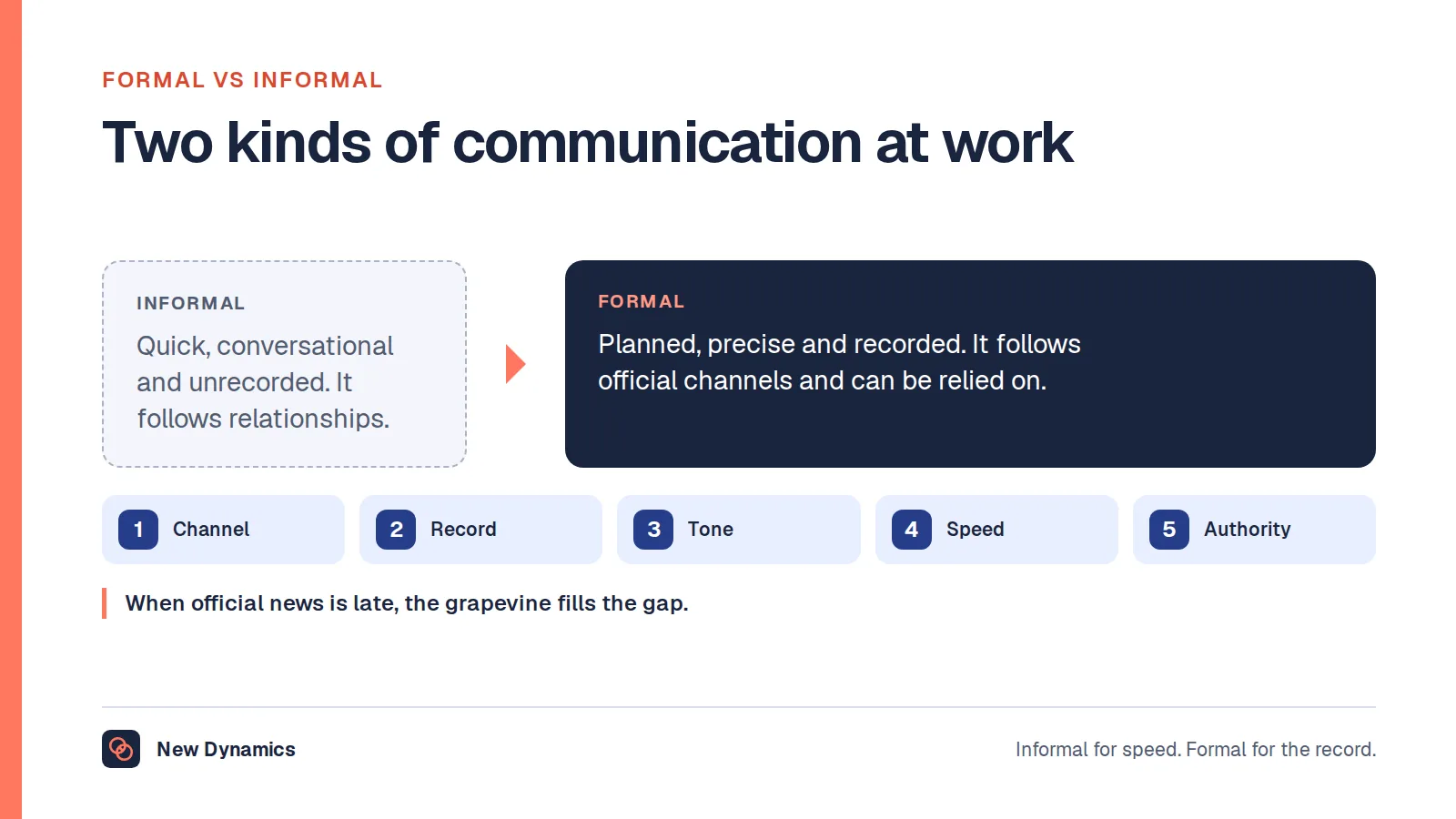
Never deliver criticism or bad news by chat message. Never rely on a corridor conversation for something that must be remembered. Our guide to formal vs informal communication goes further.
4. Be clear and brief
- Use short sentences and everyday words.
- Give one message per communication, where you can.
- Replace vague words with specifics: a date for “soon”, a name for “someone”, a number for “a few”.
- State the action, the owner and the deadline.
- Cut everything that does not help the reader to understand or to act.
Compare “We should probably tidy up the reporting at some point” with “Priya, please merge the two sales reports into one by 14 June.”
5. Listen
OpenStax reports research that North American adults “spend more than 78% of their communication time either talking or listening to others who are talking”. Listening is half of that, and the half that gets less practice.
- Give your full attention. Close the laptop, and put the phone away.
- Let people finish. Resist preparing your reply while they speak.
- Summarise what you heard: “So the main concern is the timeline, not the cost. Is that right?”
- Ask open questions, and tolerate a silence.
- Notice what is not said, and who has not spoken.
6. Check understanding, and follow up
This is the feedback step in the model, and the one most often skipped.
- Ask, “What are you taking away from this?” It works better than “Does that make sense?”, to which almost everyone says yes.
- End meetings by reading back the decisions, the owners and the dates.
- Send a two-line written summary of anything important that was agreed aloud.
- Check later whether the action happened. If it did not, ask what got in the way.

Five barriers that distort the message
- Assumptions. “Everyone knows that” is rarely true of new starters, other departments or people who missed the meeting.
- Overload. When people receive a flood of messages every day, yours competes with all of them. Send fewer, and make them better.
- Status and fear. People filter what they tell those above them. Bad news travels slowly upwards unless leaders make it safe.
- Emotion. Stress and anger distort both the sending and the receiving. Wait before you reply to a message that has annoyed you.
- Distance. Remote work removes tone, expression and chance encounters. Acas notes in its guidance on managing employees who work from home that it is a good idea to agree “how and when to communicate with each other”. It also warns that “using too many different methods to communicate can also be confusing and stressful”.
Language and culture add a sixth in many teams. Idioms, humour and indirect phrasing often fail to travel. Plain words are a courtesy to everyone.

How company culture shapes communication
Skills matter, and culture decides whether people use them. A brilliant communicator in an organisation that punishes honesty soon learns to say little.
Signs of a culture in which communication works:
- leaders share information early, including what they do not yet know;
- decisions come with reasons;
- bad news is thanked, not punished;
- people at every level are asked for their views, and can see what happened as a result;
- meetings include real disagreement;
- what leaders say matches what they do.
Communication matters most during change. The UK Health and Safety Executive's Change standard for managing work-related stress says that the organisation should provide employees “with timely information to enable them to understand the reasons for proposed changes”. It adds that employees should be aware of the probable impact of changes on their jobs, and of timetables for change.
For more on the cultures in which people stop speaking up, see our guides to hierarchy culture and the open door policy.
What managers can do
- Agree how the team communicates. Which tool is for what, expected response times, core hours and what counts as urgent. Write it down.
- Hold regular one-to-ones, and spend most of the time listening. Our one-to-one meeting questions include prompts.
- Explain the why. People carry out decisions better when they understand them.
- Say the difficult thing, directly, privately and soon. See our negative feedback examples.
- Share news with everyone at the same time, including remote and part-time colleagues.
- Ask for feedback on your own communication: “What could I have made clearer this month?”
- Go and see. Leaders who spend time where the work happens hear what reports leave out. See management by wandering around.
Common mistakes
Burying the point. Three paragraphs of background before the request.
Reply-all and copying everyone. It spreads noise and hides responsibility.
Assuming that sent means received. An email nobody read communicated nothing.
Using chat for everything. Decisions made in a fast-moving thread are lost within a week.
Avoiding the conversation. A hint dropped in an email is no substitute for a talk.
Meetings without outcomes. If nobody recorded who does what by when, expect to hold the meeting again.
Confusing volume with clarity. More updates do not mean better informed people.

Frequently asked questions
What are the keys to effective communication?
Six keys prevent most problems at work: know your purpose, know your audience, choose the right channel, be clear and brief, listen, and check understanding and follow up. Communication is judged by what the other person understood.
What is the most important key to communication?
Listening and checking understanding matter most, because communication is measured at the receiving end. If you ask what the other person has taken away, you find out at once whether your message arrived as you intended.
What are the main barriers to communication at work?
Common barriers are untested assumptions, message overload, status and fear of speaking up, strong emotion, and distance in remote and hybrid teams. Differences of language and culture add another in many workplaces.
How does company culture affect communication?
Culture decides whether people use their skills. Where leaders share information early, explain decisions and welcome bad news, people speak openly. Where honesty is punished or ignored, people say little, whatever training they have had.
How can managers improve communication in a team?
Agree how the team communicates, hold regular one-to-ones and listen in them, explain the reasons for decisions, give difficult messages directly and soon, share news with everyone at once and ask for feedback on your own communication.
Which channel should I use for an important message?
Use a conversation, in person or by video, for anything complex, sensitive or open to discussion, and follow it with a short written summary. Use email or a shared document for facts, records and decisions that people will need to find again.
Your next step: test one message
- Take the next important email you are about to send.
- Check that the first two lines say what you want the reader to know and to do.
- Replace every vague word with a date, a name or a number.
- Afterwards, ask one recipient what they took from it.
For conversation prompts and an agenda that builds two-way communication, read and download our one-to-one meeting guide. The guide is free to read, and the PDF uses our short download form.
Want feedback, goals and check-ins to keep communication flowing across your teams? Book a New Dynamics demo and bring your current routines. You can also email contact@new-dynamics.com.