TL;DR
- A daycare teacher, also advertised as a childcare worker, daycare worker, nursery worker or early years practitioner, cares for children in a nursery or daycare setting and supports their development through play. O*NET lists daycare teacher, daycare worker, infant teacher and toddler teacher among the reported titles of childcare workers, whose tasks include maintaining a safe play environment, observing and monitoring children's play, supporting emotional and social development, keeping records on individual children and communicating with parents about the day.
- The duties fall into seven groups: safety and supervision, personal care, play and learning, emotional and social development, observation and records, parents and carers, and the room itself. The daycare teacher differs from the early years or preschool teacher, who holds a teaching qualification and leads the curriculum, and from the nanny, who works in a family's home; the National Careers Service gives the route as nursery worker to room leader, nursery manager or, with further training, early years teacher.
- Employers ask for a childcare qualification at level 2 or 3, or a willingness to train through an apprenticeship, enhanced background checks, patience, sensitivity and clear communication with parents. The advert should say which room and age group, which shifts, the qualification level the ratios require and the route to room leader. Plan the first month, because a new starter who is left to find their feet in a baby room rarely stays.
A daycare room at half past five is a good test of a job description. Twelve children, two adults, one parent early and one late, a nappy, a grazed knee, a painting that must not be folded and a daily record to finish. The daycare teacher job description has to describe that day honestly: the care, the play, the learning, the records and the parents, and the shifts on which it happens. Most adverts list the qualification and forget the day.
This article sets out the duties of a daycare teacher, or childcare worker, using two primary sources, the US O*NET occupational database and the UK National Careers Service, explains what the various titles mean, separates the role from the early years teacher and the nanny, lists the skills, qualifications and checks, and gives a job description template with a first-month plan.
The first weeks decide whether a new member of room staff stays, and the first week is the manager's to plan. See how New Dynamics onboarding gives a new starter clear tasks, a buddy and planned check-ins from day one.
For care arranged privately rather than in a setting, our babysitter job description covers the responsibilities and the one-page brief parents should write.
What is a daycare teacher?
A daycare teacher cares for a group of children in a nursery, daycare centre or preschool setting during the working day and supports their learning and development through play, routines and relationships. The title is American; the same job in Britain is the nursery worker, nursery practitioner, early years practitioner or, at level 3, early years educator. The work is the same: keep the children safe, meet their needs, help them grow and tell their parents about it.
O*NET lists “Daycare Teacher”, “Daycare Worker”, “Infant Teacher” and “Toddler Teacher” among the sample of reported job titles for childcare workers, alongside childcare provider and child caregiver. Its tasks include “maintain a safe play environment”, “observe and monitor children's play activities”, “communicate with children's parents or guardians about daily activities, behaviors, and related issues”, “support children's emotional and social development, encouraging understanding of others and positive self-concepts”, “keep records on individual children, including daily observations and information about activities, meals served, and medications administered”, and “create developmentally appropriate lesson plans”.
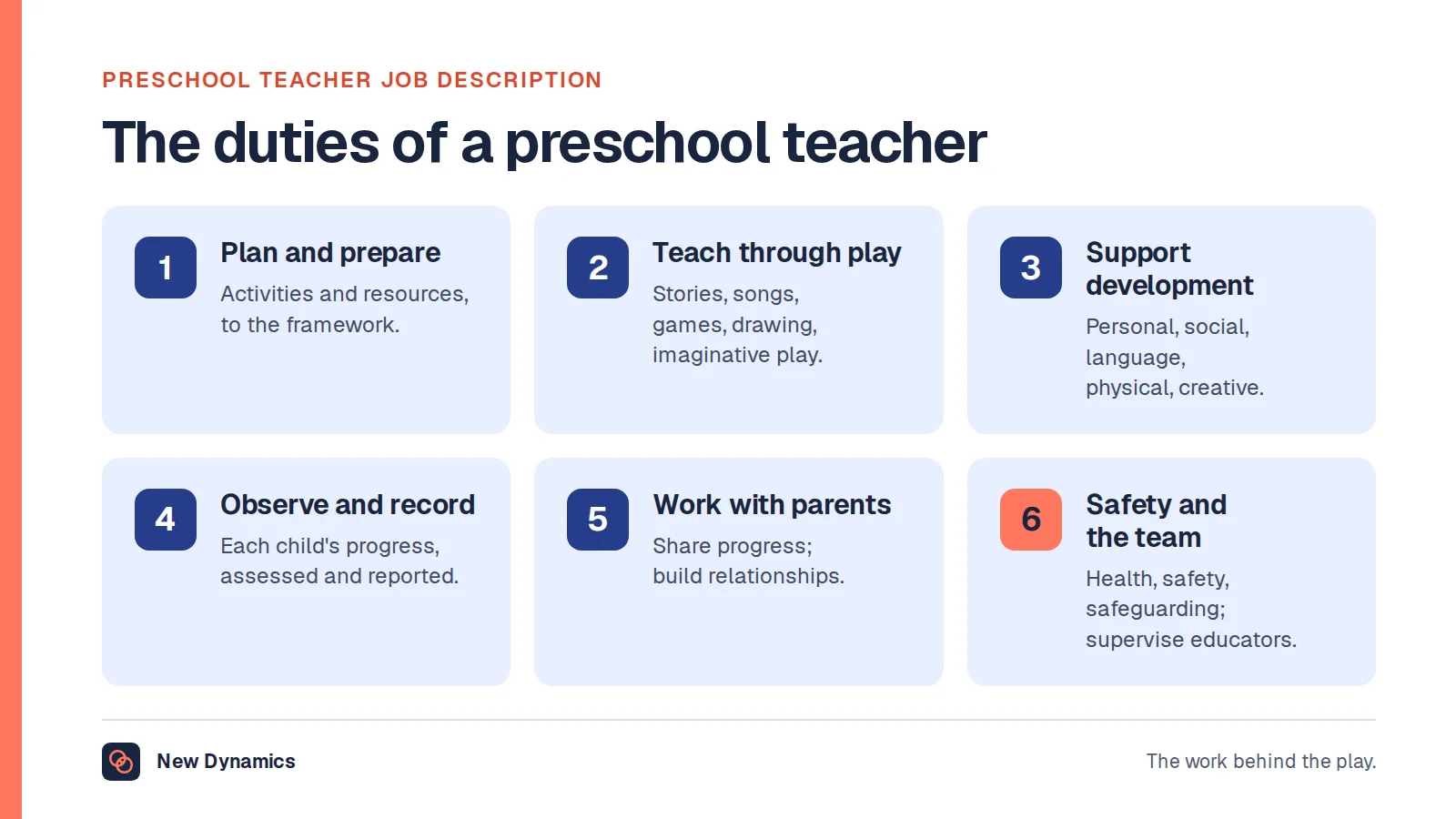
The National Careers Service describes the nursery worker's day-to-day tasks as planning and supervising activities like arts and crafts, music and cooking; helping children learn numeracy and language skills through games, singing and storytelling; taking children on outings; feeding and changing babies; keeping indoor and outdoor areas clean and safe; and recording children's development and sharing it with parents, carers and nursery staff.
Daycare teacher, childcare worker, nursery worker, early years practitioner
The titles describe the same job at different qualification levels and in different countries:
- Daycare teacher, daycare worker, childcare worker. The American titles, often with the room attached: infant teacher, toddler teacher. In Britain, infant teacher means something else entirely: a qualified teacher in the infant phase of a primary school, ages four to seven, which our teacher job description covers.
- Nursery worker, nursery assistant, nursery practitioner. The British titles; nursery assistant usually means unqualified or level 2.
- Early years practitioner and early years educator. The English apprenticeship titles at level 2 and level 3, which the National Careers Service lists as the routes in.
- Room leader, senior nursery worker. The first step up: responsible for a room, its staff and its planning.
Use the title your candidates search for, and say the level in the first line.
Daycare teacher duties: seven responsibilities
Grouped from the O*NET tasks and the National Careers Service profile, the work has seven parts.
- Safety and supervision. Maintain a safe play environment indoors and out; supervise children at all times within the staffing ratios; follow safeguarding, first aid, medication and accident procedures; sanitise toys and equipment.
- Personal care. Feed and change babies; sterilise bottles and prepare formula; help with meals, rest periods, dressing and toileting; instruct children in health and personal habits, in O*NET's words, such as eating, resting and toilet habits.
- Play and learning. Plan and lead age-appropriate activities: arts and crafts, music, stories, games, cooking, outdoor play and outings; read to children and teach simple songs, painting and handicrafts; support numeracy and language through play.
- Emotional and social development. Comfort, encourage and set boundaries; support children's understanding of others and positive self-concepts; manage behaviour calmly and consistently; help children settle and separate from parents.
- Observation and records. Observe and monitor play; record daily observations, activities, meals and medication; identify signs of emotional or developmental problems and raise them with parents or guardians and the room leader; contribute to each child's development record.
- Parents and carers. Handover at the start and end of the day; share the day's activities, behaviour and any concerns; build the relationship that makes difficult conversations possible.
- The room. Organise and store toys and materials; keep the room clean and tidy; take attendance and complete the paperwork; work as part of the room team and support colleagues, trainees and volunteers.

Daycare teacher vs early years teacher vs nanny
| Role | Setting | Holds |
|---|---|---|
| Daycare teacher or nursery worker | Nursery or daycare room | Care, play and records for a group; level 2 or 3 childcare qualification |
| Early years or preschool teacher | Nursery, preschool or school | A teaching qualification; leads the curriculum and the room team |
| Nanny | The family's home | One family's children; often sole charge |
The preschool teacher job description covers the qualified teacher, including early years teacher status and the framework in England. In many nurseries the daycare teacher and the early years teacher work in the same room; the advert should say which one it is, because the qualification, the pay and the responsibility differ.

Skills employers look for
The National Careers Service lists sensitivity and understanding, the ability to work well with others, flexibility and openness to change, excellent verbal communication, customer service skills, the ability to understand people's reactions, active listening, patience and the ability to remain calm in stressful situations, and basic computer or hand-held device skills for records. Add, for the daycare room:
- Physical stamina. The work is on the floor, on your feet and lifting; the National Careers Service describes the environment as physically active.
- Consistency. The same routine, the same boundaries and the same warmth on the fortieth day as on the first.
- Noticing. The child who is quieter than usual, the rash, the parent who is not coping.
- Plain, kind communication with parents, including about difficult things.
- Reliability on the shifts that keep the ratios legal. One absence can close a room.
Hours and environment. Daycare runs early to late; most settings staff it in shifts across the day, and some at weekends. A uniform may be required. Say the shift pattern, the holiday arrangements and whether the role is term-time or all year.
Qualifications, checks and progression
Qualifications. Employers usually ask for a childcare qualification at level 2 or level 3, or a willingness to gain one. The National Careers Service lists the routes as a college course in childcare or early years education and care, a T Level in education and early years, an early years practitioner apprenticeship at level 2 or an early years educator apprenticeship at level 3, volunteering, or applying directly. In England the early years framework sets the qualification levels that count towards staffing ratios; state the level the post needs.
Checks. Enhanced background checks are required, the National Careers Service says; add references, a health declaration, first aid and safeguarding training, and whatever your regulator requires.
Progression. The National Careers Service gives the route: with experience, specialise in supporting children with learning difficulties, disabilities or mental health needs; with further training, become a room leader or senior nursery worker, move into management as a nursery manager, or become an early years teacher. Say in the advert which of those the setting supports and how.
Daycare teacher job description template
Job title: Daycare Teacher (or Nursery Practitioner, Early Years Practitioner, Childcare Worker; add the room: Baby Room, Toddler Room, Preschool Room)
Reports to: Room Leader or Nursery Manager
Scope: State the room, the age range, the number of children and staff in the room, the setting's hours and the shift pattern.
Purpose: Keep every child in the room safe, cared for and happy, support their development through play and routine, keep accurate records and give parents an honest account of the day.
Responsibilities:
- Supervise children at all times within the staffing ratios; maintain a safe, clean play environment indoors and out; follow safeguarding, first aid, medication and accident procedures.
- Provide personal care: feeding, changing, sleep, dressing and toileting, with respect for each child.
- Plan and lead play and learning activities appropriate to the age group, indoors, outdoors and on outings.
- Support children's emotional and social development; manage behaviour calmly and consistently.
- Observe and record each child's activities, meals, medication and development; raise concerns with the room leader and parents.
- Communicate with parents and carers at handover and through the setting's records.
- Keep the room organised and stocked; complete attendance and paperwork; support colleagues, trainees and volunteers.
Skills and experience:
- Level 2 or 3 childcare or early years qualification, or willingness to train through an apprenticeship; state which is essential.
- Experience in a nursery or daycare setting desirable; experience with the room's age group an advantage.
- Patience, warmth and calm under pressure; sensitivity to children's and parents' needs.
- Clear verbal communication; basic computer skills for records.
- Enhanced background check, references, and first aid and safeguarding training, provided or held.
Working pattern: State the shifts, the earliest start and latest finish, weekend work, term-time or all year, and holiday arrangements.
Progression: Room leader, senior practitioner, nursery manager or early years teacher; say what the setting supports.
The first month
A new starter who is left to find their feet in a busy room is the one who leaves, and most of the reasons are avoidable. Plan the first month before the advert goes out:
- Week one: the room and the routine. Shadow an experienced colleague; learn the children's names, the routines, the records and the emergency procedures; complete the safeguarding and first aid induction.
- Week two: shared responsibility. Take a small group for activities and handovers with support; first check-in with the room leader.
- Weeks three and four: full duties within ratio. Own a set of children's records; lead an activity; a second check-in and a written note of what is going well and what needs support.
- End of the first month. A conversation about the probation period, the training plan and the route to level 3 or room leader.

Frequently asked questions
What does a daycare teacher do?
Cares for a group of children in a nursery or daycare room and supports their development through play: keeping the environment safe, feeding and changing, planning and leading activities, supporting emotional and social development, recording each child's day and development, and talking to parents at handover. The US occupational database lists daycare teacher among the titles of childcare workers, with tasks including maintaining a safe play environment and keeping records on individual children.
What are the duties and responsibilities of a childcare worker?
Safety and supervision, personal care, play and learning, emotional and social development, observation and records, communication with parents and carers, and keeping the room organised. The National Careers Service adds planning activities like arts and crafts, music and cooking, helping children learn numeracy and language through games and stories, taking children on outings, and recording development to share with parents.
What is the difference between a daycare teacher and a preschool teacher?
The preschool or early years teacher holds a teaching qualification and leads the curriculum and the room team; the daycare teacher or nursery worker holds a childcare qualification at level 2 or 3 and provides the care, play and records for a group of children. In many settings they work in the same room, so the advert should say which role it is.
What qualifications do you need to work in daycare?
Usually a level 2 or 3 childcare or early years qualification, or a willingness to gain one through an apprenticeship, plus enhanced background checks. The National Careers Service lists college courses, T Levels, level 2 and level 3 apprenticeships, volunteering and direct application as the routes in.
Is working in daycare a good first job?
It suits people who are patient, warm and physically active, and the training is available on the job through apprenticeships. It is demanding: early starts, late finishes, noise, lifting and difficult conversations with parents. An honest advert and a planned first month decide whether a first-jobber stays.
Your next step: describe the day, not just the qualification
- Name the room, the age group and the number of children and staff.
- State the shifts, the earliest start and latest finish, and term-time or all year.
- Say which qualification level is essential and which the setting will train.
- Write the first month before the advert goes out.
For a plan that keeps the staff you recruit, read and download our employee retention guide. The guide is free to read, and the PDF uses our short download form.
Want every new starter in every room to get the same first month and the same check-ins, without the manager chasing? Book a New Dynamics demo and bring your current induction checklist. You can also email contact@new-dynamics.com.