TL;DR
- A teacher plans, teaches and assesses lessons that meet the curriculum and the needs of their pupils, manages behaviour, keeps pupils safe, works with colleagues and support staff and reports to parents.
- In England the job is defined by the Teachers' Standards: eight standards of teaching, from setting high expectations to fulfilling wider professional responsibilities, and a second part on personal and professional conduct. They set the minimum level of practice and are used to assess teachers' performance.
- Schools look for subject knowledge, planning, classroom management, assessment, adaptability, communication with parents and resilience. The job specification should say the phase, the subject, the key stages and the safeguarding and conduct expectations.
Every teacher's day is the same shape and every teacher's day is different: thirty children, a curriculum, a lesson plan that survives until the second question, and a set of standards that says what good looks like. A job description that captures all of that is rarer than it should be.
This teacher job description explains what a teacher does, sets out six duties, summarises the Teachers' Standards that define the job in England, shows how the role differs between primary and secondary, lists the skills schools look for, gives a job specification template that you can adapt and suggests how to describe teaching on a CV.
Teachers are appraised against published standards, and the appraisal should rest on evidence gathered through the year rather than on a single observation. See how New Dynamics performance reviews bring goals, feedback and development into one fair discussion.
What is a teacher?
The Cambridge Dictionary defines a teacher as “someone whose job is to teach in a school or college”. Prospects, the UK graduate careers service, fills that out in its primary school teacher job profile: “As a primary school teacher, you'll plan and teach lessons that meet curriculum requirements and the needs of your pupils. You'll build positive relationships with pupils, organise resources effectively and create an inclusive and supportive learning environment in the classroom.”
In England the job has an official definition. The Department for Education's Teachers' Standards “set a clear baseline of expectations for the professional practice and conduct of teachers and define the minimum level of practice expected of teachers in England”. They are used to award qualified teacher status, to assess early career teachers at the end of induction and, in maintained schools, to assess teachers' performance.
Three things define the job wherever it is done.
- Accountability for progress. Teachers are answerable for what their pupils learn, not only for what they teach.
- Judgement in the room. Every lesson is adapted live to the pupils in front of the teacher.
- Duties beyond the lesson. Safeguarding, parents, colleagues, the school's wider life.
Teacher duties: six responsibilities
Prospects lists what a primary school teacher will need to do. Grouped, and with the secondary version alongside, the duties come to six.
- Plan and teach. Plan, prepare and teach engaging lessons that meet the curriculum, and organise resources and technology to support learning.
- Assess and give feedback. Monitor and assess pupils' progress, provide feedback and use assessment to plan future teaching.
- Adapt to every pupil. Adapt teaching to meet pupils' different needs, abilities and stages of development, including those with special educational needs, high ability, English as an additional language and disabilities.
- Manage behaviour and keep pupils safe. Create a positive, inclusive and stimulating environment, manage behaviour effectively and, in Prospects' words, “ensure that pupils are safe and that child protection and safeguarding procedures are followed”.
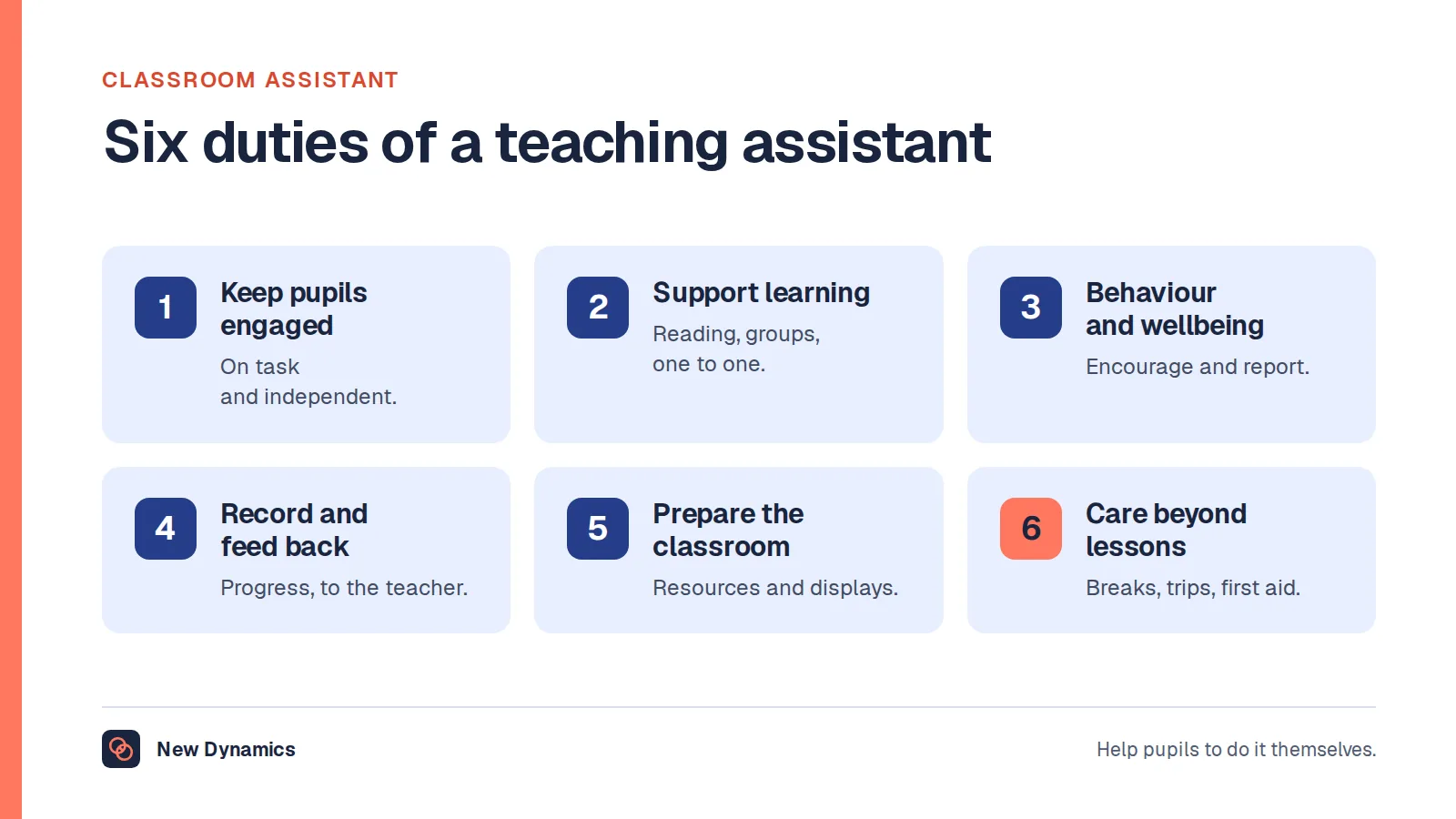
- Work with colleagues and support staff. Work closely with other teachers, teaching assistants and education professionals to support pupils' learning and wellbeing. Our guide to the teaching assistant job description covers the other side of that partnership.
- Communicate with parents. Provide feedback to parents and carers on their child's progress and development.

The Teachers' Standards: eight standards and a code of conduct
Part One of the Teachers' Standards sets out what a teacher must do, under eight headings.
- Set high expectations which inspire, motivate and challenge pupils.
- Promote good progress and outcomes by pupils.
- Demonstrate good subject and curriculum knowledge.
- Plan and teach well structured lessons.
- Adapt teaching to respond to the strengths and needs of all pupils.
- Make accurate and productive use of assessment.
- Manage behaviour effectively to ensure a good and safe learning environment.
- Fulfil wider professional responsibilities.
Part Two covers personal and professional conduct. It expects teachers to uphold public trust in the profession and maintain high standards of ethics and behaviour, within and outside school, including “treating pupils with dignity, building relationships rooted in mutual respect, and at all times observing proper boundaries appropriate to a teacher's professional position” and “having regard for the need to safeguard pupils' well-being, in accordance with statutory provisions”. Teachers must also have proper and professional regard for the school's ethos, policies and practices, and maintain high standards in their own attendance and punctuality.
The eight standards make a ready-made competency framework for a teacher job specification, an appraisal and a development plan. Schools in Wales, Scotland and Northern Ireland have their own professional standards, and other countries have theirs.

Primary and secondary: what changes
| Question | Primary | Secondary |
|---|---|---|
| Who is taught | One class, most of the day, across the curriculum | Many classes, one subject, pupils aged 11 to 16 or 18 |
| Subject knowledge | Breadth across subjects, with early reading and mathematics | Depth in one subject, to exam level |
| Pastoral role | Built into the class teacher role | Usually a form tutor role alongside subject teaching |
| Planning | Whole-day sequences for one group | Lesson sequences for several year groups and exam specifications |
Prospects' secondary school teacher profile describes the difference plainly: “You'll teach pupils aged 11 to 16 (or up to 18 if the school has a sixth form). Specialising in a particular subject, you'll plan, teach and assess lessons in line with curriculum objectives.” Early years, special school and further education teaching differ again, and the job specification should say which.

Skills schools look for
- Subject and curriculum knowledge, to the level the phase and key stages require.
- Planning, of lessons and of sequences that build.
- Classroom management, with clear routines and consistent expectations.
- Assessment, formative and summative, and the use of data to plan.
- Adaptability, for the range of needs in every class.
- Communication, with pupils, parents, colleagues and support staff.
- Resilience and organisation, because the workload is real and the days are full.
Qualified teacher status, or the equivalent recognised in the country and phase, is the usual requirement for a teaching post in a maintained school in England, along with an enhanced criminal record check with the children's barred list. Say in the advert which qualifications and checks apply.
Teacher job specification template
Adapt the template to your school and phase. Keep every line true, and name the standards you assess against.
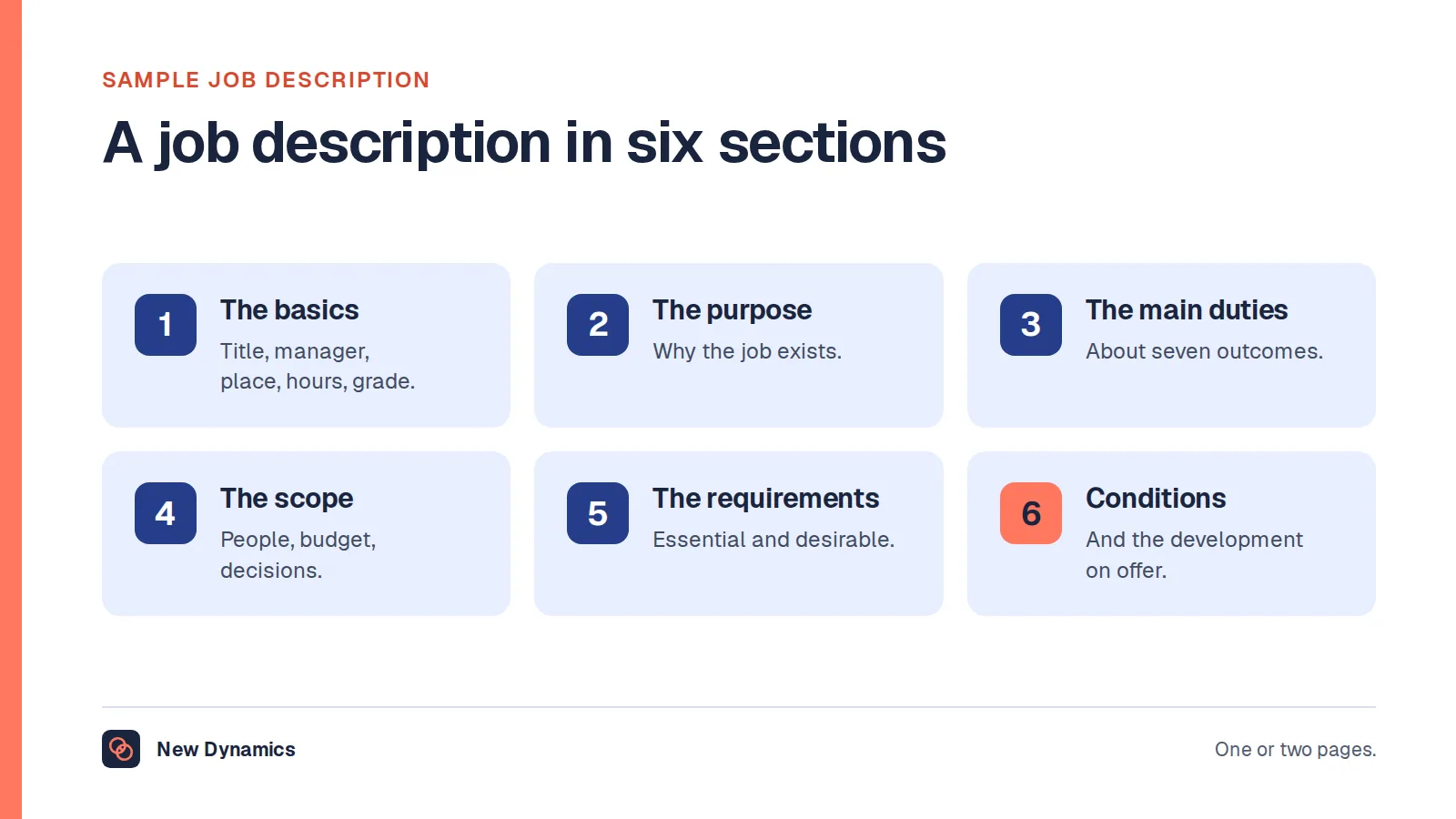
Job title: Teacher of [subject or phase]
Reports to: [Head of department, phase leader or headteacher]
Contract and hours: [Full-time or part-time], [permanent or fixed-term], teachers' pay and conditions as applicable
Purpose of the role: To plan, teach and assess [subject or phase] so that every pupil makes good progress, in line with the Teachers' Standards and the school's policies.
Main duties:
- Plan and teach well structured lessons across [key stages or year groups]
- Assess pupils' progress, give regular feedback and use assessment to plan
- Adapt teaching to the strengths and needs of all pupils
- Manage behaviour in line with the school's behaviour policy
- Safeguard pupils and follow child protection procedures
- Work with colleagues and support staff, and contribute to the wider life of the school
- Communicate with parents and carers about progress and wellbeing
- [Form tutor, subject leadership or other responsibilities]
Person specification:
- Qualified teacher status [or the equivalent required], with [subject] to [level]
- Secure subject and curriculum knowledge for [key stages]
- Evidence of good progress by pupils taught
- Clear communication with pupils, parents and colleagues
- Commitment to safeguarding and to the school's ethos
Checks: Enhanced criminal record check with the children's barred list, right to work, references and prohibition checks as required
We provide: Induction and mentoring, a professional development plan, appraisal against the Teachers' Standards with evidence gathered through the year, and [any additional responsibility allowances].
Our job description template explains the general structure.
How to describe teaching on a CV
Schools want evidence of pupil progress, classroom practice and contribution. The lines below are invented examples, to show the form.
- Progress. “Taught Year 6 for three years; the class's reading outcomes rose each year against the school's tracking.”
- Practice. “Introduced a whole-class feedback routine that was adopted across Key Stage 2.”
- Adaptation. “Planned for a class with four pupils with education, health and care plans, working with two teaching assistants.”
- Wider contribution. “Ran the school's coding club and led the transition programme with the local secondary.”
- Standards. Name the Teachers' Standards, or the equivalent framework, that your appraisal evidence covers.
Common mistakes in teacher job adverts
No phase, key stages or subject. "Teacher" alone is not a job.
Copying the standards as the duties. The standards are the framework; the advert should say what this post involves in this school.
Hiding responsibilities. Form tutoring, clubs, duties and cover should be in the advert, not discovered in September.
Silence on support. Induction, mentoring, workload and development are what good candidates compare.
Vague on safeguarding. State the checks and the expectation plainly. Candidates expect it, and the law requires it.
Frequently asked questions
What does a teacher do?
A teacher plans and teaches lessons that meet the curriculum and the needs of their pupils, assesses progress and gives feedback, adapts teaching to every pupil, manages behaviour and keeps pupils safe, works with colleagues and support staff and communicates with parents about progress and wellbeing.
What are the Teachers' Standards?
The Teachers' Standards are the Department for Education's statement of the minimum level of practice expected of teachers in England. Part One sets out eight standards of teaching, from setting high expectations to fulfilling wider professional responsibilities; Part Two sets out personal and professional conduct. They are used to award qualified teacher status and to assess performance.
What is the job specification of a teacher?
A teacher's job specification names the phase, subject and key stages, the main duties of planning, teaching, assessing, adapting, managing behaviour, safeguarding, working with colleagues and communicating with parents, the qualifications and checks required, and any additional responsibilities such as form tutoring.
What is the difference between a primary and a secondary teacher?
A primary teacher usually teaches one class across most of the curriculum for most of the day, including early reading and mathematics. A secondary teacher specialises in one subject, teaches many classes of pupils aged 11 to 16 or 18 and usually has a form tutor role alongside.
What qualifications does a teacher need in England?
Qualified teacher status, or the equivalent recognised for the phase and setting, is the usual requirement for a teaching post in a maintained school, together with an enhanced criminal record check with the children's barred list. Requirements differ in Wales, Scotland, Northern Ireland and other countries.
What skills does a teacher need?
Subject and curriculum knowledge, lesson and sequence planning, classroom management, assessment and the use of data, adaptability to a range of needs, clear communication with pupils, parents and colleagues, and resilience and organisation.
Your next step
If you are recruiting, write the phase, subject, key stages and additional responsibilities into the first paragraph of the advert, and say how appraisal evidence is gathered. If you are applying, write one line for each of the eight standards, with an example.
For a method that makes appraisal rest on evidence gathered through the year, read and download our performance review guide. The guide is free to read, and the PDF uses our short download form.
Want appraisal against the standards to draw on goals, feedback and observations kept in one place? Book a New Dynamics demo and bring your current approach. You can also email contact@new-dynamics.com.