TL;DR
- A classroom assistant, more often called a teaching assistant or TA in the UK, is employed to help a teacher in a classroom, for example by giving help to children who need extra support.
- The six main duties are keeping pupils engaged and independent, supporting reading and learning activities, supporting behaviour and wellbeing, recording progress for the teacher, preparing the classroom and caring for pupils outside lessons.
- The role has three broad levels: teaching assistant, specialist or learning support assistant, and higher level teaching assistant. Everyone who works with children needs safeguarding checks and training.
In most classrooms there are two adults, and the second one rarely gets the credit. The teacher plans and leads the lesson. The assistant is the reason that the child who was stuck on the second question is now on the fifth, and that the pupil who was close to tears has rejoined the group.
This article gives a classroom assistant job description: what the role is called, what a teaching assistant does, the three levels of the job, the skills that matter, the safeguarding checks that UK schools must make, a template and the mistakes that schools make when they write one.
Support staff often start in the middle of a school year, with a great deal to learn quickly. See how New Dynamics onboarding brings tasks, early goals and manager conversations into a clear path for a new starter.
What is a classroom assistant or teaching assistant?
The Cambridge Dictionary defines a teaching assistant, abbreviated TA, as, in the United Kingdom, “a person who is employed to help a teacher in a classroom, for example giving help to children who need extra support”.
Classroom assistant is another name for the same job. Prospects, the UK careers service, notes in its teaching assistant job profile that job titles vary and may include classroom assistant, learning support assistant and pupil support assistant. England's occupational standard lists classroom assistant, learning support assistant and teaching assistant together, and Skills England's apprenticeship listing sums up the purpose in one line: “Supporting the class teacher to enhance learning.”
Prospects gives the fuller picture: “Teaching assistants support pupils in their educational, emotional and social development”. They work with pupils individually, in groups or as a whole class, “helping them to access learning, build confidence and develop independence”.
In the United States, similar roles are called teacher's aide, paraprofessional or instructional assistant, and the requirements are set by states and school districts.
What does a teaching assistant do? Six duties
These six group the duties that Prospects lists.
- Keep pupils engaged. Make sure that the pupils you support can take part and stay on task, in Prospects' words, “so that they can become independent learners”.
- Support learning activities. Help with reading, literacy and other activities, as a class, in groups or one to one.
- Support behaviour and wellbeing. Support pupils' social and emotional development, help the teacher to manage challenging behaviour and promote positive behaviour. Report concerns.
- Record and feed back. Prospects puts it as a duty to “monitor and record pupils' progress and provide detailed and regular feedback to teachers”.
- Prepare the classroom. Set up learning spaces and resources, make displays of pupils' work and clear away afterwards, which frees the teacher's time for teaching.
- Care beyond lessons. Look after pupils who have had accidents or are upset, give first aid if trained, and support pupils during exams, trips, clubs, playtime and lunchtime.
The first duty deserves attention. A good assistant helps a pupil to do the work. A poor arrangement has the assistant doing the work for the pupil. A job description that speaks of independence sets the right expectation from the start.

Three levels of the role
- Teaching assistant or classroom assistant. General support for a class or year group, under the direction of the teacher.
- Specialist or learning support assistant. Prospects notes that some TAs “work exclusively with pupils who have special educational needs and disabilities (SEND)”, or additional support needs in Scotland. The post may be attached to one pupil or to a small group, and needs specific training.
- Higher level teaching assistant (HLTA). Prospects explains that an HLTA may deliver tailored teaching activities to pupils one to one, in small groups “or, for short periods, as a whole class under the direction and supervision of a teacher”. HLTAs also contribute to planning, and may supervise other support staff.
State the level in the job title and the description. The pay, the training and the expectations differ.

Five skills of a good classroom assistant
Prospects lists the skills that schools look for. They fall into five groups.
- Communication and relationships. The skill “to motivate and inspire pupils, help them understand tasks, stay engaged, develop independence and make progress in lessons”.
- Literacy, numeracy and digital skills. Enough to support classroom activities, record progress, prepare resources and use school systems.
- A positive approach to behaviour. Prospects describes this as “using praise, encouragement and clear boundaries”.
- Teamwork. Working under the direction of teachers, and with other support staff, professionals, parents and carers.
- Safeguarding and inclusion. The awareness to notice concerns and follow procedures, and a commitment to pupils with different learning, communication, social, emotional or physical needs.
Flexibility runs through all five. Classes, pupils and plans change at short notice.
Qualifications. Requirements vary between schools. Prospects mentions qualifications in supporting teaching and learning, experience in childcare, playwork or youth work, and the Level 3 teaching assistant apprenticeship, which has a typical duration of 18 months. It advises applicants to check each vacancy carefully.
Safeguarding checks and duties in the UK
Anyone who works with children must be checked. Prospects summarises the position: applicants “need to pass safeguarding checks, such as an enhanced DBS check in England and Wales, PVG scheme membership in Scotland, or an enhanced AccessNI check in Northern Ireland”.
In England, the Department for Education's statutory guidance, Keeping children safe in education, sets out “the legal duties that schools and colleges must comply with to safeguard and promote the welfare of children and young people under the age of 18”. It says that all staff must read part one of the guidance in full, and must follow their school's or college's safeguarding policies and procedures. That includes classroom assistants.
A job description should therefore state the check required, the duty to follow safeguarding procedures and the training given at induction. This is general information, not legal advice. Other countries have their own checks and rules.
Classroom assistant job description template
Adapt the wording to your school. Replace the text in square brackets.
Job title: Teaching assistant [or classroom assistant, learning support assistant, HLTA]
Reports to: [Class teacher, SENCO or head of year]
Hours: [Hours per week], term time only [plus training days]. [Permanent, or fixed term linked to a pupil's support plan.]
Purpose of the job: To support the class teacher to enhance learning, so that every pupil can take part, make progress and become more independent.
Main duties
- Support pupils individually and in groups with tasks set by the teacher, and encourage them to work independently.
- Deliver agreed reading, literacy, numeracy or other support activities, and record what happened.
- Support pupils' behaviour, social and emotional development in line with the school's policies.
- Observe and record pupils' progress, and give regular feedback to the teacher.
- Prepare and clear away resources and learning spaces, and help with displays.
- Supervise and care for pupils at break and lunch, on trips and during exams, as required.
- Follow the school's safeguarding, health and safety and confidentiality procedures, and report concerns at once to the designated safeguarding lead.
- [For SEND posts: carry out the support set out in the pupil's plan, including personal care or specialist programmes, after training.]
Essential requirements
- Good literacy and numeracy, with [qualification level required].
- Experience of working with or caring for children or young people, paid or voluntary.
- Patience, warmth and clear communication.
- Willingness to work under direction and as part of a team.
- A satisfactory enhanced [DBS, PVG or AccessNI] check.
Desirable
- A qualification in supporting teaching and learning, or a teaching assistant apprenticeship.
- Experience of [age group, SEND, a specific language or programme].
- First aid training.
Conditions: [Pay grade and whether pay is term time only], [holiday], [training and support for development].
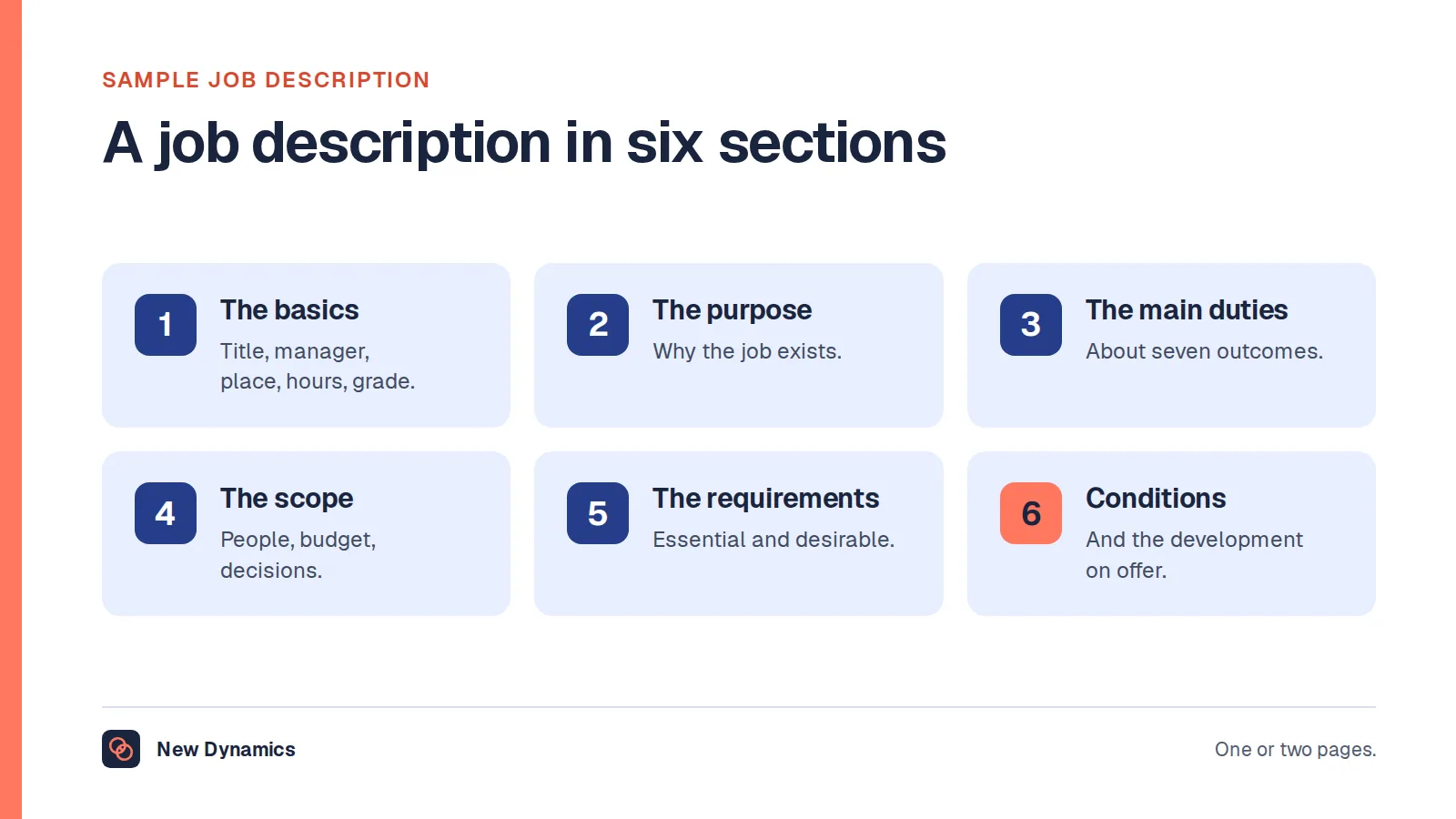
For the general format, see our sample job description, and for help with separating essential from desirable, our guide to job requirements.
Common mistakes
“General classroom duties.” A description that says only this leaves the assistant photocopying. Name the work with pupils first.
Dependence by design. An assistant who sits beside the same pupil all day can become a barrier between the pupil and the teacher. Write independence into the purpose.
No time with the teacher. An assistant who meets the lesson plan at the classroom door cannot support it. Build in time to talk.
Vague pay. Term-time-only pay confuses applicants. Give the actual salary as well as the full-time equivalent.
Hidden personal care. If the post includes it, say so plainly, with the training offered.
No development. Some teachers began as assistants. Show the route to HLTA or to teacher training.
Frequently asked questions
What is the job description of a classroom assistant?
A classroom assistant, or teaching assistant, helps a teacher in a classroom. The job covers supporting pupils individually and in groups, helping with reading and learning activities, supporting behaviour and wellbeing, recording progress for the teacher, preparing resources and supervising pupils outside lessons.
What does a teaching assistant do?
Prospects says that teaching assistants support pupils in their educational, emotional and social development. They help pupils to access learning, build confidence and develop independence, and they take on duties that free the teacher's time for teaching.
Is a classroom assistant the same as a teaching assistant?
Yes, in most UK schools. Job titles vary and also include learning support assistant and pupil support assistant. A higher level teaching assistant is a more senior post that may lead small groups or, for short periods, a whole class under a teacher's direction.
What qualifications do you need to be a teaching assistant?
Requirements vary between schools. Good literacy and numeracy and experience with children are usual. Qualifications in supporting teaching and learning help, and in England the Level 3 teaching assistant apprenticeship is a paid route into the work.
Do teaching assistants need a DBS check?
In England and Wales, yes. Prospects notes that applicants need to pass safeguarding checks, such as an enhanced DBS check in England and Wales, PVG scheme membership in Scotland or an enhanced AccessNI check in Northern Ireland.
What is a higher level teaching assistant?
A higher level teaching assistant, or HLTA, has extra responsibility. Prospects says that an HLTA may deliver tailored teaching activities one to one, in small groups or, for short periods, as a whole class under the direction and supervision of a teacher, and may supervise other support staff.
Your next step
If you are hiring, decide which of the three levels the post is, copy the template and put the work with pupils at the top. If you are applying, gather examples of helping a child to do something for themselves.
For the whole hiring process, from the job description to the offer, read and download our recruitment and selection guide. The guide is free to read, and the PDF uses our short download form.
Want every new member of staff to have clear tasks and goals from the first day? Book a New Dynamics demo and bring your current approach. You can also email contact@new-dynamics.com.