TL;DR
- ONS describes labour productivity as the “efficiency of the UK workforce, including output per worker, per job and per hour”. It is a ratio, and effort is not in it.
- The national measure moves by fractions of a percent a year, which is useful calibration when someone proposes transforming it in a quarter.
- What an employer controls is obstacles, fit between work and capability, clarity, and what gets measured, not how hard people are trying.
"We need to improve productivity" almost always means "people should work harder". The published measure says something different, and the difference changes what you should do about it.
This article covers what employee productivity measures, how much it actually moves, why effort is the wrong lever, and the four things an employer can change.
Productivity conversations go better when objectives and progress are already visible. See how New Dynamics goals and OKRs keep them in one place.
For the design side of removing obstacles, see our post on nudge theory and the EAST framework.
What it measures

The ONS describes labour productivity as the "efficiency of the UK workforce, including output per worker, per job and per hour", with data "available by industry and by region".
It is a ratio. Output on top, time or people underneath. Working longer raises the denominator as fast as the numerator, which is why hours are not a productivity strategy. Effort does not appear anywhere in the definition.
How much it moves
Worth knowing before anyone promises a transformation. The ONS flash estimate for the second quarter of 2026, using PAYE Real Time Information, showed "output per hour and output per worker were 0.7% and 1.4% higher in the year to Quarter 2 2026, respectively, compared with Quarter 2 2025". Estimates based on the Labour Force Survey pointed the other way for one of the measures: "output per hour worked in the year to Quarter 2 (Apr to Jun) 2026 was 0.2% lower", while output per worker "increased by 0.4%".
Two lessons. National productivity moves by fractions of a percent a year, so a plan to raise it by a fifth in a quarter is describing something else. And the measures disagree depending on the data source, ONS is "developing a new component-based approach to measuring labour productivity to address challenges associated with labour market measurement". If the national statistician finds this hard to measure, your spreadsheet will too.
Why effort is the wrong lever
Most of what sets output per hour is not decided by the person doing the work: the tools they use, the process they work inside, how much rework arrives, how many approvals a decision needs, whether the brief was clear.
Pressing on effort in that situation produces three predictable results. People work longer, which flatters output while leaving the ratio unchanged or worse. Quality drops, generating rework that reduces output later. And the people with the most options leave.
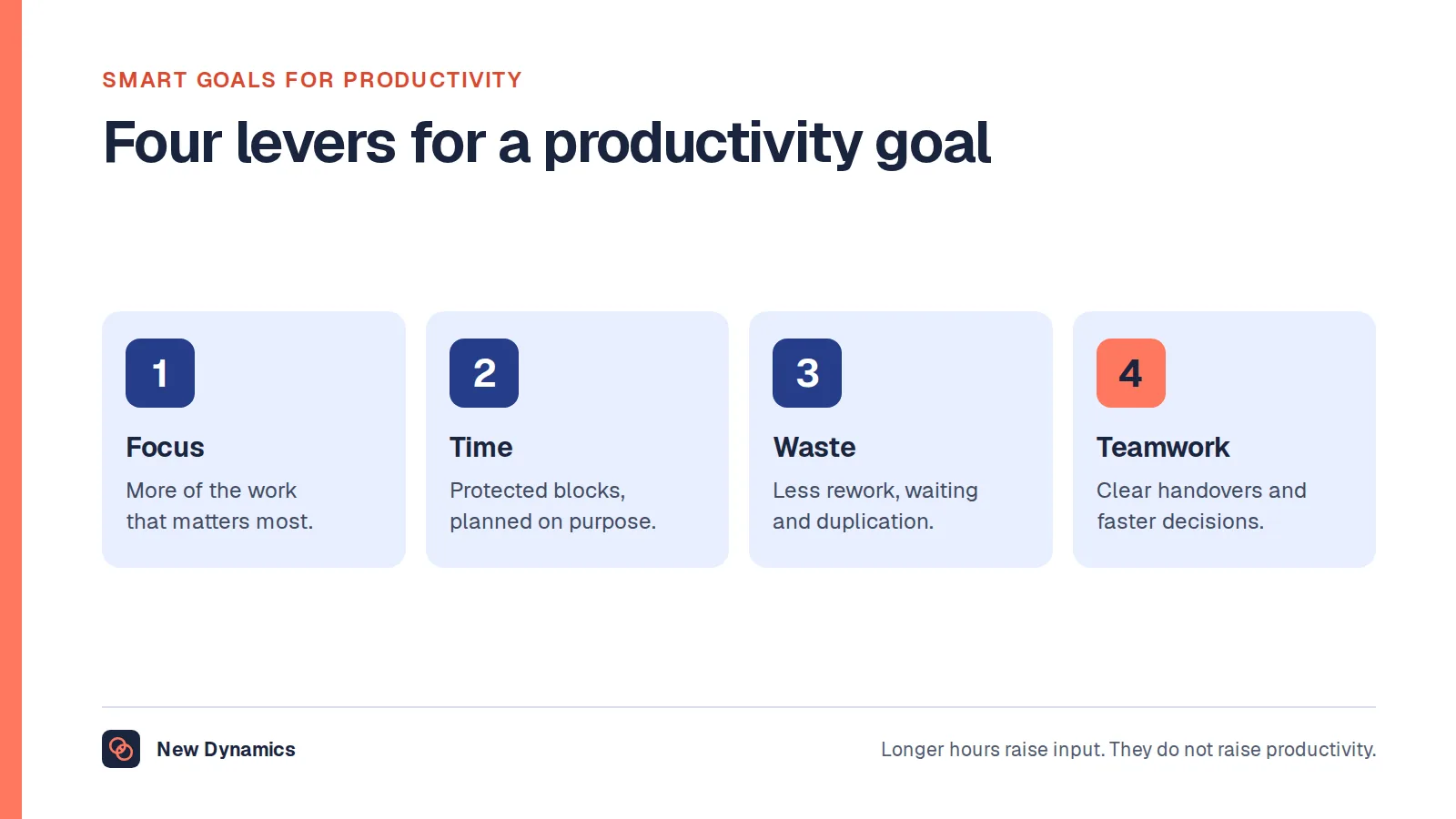
The four things you control

1. Obstacles. The waiting, the rework, the approvals, the tool that takes four clicks. Ask people what stopped them last week and you will get a list; most items are cheaper to fix than any programme.
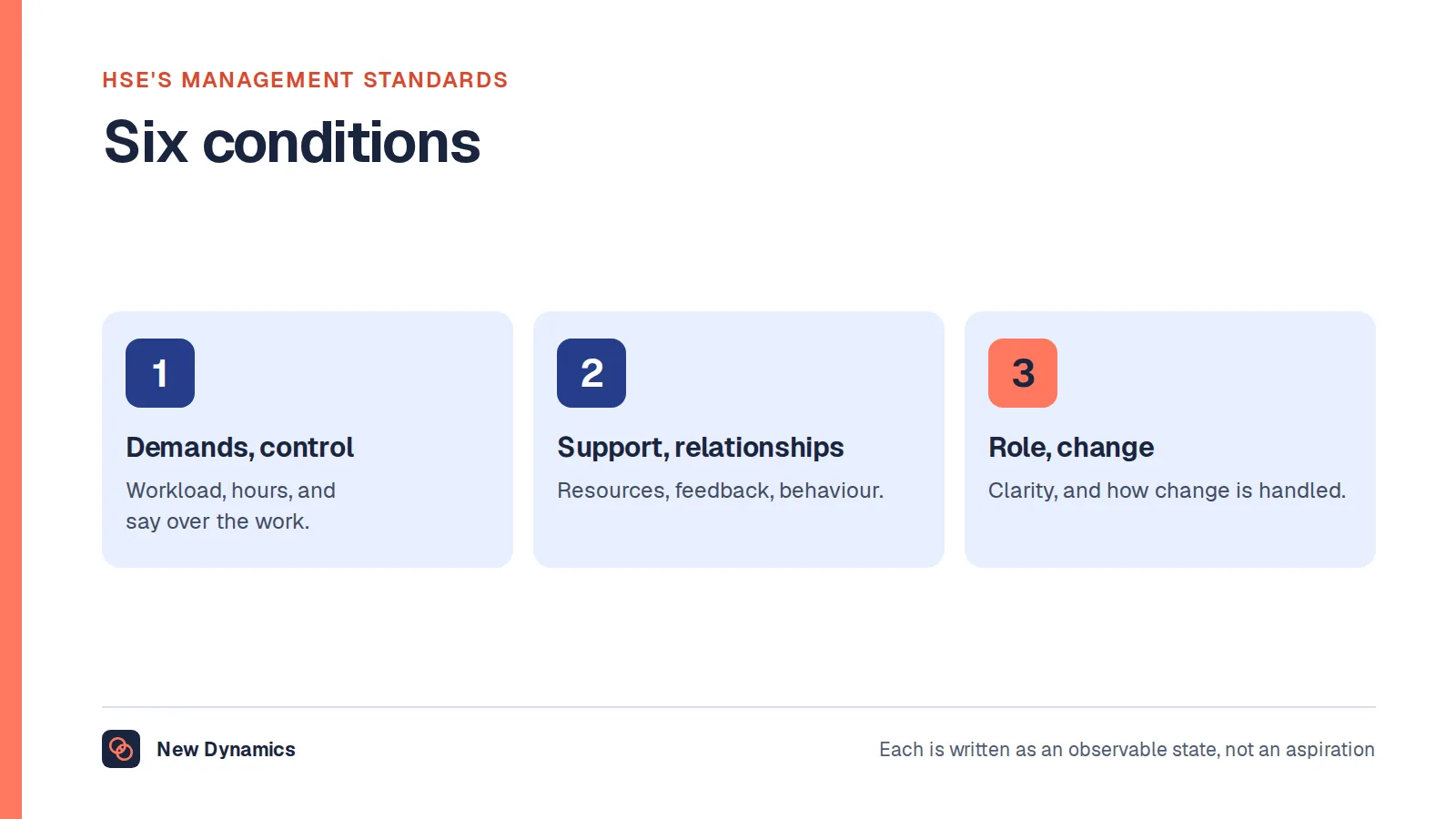
2. Fit between work and capability. HSE's Demands standard expects an organisation to provide "adequate and achievable demands in relation to the agreed hours of work", to ensure "people's skills and abilities are matched to the job demands", and that "jobs are designed to be within the capabilities of employees". A person doing work they are not equipped for is slow for a reason that training or redesign fixes and pressure does not.
3. Control and clarity. The same standards expect employees to "have control over their pace of work", to be "encouraged to use their skills and initiative", and to "know how to access the required resources to do their job". Our employee experience post covers the full set of conditions.
4. What you measure. Acas's guidance on changing your culture puts it in one line: "design performance measures based on output and achievements rather than hours worked." Measuring presence produces presence.
Measuring it where output is not countable
Most office work has no natural unit. Three honest approaches:
- Cycle time. How long a piece of work takes from request to done, including the waiting. Waiting is usually most of it.
- Rework rate. How often something comes back. Falling rework is a real productivity gain that raw output hides.
- Completion of the things you agreed. Not a proxy for effort, but a check on whether the work in the plan is the work being done.
Whatever you pick, publish the definition beside the number, our HR metrics post covers why a measure without its formula cannot be compared with anything.
What not to do
- Monitor intensity. Activity measures reward looking busy, and the people best at gaming them are rarely the ones doing the hardest work.
- Add a productivity initiative on top of the workload it is meant to reduce.
- Compare teams with different work and treat the difference as effort.
- Set a target without changing anything, which converts a measurement problem into a trust problem.
A short diagnostic

- Ask what stopped them. One question, to five people, about last week specifically.
- Count the waiting in one process from request to delivery.
- Check the fit. Is anyone doing work their role was not designed for, or without the tools for it?
- Check what you reward. If the measures count hours or activity, fix that before anything else.
Do those four and you will have a list of real constraints. None of them will be "people are not trying hard enough".
Frequently asked questions
What is employee productivity?
The relationship between output and the time or people used to produce it. ONS describes labour productivity as the efficiency of the workforce, measured as output per worker, per job and per hour. Effort is not part of the definition.
How do you improve employee productivity?
Remove obstacles, match work to capability, give people control over how the work is done and access to the resources it needs, and measure output rather than hours. Pressure on effort tends to raise hours rather than the ratio.
How is productivity measured?
Nationally, as output per hour, per worker or per job. Inside an organisation where output is not countable, cycle time from request to completion, rework rates and completion of agreed work are more honest than activity counts.
How much can productivity realistically improve?
National output per hour moves by fractions of a percent a year, and different data sources disagree on the direction. That is useful calibration: a plan promising a step change in a quarter is usually measuring something other than productivity.
Does working longer hours increase productivity?
Not by itself. Productivity is a ratio with time in the denominator, so longer hours raise the divisor too. Longer hours can increase total output while leaving productivity flat or falling, especially once rework is counted.
Should you monitor employees to improve productivity?
Monitoring intensity measures activity rather than output, and activity measures reward the appearance of work. Asking people what obstructed them last week produces more actionable information than any activity record.
What is the difference between productivity and performance?
Productivity is a ratio of output to input. Performance is a judgement about how well someone is doing their job, which includes quality, behaviour and context. A person can be highly productive in a badly chosen task.
Your next step: ask the obstacle question
- Ask five people what stopped them finishing something last week.
- Time one process end to end, counting the waiting separately.
- Check whether anything you currently measure counts hours or activity.
- Fix one obstacle and tell people it was fixed.
For running performance in a way that supports this rather than cutting across it, read and download our modern performance management guide. The guide is free to read, and the PDF uses our short download form.
Want objectives and progress visible without counting activity? Book a New Dynamics demo and bring your current measures. You can also email contact@new-dynamics.com.