TL;DR
- Productivity is the value you create for the time and effort you put in. A good productivity goal raises output that matters, or frees time, without harming quality or health.
- Write each goal with a baseline, a target, a date and a safeguard. “Cut my average email response time from two days to one by 30 June, with no rise in errors” is a SMART goal. “Be more productive” is a wish.
- Pick one or two goals at a time. Most gains come from removing waste, such as unclear priorities, needless meetings and rework. Working longer hours is not a productivity strategy.
“Be more productive” appears on a great many development plans, and it changes very little. It does not say what will be different, by how much or by when. It also hints, unhelpfully, that the answer is to try harder.
This article gives you 30 SMART goals for productivity that you can adapt, for yourself and for a team. Each one has a baseline, a target and a date. We also cover how to choose the right goal, how to protect quality and wellbeing, and the mistakes to avoid.
Goals work when they are visible and reviewed regularly. See how New Dynamics Goals & OKRs keeps goals, progress and check-ins in one shared place.
What does productivity mean at work?
Productivity is the value you create for the time and effort you put in. Economists measure it as output per hour or per worker. At the level of one person or one team, it is simpler to ask two questions:
- Are we spending our time on the work that matters most?
- Are we doing that work without avoidable delay, waste and rework?
That gives four levers for a productivity goal.
- Focus. Do more of the important work and less of the rest.
- Time. Protect time for concentration, and plan it on purpose.
- Waste. Remove rework, waiting, duplicated effort and needless meetings.
- Teamwork. Improve handovers, decisions and shared ways of working.
Notice what is missing: longer hours. Working more hours raises input. It does not raise productivity, and it carries real costs, which we return to below.

What makes a productivity goal SMART?
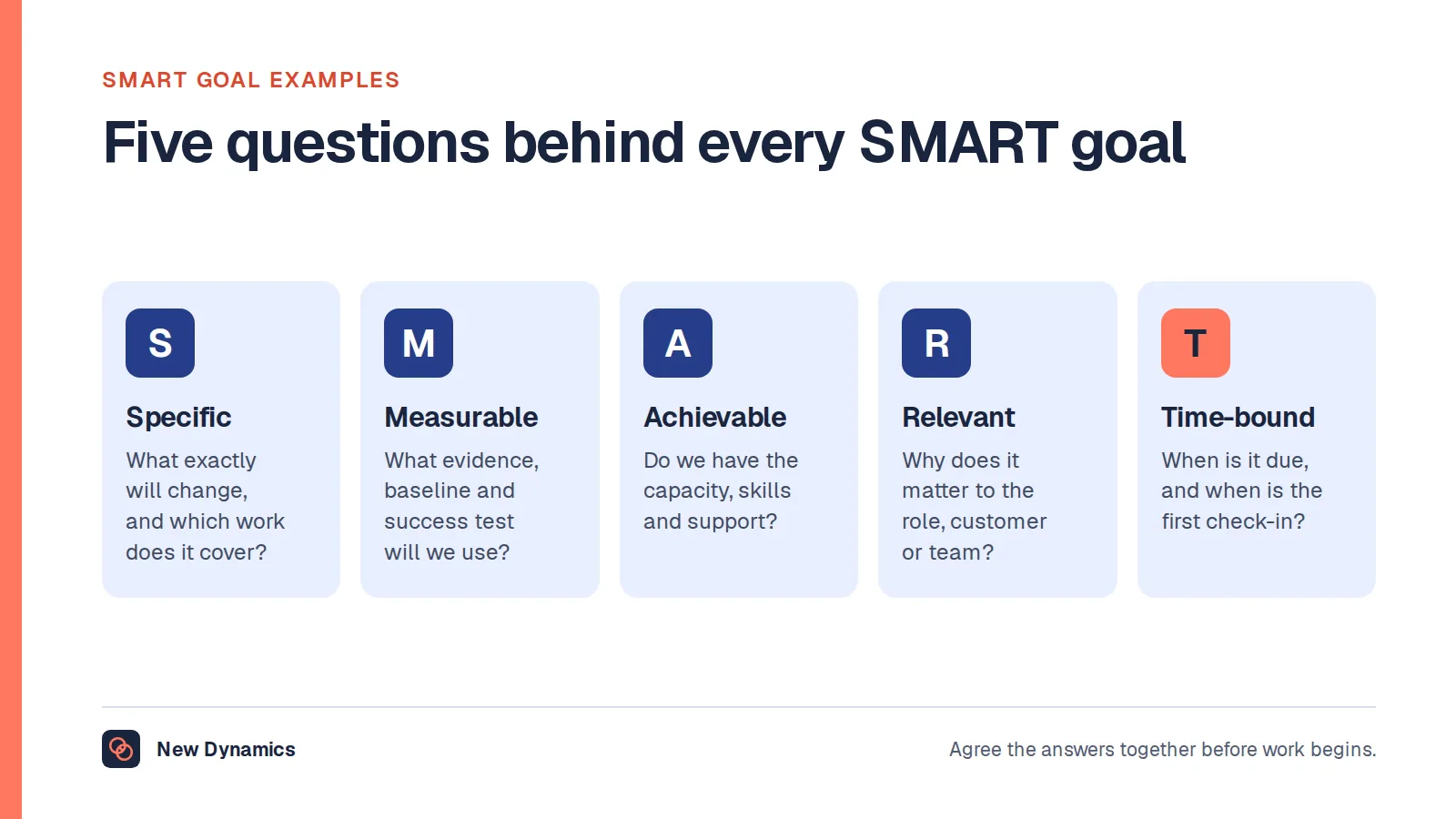
SMART stands for specific, measurable, achievable, relevant and time-bound. Our guide to what the SMART goals acronym stands for explains each letter.
Acas, in its guidance on performance reviews and setting objectives, uses a productivity example. An employee sets an objective to reduce how long they take to respond to customer emails. It is made measurable by agreeing a reduction in average response time, and achievable by sending automatic acknowledgements and using templates for replies. The employee and their manager review it after three months.
Acas adds that objectives “should be fair and reflect the employee's usual tasks and workload”. That matters for productivity goals in particular. A target that can only be met by working evenings is not achievable in any useful sense.
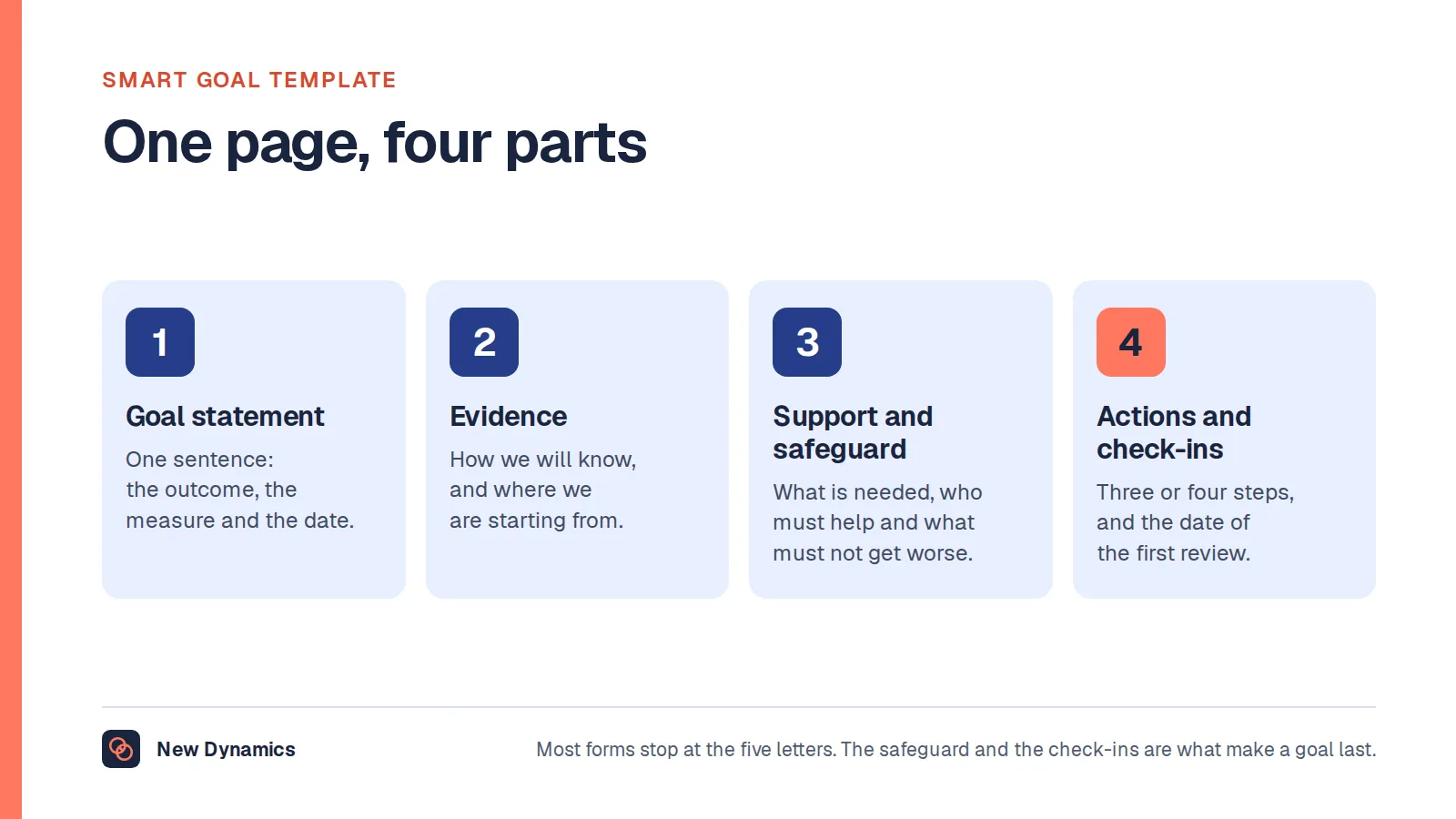
For productivity, we suggest adding one more element: a safeguard. Pair every speed or volume measure with a quality or wellbeing measure, so that the goal cannot be met by cutting corners.
A simple formula:
By [date], I will [change] from [baseline] to [target], by [method], while keeping [safeguard].
You can fill this in on our SMART goal template.
Personal productivity: focus and priorities
The figures in these examples are illustrative. Measure your own baseline for two weeks before you set a target.
- By 30 June, I will finish my single most important task before midday on at least four days a week, up from about two, by choosing it the afternoon before.
- By the end of this quarter, I will spend at least 60% of my working week on my three agreed priorities, up from an estimated 40%, measured by a weekly calendar review.
- For the next eight weeks, I will agree my top three priorities with my manager every Monday, and decline or defer at least one request a week that does not fit them.
- By 31 March, I will reduce my open projects from seven to four, by finishing two and handing one over, so that each gets proper attention.
- For the next month, I will write a plan for the next day before I log off, on at least 18 of 20 working days.
Time management goals
- From next week, I will protect two 90-minute focus blocks on four days a week, with notifications off, and keep at least 80% of them for a quarter.
- By 30 April, I will check email at three set times a day, not continuously, and reply to all internal messages within one working day.
- For the next six weeks, I will estimate the time for each main task and compare it with the actual time, to bring my estimates within 20% of actuals.
- By the end of the quarter, I will deliver at least 90% of my agreed tasks by the agreed date, up from about 75%, by flagging risks at least two days ahead.
- For the next two months, I will batch my administrative tasks into two sessions a week, and cut the time I spend on them from about five hours to three.
- I will take a proper lunch break away from my desk on at least four days a week this quarter, and note whether my afternoon output changes.
Email, chat and meetings
- By 31 May, I will cut the hours I spend in recurring meetings from twelve a week to eight, by leaving two, shortening two and sending updates in writing for one.
- From next month, every meeting I organise will have a stated purpose and an agenda sent a day ahead, and will end with written actions. I will check this with attendees after four weeks.
- By 30 June, I will reduce my unread inbox from over 2,000 messages to under 50, using filters and a weekly 30-minute clear-out, and hold it there for a month.
- For the next quarter, our team will move status updates from the weekly meeting to a shared written update, and cut the meeting from 60 minutes to 30.
- By the end of next month, I will switch off chat notifications during focus blocks and agree with my team an urgent route, such as a phone call, for real emergencies.
Quality and rework
Fixing mistakes quietly eats time. These goals raise output by getting work right first time.
- By 30 September, I will cut the share of my reports returned for correction from 15% to 5%, by using a checklist before I submit.
- This quarter, the team will reduce reopened support tickets from 9% to 5%, by confirming the fix with the customer before closing.
- By 31 March, I will document my five most frequent processes, so that a colleague can complete each one without asking me.
- By the end of the half-year, we will automate three manual reconciliations and cut month-end close from nine working days to six, with no increase in audit adjustments.
- For the next two months, I will ask for a review of every proposal at outline stage, to reduce late rewrites from about one in three to one in ten.
Team productivity goals for managers
- By 30 June, every team member will have three or fewer agreed priorities, written down and reviewed in fortnightly one-to-ones.
- This quarter, we will cut the average time a request waits for a decision from five working days to two, by agreeing who decides what.
- By 31 May, we will reduce work in progress on the team board from 25 items to 12, by finishing before starting and by stopping three low-value activities.
- Over the next quarter, I will remove at least one blocker a week that the team raises, and report back on each within five working days.
- By the end of the year, we will cut handover errors between shifts from about ten a month to three, using a standard handover note.
- This quarter, the team will agree core hours for meetings and keep Wednesday afternoons free of internal meetings, then review the effect on delivery at quarter end.
- By 30 September, 90% of the team will say in our pulse survey that they “can concentrate on their work without frequent interruption”, up from 60%.
For more goals aimed at managers, see our 50 SMART goal examples.
Energy and sustainable pace
- For the next quarter, I will finish work by 6pm on at least four days a week, and I will raise it with my manager in any week where that is not possible.
- By 31 August, I will take all of my remaining annual leave for the year, booked in advance, with cover notes prepared a week before each break.
These belong on a list of productivity goals because tired people tend to work more slowly and make more mistakes.

How to choose the right productivity goal
- Find where the time goes. Keep a simple log for one or two weeks. Most people are surprised by the result.
- Look for waste before effort. Ask what causes delay, rework or waiting. Those are usually better targets than “do more”.
- Pick a lever. Focus, time, waste or teamwork.
- Measure a baseline. Without one, you cannot tell whether anything improved.
- Set one or two goals. Productivity goals compete with each other and with real work. Two is plenty.
- Add a safeguard. Decide which quality or wellbeing measure must not get worse.
- Review often. Check progress weekly on your own, and every two to four weeks with your manager.
A useful test: if you achieved the goal, would a customer or a colleague notice the difference? If not, choose another.
Safeguards: do not trade quality or health for speed
Productivity goals are easy to game. Calls get shorter, and customers ring back. Tickets close faster, and reopen. The cure is to pair measures, as in examples 17 to 21, and to look at results as well as activity. Our success indicator examples explain how to choose balanced measures.
Health needs a safeguard too. In Great Britain, the Health and Safety Executive's Demands standard for managing work-related stress says the organisation should provide employees with “adequate and achievable demands in relation to the agreed hours of work”.
The evidence on very long hours is stark. In 2021 the World Health Organization and the International Labour Organization published estimates on long working hours, heart disease and stroke. The study concluded that “working 55 or more hours per week is associated with an estimated 35% higher risk of a stroke and a 17% higher risk of dying from ischemic heart disease, compared to working 35-40 hours a week”.
So treat any productivity goal that depends on longer hours as a warning that the workload or the plan needs to change. For the wider picture, see our employee wellness programme ideas.
Common mistakes with productivity goals
Measuring activity. Emails sent, hours logged and lines of code written are inputs. Measure what was finished and whether it was any good.
Too many goals. Five productivity goals at once is itself a productivity problem.
No baseline. “Spend less time in meetings” means little if nobody knows the starting point.
Goals imposed without a conversation. People know where their time is wasted. Ask them. Acas says objectives should be fair and reflect usual tasks and workload.
Treating a system problem as a personal one. If the whole team is drowning in approvals, one person's time management goal will not fix it. Managers should use goals 22 to 28.
Monitoring in place of trust. Tracking keystrokes or screen time measures presence. It can damage trust, and it says nothing about value created.
Forgetting to stop. When a goal is met, make the new habit routine and move on. When it is not working, change it.

Frequently asked questions
What is a SMART goal for productivity?
It is a productivity aim written so that it is specific, measurable, achievable, relevant and time-bound. For example: “By 30 June, I will cut the hours I spend in recurring meetings from twelve a week to eight, by leaving two, shortening two and replacing one with a written update.”
What are examples of productivity goals for work?
Examples include finishing your most important task before midday on four days a week, protecting two focus blocks a day, cutting reports returned for correction from 15% to 5%, replying to internal messages within one working day, and reducing open projects from seven to four.
How do you measure productivity at work?
Measure the output that matters against the time or effort used. Useful measures include tasks delivered on time, time from request to delivery, the share of work done right first time and time spent on agreed priorities. Always pair a speed measure with a quality measure.
What is a good time management SMART goal?
Try: “From next week, I will protect two 90-minute focus blocks on four days a week, with notifications off, and keep at least 80% of them for a quarter.” It is specific, you can count it, it is realistic and it has a review date.
How many productivity goals should I set?
Set one or two at a time. Each new habit takes attention, and goals compete with your everyday work. When one has become routine, choose the next. A long list usually means that none of them gets done.
Do productivity goals mean working longer hours?
No. Productivity is about the value created for the time put in, so longer hours raise input, not productivity. Good goals remove waste, sharpen priorities and protect focus. If a goal can only be met by working evenings, the workload needs to change.
Your next step: log one week, then set one goal
- Keep a simple time log for the next five working days.
- Circle the biggest source of waste: waiting, rework, interruptions or low-value meetings.
- Write one goal using the formula: date, change, baseline, target, method and safeguard.
- Share it with your manager and put a review in the calendar for four weeks' time.
For the full method, with a worksheet and review prompts, read and download our SMART goals guide. The guide is free to read, and the PDF uses our short download form.
Want every goal visible, owned and reviewed in regular check-ins? Book a New Dynamics demo and bring the goals you are working on. You can also email contact@new-dynamics.com.