TL;DR
- An employee referral is a recommendation by a current employee of someone they know for a vacancy. A referral scheme, or programme, is the employer's system for inviting, tracking and rewarding those recommendations.
- Referrals tend to be quicker and cheaper than other sources and arrive with a realistic picture of the job. Their weakness is that people know people like themselves, so a scheme that replaces advertising can narrow the workforce and create indirect discrimination risk.
- Run it as one source among several, put referred candidates through the same selection process, pay any bonus through payroll as taxable earnings, and measure who is referred and who is hired.
Ask a room of managers where their best hire came from and someone will say “a colleague knew her”. Ask an employment lawyer about the same hiring method and they will talk about word of mouth and indirect discrimination. Both are right, which is why employee referral schemes need design rather than enthusiasm.
This article explains what an employee referral is, how a referral scheme for employees works in six steps, what referrals do well and badly, how bonuses are taxed in the UK, the fairness risk and how to manage it, and a short policy template.
A referral is only the first step in a hiring workflow that should be the same for everyone. See how New Dynamics workflows let you shape forms, stages and approvals around the way you work.
What is an employee referral?
The Cambridge Dictionary defines a referral as “the act of directing someone to a different place or person for information, help, or action”. In recruitment, an employee referral is exactly that: a current employee directs someone they know towards a vacancy, and directs the employer's attention towards that person.
Three related terms are used loosely.
| Term | What it means |
|---|---|
| Employee referral | One recommendation: an employee puts forward a person for a job |
| Job referral | The same thing from the candidate's side: being put forward for a job by someone who works there |
| Employee referral scheme | The employer's system for inviting, logging, tracking and often rewarding referrals; also called a referral programme |
A referral is not a hire, and it is not a recommendation that the person should be hired. It is an introduction. Our guide to the meaning of hiring places referrals alongside direct hiring, agencies and hiring events as one of four main sources.
How a referral scheme for employees works

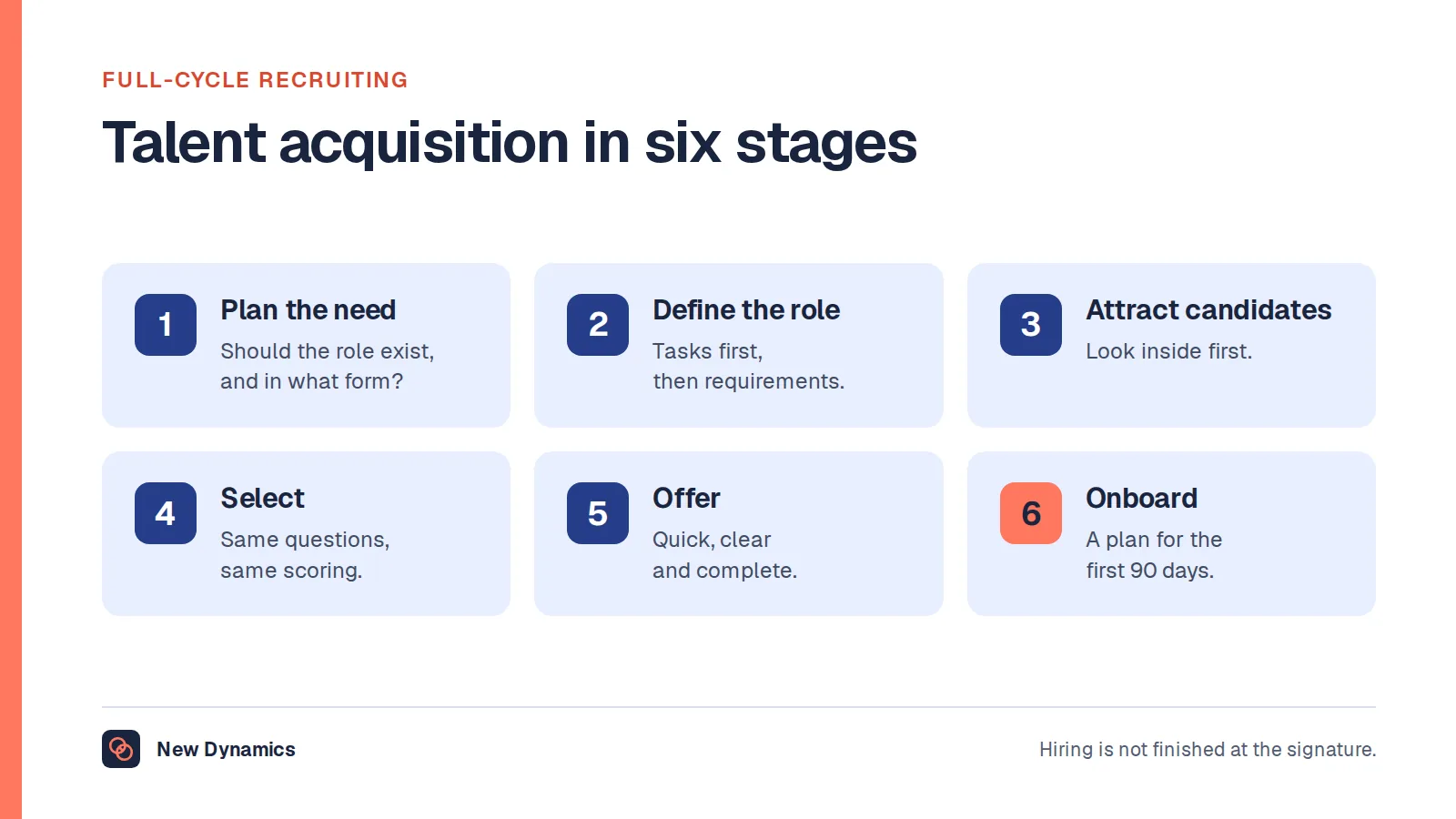
- Publish the vacancies. Employees can only refer people to jobs they know about. Share open roles internally with a short description of who would suit them.
- The employee refers. Through a form, the applicant tracking system or an email to HR, giving the candidate's name, contact details, how they know them and why they fit. The candidate should know they are being referred.
- HR logs the referral. Date, referrer, candidate and role. This record decides bonus eligibility later and lets you measure the scheme.
- The candidate goes through the same selection process. Same application, same criteria, same interviews, same scoring as every other candidate. The referrer is kept out of the decision.
- Hire and start. If the candidate is hired, the new starter is onboarded like anyone else.
- The bonus is paid after the qualifying period. Typically once the new starter has passed probation or completed a set number of months, and paid through payroll.
What referrals do well
- Speed and cost. No agency fee and no advertising spend, and a candidate who is often ready to talk.
- A realistic preview. The referrer has usually told the candidate what the job and the organisation are really like, so fewer surprises on both sides.
- A warm start. The new starter already knows one person, which helps in the first weeks.
- Engagement. Employees who refer are, by definition, willing to recommend their employer.
Those advantages are widely reported by employers. We have not found reliable published figures that apply across industries, so measure your own results rather than relying on claims.
What referrals do badly
- People know people like themselves. A workforce that hires mainly through referrals tends to reproduce its current profile: the same schools, backgrounds, ethnicities, ages and networks.
- Loyalty gets confused with judgement. A referrer may push for a friend; a manager may feel obliged to a colleague who referred someone.
- Cliques. Clusters of friends hired together can form groups that others find hard to join, and can leave together.
- Bonus chasing. A large bonus can produce volume rather than quality.
The first of these has a legal dimension in Great Britain.
The fairness risk: word of mouth and indirect discrimination
GOV.UK's guidance for employers on discrimination in recruitment warns: “Where you advertise might cause indirect discrimination - for example, advertising only in men's magazines.” Recruiting only through the networks of the existing workforce raises the same problem: if the workforce is not diverse, the pool of referred candidates will not be either, and people outside those networks never hear about the job.
Four controls keep a referral scheme on the right side of that guidance.
- Referrals are one source, not the source. Advertise every vacancy openly as well.
- Same process for everyone. Referred candidates are scored against the same criteria; referrers do not sit on panels for their own referrals.
- Measure the scheme. Track who is referred and who is hired through referrals, by the characteristics you monitor, and compare with other sources.
- Adjust if it skews. If referrals are narrowing the workforce, add sourcing routes or cap the share of hires from referrals.
This is general information about guidance that applies in Great Britain, not legal advice, and the law differs elsewhere. Our guide to the definition of discrimination at work explains the terms, and our article on nepotism at work covers what happens when personal connections start to decide outcomes.

Referral bonuses: design and tax
How much. There is no standard figure. Employers typically pay more for roles that are harder to fill, and some pay in two instalments, at start and after probation. Set the amount low enough that it rewards a good introduction rather than buying a hire.
When. After a qualifying period is the norm, so that the bonus reflects a hire that has worked out.
Who is eligible. Most schemes exclude the hiring manager, the recruitment team and senior leaders for their own vacancies, and exclude referrals of former employees or agency candidates already in process.
Tax, in the UK. A referral bonus is a bonus, and GOV.UK's guidance on expenses and benefits: bonuses says that a cash bonus “counts as earnings”, so the employer must “add it to your employee's other earnings” and deduct and pay PAYE tax and Class 1 National Insurance through payroll. Non-cash rewards have their own rules, and some must go through PAYE too. Say in the policy that the bonus is paid through payroll and taxed, so that nobody is surprised.
Non-financial alternatives. Some organisations use recognition, extra leave or a charitable donation instead of cash, or alongside a smaller bonus. These can reduce bonus chasing, though extra leave and vouchers may also be taxable, so check the GOV.UK rules for the item.
Measuring the scheme
- Referral rate: referrals per 100 employees per year.
- Conversion: the share of referrals shortlisted, interviewed and hired, compared with other sources.
- Quality: probation pass rate and one-year retention of referred hires against other hires.
- Diversity: the profile of referred candidates and hires against the applicant pool and the workforce.
- Cost: bonuses paid per hire against agency and advertising cost per hire.
Review the numbers twice a year and change the scheme, or pause it, if the diversity measure is going the wrong way.
Employee referral policy template
Adapt this to your organisation. Keep every line true.
Purpose. To encourage employees to introduce suitable people for our vacancies, as one of several ways we recruit.
Who can refer. All employees, except the hiring manager and members of the recruitment team for the vacancy concerned, and members of the senior leadership team.
How to refer. Submit the referral form with the candidate's name, contact details, the role and why you think they fit. Tell the candidate you are referring them. Referrals are logged by HR on the date received.
Selection. Referred candidates go through the same selection process and criteria as all other candidates. Referrers do not take part in selection for their own referrals. We advertise all vacancies openly.
Bonus. [Amount] for each referred candidate hired into a permanent role, paid through payroll after the new starter completes [three months / probation]. The bonus is taxable earnings. Where two employees refer the same person, the first logged referral qualifies.
Exclusions. Former employees who left within the last [12 months], candidates already in our process or introduced by an agency, and referrals for temporary or contract roles unless stated.
Monitoring. We monitor the diversity of referred candidates and hires and may adjust or pause the scheme if it narrows our workforce.
Our job description template helps with the internal role summaries that make referrals possible.

Frequently asked questions
What is an employee referral?
An employee referral is a recommendation by a current employee of a person they know for a vacancy at their employer. It is an introduction, not a hiring decision. The referred candidate should go through the same selection process as everyone else.
What is a job referral?
A job referral is the same thing seen from the candidate's side: being put forward for a job by someone who already works there. It often comes with a realistic account of the role and a warm introduction to the hiring team.
How does a referral scheme for employees work?
The employer publishes vacancies internally, employees submit referrals, HR logs them, referred candidates go through the standard selection process, and if the person is hired the referrer usually receives a bonus after a qualifying period such as probation.
Are employee referral bonuses taxable in the UK?
Yes. GOV.UK says a cash bonus counts as earnings, so the employer adds it to the employee's other earnings and deducts PAYE tax and Class 1 National Insurance through payroll. Non-cash rewards have their own rules and may also be taxable.
Are employee referrals fair?
They can be, if referrals are one source among several, referred candidates are assessed against the same criteria as everyone else and the employer monitors who is referred and hired. Relying only on word of mouth can indirectly discriminate against people outside the existing workforce's networks.
How much should an employee referral bonus be?
There is no standard amount. Set it high enough to prompt introductions and low enough that it rewards a good match rather than volume. Many employers vary it by how hard the role is to fill and pay it after the new starter passes probation.
Your next step: check your scheme against four questions
- Is every vacancy also advertised openly?
- Do referred candidates face the same criteria and panels as other candidates?
- Is the bonus paid through payroll and described as taxable in the policy?
- Do you know the diversity of your referred hires compared with other sources?
For a fair process from vacancy to offer, read and download our recruitment and selection guide. The guide is free to read, and the PDF uses our short download form.
Want referrals, applications and interviews to follow one fair workflow? Book a New Dynamics demo and bring your current scheme. You can also email contact@new-dynamics.com.