TL;DR
- Hiring means starting to employ someone: the act of taking a person on. Recruitment is the wider activity of finding and attracting candidates, and hiring is the decision and the paperwork that ends it.
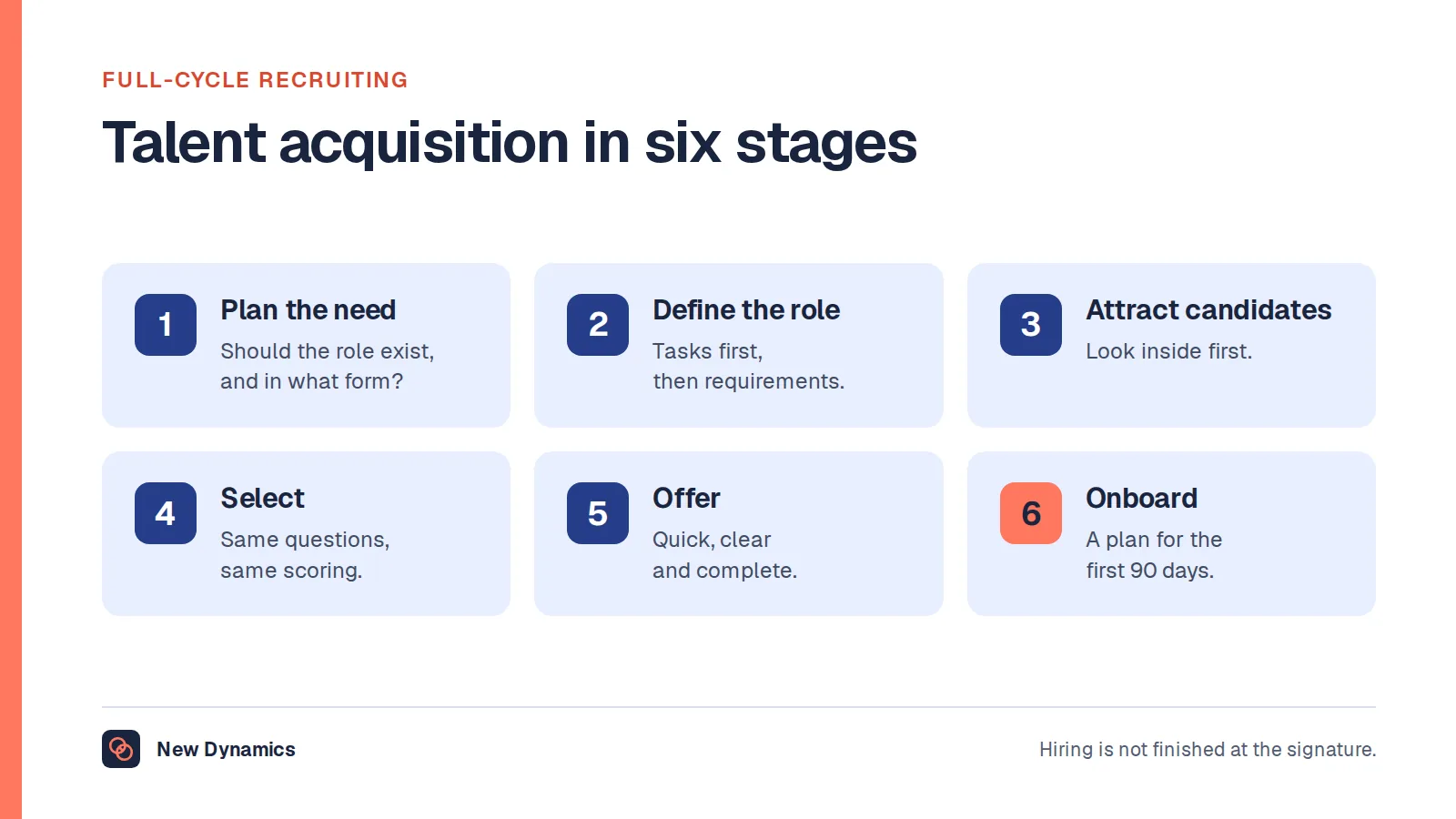
- The hiring process runs in six steps: define the job, attract candidates, screen, interview and assess, check, and offer, contract and start. In the UK there is no legally required process, but the process must be fair, and discrimination and data protection law apply throughout.
- There are four main ways to hire: directly, through an agency, through employee referrals and through hiring events. Most employers use more than one, and the choice depends on the role, the timescale and the cost.
“We're hiring” is the two-word sentence on the shop window, the careers page and the social media post. It sounds simple. Behind it sits a decision about who will do a job for years, a process with legal duties at every stage, and a choice of routes that differ in cost, speed and fairness.
This article gives the meaning of hiring, separates it from recruitment, sets out the hiring process in six steps, summarises what UK law requires of the process, and compares direct hiring, agencies, employee referrals and hiring events.
Every hire is a bet on a person, and the bet is settled in the first months. See how New Dynamics onboarding brings tasks, early goals and manager conversations into a clear path for a new starter.
What does hiring mean?
The Cambridge Dictionary defines hiring as “the act of starting to employ someone”. The verb hire, in the employment sense, means “to employ someone or pay someone to do a particular job”. In British English the same verb also means to rent something for a short period, which is why British employers often say recruit or take on where Americans say hire.
Hiring and recruitment overlap, and the distinction is useful.
- Recruitment is the activity of finding and attracting people for a vacancy: the advert, the search, the applications.
- Hiring is the decision and the act of taking someone on: the selection, the offer, the contract and the start.
- Talent acquisition is the strategy above both. Our guide to talent acquisition explains the difference.
So a company can recruit for months and hire nobody. And a hiring decision can be made in a morning after a long recruitment.
The hiring process: six steps
Acas, the public body that advises on workplace relations, says in its guidance on how employers should recruit that “It's up to employers how they recruit for their organisation. There are no set processes that are required by law. But employers must follow a fair process.” The six steps below are the usual shape of a fair one.
- Define the job. Agree that the vacancy is needed, write the job description and the person specification, and set the pay range. Our guide to the job description template shows how.
- Attract candidates. Write and place the advert, search, ask for referrals or brief an agency. Our guide to writing a job ad covers the advert.
- Screen. Compare applications against the person specification, using the same criteria for everyone, and shortlist.
- Interview and assess. Structured interviews, work samples or tests, scored against the criteria by more than one person.
- Check. Right to work, references, qualifications and, where the role requires it, criminal record checks.
- Offer, contract and start. Make the offer, agree pay and terms and issue the written contract. GOV.UK's guide to employing someone notes that “When someone accepts a job offer they have a contract with you as their employer.” Then tell the tax authority, set up payroll and pension, and run the induction.
The order matters less than the consistency. A process that treats every candidate the same way, against the same criteria, is both fairer and more accurate.

What the law requires in the UK
A fair process, not a set one. Acas says employers must follow a fair process, and that other laws, including discrimination and data protection law, apply throughout the whole recruitment process. Our guide to the definition of discrimination at work explains the protected characteristics.
No detriment for union membership. Acas states that it is against the law to treat someone less favourably or cause them detriment based on whether they are, or are not, a trade union member, and gives “not being offered the job” as an example of detriment in recruitment.
Employer duties around the hire. GOV.UK's step-by-step guide for employers covers the duties that surround the decision: checking the person's employment status, recruiting fairly, checking whether they need to be put into a workplace pension, agreeing a contract and salary at or above the National Minimum Wage, and telling HMRC about the new employee. GOV.UK says: “You must tell HMRC about your new employee on or before their first pay day.”
This is general information about the UK, not legal advice. Other countries have their own rules, and some set procedures that the UK does not.

Four ways to hire
- Direct hiring. The employer runs the process itself and employs the person directly, on its own contract. The phrase is also used to distinguish a permanent, direct employee from a temporary or agency worker, and in some countries to distinguish a direct approach from a job board. It usually costs the least in fees and the most in internal time.
- Agency hiring. A recruitment agency finds and screens candidates for a fee, or supplies temporary workers who remain the agency's employees. GOV.UK notes that an employer can use a recruitment agency or recruit itself. Faster for scarce skills, and costlier.
- Employee referral hiring. Existing employees recommend people they know, often for a bonus paid after the new starter passes probation. Referred candidates arrive with a warm introduction and a realistic picture of the job. The risk is a workforce that grows to look like itself, so referrals should feed the same fair process as everyone else, not bypass it.
- Hiring events. Open days, job fairs, assessment centres and walk-in interview days, where an employer meets many candidates in one place and often makes offers on the day. Useful for volume hiring in retail, hospitality, logistics and care. The event should still score candidates against the same criteria, and the offer should still be followed by the checks.
Most employers use more than one route. The test for each is the same: does it bring in people who can do the job, treat every candidate fairly and stand up to scrutiny afterwards?

Common hiring mistakes
Hiring in a hurry. A vacancy is painful, and a bad hire is worse. Keep the process even when the pressure is on.
Different questions for different candidates. Unstructured interviews are harder to compare and harder to defend.
Skipping the checks. Right to work, references and qualifications take days and prevent years of trouble.
Deciding alone. One interviewer's impression is where bias lives. Two or three people scoring independently is better.
Stopping at the offer. A hire is complete when the person is doing the job well, not when they sign. Induction is part of hiring.
Frequently asked questions
What does hiring mean?
Hiring means starting to employ someone: the decision to take a person on for a job and the act of doing so, including the offer and the contract. Recruitment is the wider activity of finding and attracting candidates; hiring is the decision that ends it.
What are the steps in the hiring process?
Define the job, attract candidates, screen applications, interview and assess, check right to work and references, make the offer and issue the contract, and start the person with an induction. In the UK no particular process is required by law, but the process must be fair.
What is the difference between recruitment and hiring?
Recruitment is finding and attracting candidates for a vacancy. Hiring is selecting one and taking them on. In everyday use the words overlap, and "recruitment and hiring process" usually means the whole sequence from vacancy to start.
What is direct hiring?
Direct hiring means the employer runs the process itself and employs the person directly, on its own contract, rather than through an agency or as a temporary or contract worker. The phrase is also used for a permanent role as opposed to an agency placement.
What is employee referral hiring?
Employee referral hiring is filling vacancies with people recommended by existing employees, often with a bonus paid once the new starter has settled. Referrals should go through the same fair selection process as other candidates.
What are hiring events?
Hiring events are occasions such as job fairs, open days and assessment centres where an employer meets many candidates at once, interviews or assesses them and often makes offers on the day. They suit volume hiring, and the usual checks still follow the offer.
Your next step
Write down your hiring process as six steps on one page, with who does what at each step. If the page shows a step with no criteria, or a decision made by one person alone, that is where to start.
For a full method, read and download our recruitment and selection guide. The guide is free to read, and the PDF uses our short download form.
Want every new hire to start with clear goals and a manager who checks in? Book a New Dynamics demo and bring your current approach. You can also email contact@new-dynamics.com.