TL;DR
- The same thing goes by several names. Research commissioned by Acas notes the main ones are “'staff network', 'employee network', 'staff forum', 'employee support group', 'employee resource group'”, and that they are “typically employer sponsored”.
- They do two things at once: “a focus on self-help as well as organisational change”, supporting members while pressing for different practices.
- The success factors named in that research are mostly things the organisation provides: “clarity of purpose; staff participation; adequate resourcing; a senior manager championing the network... as well as succession planning”.
A network gets launched with an all-staff email and a logo. Two years later the same three people are running it in their own time, and nothing about the organisation has changed.
This article covers what employee resource groups are, what they actually do, the factors research associates with them working, and what an employer has to provide if it wants one to succeed.
Networks surface things that ordinary reporting misses. See how New Dynamics feedback keeps that flowing between surveys.
The name varies; the thing does not
Research commissioned by Acas and carried out by the Race and Society Research Cluster at Essex Business School notes that "a variety of terminology is used to describe staff networks, the main ones being 'staff network', 'employee network', 'staff forum', 'employee support group', 'employee resource group'". They are, it adds, "typically employer sponsored".
A note on the evidence before going further. That research is qualitative, based on stakeholder interviews with "network chairs, human resources, senior managers, and trade unions" and "7 focus groups with staff race network members", across case studies including "a finance organisation in the private sector and central and local government, the NHS and fire services in the public sector". It is specifically about staff race networks, and it carries a disclaimer that it "contains the views of the authors and does not represent the views of the Acas Council". Treat what follows as informed findings from that setting rather than a general law.
What they do

Two things at once. The research describes identity-based networks as organised "formally and informally" to "address organisational inequalities", with "a focus on self-help as well as organisational change", and which "may try to promote a business case for that change".
In the case studies, networks had "a social and 'business' side": they worked "to provide social, emotional, informational and developmental support to their members", while "ultimately they wanted to see progress on race equity, not least by fostering changes in organisational cultures and practices".
That dual purpose is worth naming out loud when a network starts, because the two halves need different things. Support needs time and a safe space. Change needs access to whoever decides.
What makes them work

The research is direct about this. "The evidence base suggests that identity-based networks may help address inequalities and a range of factors may be important to their success. These include; clarity of purpose; staff participation; adequate resourcing; a senior manager championing the network and building other organisational allies; as well as succession planning."
Five factors, and only one of them (participation) is mainly supplied by members. The rest are organisational decisions:
- Clarity of purpose. Decided at the start, in writing, including which of the two jobs is primary.
- Adequate resourcing. Time counted as work, and a budget, however small.
- A senior champion who builds allies rather than merely lending a name.
- Succession planning, because the alternative is a network that ends when its chair moves on.
An organisation that provides none of these has not started a network; it has given some people extra unpaid work.
Governance, and why formality helped
A finding that surprises people who expect networks to prefer informality: members wanted more structure, not less.
Case study networks shared "common features" of "network chairs, executive committees, working groups and executive sponsors", and members "felt that formal organisation supported their views being taken more seriously".
There is a second benefit the research records. Network leaders "discussed how their network role allowed them to build leadership skills and experience that could be deployed in other roles in their organisation", which makes chairing a development opportunity, and an argument for rotating it rather than letting one person carry it indefinitely.
Networks and unions
Where a union is recognised, the relationship needs stating rather than leaving ambiguous. The research puts it carefully: "while staff networks may need to manage potential tensions in voice mechanisms, they can complement rather than be an alternative to existing democratic union institutions."
A network is not a bargaining body and should not be used as a substitute for one.
What a network is not
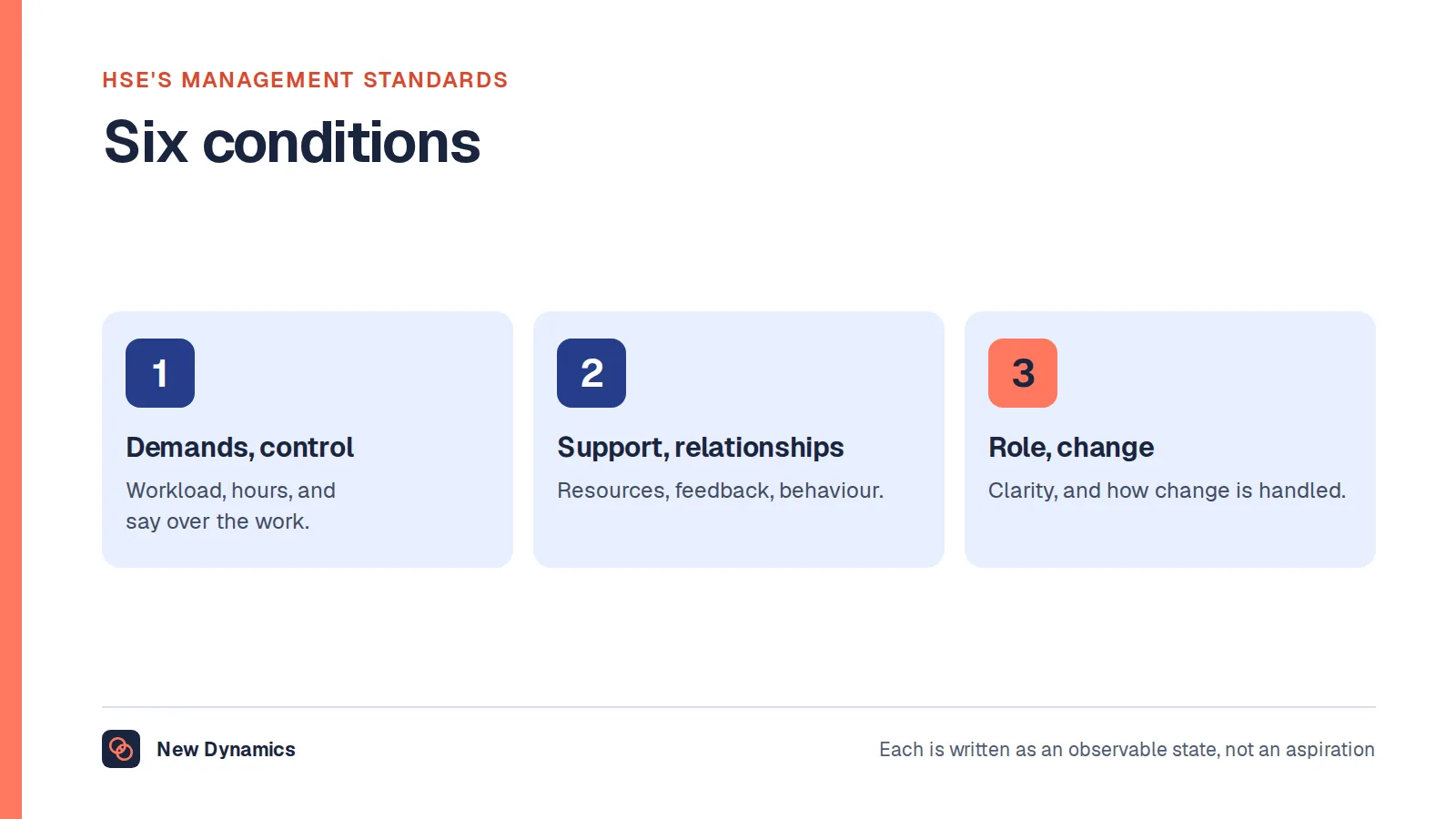
- Not a substitute for the employer's duties. HSE's Relationships standard expects the organisation to promote "positive behaviours at work to avoid conflict and ensure fairness", to have "agreed policies and procedures to prevent or resolve unacceptable behaviour", and to have systems "to enable and encourage employees to report unacceptable behaviour". Those are the employer's, not the network's.
- Not a grievance channel. A network can support someone raising a concern; it cannot handle the case.
- Not free consultancy. Asking a network to audit your policies is asking members to do a second job.
- Not evidence on its own. Our inclusion survey questions post covers measuring the experience across everyone, not only the people who joined.
Starting one

- Agree the purpose in writing, including whether it is primarily support, primarily change, or explicitly both.
- Resource it before launching. Hours counted as work, a small budget, and a room.
- Name the sponsor and the route. Who the network can put a proposal to, and how often.
- Plan the succession at the start, with a term for the chair and a deputy from day one.
Our diversity in the workplace post covers the wider picture a network sits inside.
Frequently asked questions
What is an employee resource group?
An employer-sponsored group of employees, usually organised around a shared characteristic or experience, that supports its members and presses for changes in organisational practice. The same thing is called a staff network, employee network, staff forum or employee support group.
What do employee resource groups do?
Two things: provide social, emotional, informational and developmental support to members, and work for organisational change, often by making a case for it to decision-makers. Research describes this as a focus on self-help as well as organisational change.
What makes an employee network successful?
Research commissioned by Acas points to clarity of purpose, staff participation, adequate resourcing, a senior manager championing the network and building allies, and succession planning. Most of those are supplied by the organisation rather than by members.
Should employee networks be formal or informal?
Case study networks moved towards formality (chairs, committees, working groups and executive sponsors) and members felt this meant their views were taken more seriously. Informality is easier to start and harder to sustain.
Do employee networks replace trade unions?
No. The research notes networks can complement rather than replace existing union institutions, while acknowledging that tensions between voice mechanisms may need managing. A network is not a bargaining body.
Who should chair an employee network?
A member, with a defined term and a deputy in place from the start. Research records that the role builds leadership skills usable elsewhere, which is a reason to rotate it rather than let one person carry it indefinitely.
Should chairing a network count as work time?
Yes, if you want it to last. Adequate resourcing is one of the success factors identified in the research, and a network run entirely in people's own time depends on goodwill that eventually runs out.
Your next step: check what you are providing
- Write down the network's purpose, and check members agree with it.
- Count the hours members spend, and decide whether they are work.
- Name the sponsor and the meeting at which proposals get decided.
- Set a term for the chair, and find a deputy.
For the wider programme this sits inside, read and download our diversity and inclusion guide. The guide is free to read, and the PDF uses our short download form.
Want what networks raise to reach the people who can act on it? Book a New Dynamics demo and bring your current arrangements. You can also email contact@new-dynamics.com.